
Why Documents Expire After Attestation: UAE Expat Guide

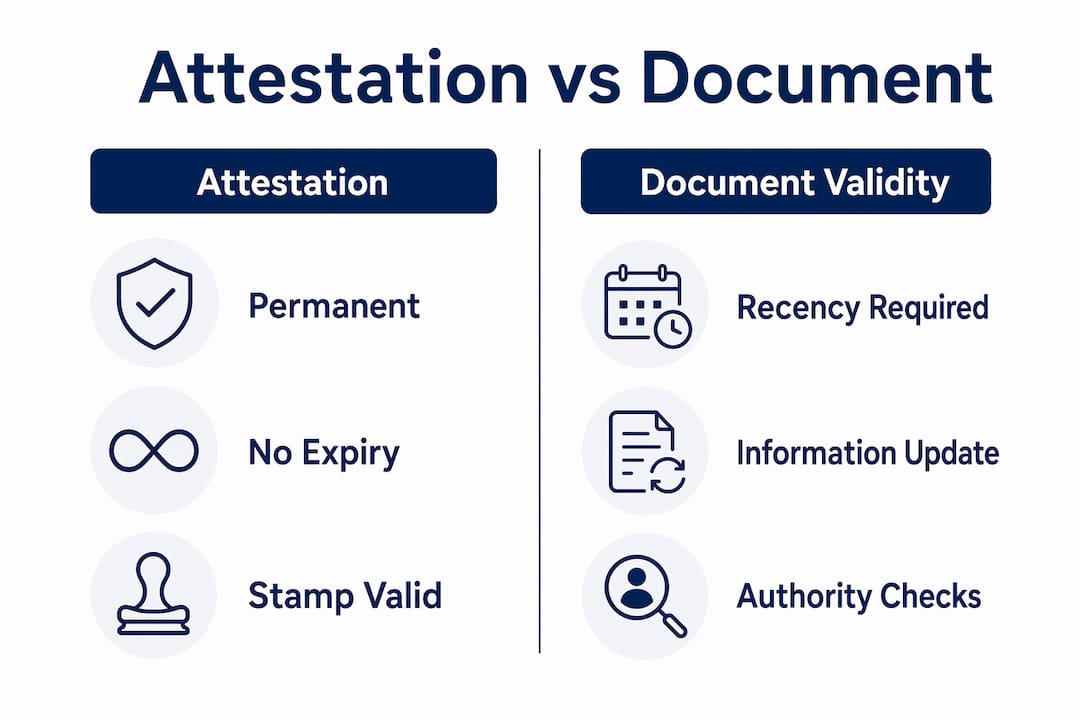
Attested documents do not technically expire, but receiving authorities in the UAE routinely reject them once the information inside becomes outdated. This is the core reason why documents expire after attestation: the attestation stamp is permanent, but the facts it certifies can go stale. The UAE Ministry of Foreign Affairs confirms that attestation itself carries no expiration date. The problem is not the stamp. The problem is what the stamp is certifying. Filipino expats in the UAE run into this distinction constantly, and misunderstanding it leads to rejected applications, delayed visas, and wasted processing fees.
Why do documents expire after attestation?
The attestation act is permanent. The UAE Ministry of Foreign Affairs states this clearly in its official FAQ: the attestation stamp does not expire. What expires is the relevance of the information inside the document. A police clearance attested in january 2024 still carries a valid stamp in 2026, but the clearance itself only reflects your criminal record status as of that date. Two years later, that information is no longer current. Receiving authorities care about accuracy, not just authentication.
This distinction trips up a lot of expats. The confusion arises from conflating the permanent validity of the attestation act with the dynamic currency of document contents. Attestation proves a document was genuine at the time of stamping. It does not guarantee the document reflects your current legal, professional, or personal status. That gap between “authenticated” and “current” is exactly why institutions impose their own recency windows.

Which documents have recency requirements in the UAE?
Not all attested documents face the same scrutiny. The type of document determines how quickly it becomes unacceptable to UAE authorities, regardless of attestation status.
Police clearance certificates. Police clearances are typically valid for 6 months and are commonly rejected if older when presented to UAE authorities. This is the most time-sensitive document Filipino expats deal with.
Business and commercial certificates. Business records and certificates of good standing are commonly rejected if older than 3 months. Company status changes fast, so authorities want the most recent snapshot.
Educational certificates. Degrees and transcripts are generally stable. A diploma attested five years ago still reflects the same qualification. Exceptions exist when institutions require proof of recent enrollment or updated academic standing.
Civil documents. Birth certificates and marriage certificates rarely face recency issues because the underlying facts do not change. However, some UAE entities still request recently attested copies to confirm no amendments have been filed.
Medical and health certificates. These carry strict recency requirements because health status changes. Most UAE employers and immigration authorities require medical certificates issued within 3 months.
Pro Tip: Before submitting any attested document, call the receiving authority and ask specifically how old the document can be. Do not assume the attestation stamp is enough.
Why do UAE authorities reject older attested documents?
Receiving authorities in the UAE operate on internal policies that go beyond what the Ministry of Foreign Affairs mandates. These policies exist because institutions need to make decisions based on accurate, current information. An attested document from three years ago tells them what was true then, not what is true now.
The logic is straightforward. A UAE employer reviewing your police clearance needs to know your current criminal record status, not your status from two years ago. The attestation stamp tells them the document was genuine when issued. The employer’s internal policy tells them the document must be recent enough to be relevant. These are two separate standards operating simultaneously.
Institutional risk management. Organizations that rely on outdated information expose themselves to legal liability. Requiring recent documents reduces that risk.
Regulatory compliance. UAE government entities follow federal guidelines that specify acceptable document ages for visa processing, employment permits, and residency applications.
Operational accuracy. Private companies, banks, and schools set their own recency windows based on how quickly the relevant information can change.
Anti-fraud measures. Requiring recent documents makes it harder to use old paperwork that no longer reflects a person’s actual status.
“Some institutions reject older digitally signed or notarized documents because they require current, accurate information, despite the signature or attestation being technically valid. Documents must reflect current legal standing, and institutions have internal policies enforcing this.”
The absence of standardized frameworks for cross-temporal attestations makes this even more complicated. Different UAE entities apply different thresholds, and there is no single rule that covers every situation. This is why expats who move between employers or visa categories often find themselves re-attesting documents they thought were already processed.
How do digital signatures affect attestation validity?
Digital attestation adds another layer of complexity. A digitally signed document carries a certificate issued by a trusted authority. That certificate has its own expiry date, which is separate from the attestation itself.
Aspect | What expires | What stays valid |
Attestation stamp | Never expires | Permanently valid per UAE MOFA |
Notarial act | Never expires | Valid if notary held active commission at signing |
Digital certificate | Expires on set date | Signature remains valid if created before expiry |
Document content | Becomes outdated | Must reflect current status to be accepted |
The key concept here is long-term validation, or LTV. Digital signatures designed with LTV can remain verifiable for many years after the certificate expires. LTV embeds a timestamp and revocation information at the time of signing, preserving the signature’s defensibility for decades. This means a digitally attested document is not automatically invalid just because the certificate has expired.
The practical problem is that receiving institutions do not always understand LTV. Many institutions see an expired certificate and reject the document outright. Managing long-term verifiability requires preservation of certificate chains, revocation evidence, and trusted timestamps. Most expats cannot verify this themselves, which is why working with a knowledgeable attestation service matters.
Pro Tip: If a UAE authority rejects your digitally attested document due to certificate expiry, ask them to verify the embedded timestamp. A document signed before certificate expiry is still legally valid under LTV standards.
Similarly, the notarial act does not expire if the notary held a valid commission at the time of signing. The problem is not the notarization itself. The problem is whether the receiving institution’s recency policy accepts a document notarized two or three years ago. Those are two entirely different questions.
Practical tips for keeping your attested documents accepted
The most common mistake Filipino expats make is assuming that once a document is attested, the work is done. Applicants often mistakenly believe attested documents are accepted indefinitely, whereas many documents require renewal due to the sensitive nature of the information they contain. Proactive document management prevents last-minute scrambles.
Confirm recency requirements before you submit. Contact the receiving authority directly. Ask what document age they accept, not just what documents they require. This single step prevents most rejections.
Track your document issuance dates. Keep a simple spreadsheet with each document’s issue date, attestation date, and the recency window required by your employer, visa authority, or school. Set reminders 60 days before any document approaches its limit.
Renew police clearances on a regular cycle. Since police clearances are valid for roughly 6 months, expats who change jobs or renew visas frequently should plan attestation around their renewal calendar, not around when they happen to need the document.
Work with an attestation service that knows UAE rules. Generic attestation providers may not know the specific recency thresholds applied by UAE government entities, private employers, or educational institutions. A service specializing in Filipino expat documentation in the UAE understands these nuances.
Keep certified copies of all attested documents. Originals can be lost or damaged. Certified copies with attestation records make re-attestation faster and cheaper.
Understand the difference between legalization and attestation. The distinction between legalization and attestation affects which documents need to go through which process, and how recency requirements apply to each.
Key Takeaways
Attested documents do not expire on their own, but the information they contain becomes outdated, and UAE authorities reject documents that no longer reflect a person’s current status.
Point | Details |
Attestation is permanent | The UAE MOFA confirms the attestation stamp carries no expiration date. |
Content currency drives rejection | Authorities reject documents when the information inside is no longer current, not because the stamp expired. |
Police clearances expire fastest | UAE authorities typically reject police clearances older than 6 months, making them the most time-sensitive document. |
Business records have a 3-month window | Certificates of good standing and commercial filings are commonly rejected if older than 3 months. |
Digital signatures need LTV to stay valid | Long-term validation preserves a digital signature’s verifiability even after the certificate expires. |
What I’ve learned from watching expats get this wrong
The expats who run into the most trouble are the ones who treat attestation as a one-time task. They get their documents stamped, file them away, and assume they are covered indefinitely. Then a visa renewal comes up, or a new employer asks for a police clearance, and they discover the document they paid to attest six months ago is no longer acceptable.
The deeper issue is that the UAE’s document requirements are not fully standardized across entities. A government ministry may accept a police clearance that is five months old. A private employer in the same city may reject anything older than three months. Neither is wrong. They are just applying different internal policies to the same document. Expats who do not know this spend money re-attesting documents that were not actually expired, or worse, submit outdated documents and face delays they could have avoided.
What I tell people is this: the attestation stamp is your proof of authenticity. The recency window is your proof of relevance. You need both. Checking the UAE attestation requirements for 2026 before you submit anything is the fastest way to avoid a rejection you did not see coming. Proactive document management is not complicated. It just requires knowing which questions to ask before you submit, not after.
— Harris
How Harrisncharms helps you stay ahead of document expiration
Filipino expats in the UAE deal with some of the most document-intensive processes in the region. Harrisncharms specializes in UAE document attestation for Filipino expats, with direct knowledge of which documents face recency requirements, which authorities apply the strictest windows, and how to time your attestation to avoid rejection.

Whether you need a police clearance attested on a tight timeline or guidance on which documents to renew before a visa application, Harrisncharms provides clear, specific advice based on current UAE requirements. The team also covers the full OFW attestation process from the Philippines to the UAE, so you know exactly what to prepare and when.
FAQ
Does an attestation stamp ever expire?
No. The UAE Ministry of Foreign Affairs confirms that the attestation stamp carries no expiration date. The stamp is permanently valid.
Why do UAE authorities reject old attested documents?
Authorities reject old documents because the information inside may no longer be accurate, not because the attestation stamp has expired. Each institution applies its own recency policy based on how quickly the document’s content can change.
How long is a police clearance valid after attestation in the UAE?
Police clearances are typically valid for 6 months and are commonly rejected by UAE authorities if older when submitted, regardless of attestation status.
Do digital signatures on attested documents expire?
The digital certificate expires, but the signature itself remains valid if it was created before the certificate expired. Long-term validation preserves the signature’s verifiability for years after certificate expiry.
How often should Filipino expats renew their attested documents?
Police clearances need renewal roughly every 6 months. Business documents should be renewed every 3 months. Educational certificates and civil documents rarely need renewal unless the receiving authority specifically requests a recent copy.
Recommended
Comments