
How to Secure Residency Document Attestation in the UAE

Residency document attestation is the official multi-step verification process that makes your foreign documents legally valid for UAE residency applications, Emirates ID, family sponsorship, and banking. For Filipino expats, knowing how to secure residency document attestation means following a four-step legalization chain that starts in the Philippines and ends with the UAE Ministry of Foreign Affairs (MOFA). Skipping any step or completing them out of order causes rejection and forces you to restart from scratch. The UAE government requires this process as a fraud prevention measure that protects the integrity of every residency and employment application.
What documents do Filipino expats need to attest for UAE residency?
The residency document attestation process applies to a specific set of personal and professional records. Knowing which documents qualify, and in what condition, saves you from costly delays.
Common documents that require attestation include:
Educational certificates (college degrees, diplomas, transcripts)
Marriage certificates
Birth certificates
Affidavits and special powers of attorney
Employment contracts and experience letters
Medical certificates and police clearances
Every document must be an original or a certified true copy issued by the originating authority. Laminated originals cannot be attested because lamination physically blocks official stamps and seals. If your document is laminated, request a fresh certified copy from the Philippine Statistics Authority (PSA) or the issuing institution before you begin.
Language is another prerequisite. Documents not written in Arabic or English require translation by a UAE Ministry of Justice-approved translator before attestation proceeds. Using an unauthorized translator causes rejection at the MOFA stage. Check the UAE Ministry of Justice’s official list of accredited translators before commissioning any translation work.
Document Category | Key Prerequisite |
Educational certificates | Must be original or PSA-certified copy; no lamination |
Civil documents (birth, marriage) | PSA-issued copy required; must be current and valid |
Employment records | Must carry official company letterhead and authorized signature |
Affidavits and legal documents | Must be notarized by a licensed Philippine notary public |
Foreign-language documents | Must include UAE MOJ-approved certified translation |
Pro Tip: Request at least two certified copies of every document from the PSA or issuing institution. Attestation consumes the original, and having a spare copy prevents delays if one gets lost in transit.
How to secure residency document attestation step by step
The attestation process for Filipino expats follows a strict, non-negotiable sequence. Think of it as a relay race. Each authority passes the baton to the next, and missing or reversing any step invalidates the entire chain and forces you back to step one.
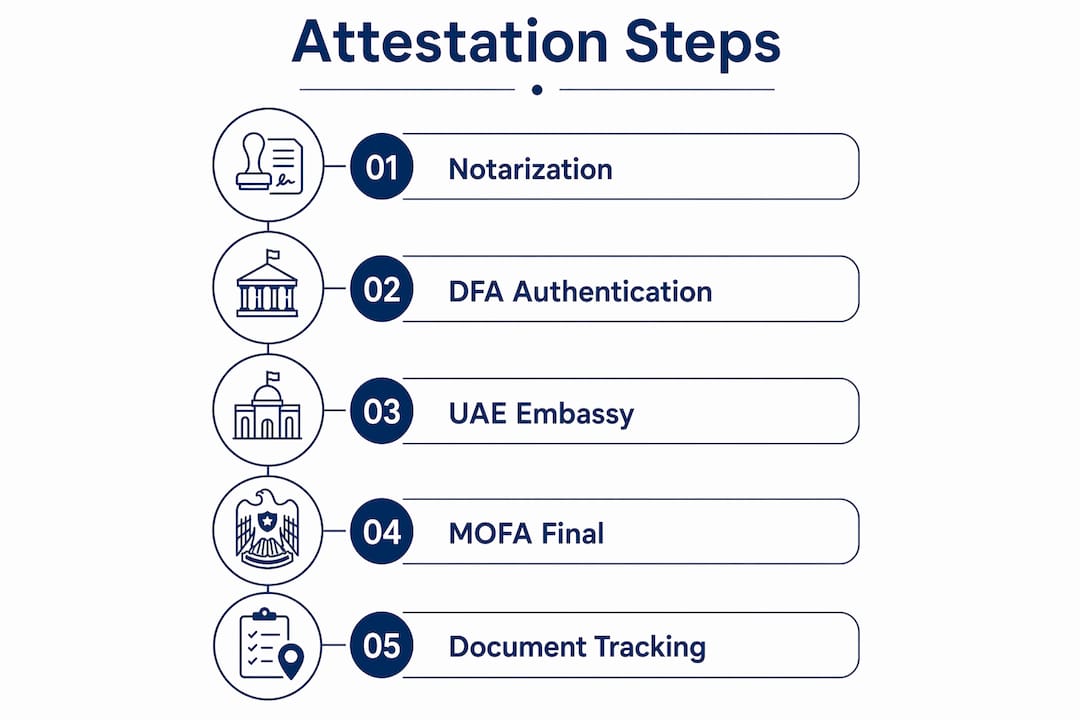
Step 1: Notarization in the Philippines
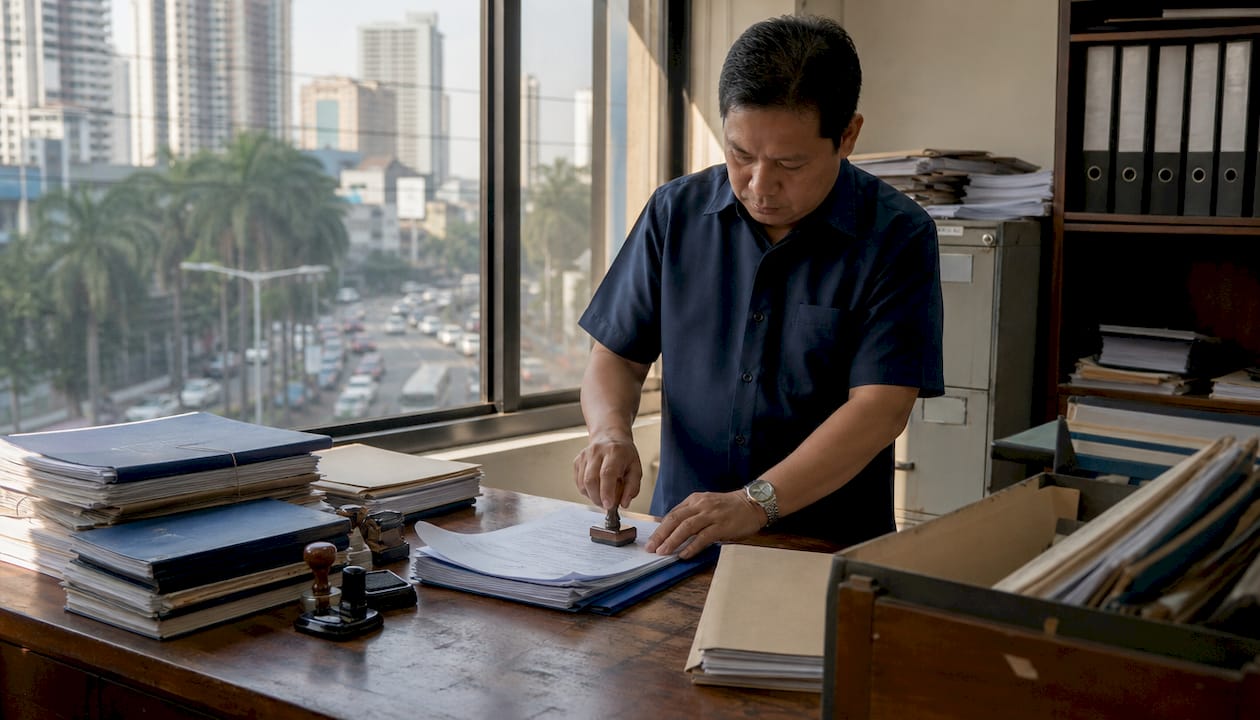
A licensed Philippine notary public must authenticate your document first. This step confirms the document’s authenticity at the local level. Without notarization, the Department of Foreign Affairs (DFA) will not process your application.
Step 2: Authentication by the Philippine DFA
The DFA’s Office of Consular Affairs authenticates the notary public’s signature and seal. This is the Philippine government’s official confirmation that the document is genuine. The DFA issues a red ribbon or apostille certificate depending on the document type and destination country requirements.
Step 3: Legalization by the UAE Embassy in the Philippines
The UAE Embassy authenticates the DFA’s stamp, serving as the legal link between the Philippine government and UAE authorities. This step confirms to UAE MOFA that the document has been verified by the Philippine government. The UAE Embassy in Manila handles this for documents originating in the Philippines.
Step 4: Final attestation by UAE MOFA
UAE MOFA applies the final stamp that makes your document legally valid inside the UAE. Without the MOFA stamp, immigration systems reject documents for residency visa processing, and banks refuse them during compliance checks. This is the step that activates your document for all UAE administrative purposes.
Common procedural errors to avoid:
Attempting to attest a Philippine document outside the Philippines
Submitting laminated documents at any stage
Using a translator not approved by UAE Ministry of Justice
Skipping DFA authentication and going directly to the UAE Embassy
Failing to check document expiry dates before submission
Pro Tip: Track your application reference number at each stage. Both the DFA and UAE MOFA provide tracking systems. Checking status every two to three days catches errors before they become full restarts.
For a detailed breakdown of how attested documents are accepted by UAE authorities, the acceptance process guide at Harrisncharms covers each stage clearly.
Method | Timeline | Best For |
Physical attestation | Up to 3 working days per stage | Philippine-origin documents |
Digital attestation (eDAS 2.0) | As fast as 3 minutes | UAE-issued digital documents |
How can digital attestation speed up your residency document process?
The UAE’s eDAS 2.0 platform represents a significant shift in how certain documents get attested. Understanding eligibility saves you days of waiting.
Documents issued digitally within the UAE that include a verification feature such as a QR code or barcode qualify for digital attestation through eDAS 2.0. This applies to many UAE-issued certificates, government letters, and institutional documents. Philippine-origin documents processed through the physical four-step chain do not qualify for eDAS 2.0.
Benefits of digital attestation through eDAS 2.0:
Official e-stamp issued in as little as 3 minutes, compared to up to 3 working days for physical processing
No courier coordination or physical document handling required
Accessible through the UAE Pass digital identity credential
Reduces risk of document loss during transit
Documents not eligible for digital attestation:
Philippine-origin documents (degrees, PSA certificates, affidavits)
Documents without embedded digital verification features
Handwritten or manually signed documents without a digital counterpart
Documents requiring physical stamps from foreign authorities
Pro Tip: If you hold any UAE-issued certificates, such as a UAE trade license or a locally issued educational certificate, check eDAS 2.0 eligibility before scheduling a physical appointment. You may save days of processing time.
The Philippine-specific attestation guide at Harrisncharms explains which of your documents qualify for each pathway and what to prepare for each route.
What challenges do Filipino expats face during residency attestation?
The attestation process has several failure points that catch Filipino expats off guard. Knowing them in advance keeps your application moving forward.
The most common mistakes include:
Notarizing a Philippine document in the UAE instead of the Philippines. Attestation must occur in the issuing country. A Philippine degree notarized in Dubai will be rejected at every subsequent stage.
Submitting laminated documents. Lamination blocks stamps and seals, making the document ineligible for attestation at any stage.
Using an unaccredited translator. Only UAE Ministry of Justice-approved translators produce translations that MOFA accepts.
Incomplete applications. Missing a single supporting document causes the entire submission to be returned.
Document authenticity issues create a separate category of problems. Degrees from unaccredited Philippine institutions face additional scrutiny. The UAE Ministry of Human Resources and Emiratisation (MOHRE) may require verification directly with the issuing institution. Start this verification process early if your degree comes from a smaller or newer institution.
Common Error | Consequence | Solution |
Wrong jurisdiction notarization | Full process restart from step one | Always notarize in the Philippines |
Laminated document submitted | Rejected at first stage | Request new PSA or institution copy |
Unauthorized translator used | Rejected at MOFA stage | Use UAE MOJ-approved translator only |
Skipped DFA authentication | UAE Embassy refuses to process | Follow the four-step sequence strictly |
Missing supporting documents | Application returned incomplete | Prepare a full checklist before submission |
Pro Tip: Make high-resolution scans of every document before submitting originals. If a document is lost by a courier or government office, your scanned copy speeds up the replacement request significantly.
For a complete overview of the legal documents required for UAE processes as a Filipino expat, Harrisncharms has a dedicated resource that covers the full list by use case.
Key Takeaways
Securing residency document attestation for the UAE requires completing a strict four-step legalization chain, starting in the Philippines and ending with UAE MOFA, with no steps skipped or reversed.
Point | Details |
Four-step chain is mandatory | Follow Notary → DFA → UAE Embassy → UAE MOFA in exact sequence without exception. |
Laminated documents are rejected | Request a fresh PSA or institution-certified copy before starting the process. |
Translation must be MOJ-approved | Only UAE Ministry of Justice-accredited translators produce MOFA-accepted translations. |
Digital attestation applies to UAE-issued docs | eDAS 2.0 issues an official e-stamp in minutes for qualifying digital documents with QR or barcode. |
Wrong jurisdiction restarts the process | Always notarize Philippine documents in the Philippines, never in the UAE. |
What I’ve learned from watching Filipino expats navigate attestation
Most Filipino expats underestimate how unforgiving the attestation sequence is. I’ve seen people arrive in the UAE with documents notarized locally in Dubai, thinking they saved time. They didn’t. Every one of those cases required a full restart, which meant flying documents back to the Philippines or waiting weeks for couriers.
The single most valuable thing you can do is start the process before you need the documents. Attestation for a family sponsorship visa or Emirates ID application takes weeks when everything goes right. When something goes wrong, it takes months. Starting three months ahead of your target date gives you room to fix mistakes without missing deadlines.
Physical document handling deserves more attention than most guides give it. Use a tracked courier service for every leg of the process. Keep the tracking number and the sender’s receipt. Government offices do occasionally misplace documents, and having proof of delivery protects you during any dispute.
One more thing: verify each stage before moving to the next. Don’t assume the DFA stamp is correct just because you received the document back. Check that the seal is clear, the signature is present, and the document matches your name exactly as it appears on your passport. A name discrepancy at the DFA stage becomes a MOFA rejection three weeks later.
The Filipino expat attestation guide at Harrisncharms is the resource I point people to when they want a single, organized reference for the full process.
— Harris
Harrisncharms makes residency attestation less stressful
Residency document attestation involves multiple government offices, strict sequencing, and zero tolerance for errors. Getting it right the first time saves weeks of delays and unnecessary costs.

Harrisncharms specializes in document attestation services for Filipino expats in the UAE. The team handles the full process from Philippine notarization coordination through UAE MOFA submission, including translation checks, document condition reviews, and courier management. Every application goes through a pre-submission review to catch errors before they cause rejections. Filipino expats across the UAE trust Harrisncharms to keep their applications on track and their documents moving through the right channels in the right order.
FAQ
What is residency document attestation?
Residency document attestation is the official process of verifying foreign documents through a chain of government authorities so they are legally accepted in the UAE. The mandatory sequence runs from local notarization through the UAE Ministry of Foreign Affairs (MOFA).
What are the steps for document attestation for Filipino expats?
Filipino expats must follow four steps: notarization in the Philippines, authentication by the Philippine DFA, legalization by the UAE Embassy in Manila, and final attestation by UAE MOFA. Completing these steps out of order causes rejection.
Can I attest my Philippine documents in the UAE?
No. Documents must be attested in the issuing country. Attempting to notarize or authenticate a Philippine document in the UAE invalidates the process and forces a full restart from the Philippines.
How long does the residency document attestation process take?
Physical attestation takes up to 3 working days per stage, while digital attestation through eDAS 2.0 can issue an official e-stamp in 3 minutes for qualifying UAE-issued digital documents. Philippine-origin documents follow the physical timeline.
What happens if I skip the MOFA attestation step?
UAE immigration systems will not accept documents for residency visa or Emirates ID applications without the MOFA stamp. Banks also reject unstamped documents during compliance checks, making the MOFA step non-negotiable for all UAE administrative purposes.
Recommended
Comments