
Stamp Legalization Explained: The U.S. Guide for 2026
Updated: Sep 3

Stamp legalization is the official process of verifying that a public document’s signature, seal, or stamp is authentic so foreign authorities will accept it. It confirms who signed the document and in what capacity, not whether the facts inside are accurate. Your first move: check whether the destination country is a member of the 1961 Hague Apostille Convention. That single check determines your entire path. If the destination is a Hague member, you need an apostille. If it is not, you face a longer consular legalization chain. Both routes are covered in detail below.
Key Takeaways
Stamp legalization verifies the authenticity of a document’s signature and seal for foreign use, and the destination country’s Hague Convention status determines whether you need an apostille or a full consular legalization chain.
Point | Details |
Apostille vs. consular legalization | Hague member destinations require an apostille; non-Hague destinations require a multi-step consular chain. |
Who issues in the U.S. | State Secretaries of State issue apostilles for state documents; the U.S. Department of State handles federal documents. |
Most critical pre-check | Verify the notary commission expiration date before submitting — an expired commission invalidates the entire chain. |
Translation requirements | Many destinations require certified or sworn translations; confirm sequencing (before or after legalization) with the recipient authority. |
Harrisncharms | Handles the full legalization and attestation process for Filipino expats in the UAE, from document preparation through final certification. |
Table of Contents
What stamp legalization actually verifies (and what it doesn’t)
Apostille vs. consular legalization: which route applies to you?
Which documents are commonly legalized and when you need a translation
Pre-submission checklist: what to verify before you send anything
A concrete example: the authentication chain for a non-Hague country
Practitioner warnings: the pitfalls that cause the most rejections
What stamp legalization actually verifies (and what it doesn’t)
Document legalization is the formal authentication of public documents for international use. The process confirms three things: the signature on the document is genuine, the seal or stamp belongs to the issuing authority, and the official who signed had the legal capacity to do so. It does not verify whether the information inside the document is true.
That boundary matters more than most people realize. A foreign embassy accepting your legalized birth certificate is trusting that the registrar’s signature is real. Whether the birth date is accurate is a separate question they will verify through their own means.
Legalization applies to public documents (government-issued certificates, court orders, notarized instruments).
Private documents typically need notarization before they enter the legalization chain.
Some document exchanges between countries with bilateral agreements skip legalization entirely.
Certain internal government-to-government transfers are also exempt.
When legalization is not required, the receiving authority usually tells you directly. When in doubt, ask the institution that will ultimately receive the document.
Apostille vs. consular legalization: which route applies to you?
The decision comes down to one fact: is the destination country a party to the Hague Apostille Convention?
If both countries are Hague members, an apostille replaces consular legalization entirely. In the U.S., state Secretaries of State issue apostilles for state-level documents. The U.S. Department of State handles federal documents. The apostille is a standardized certificate accepted by many countries that travels with the document and tells the receiving authority everything it needs to know about the issuing official.
If the destination is not a Hague member, you need consular/diplomatic legalization. That process runs through multiple domestic steps and ends with certification by the destination country’s embassy or consulate in the U.S. It takes longer, costs more, and requires coordinating with an embassy that may have limited appointment slots.
Factor | Apostille | Consular legalization |
When it applies | Both countries are Hague Convention members | Destination country is not a Hague member |
Who issues it | State Secretary of State (state docs); U.S. Dept. of State (federal docs) | Destination country’s embassy or consulate in the U.S. |
Typical complexity | Single certificate, one authority | Multi-step chain ending at embassy |
Speed | Faster (days to a few weeks) | Slower (weeks to months) |
Where to verify eligibility | HCCH status table | Destination embassy’s consular section |
For a deeper breakdown of how these two routes differ in practice, the apostille versus consular legalization guide at Harrisncharms walks through both paths with country-specific examples.
How the stamp legalization process works for U.S. documents
The exact chain depends on whether your document is state-issued or federal. Follow the steps in order.
For state-issued documents (birth certificates, marriage licenses, court orders, notarized instruments):
Confirm document type. Is it an original government-issued certificate, a certified copy, or a notarized private document? Each has a different starting point.
Notarize if needed. Private documents (affidavits, powers of attorney) must be notarized by a commissioned notary public before entering the chain. Public certificates issued directly by a government office usually skip this step.
County or court clerk certification (if required). Some states require the notary’s signature to be certified at the county level before the Secretary of State will act. Check your state’s specific rules.
Secretary of State apostille or authentication. For Hague-member destinations, the Secretary of State issues the apostille here. For non-Hague destinations, the Secretary of State issues an authentication certificate instead, which then moves to the next step.
Embassy/consulate legalization (non-Hague only). The destination country’s embassy in the U.S. applies the final certification. This step requires scheduling an appointment and paying consular fees.
For federally issued documents (FBI background checks, federal court documents, documents bearing a federal official’s signature):
The U.S. Department of State’s Office of Authentications handles federal authentication. Some documents require state-level certification before the federal step. Submission options include in-person appointments in Washington, D.C., mail-in requests, and authorized courier services. The requesting authentication services page lists current forms, fees, and turnaround estimates.
Pro Tip: Check the notary commission expiration date before anything else. An expired commission invalidates the entire chain, and you will restart from the notarization step. Also confirm the notarization wording matches your state’s requirements — missing phrases like “acknowledged before me” are a common rejection trigger.
Which documents are commonly legalized and when you need a translation
Most personal and legal documents that cross borders go through some form of legalization. The most common ones include:
Birth and death certificates
Marriage and divorce certificates
Adoption and custody orders
Academic diplomas and official transcripts
Powers of attorney
Police clearance certificates
Corporate documents (articles of incorporation, board resolutions)
Notarized affidavits and declarations
Translation is a separate requirement from legalization, and the rules vary by destination. Many countries require a certified or sworn translation attached to the document before their authorities will process it. Some require the translation to be done by a translator certified in the destination country, not in the U.S. Others accept translations prepared in the U.S. as long as they carry a translator’s certification statement.
The sequencing matters too. Certain authorities want the translation attached before legalization so the apostille covers both the original and the translation. Others accept the translation submitted separately afterward. Always confirm the recipient institution’s exact requirement before you prepare anything. For UAE-specific sequencing, the document legalization vs. attestation guide covers how attestation and translation interact for that destination.
What to expect for processing times, fees, and delays
Processing times vary widely across the chain. State apostille services can run from same-day (in states with walk-in options) to two to four weeks for mail-in requests. Federal authentication at the U.S. Department of State adds additional time on top of that. Embassy legalization steps for non-Hague countries can add several more weeks, particularly when consular appointment slots are limited.
Fees follow a similar range. State apostille fees are generally nominal. Federal authentication carries its own schedule. Embassy consular fees vary by country and document type, and they are paid in addition to all domestic fees. Courier costs, notary fees, and translation charges stack on top.
Common causes of delay:
Missing or defective notarization (wrong wording, illegible seal, expired commission)
Submitting a photocopy when an original or certified copy is required
Embassy appointment backlogs, especially at smaller consulates
Requirement mismatches discovered only after submission
Translation disputes at the receiving authority
Practical mitigation: pre-check every notarization detail before you mail anything, use tracked courier services with signature confirmation, and contact the destination embassy’s consular section early to confirm their current appointment wait times.
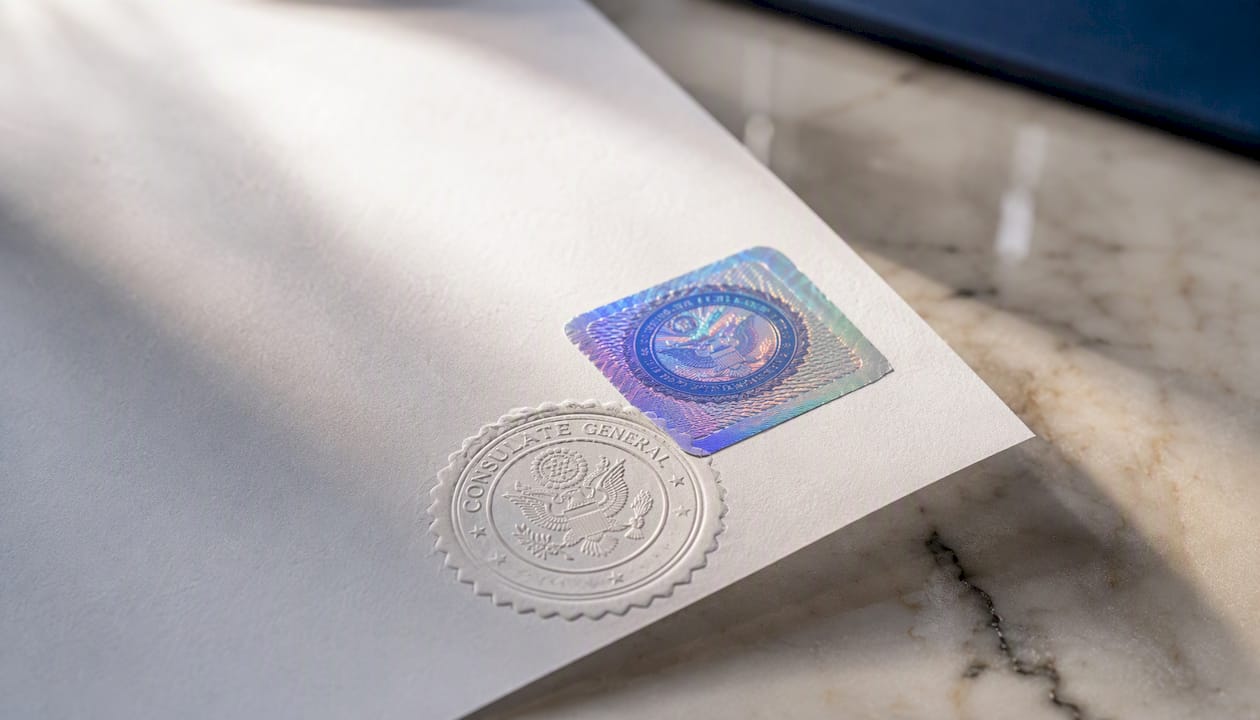
What a “legalization stamp” actually looks like
The term “legalization stamp” is informal. What you actually receive depends on the authority and the route.
An apostille is a standardized one-page certificate or adhesive sticker format established by the 1961 Hague Apostille Convention. It typically lists the country of origin, the name of the signatory, the capacity in which they signed, the seal or stamp applied, the place and date of issue, and the issuing authority’s details. It is either attached as a separate sheet or affixed directly to the document.
Consular legalization looks different. It is usually an ink stamp, an embossed seal, or a sticker applied by the embassy, often accompanied by a handwritten or printed certification statement. The format varies by country.
Apostille verification methods explains what recipient authorities check when they receive an apostilled document, which helps you understand why the format and completeness of the certificate matter.
As Belgian Foreign Affairs notes, legalization is a chain of certifications, each one confirming the signature and capacity of the authority before it. The visual stamp or certificate is the physical evidence of that chain.
Pre-submission checklist: what to verify before you send anything
Run through this list before submitting documents for legalization. One missed item can restart the entire process.
Confirm the destination country’s Hague Convention status using the HCCH status table.
Verify whether you need an original document or a certified copy (many authorities reject photocopies).
Check that notarization is complete, with correct wording, a legible seal, and a valid commission expiration date.
Confirm the notary’s commission number and expiration date appear on the document.
Determine whether a translation is required and whether it must be sworn, certified, or prepared in the destination country.
Prepare multiple copies of every document in case one set is rejected or retained.
Plan secure return shipping with tracking and signature confirmation.
Contact the destination embassy’s consular section to confirm their current requirements and appointment availability.
A concrete example: the authentication chain for a non-Hague country
Say you need to legalize a notarized power of attorney issued in California for use in a country that is not a Hague Convention member.
Step 1 — Notarization. A California notary public witnesses your signature and notarizes the power of attorney. The notary’s seal, commission number, and expiration date must all appear on the document.

Step 2 — County clerk certification (if required by California). Some California documents require the county clerk to certify the notary’s signature before the Secretary of State will act. Check California’s current rules.
Step 3 — California Secretary of State authentication. Because the destination is not a Hague member, the Secretary of State issues an authentication certificate rather than an apostille. This certifies the notary’s signature and commission.
Step 4 — U.S. Department of State authentication (if required). For some non-Hague destinations, the destination embassy requires the U.S. Department of State to authenticate the Secretary of State’s signature before the embassy will act. Check the specific embassy’s requirements.
Step 5 — Destination country’s embassy legalization. The embassy or consulate of the destination country in the U.S. applies the final certification. Each step in the chain is verifying the previous authority’s signature, not the document’s content.
For a detailed walkthrough of this chain applied to Philippine documents destined for the UAE, the how to legalize Philippine documents for use in the UAE guide covers each step with country-specific detail.
Practitioner warnings: the pitfalls that cause the most rejections
These are the mistakes that practitioners and government guidance flag most often.
Confusing apostille with content verification. An apostille tells the receiving country the signature is real. It says nothing about whether the facts in the document are correct. Recipient authorities will still verify content through their own channels.
Relying on a signature stamp when an original signature is required. Many receiving authorities insist on original handwritten signatures for security reasons. Always confirm before submitting.
Submitting documents with expired notary commissions. This is the single most common cause of chain invalidation. The entire process restarts from notarization.
Underestimating the slowest step. The overall timeline is only as fast as the slowest link. Embassy appointment backlogs routinely add weeks. Build that buffer into your planning.
Missing translation requirements. Discovering that a sworn translation was required only after the document has been legalized means starting the translation process from scratch, sometimes with re-legalization required.
Pro Tip: When you are unsure about a specific requirement, contact the destination embassy’s consular section directly. Their answer is the most authoritative local guidance you can get, and it takes one email or phone call to avoid weeks of rework.
A note from Harris on the most common mistake
The single most avoidable mistake I see is submitting documents without checking the notary commission expiration date first. It sounds minor. It is not. One expired commission date and the entire chain collapses. Everything else you paid for and waited on becomes worthless until you restart from step one.
The second most common issue is assuming apostille and consular legalization are interchangeable. They are not. The destination country’s Hague status is the fork in the road, and taking the wrong path costs time and money that could have been saved with a two-minute check.
If you prefer a done-for-you approach rather than managing each step yourself, Harrisncharms handles the full document legalization process for Filipino expats and workers, from notarization coordination through final attestation or apostille.
Harrisncharms handles the full process for you
Document legalization has a lot of moving parts: notarization requirements, state versus federal steps, embassy appointments, translation sequencing. Getting one step wrong means restarting the chain.

Harrisncharms specializes in document attestation, apostille processing, and legalization for Filipino expatriates and workers in the UAE. Whether you need a Philippine birth certificate attested for UAE residency, a power of attorney legalized for use abroad, or a police clearance processed for employment, Harrisncharms manages each step so nothing falls through the gaps. The service covers the full chain: from confirming notarization requirements through final attestation or apostille, plus certified translation when the destination requires it.
If you are preparing Philippine documents for use in the UAE or internationally, get started with Harrisncharms and skip the guesswork on which steps apply to your specific document and destination.
This article is general information, not a substitute for advice from a qualified lawyer. Consult a qualified legal professional about your own circumstances before acting on anything here.
Sources
Before you submit anything, verify requirements directly from official sources. Here are the principal ones:
Recommended
Comments