
PSA Authentication Explained for Filipino Expats in the UAE
Updated: Sep 3
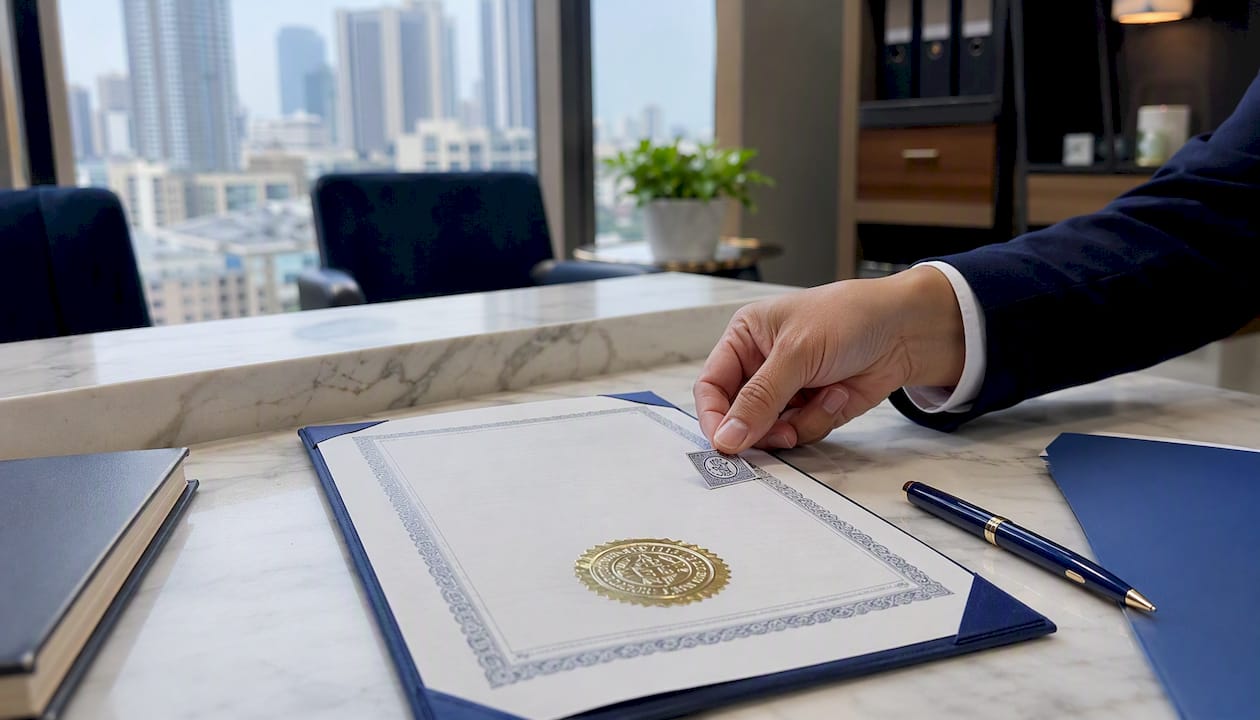
PSA authentication, in the context of Philippine civil documents, refers to the DFA-issued Apostille (or Certificate of Authentication for non-Apostille countries) affixed to PSA civil registry documents to make them legally valid abroad. The Philippine Statistics Authority (PSA) issues the original documents on SECPA security paper; the Department of Foreign Affairs (DFA), through its Office of Consular Affairs Authentication Division, then certifies their origin under the Hague Apostille Convention (HCCH). This process applies to PSA-issued birth, marriage, and death certificates, as well as CENOMAR. It certifies the document’s origin and the authority of the issuing officer, not the factual accuracy of the entries themselves.
Key actors and legal basis:
PSA issues the original civil registry document on SECPA security paper.
DFA Authentication Division affixes the Apostille as the Philippines’ Competent Authority under the Hague Convention.
HCCH Apostille Convention is the international treaty that makes the apostille recognized in over 120 member countries, including the United States.
Key Takeaways
PSA authentication for U.S. use means getting the DFA Apostille affixed to your PSA civil registry document, and the process is fully manageable from abroad when you prepare correctly.
Point | Details |
PSA authentication = DFA Apostille | The DFA affixes the Apostille to PSA documents; it certifies origin, not factual content. |
U.S. requires apostille | Most U.S. agencies and immigration authorities require an apostille on Philippine public documents. |
Order fresh SECPA originals | Never use laminated or old copies; order extras if multiple recipients need originals. |
Apply from abroad via representative or processor | Prepare a notarized SPA; confirm e-Apostille acceptance before paying for physical delivery. |
Harrisncharms manages the full workflow | From PSA ordering to DFA filing and insured courier delivery to the UAE or U.S. |
Table of Contents
When do you need PSA authentication for U.S. use?
Most U.S. government agencies, immigration authorities, employers, schools, and banks require an apostille on Philippine public documents before accepting them. Always confirm with the specific recipient institution, since requirements vary.
Common scenarios that require PSA authentication:
Visa and immigration filings with USCIS or the U.S. Embassy, including petition-based immigrant visas and adjustment of status.
Marriage to a U.S. citizen or foreign national, where a PSA marriage or birth certificate must be presented to civil authorities.
School enrollment or credential verification at U.S. universities or licensing boards.
Employment abroad, particularly for jobs requiring verified civil status or identity documents.
Property, inheritance, or legal matters presented to U.S. courts or notarial authorities.
Some institutions accept certified copies or embassy-assisted documents. A small number of countries or specific institutions may require additional steps beyond the apostille, such as consular legalization or extra certification, particularly for non-Hague Convention destinations.
Apostille vs. consular legalization vs. notarization: which one do you need?
These three terms get mixed up constantly, and choosing the wrong route wastes time and money.
Apostille is issued by the DFA as the Philippines’ Competent Authority under the Hague Convention. It replaced the old red-ribbon process for all Convention member countries, including the United States. The DFA Apostille certifies the document’s origin and the signing officer’s authority. It does not verify the factual contents.
Consular legalization applies when the destination country is not a Hague Convention member, or when a specific institution in a Convention country still insists on embassy-level certification. The process involves a DFA Certificate of Authentication followed by legalization at the destination country’s embassy in Manila.
Notarization is a prior step, not a replacement. A notary public authenticates private documents such as powers of attorney or personal declarations. For PSA civil registry documents, notarization alone is never sufficient for foreign use. It may be required as a preliminary step before the DFA will process certain supporting documents.
Feature | Apostille | Consular Legalization | Notarization |
Issued by | DFA (Philippines) | DFA + foreign embassy | Notary public |
Covers | PSA/public documents | PSA/public documents | Private documents |
Typical destination | Hague Convention countries (U.S., UAE, etc.) | Non-Convention countries | Preliminary step only |
Certifies | Origin and officer authority | Origin + embassy endorsement | Signatory identity |
For a detailed side-by-side breakdown, the apostille versus consular legalization guide covers the Philippine-specific process in full.
Step-by-step process to get your PSA document apostilled for U.S. use
Follow these steps in order. Skipping or reordering them is the most common source of delays.
Order a fresh PSA original on SECPA security paper. Go to Psa and request the specific document (birth, marriage, death certificate, or CENOMAR). Do not use old copies, laminated originals, or photocopies. Order extras if you need multiple originals for different recipients.
Check whether an LCR copy is required. If entries on your PSA document are unclear or the record was newly registered, you will need an LCR Form 1A, 2A, or 3A certified by the PSA before the DFA will process the apostille. The official documentary requirements specify exactly when this applies.
File for the Apostille via the DFA online portal. The DFA now offers a fully online apostille workflow for PSA documents, announced April 11, 2025. Order through the apostille portal, pay via Landbank LinkBiz, and choose either an e-Apostille (PDF delivered by email) or a paper apostille.
Pay the combined fees. The PSA document fee is PHP 300 (electronic copy via PSA Helpline); the DFA Apostille fee is PHP 200 for the electronic apostille. Paper apostille options carry an additional DFA fee. Verify current amounts on the official portals before paying, as fees are subject to change.
Receive and verify your apostille. For e-Apostille, delivery arrives by email after DFA processing. For paper apostille, documents are delivered to DFA-OCA Aseana and claimed at Double Dragon Plaza, Pasay City. You can also use the e-Apostille portal to track status.
Pro Tip: Before paying for physical delivery, confirm with your U.S. recipient whether they accept an e-Apostille PDF. Many U.S. agencies and universities now accept electronic apostilles, which saves you shipping costs and transit risk.
Processing timelines vary. PSA document preparation typically takes several business days for delivery; DFA apostille processing adds additional time depending on volume. Build in sufficient time when working from abroad, with extra allowance for courier transit.
What to prepare before you start: document checklist
Screenshot this list and share it with your representative if you are filing from the UAE.
Original PSA certificate printed on SECPA security paper (not laminated, not a photocopy)
Valid government-issued ID (for the claimant or authorized representative)
Payment proof or receipt from PSA Helpline and DFA portal
LCR Form 1A/2A/3A (only if entries are unclear or the record is newly registered)
Special Power of Attorney (SPA/POA) notarized in the Philippines or apostilled if executed abroad, when using an authorized representative
Copies of the representative’s valid ID
Recipient’s stated preference: e-Apostille (PDF) or paper apostille
Courier packing materials if sending originals by mail (padded envelope, tracking, insurance)
The PSA birth certificate guide for Filipino expats covers ordering and handling SECPA originals in more detail.
How to apply for PSA authentication when you are outside the Philippines
Philippine embassies and consulates do not issue the DFA Apostille. The DFA in the Philippines is the sole issuing authority. That said, embassies can sometimes assist with ordering PSA copies or provide local services that simplify collection. For OFWs, embassy-assisted PSA issuance can bundle document requests with apostille arrangements in some cases.
Your practical options from the UAE or United States:
Authorized representative route. Prepare a notarized SPA naming your representative in the Philippines. They present the SPA, their valid ID, and your ID copy at the DFA/PSA service counter. The SPA must be specific about the documents and transactions authorized.
Courier route. If you already have a PSA original, you can courier it to your representative or directly to a processor in the Philippines. Use an insured, trackable courier. Pack SECPA originals flat in a rigid envelope to prevent creasing or damage, which can cause rejection. See the authorized couriers guide for packing and labeling best practices.
Full-service processor route. A document service provider handles the PSA order, DFA apostille filing, POA management, and courier delivery to your UAE or U.S. address. You supply the required documents and identification; the processor manages the workflow.
Pro Tip: Confirm whether your U.S. or UAE recipient accepts an e-Apostille before you pay for physical document delivery. Choosing the wrong format means starting the delivery process over.
Common mistakes that cause rejections or long waits
Mismatched PSA QR data. If the QR code on your SECPA document does not match the printed entries, the DFA will flag the application. This usually requires going back to the PSA for a corrected copy.
Laminated or damaged originals. The DFA will not process laminated SECPA documents. Order a fresh copy.
Missing LCR copy. Newly registered records or documents with unclear entries require an LCR Form 1A/2A/3A. Submitting without it stops the application.
Incomplete or vague SPA. A POA that does not specifically name the documents and transactions authorized will be rejected at the DFA counter.
Recipient insisting on the old red ribbon. The red-ribbon process no longer exists for Hague Convention countries. Direct the recipient to the HCCH Apostille Convention member list and the DFA’s official apostille guidance.
Lost or damaged originals in transit. File an insurance claim immediately with the courier. Gather all tracking records and delivery confirmation. Request a new PSA original and restart the apostille process with the replacement document.
For verifying an apostille once it reaches the U.S. or UAE, the apostille verification methods guide walks through the official verification tools.
What working through PSA/DFA workflows actually teaches you
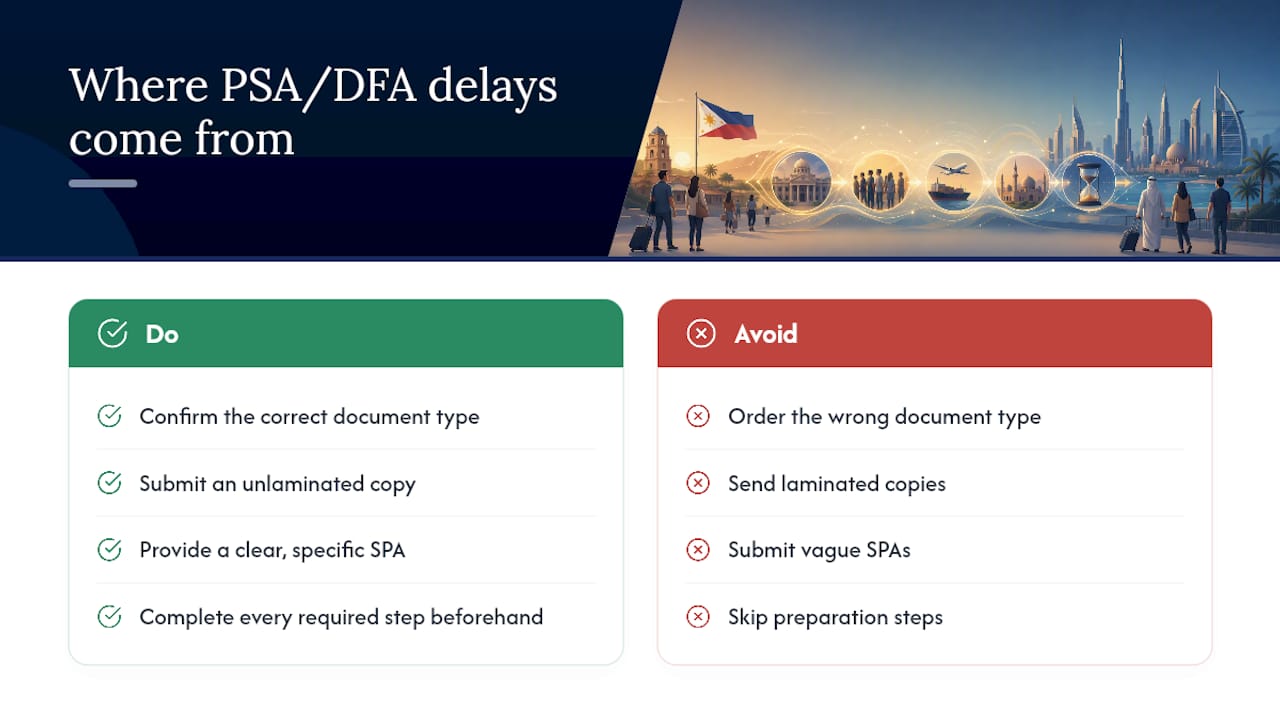
After handling PSA and DFA apostille workflows for Filipino expats in the UAE, one pattern stands out: the delays almost never come from the DFA itself. They come from applicants who ordered the wrong document type, used a laminated copy, or sent a vague SPA that the counter staff had to reject on the spot.
The process is more straightforward than it looks on paper, but it has zero tolerance for incomplete preparation. Every step in this article exists because someone skipped it and paid for it in weeks of waiting.
Harrisncharms handles PSA apostille from the UAE so you don’t have to
Getting a PSA document apostilled from the UAE means coordinating across time zones, managing a representative in the Philippines, and tracking originals through international courier. Harrisncharms handles that entire chain for Filipino expats: PSA document ordering, DFA apostille filing, SPA and POA management, insured courier delivery to your UAE address, and certified translations when your recipient requires them.
The service runs on a fee-for-service basis. You pay per document processed, with no retainer or long-term commitment. Before reaching out, prepare the checklist items above (your PSA original or ordering details, a valid ID, and your recipient’s apostille format preference). Then contact Harrisncharms to get your documents moving.
Sources
Check fees and processing times directly on these official sites before placing any order, as amounts and procedures are updated without advance notice.
This article is general information, not a substitute for advice from a qualified lawyer. Consult a qualified legal professional about your own circumstances before acting on anything here.
Recommended
Comments