
DFA Authentication for Philippine Documents: U.S. Guide
Updated: Sep 2
DFA authentication, as it applies to Philippine public documents, is now almost always an Apostille issued by the Department of Foreign Affairs under the 1961 Hague Apostille Convention. The Philippines officially acceded on May 14, 2019, which replaced the old “red ribbon” certification chain with a single Apostille certificate for documents headed to fellow Hague member countries. Your first move: confirm whether your destination country is a Hague member, then book an appointment through Apostille to start the DFA eApostille process.
Key Takeaways
DFA authentication for Philippine public documents is now an Apostille for Hague-member destinations, requiring an online appointment, valid IDs, and proper document certification before the DFA window.
Point | Details |
Apostille vs. authentication | Hague-member destinations (including the U.S.) need a DFA Apostille; non-Hague countries require additional consular legalization. |
Appointment is mandatory | All applications go through the DFA online portal; walk-ins are not accepted at any DFA apostille office. |
Document preparation matters | PSA originals, notarized private documents, and CHED CAV records must be current, legible, and properly certified before submission. |
Processing time | Regular service runs 3–5 working days; expedited service takes 1–2 working days at select offices. |
Unclaimed documents | DFA retains processed documents for three months from the release date before disposal. |
Table of Contents
What does “DFA authentication” actually mean for Philippine documents?
Who issues DFA Apostilles, and where do U.S.-based applicants find guidance?
How to get a DFA Apostille when you are in the United States
What counts as an acceptable document or ID at the DFA window?
What if the destination country is not in the Hague Convention?
How long does DFA Apostille processing take, and what does it cost?
Common mistakes that slow down or kill your DFA Apostille application
What does “DFA authentication” actually mean for Philippine documents?
Before May 2019, getting a Philippine document accepted abroad meant running it through a multi-step chain: the issuing agency certified it, the DFA stamped it with a red ribbon, and then the destination country’s embassy or consulate legalized it. That process was slow, expensive, and easy to get wrong.
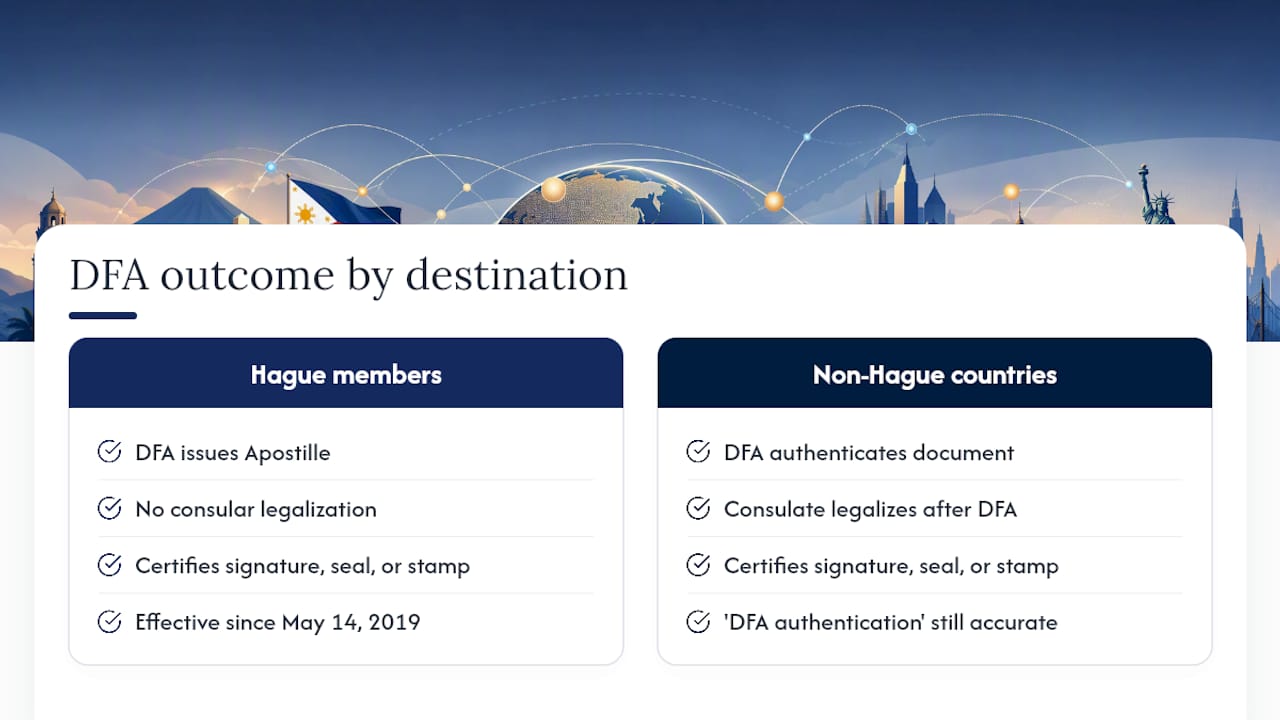
The Hague Apostille Convention changed all of that. When the Philippines joined on May 14, 2019, the DFA began issuing a standardized Apostille certificate instead of the red ribbon authentication. For any destination country that is also a Hague member, the Apostille is the final step. No embassy legalization needed.
“After DFA apostillization, there is no more need for legalization by Embassies or Consulates — except for non-Apostille countries and those that objected to the Philippine accession.” FAQs | Authentication Division
So when someone searches “what is DFA authentication,” they are usually asking about this process. The DFA’s Authentication Division affixes a square Apostille stamp bearing the heading “Apostille” and a reference to the Hague Convention. It certifies the origin of the document, specifically the authenticity of the signature, seal, or stamp on it, not the content itself.
A quick note on terminology: “DFA authentication” is still technically accurate when consular legalization is required for non-Hague destinations. In that case, the DFA authenticates the document first, and the destination country’s consulate legalizes it afterward. The phrase covers both scenarios, but for most U.S.-based applicants dealing with Philippine documents, Apostille is the relevant process.
Is a DFA Apostille the same as DFA authentication?
For most practical purposes, yes. If your document is going to a Hague member country, the DFA Apostille replaces what used to be called “DFA authentication.” The two terms describe the same competent authority doing the same job, just under a newer, simpler framework.
Where they diverge is destination. The United States is a Hague member, so Philippine documents headed to the U.S. for employment, immigration, or education purposes need a DFA Apostille, not the old red ribbon. For a country outside the Hague Convention, the DFA still authenticates the document, but that authentication is only step one. The destination country’s consulate or embassy must then legalize it separately.
Scenario | What you need | Extra steps |
Document used in a Hague member country (e.g., the U.S.) | DFA Apostille | None after DFA processing |
Document used in a non-Hague country | DFA authentication | Destination country’s consulate legalization required |
U.S.-issued document used in another Hague country | U.S. state or federal apostille |
The practical difference for applicants is significant. Hague-country processing ends at the DFA window. Non-Hague processing means additional appointments, fees, and lead time at a foreign consulate in the Philippines or abroad. Always confirm destination country status before you prepare anything. See the apostille vs. consular legalization breakdown for a deeper look at when each path applies.
Who issues DFA Apostilles, and where do U.S.-based applicants find guidance?
The competent authority is the Department of Foreign Affairs — Office of Consular Affairs (DFA-OCA), operating through its Authentication Division. All Apostille applications for Philippine public documents run through this office, either at DFA main offices in the Philippines or through DFA regional consular posts.
For applicants currently in the United States, the process still requires the documents to be processed in the Philippines. That means either:
Traveling to the Philippines and handling it personally
Authorizing a representative to appear at the DFA on your behalf
Working with a document services provider who manages the workflow
Where to find official guidance:
DFA Authentication Division: Apostille — appointment booking, policy explanations, FAQs, and document checklists
DFA appointment portal: appointment.apostille.gov.ph — required for all applications; walk-ins are not accepted
Philippine Consulate General (PCG) offices in the U.S.: PCG New York and other PCG offices provide country-specific guidance for Filipinos abroad; check the relevant PCG page for your jurisdiction
The DFA does not process U.S.-issued documents. If you need to authenticate a U.S. birth certificate, diploma, or court record for use in the Philippines or elsewhere, that goes through U.S. state or federal channels, not the DFA.
How to get a DFA Apostille when you are in the United States
The core workflow is: book an appointment online, send your documents and an authorized representative to the DFA office in the Philippines, pay the fee, and collect the apostilled document. Here is the full sequence.
Confirm document eligibility. The DFA Apostille covers the same document types that were subject to red ribbon authentication: PSA certificates (birth, marriage, death), notarized private documents, court records, and academic records with a Certification, Authentication, and Verification (CAV) from CHED when required. Document types and eligibility are listed on the DFA FAQs page.
Obtain certified copies or originals from the issuing agency. PSA-issued documents must come directly from the Philippine Statistics Authority. Academic records typically require a CAV from CHED. Private documents (contracts, affidavits) must be notarized by a Philippine notary public before DFA processing.
Book an online appointment through the DFA appointment portal at appointment.apostille.gov.ph. Walk-in applications are not accepted. Choose your preferred DFA office and service type (regular or expedited). For a detailed walkthrough of the 2026 appointment flow, the step-by-step Filipino apostille process guide covers current portal steps.
Prepare your representative’s documents. Since you are in the U.S., a representative will appear at the DFA on your behalf. They must bring:
The original document(s) for apostillization
Your valid government-issued ID (digitized Philippine IDs bearing your signature: SSS, UMID, Driver’s License, PRC ID, Postal ID, PhilSys ID, or similar)
A signed authorization letter from you
The representative’s own valid ID
Pay the fee at the DFA cashier. Payment is made on-site at the time of the appointment. Fees vary by service type; see the timeline and fees section below.
Collect the apostilled document. The representative picks up the processed document on the scheduled release date. If you are using a courier, arrange pickup through your authorized representative. Unclaimed documents are retained for three months from the scheduled release date before disposal.
Pro Tip: Check the currency of your PSA certificate before booking. DFA pre-assessment officers reject PSA documents that are faded, damaged, or issued too far in the past for the receiving institution’s standards. Ordering a fresh PSA copy before your appointment saves you a wasted trip and a rebooked slot.
For PSA-specific preparation, the PSA DFA Apostille guide covers common pitfalls with PSA certificates in detail.
What counts as an acceptable document or ID at the DFA window?
The DFA’s application process page is specific about what passes pre-assessment and what does not.
Acceptable documents for apostillization:
PSA-issued civil registry documents (birth, marriage, death, CENOMAR)
Notarized private documents (affidavits, contracts, special powers of attorney)
Court documents and decisions
Academic records with CHED CAV (when required by the school or receiving institution)
NBI clearance and other government-issued certifications
Acceptable IDs (must be digitized Philippine government IDs bearing the owner’s signature):
SSS ID, UMID, Driver’s License, PRC ID, Postal ID, PhilSys ID, Voter’s ID, Senior Citizen ID, PWD ID, Seaman’s Book, or Philippine passport
Common rejection triggers:
IDs that are expired, unsigned, or non-digitized
Altered or hand-annotated appointment letters (editing an appointment letter is treated as falsification of a public document under Philippine law)
Photocopies submitted instead of originals or certified copies
Foreign-issued documents presented for DFA apostillization (the DFA only apostillizes Philippine public documents)
PSA certificates that are illegible, faded, or otherwise defective
What if the destination country is not in the Hague Convention?
Not every country has joined the Apostille Convention. If your document is headed to a non-Hague country, the DFA can still authenticate it, but that authentication is not the end of the road.
After DFA processing, the destination country’s embassy or consulate in the Philippines must legalize the document. That step adds time, fees, and often a translation requirement. The sequence looks like this:
Confirm destination country status using the HCCH status table at hcch.net before preparing anything
Contact the destination country’s consulate in the Philippines to get their specific requirements (some require translation into their national language, notarization of the translation, and additional fees)
Allow extra lead time. Consular legalization can add weeks to the process, depending on the consulate’s schedule and backlog
Budget for additional costs. Translation, notarization, and consular fees stack on top of the DFA authentication fee
A practical example: a Philippine birth certificate headed to the U.S. needs only a DFA Apostille. The same certificate headed to a non-Hague country needs DFA authentication plus consular legalization at that country’s Philippine embassy, plus potentially a certified translation. The guide to legalizing Philippine documents for non-Hague destinations walks through a comparable process for another non-Hague jurisdiction.
How long does DFA Apostille processing take, and what does it cost?
The DFA offers two service tiers. Processing times below reflect standard DFA published windows; actual release depends on document volume and whether pre-assessment passes on the first attempt.
Service type | Typical processing time | Notes |
Regular service | a few working days | Standard for most document types |
Expedited service | about one working day | Available at select DFA offices; higher fee |
Official fee amounts are published on the DFA Authentication Division site and are subject to change. Check apostille.gov.ph directly for current rates before your appointment, as fees are paid at the cashier on the day of the appointment.
Timeline variability is real. Documents flagged for additional verification, missing pre-assessment requirements, or submitted during peak periods (before major holidays or school enrollment seasons) can take longer. Unclaimed documents sit in DFA storage for three months before disposal, so coordinate pickup carefully. For a detailed breakdown of processing windows and delay factors, the apostille processing timeline guide covers current conditions.
Common mistakes that slow down or kill your DFA Apostille application
Most rejections come from the same short list of errors. Knowing them in advance costs nothing; learning them at the DFA window costs you an appointment.
Altered appointment letters. Never hand-write corrections or edit your DFA appointment confirmation. Any alteration is treated as falsification under Philippine law.
Expired or non-digitized IDs. The DFA will not accept IDs that are expired, unsigned, or from the pre-digitization era.
Uncertified copies. Submitting a photocopy of a PSA document instead of an original PSA-issued copy triggers immediate rejection.
Foreign documents. The DFA apostillizes Philippine public documents only. U.S.-issued documents go through U.S. state or federal apostille channels.
Delayed pickup. Documents not claimed within three months of the scheduled release date are disposed of. Plan your representative’s pickup schedule before the appointment, not after.
Pro Tip: If you are using a courier or third-party representative, prepare a complete authorization package before the appointment date: a signed authorization letter, a photocopy of your valid ID, and a list of the documents being submitted. Representatives who arrive without a complete package are turned away, and rescheduling costs you time.
Official resources to consult before you apply
Use these sources for appointments, current fees, country status checks, and document-specific rules:
DFA Authentication Division homepage: Apostille — policy explanations, appointment links, and service updates
DFA application process page: Apostille — step-by-step procedure, acceptable IDs, and release rules
DFA FAQs: Apostille — document eligibility, Apostille vs. authentication, and non-Hague country rules
HCCH status table: Hcch — confirm whether your destination country is a Hague member
Philippine Consulate General (U.S.): Check the PCG office for your jurisdiction (e.g., PCG New York) for country-specific guidance for Filipinos in the U.S.
To verify an Apostille after it has been issued, the DFA eApostille system includes a QR code on the certificate. Scanning it through the DFA verification portal confirms the document’s authenticity without contacting the issuing office directly.
A note from Harris at Harrisncharms
The DFA Apostille process is straightforward once you know the rules, but the pre-assessment stage catches a lot of people off guard, especially applicants managing the process from abroad. A faded PSA certificate, a missing authorization letter, or an expired ID can cost you a full appointment slot and push your timeline back by weeks.
Harrisncharms has handled Philippine document attestation, apostille, and legalization for Filipino expats navigating exactly this kind of process. If you want someone to manage the workflow, coordinate with your representative in the Philippines, and make sure your documents clear pre-assessment the first time, reach out to Harrisncharms for assisted document services.
Sources
Recommended
Comments