
Guide to DFA Apostille for Filipinos in the U.S.
Updated: Aug 31
To get a DFA eApostille from the United States, you need to complete two stages: first, get your Philippine document authenticated by its issuing agency (PSA, CHED, DepEd, or NBI), then book a DFA appointment through appointment.apostille.gov.ph and have the DFA issue the eApostille through PARS at apply.apostille.gov.ph. This guide to DFA apostille covers every step, from ordering certified copies in the Philippines to verifying the QR code your receiving institution will scan.
Your immediate next steps:
Order certified copies from the issuing Philippine agency (PSA for civil registry documents, CHED for diplomas, NBI for clearances)
If you cannot travel to the Philippines, draft a notarized Special Power of Attorney (SPOA) and have it authenticated at the nearest Philippine Embassy or Consulate in the U.S.
Book your DFA appointment at appointment.apostille.gov.ph and pay the booking fee within one hour of booking
Prepare a valid, signed government-issued ID and print your appointment slip
Once the eApostille is issued via PARS, verify it using the QR code before submitting to any U.S. institution
Pro Tip: Harrisncharms handles document collection, SPOA preparation, and DFA submission for Filipinos who cannot travel. If logistics are the obstacle, that is the fastest path forward.
Table of Contents Guide to DFA Apostille
What is the DFA eApostille and the digital-first rule?
The DFA eApostille is a digital certificate issued by the Department of Foreign Affairs under the Hague Apostille Convention, confirming the authenticity of a Philippine public document’s signature and seal for use in member countries. One point that trips people up: the apostille does not validate the content of your document. It only confirms that the signature and official seal belong to a recognized Philippine authority. If there is an error in your PSA birth certificate, the apostille will not fix it — you need to correct the record at the source first.
The DFA’s digital-first approach means the eApostille is delivered electronically through PARS, with a QR code for verification. Receiving institutions abroad scan that QR code to confirm authenticity rather than relying on a physical stamp. A printed copy may be accepted by some organizations, but the authoritative verification method is always the QR scan or the PARS verification page.
Key facts about the eApostille:
Certifies the signature and seal of the issuing Philippine official only
Does not certify content accuracy — verify your document’s details at the source before submitting
Delivered digitally through PARS; QR verification is the official confirmation method
Only applies to Philippine public documents intended for use abroad — foreign-issued documents cannot be apostilled by the DFA
The Philippines joined the Apostille Convention on May 14, 2019, replacing the old “red ribbon” authentication chain. The practical benefit: once your document is apostilled, you no longer need a separate legalization step at the foreign embassy in Manila, provided the destination country is a Convention member.
Pro Tip: Austria, Finland, Germany, and Greece objected to the Philippines’ accession. If your document is headed to any of those four countries, you still need embassy legalization — not an apostille.
Who actually needs a DFA apostille?
Most Filipinos living in the U.S. encounter the apostille requirement when a U.S. institution or a third country asks for proof that a Philippine document is genuine. Common situations include:
Employment: U.S. employers or foreign companies requiring authenticated Philippine diplomas, TORs, or NBI clearances
Immigration and residency: Visa applications that require apostilled birth certificates, marriage certificates, or CENOMAR (Certificate of No Marriage Record)
Academic credential recognition: Universities or licensing boards requiring authenticated transcripts or diplomas
Marriage registration: Registering a Philippine marriage abroad or marrying a foreign national who needs proof of your civil status
Adoption: International adoption proceedings that require apostilled civil registry documents
Business and contracts: Foreign counterparties requiring apostilled corporate documents or notarized agreements
When the destination country is a Hague Convention member, an apostille replaces the old embassy legalization chain entirely. For countries outside the Convention, or for the four objecting countries listed above, contact the relevant embassy directly to confirm what authentication they require. For a detailed comparison of when apostille applies versus consular legalization, the apostille versus legalization guide breaks it down by scenario.
Which Philippine documents are eligible for apostille?
The DFA apostilles Philippine public documents only. The documentary requirements specify that every document must bear the visible, original signature of the issuing official — documents with only digital signatures or unclear stamps are routinely rejected at the DFA window.
Document Type | Issuing Agency | Pre-DFA Authentication Required |
Birth, marriage, death certificates; CENOMAR | Philippine Statistics Authority (PSA) | None — PSA copy goes directly to DFA |
Diploma, Transcript of Records (TOR) | CHED (college/university) | CHED Certification/Authentication/Verification (CAV) |
school records | DepEd | DepEd Regional Office certification |
NBI Clearance | National Bureau of Investigation (NBI) | None — NBI copy goes directly to DFA |
PRC-issued licenses and certificates | Professional Regulation Commission (PRC) | PRC authentication |
Court documents | Regional Trial Court / Supreme Court | Certified true copy from the issuing court |
Notarized private documents (e.g., SPOA, deeds) | Notary Public | IBP or RTC certification of notary’s signature |
Business documents (SEC, DTI, BIR) | SEC / DTI / BIR | Certified true copy from issuing agency |
For academic documents, the CHED CAV is the step most applicants miss. Your university diploma alone is not enough — CHED must first certify it before the DFA will accept it. DepEd records follow a similar path through the Regional Office. The Philippine school document apostille guide covers the CHED and DepEd certification steps in detail.
How do you get a DFA eApostille step by step from the U.S.?
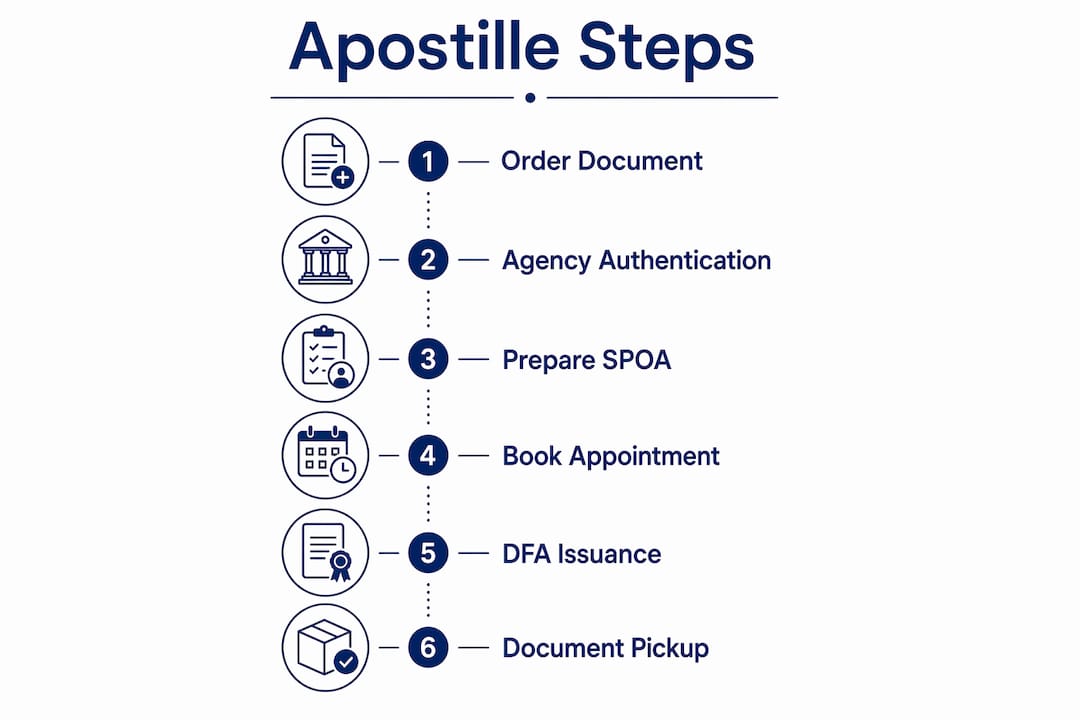
The two-stage process is: originating-agency authentication first, DFA apostillization second. Here is the full workflow for U.S.-based applicants.
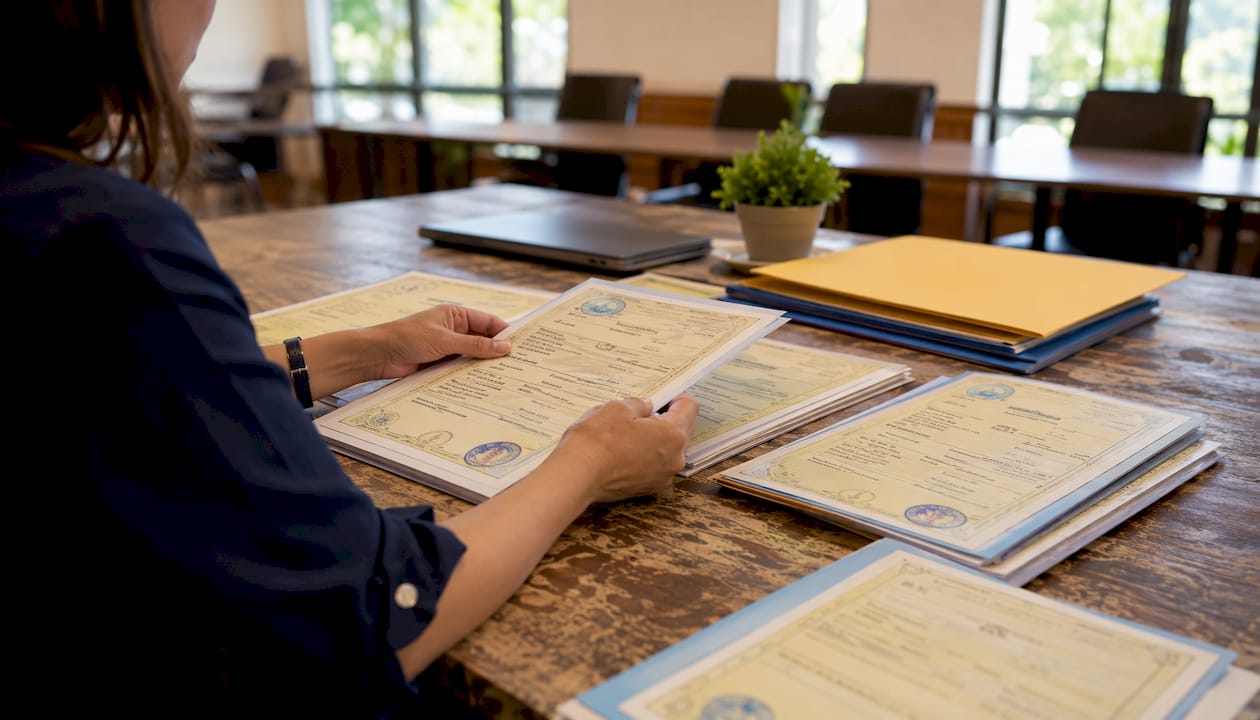
1. Order certified copies from the issuing Philippine agency. PSA documents can be ordered online through the PSA Serbilis or PSA Helpline portals and shipped internationally. CHED, DepEd, NBI, and PRC documents typically require a representative in the Philippines or a courier arrangement. Budget several weeks for delivery depending on the agency and shipping method.
2. Complete any required agency-level authentication. Send documents to CHED for the CAV, DepEd Regional Office for school records, or the issuing court for certified true copies. This step happens in the Philippines, so a local representative or a service like Harrisncharms is often the practical solution.
3. Prepare your SPOA if using a representative. If you cannot attend the DFA appointment yourself, draft a Special Power of Attorney authorizing a named individual in the Philippines. Notarize it in the U.S. and have it authenticated by the Philippine Embassy or Consulate nearest to you. Details on this step are in the next section.
4. Book a DFA appointment through appointment.apostille.gov.ph. Walk-ins are not accepted except for senior citizens, pregnant applicants, and persons with disabilities. Select your preferred DFA office, choose a date, and pay the ₱200 booking fee within one hour — the fee is nonrefundable and covers one document listed during booking. Print the confirmed appointment slip.
5. Attend the appointment (or send your authorized representative). Bring the original document, the printed appointment slip, a valid signed government-issued ID, and the payment receipt. The DFA processor will assess the document and collect the processing fee.
6. DFA issues the eApostille through PARS. Regular processing takes five working days and costs ₱100; expedited and eApostille processing each take two working days and cost ₱200. Once issued, retrieve and verify the eApostille using the QR code on the PARS portal.
Courier logistics: Use a tracked international courier (DHL, FedEx, or LBC for Philippine routes) to send documents to your representative. Keep tracking numbers and copies of everything you ship.
Pro Tip: Unclaimed documents at the DFA are disposed of after three months. If your representative cannot pick up on time, arrange a backup or request a courier pickup before that window closes.
How do you use a representative with a Special Power of Attorney?
A Philippine-based representative can attend the DFA appointment on your behalf, but the SPOA must meet specific requirements or the application will be rejected at the window.
SPOA essentials:
Must be an original, signed document — photocopies are not accepted
Must name the representative explicitly and specify the authority to process apostille applications on your behalf
Must be notarized by a U.S. notary public
Must then be authenticated by the Philippine Embassy or Consulate in the U.S., or apostilled if the U.S. document is being used under the Hague Convention framework — follow DFA’s guidance on foreign notarizations
What the representative must bring to DFA:
The original authenticated SPOA
Their own valid, signed government-issued ID
The document owner’s valid ID (photocopy, or original if available)
The printed appointment slip and payment receipt
All documents to be apostilled
For minor document owners, the DFA requires an original, authenticated SPOA from the parent or legal guardian — this is one of the most common causes of delay. Company representatives must also bring proof of their affiliation with the organization.
Pro Tip: Prepare two notarized originals of your SPOA before you leave the U.S. notary. The Philippine Embassy will retain one for their records, and the DFA window requires the other.
What mistakes delay or reject an apostille application?
Most rejections come down to a short list of avoidable errors.
Altered appointment slips: The DFA treats any alteration as falsification — a criminal offense. If you need to change your appointment, cancel and rebook through the official portal
Photocopies instead of certified true copies: Only original certified copies from the issuing agency are accepted
Missing agency authentication: Submitting a diploma without the CHED CAV, or a school record without DepEd certification, will result in immediate rejection
Documents without visible original signatures: Digital-only signatures or unclear stamps fail the DFA’s signature visibility requirement
Wrong ID type: IDs without the applicant’s signature are not accepted as valid government-issued identification
Incomplete SPOA for minors: Missing authentication or missing proof of guardianship stops the application
Paying fixers: Informal “fast-track” services offer no legitimate benefit and carry real criminal risk. The DFA’s online appointment system is the only valid path
If a document is rejected for further verification, it will only be authenticated after the issuing office confirms authenticity. Contact the DFA Authentication Concerns Hotline at 8651-9400 loc. 2266 to follow up on pending verifications.
How do you verify an eApostille and present it to U.S. institutions?
Scan the QR code on the eApostille using any smartphone camera or QR reader — it links directly to the PARS verification page.
Cross-check the details: Confirm the document owner’s name, the issuing official’s name, and the apostille date match your records.
Keep your DFA reference/transaction number as a backup verification method if the QR code is unavailable.
Submit to the U.S. institution with the original apostilled document. Some organizations also accept a printed copy alongside the QR verification link; confirm the receiving party’s policy before submitting.
Include a short verification note with your submission explaining how to scan the QR code, especially if the receiving institution is unfamiliar with Philippine eApostilles.
Pro Tip: If a U.S. employer or school asks for a “certified translation,” that is a separate requirement from the apostille itself. The apostille confirms origin; a certified translation converts the content into English for the receiving party.
What do DFA fees and processing times look like?
The official DFA fee schedule currently lists three processing tiers:
Regular processing: ₱100, released in five working days
Expedited processing: ₱200, released in two working days
eApostille processing: ₱200, released in two working days
The online appointment booking fee applies per document listed during booking, payable within one hour and nonrefundable. Add this to your total budget alongside the processing fee, which varies by processing tier.
For U.S.-based applicants, the realistic total timeline runs longer than the DFA processing window alone. PSA document delivery can take two to four weeks internationally; CHED CAV processing adds additional weeks; and international courier transit adds days on each end. Budget six to ten weeks from the moment you order your documents to the moment you hold a verified eApostille. Check the official DFA pages before acting — fees and timelines are subject to change.
Key Takeaways
Getting a DFA eApostille from the U.S. requires completing originating-agency authentication first, then booking through PARS and the DFA appointment portal, with a properly authenticated SPOA if you are using a representative.
Point | Details |
Two-stage process | Originating-agency authentication (PSA, CHED, DepEd, NBI) must be completed before DFA will accept any document. |
Booking and fees | Book at appointment.apostille.gov.ph; pay the nonrefundable ₱200 booking fee within one hour of reserving your slot. |
SPOA requirements | U.S.-notarized SPOAs must be authenticated by the Philippine Embassy or Consulate before a representative can use them at DFA. |
Processing tiers | Regular processing costs ₱100 (five days); expedited and eApostille processing each cost ₱200 (two days). |
Harrisncharms assistance | Harrisncharms manages document collection, SPOA handling, and DFA submission for Filipinos who cannot travel to the Philippines. |
Why U.S.-based Filipinos need a clearer apostille guide
Most apostille guides are written for applicants who can walk into a DFA office themselves. The reality for Filipinos living in the United States is messier: you are ordering documents from agencies you cannot visit, notarizing SPOAs in a country with different notarial rules, and coordinating couriers across time zones. The two-day DFA processing window sounds fast until you account for the six weeks of logistics that precede it.
What I find underappreciated in most guides is the agency authentication step. People focus on the DFA appointment and miss the fact that a diploma without a CHED CAV, or a school record without DepEd certification, will be turned away at the window regardless of how well everything else is prepared. That single gap accounts for a significant share of first-attempt rejections.
The other thing worth saying plainly: the eApostille system, for all its bureaucratic friction, is genuinely better than the old red-ribbon chain. Fewer steps, lower cost, and a QR code that any institution worldwide can verify in seconds. The process is not broken. It just requires knowing exactly which agency to contact first, and in what order.
Harrisncharms can handle the logistics for you
For Filipinos in the U.S. who need Philippine documents apostilled but cannot travel, Harrisncharms offers a fee-for-service solution that covers the parts of this process that are hardest to manage from overseas.
Services include document collection from PSA, CHED, DepEd, and NBI; SPOA preparation and authentication coordination; international courier management; DFA appointment attendance and submission; and certified translation when required by the receiving institution. Every service is priced per document, with no ongoing subscription.
Harrisncharms does not offer or guarantee expedited DFA slots — appointment availability is controlled entirely by the DFA, and any service claiming otherwise is not legitimate. What Harrisncharms does provide is accurate, compliant handling so your documents arrive at the DFA window correctly prepared the first time.
To get a quote or ask about your specific documents, visit harrisncharms.com and start a consultation. Bring your document list and the country where you intend to use them — that is all the information needed to map out the right process for your situation.
Useful official sources
Verify current fees, requirements, and appointment availability directly from these official pages before acting. Procedures and fees change without notice.
Authentication Division (apostille.gov.ph): Main DFA apostille hub — news, advisories, contact information, and office locations
PARS — apply.apostille.gov.ph: Philippine Apostille Registration System for eApostille issuance and retrieval
DFA Appointment Portal — appointment.apostille.gov.ph: Book your DFA apostille appointment and pay the booking fee
Documentary Requirements — apostille.gov.ph/documentary-requirements: Full list of required documents by document type and issuing agency
Application Process — apostille.gov.ph/application-process: Official fee schedule, processing tiers, and step-by-step instructions
Apostille FAQs — apostille.gov.ph/faqs: Answers to common questions including eligible documents, QR verification, and country coverage
Harrisncharms DFA Apostille resources: Publisher guides covering appointment logistics, document checklists, and representative workflows
This article is general information, not legal advice. Confirm current DFA requirements, fees, and processing times at the official DFA pages or with a qualified professional before submitting your documents.
Recommended
Comments