
Cenomar for Filipinos in the UAE: 2026 Guide

A Certificate of No Marriage Record, or Cenomar, is the official Philippine Statistics Authority (PSA) document certifying that a person has no registered marriage in the civil registry as of the date of issuance. For Filipinos living in the UAE, this certificate is not optional paperwork. It is a legal requirement for marriage license applications at the Philippine Consulate General in Dubai, proof of civil status for UAE government transactions, and a foundational document in many family and immigration proceedings. Getting it right the first time matters, because errors in names or missing authentication are the most common reasons applications get rejected.
What does a Cenomar actually certify?
A Cenomar certifies no marriage record found in the PSA civil registry database at the time of issuance. This distinction is critical. The document does not declare you legally single in an absolute sense. It reflects the state of PSA records on a specific date, which means a marriage registered after issuance would not appear on that certificate.
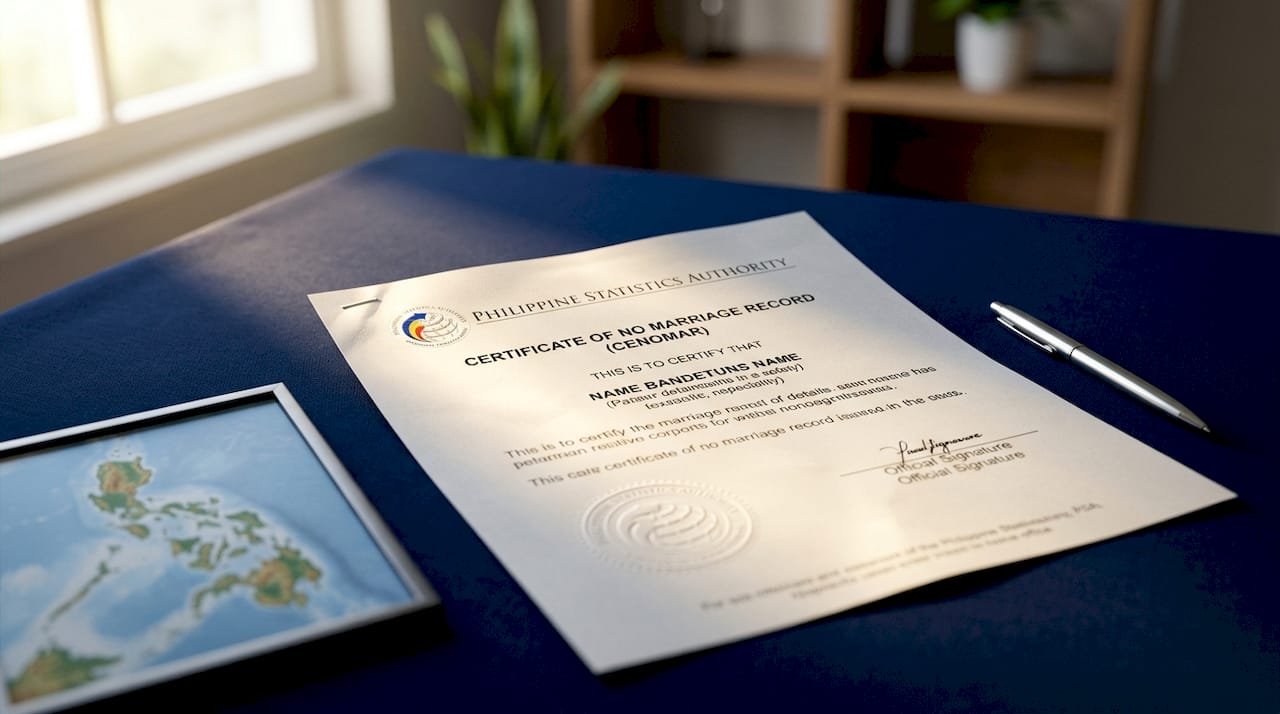
This is also why the Cenomar differs from a PSA Certificate of Marriage (COM) and from a CEMAR (Certificate of Marriage). The COM confirms a marriage exists in the registry. The CEMAR is issued when a marriage record is found but with specific annotations. The Cenomar, by contrast, is issued precisely when no marriage record is found at all.
Accuracy of your personal details is what determines whether PSA retrieves the correct record. Your full legal name, middle name, and parents’ full names must match exactly what appears in the civil registry. A single discrepancy, such as a missing middle name or a transposed letter, can result in an incorrect or failed search.
The Cenomar is also a living document in the sense that it can be superseded by updated records. If your civil status changes after issuance, the certificate no longer reflects your current status. This is why consulates and foreign authorities require recently issued copies rather than older certified versions.
How to apply for a Cenomar from the UAE
The PSA is the sole issuing authority for the Cenomar. Overseas applicants cannot obtain a Cenomar directly from Philippine consulates abroad. The document must originate from PSA in the Philippines, which means you need either a trusted representative back home or access to PSA’s online ordering system.
Here is the step-by-step process for Filipinos in the UAE:
Order through PSAHelpline.ph. The PSA’s official online portal accepts requests from overseas applicants. In 2026, PSAHelpline allows e-certificate ordering with delivery by email after identity verification and payment. This means you can receive a valid PSA-issued PDF without waiting for physical mail, which is a significant time-saver for UAE-based Filipinos.
Provide complete and accurate personal details. You will need to submit your full legal name exactly as it appears in your birth certificate, your parents’ full names including middle names, your date of birth, and your place of birth. Any mismatch with PSA records will cause a failed search or an incorrect result.
Choose physical or e-certificate delivery. The e-certificate option is faster and accepted by the DFA for apostille processing. Physical copies can be mailed to a representative in the Philippines if needed.
Authorize a representative if necessary. If you prefer a physical copy processed by someone in the Philippines, you must provide a notarized Special Power of Attorney (SPA). For UAE-based applicants, this SPA must be consularized at the Philippine Consulate General in Dubai before it is valid for use in the Philippines.
Specify the purpose on the request. If you need the Cenomar for marriage purposes, state this clearly during the application. The Philippine Consulate in Dubai requires the certificate to be marked “For Marriage Purposes.”
Pro Tip: Order your Cenomar at least three months before your intended wedding date or legal deadline. This gives you time to complete the DFA Apostille process and still submit a certificate within its six-month validity window.
Why the DFA Apostille is non-negotiable for UAE use
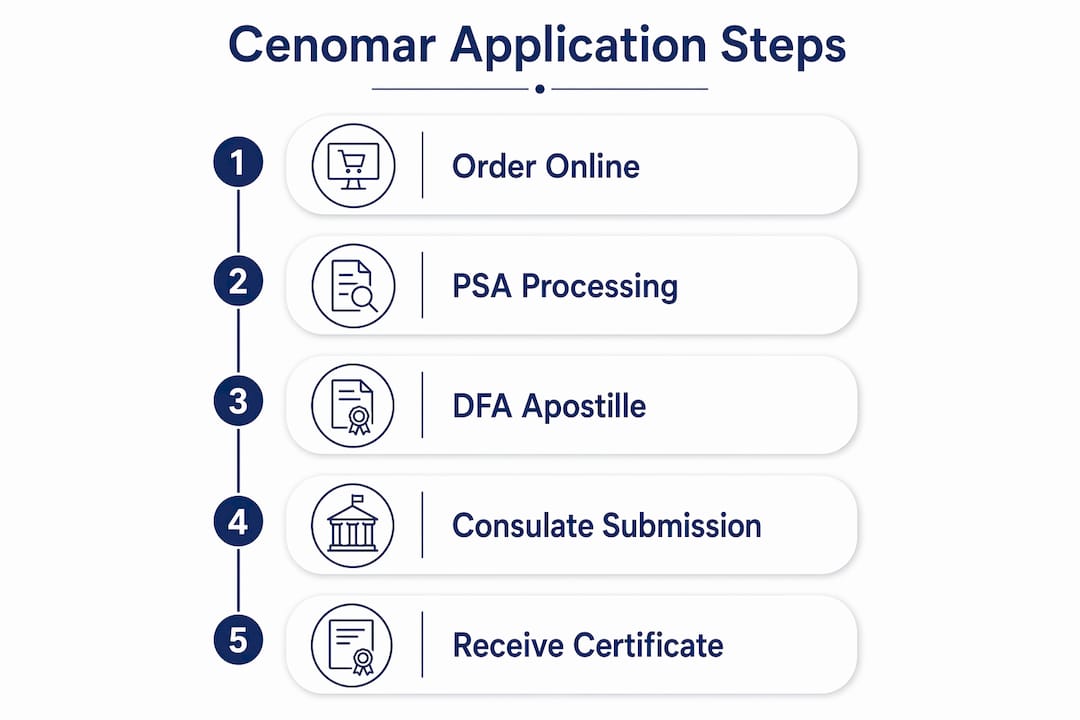
The DFA Apostille is the authentication mechanism that makes your PSA-issued Cenomar legally recognized in the UAE and other countries that are signatories to the Hague Convention. The apostille certifies the official signature and seal on the document, eliminating the need for traditional consular legalization in participating countries. The UAE recognizes apostilled Philippine documents, which is why this step is mandatory, not optional.
Authenticating the Cenomar with a DFA Apostille is required for UAE use. Submitting an unapostilled PSA copy, even an original, is one of the most common causes of rejection at the Philippine Consulate in Dubai and at UAE government offices.
The process follows a strict sequence:
Step 1: Obtain the PSA-issued Cenomar (physical or e-certificate).
Step 2: Submit the Cenomar to the DFA for Apostille authentication. This can be done in person at a DFA office in the Philippines or through an authorized representative.
Step 3: Receive the apostilled Cenomar and send it to the UAE, either directly to you or to the consulate as part of your application package.
Common pitfalls at this stage include submitting the document for apostille before the PSA has issued it (the sequence cannot be reversed), using an expired or outdated Cenomar for apostille (the document must still be within its validity period when submitted), and failing to verify that the apostille stamp itself is complete and legible.
Pro Tip: If you are using the PSA e-certificate, confirm with the DFA office or your document service provider that the digital version is accepted for apostille processing before you proceed. Not all DFA branches handle e-certificates identically.
For a thorough walkthrough of the authentication steps, the PSA DFA Apostille guide from Harrisncharms covers the full process with specific requirements for Philippine documents used abroad.
What the Philippine Consulate in Dubai requires for marriage
The Philippine Consulate General in Dubai applies specific validation rules for Cenomar submissions tied to marriage license applications. Understanding these rules before you apply prevents delays that can push back your wedding date by weeks or months.
The Philippine Consulate in Dubai requires an original DFA-apostilled PSA Cenomar that meets all of the following criteria:
Valid for six months from the issuance date. The Cenomar validity period is strictly six months. A certificate issued more than six months before your consulate appointment will be rejected outright.
Marked “For Marriage Purposes.” The certificate must carry this specific notation. A general-purpose Cenomar will not satisfy consular requirements for marriage processing.
Complete and exact full names and parents’ names. The accuracy of full names on the Cenomar is one of the most scrutinized elements. Many applications are rejected because a middle name is abbreviated, a surname is misspelled, or a parent’s name does not match the civil registry record.
DFA Apostille authentication. Failing to submit the apostilled version is a documented and frequent cause of denial, even when the original PSA copy is present.
Recently issued. Foreign authorities, including the Philippine Consulate, may reject older certified copies even if they are technically within the six-month window. Aim for a certificate issued no more than two to three months before your submission date to give yourself a buffer.
For a broader view of how Philippine civil documents are handled for UAE legal use, the document attestation guide from Harrisncharms covers attestation and legalization requirements specific to Filipino expats.
Key takeaways
A Cenomar issued by the PSA and authenticated by the DFA Apostille is the only version accepted by the Philippine Consulate in Dubai and UAE authorities for marriage and legal purposes.
Point | Details |
PSA is the sole issuer | Order through PSAHelpline.ph; consulates abroad do not issue Cenomars. |
DFA Apostille is mandatory | Unapostilled Cenomars are rejected by UAE authorities and the Philippine Consulate. |
Six-month validity window | Apply close enough to your deadline so the certificate does not expire before use. |
Name accuracy is critical | Full names and parents’ names must match civil registry records exactly to avoid rejection. |
“For Marriage Purposes” marking | Consulate submissions for marriage licenses require this specific notation on the document. |
What I’ve learned from watching Cenomar applications go wrong
I have seen the same mistakes repeat across hundreds of document requests from Filipinos in the UAE. The most painful ones are not the complex cases. They are the straightforward applications that fail because of a single overlooked detail.
The most common error I see is submitting a Cenomar that was ordered months before the consulate appointment. The applicant did everything right: correct names, proper apostille, right purpose marking. But they ordered the certificate four months before their wedding date, and by the time they submitted it, the six-month window had closed. The consulate rejected it, and they had to restart the entire process.
The second pattern I see constantly is name mismatches. A person goes by a shortened version of their name in daily life, and that version slips into the PSA request form. The certificate comes back with a name that does not match their passport or birth certificate, and the consulate flags it immediately. Always use your full legal name exactly as it appears on your PSA birth certificate, not the name on your Emirates ID or your company ID.
My honest advice: treat the Cenomar application as the first step in a chain, not a standalone task. The sequence is PSA issuance first, DFA Apostille second, consulate submission third. Skipping or reversing any step in that chain means starting over. And if you are handling this from the UAE without a trusted representative in the Philippines, working with a professional document service is not a luxury. It is the most reliable way to get it done correctly the first time.
— Harris
Get your Cenomar processed correctly from the UAE

Harrisncharms handles PSA Cenomar applications and DFA Apostille processing for Filipinos based in the UAE. Whether you need a certificate for marriage at the Philippine Consulate in Dubai or for other legal purposes, the team manages the full sequence: PSA ordering, apostille authentication, and delivery coordination. Every document is processed to meet Philippine Consulate requirements, including the “For Marriage Purposes” marking and the six-month validity rule. Skip the back-and-forth and get it right the first time. Visit Harrisncharms to start your request or learn more about available document services for UAE-based Filipinos.
FAQ
What is a Cenomar and who issues it?
A Cenomar is a Certificate of No Marriage Record issued by the Philippine Statistics Authority (PSA), certifying that no marriage record exists for a person in the civil registry as of the issuance date.
Can I apply for a Cenomar while living in the UAE?
Yes. You can order a Cenomar through PSAHelpline.ph from the UAE, with the option to receive a valid PSA e-certificate by email after identity verification and payment.
Does a Cenomar expire?
A Cenomar is valid for six months from the date of issuance for marriage purposes. The Philippine Consulate in Dubai will reject certificates that fall outside this window.
Do I need a DFA Apostille on my Cenomar for UAE use?
Yes. The DFA Apostille is required for the Cenomar to be accepted by UAE authorities and the Philippine Consulate in Dubai. An unapostilled PSA copy will not be accepted regardless of its authenticity.
What happens if my name is wrong on the Cenomar?
A Cenomar with incorrect or incomplete names will be rejected by the Philippine Consulate in Dubai. You must reorder the certificate using your exact full legal name and parents’ names as they appear in the PSA civil registry.
Recommended
Comments