
Why Non-Hague Countries Need Attestation: Expat Guide

Non-Hague countries require consular attestation because they never joined the 1961 Hague Apostille Convention and therefore do not recognize the apostille certificate as valid proof of a document’s authenticity. Instead, they rely on their own embassies and consulates to vouch for foreign documents through a multi-stage verification chain. If your destination is outside the Hague network, an apostille will be rejected outright, and you will need to start the attestation process from scratch.
The U.S. Department of State issues authentication certificates specifically for documents headed to non-Hague countries, and your state’s Secretary of State office handles the first authentication step for state-issued documents. The United States and over 100 other countries are parties to the Hague Convention, which means a significant portion of the world still sits outside it.
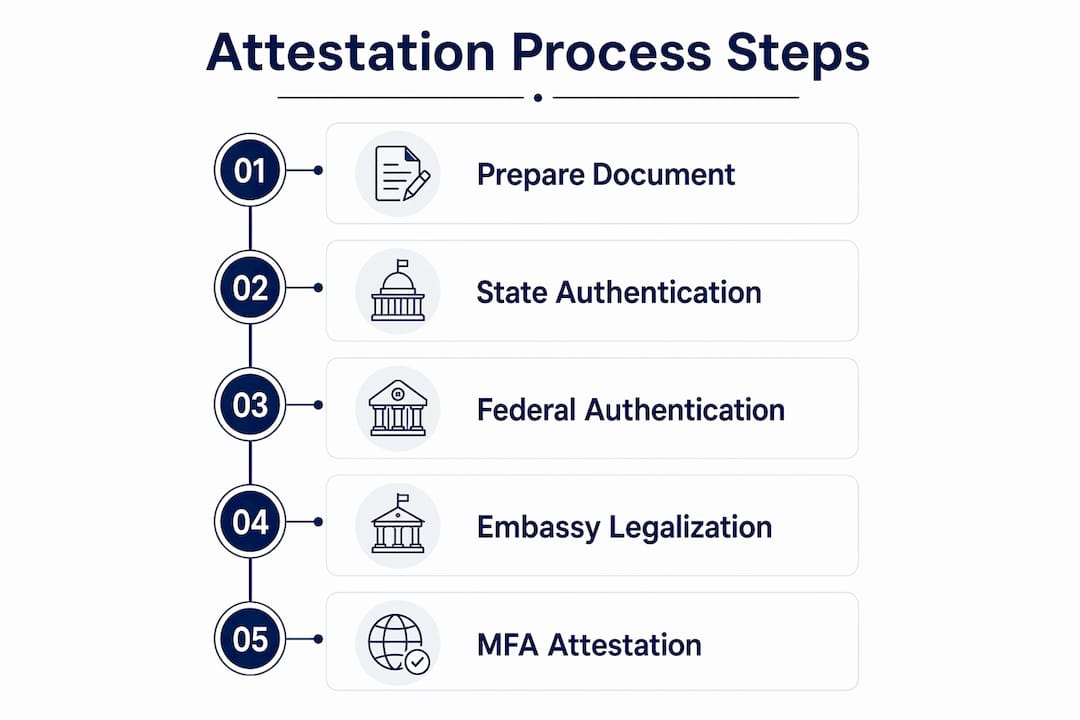
The typical attestation chain looks like this:
Notarize the document (or obtain a certified copy from the issuing authority)
Get authentication from your state Secretary of State (state documents) or the U.S. Department of State (federal documents)
Submit to the destination country’s embassy or consulate in the U.S. for legalization
Complete any final Ministry of Foreign Affairs (MFA) attestation required upon arrival in the destination country
Table of Contents
Why non-Hague countries need attestation instead of an apostille
An apostille is a single standardized certificate issued under the 1961 Hague Convention. For state-issued documents, your state’s Secretary of State issues it. For federal documents, the U.S. Department of State’s Office of Authentications handles it. The whole process can wrap up in days when everything is in order. The catch: it only works between Hague member states. Send an apostilled document to a country outside the Convention, and that country’s authorities have no legal obligation to accept it.
Consular attestation, by contrast, is a multi-stage process. Each stage adds a layer of official verification, ending at the destination country’s embassy or consulate in the U.S. Some countries then require a final MFA attestation after the document arrives in-country. It takes longer and costs more, but for non-Hague destinations it is the only recognized route.
Document type | Apostille issuer | Authentication chain starter |
State vital records (birth, marriage) | State Secretary of State | State Secretary of State |
State court documents | State Secretary of State | State Secretary of State |
Federal documents (FBI clearance, passport records) | U.S. Dept. of State Office of Authentications | U.S. Dept. of State Office of Authentications |
Notarized private documents | State Secretary of State | Notary → State Secretary of State |
Quick decision rule: Check whether your destination country is a Hague member before you do anything else. If it is, get an apostille. If it is not, you need the full attestation chain.
Why do non-Hague countries reject apostilles?
The short answer is that they never agreed to accept them. The Hague Convention is a treaty, and countries outside it made a deliberate choice not to sign, for a range of reasons.
Some countries resisted on sovereignty grounds, preferring to keep document verification under direct diplomatic control rather than delegating trust to a foreign government’s certification stamp. Others face administrative complexity: countries where document issuance is decentralized across provinces or states find it difficult to designate a single apostille-issuing authority as the Convention requires. A few have unresolved legal questions about how the Convention interacts with their domestic law.
The practical consequence is that embassies and consulates become the receiving state’s guarantors of authenticity. When the UAE’s Ministry of Foreign Affairs requires attestation on a Philippine birth certificate, it is because no treaty obligates the UAE to trust a Philippine apostille. The embassy chain substitutes for that missing treaty relationship.
Common regions where you will encounter this requirement:
Gulf Cooperation Council (GCC) states — the UAE, Saudi Arabia, Qatar, Kuwait, Bahrain, and Oman all require consular legalization for foreign documents
Several African jurisdictions — many sub-Saharan countries have not joined the Convention
Parts of Asia — a number of Southeast and South Asian states remain outside the Hague network, though membership has grown in recent years
The list shifts as countries accede to the Convention, so always verify current status before preparing documents.
How to get your U.S. documents attested for a non-Hague country
Follow this sequence exactly. Skipping or reordering steps is the most common reason embassies reject documents, and fixing a mis-sequenced file means starting over.

Step 1 — Prepare the document (1–3 days) Obtain an original or a certified copy from the issuing authority. Do not notarize original public documents such as birth certificates or court records; notarizing a public document can actually invalidate it for authentication purposes. Notarization applies to private documents (affidavits, powers of attorney, contracts) that need a notary’s signature before the state can authenticate them.
Step 2 — State Secretary of State authentication (3–10 business days) For state-issued documents, submit to your state’s Secretary of State office. Each state has its own fee schedule and processing window. California’s SOS office, for example, handles authentication requests separately from apostilles. Check your specific state’s page for current turnaround times and fees.
Step 3 — U.S. Department of State authentication (4–6 weeks) Federal documents, and state documents that require federal-level authentication for certain destinations, go to the U.S. Department of State Office of Authentications. This is the step most people underestimate. The Department of State window alone can run four to six weeks, and that is before the document reaches any embassy.
Step 4 — Embassy or consulate legalization (1–4 weeks) Once U.S. authentication is complete, submit the document to the destination country’s embassy or consulate in the U.S. Each embassy sets its own fees, appointment requirements, and processing times. Gulf-state embassies, in particular, often require Arabic translations to be submitted alongside the original document.
Step 5 — Destination MFA attestation (1–5 business days after arrival) Many non-Hague countries, including the UAE, require a final attestation from their own Ministry of Foreign Affairs after the document enters the country. For Filipino expats using Philippine documents in the UAE, this MFA step is mandatory and must not be skipped. A document that cleared every U.S. step but missed the in-country MFA stamp will still be rejected by UAE authorities.
Pro Tip: Build a courier budget into your plan from the start. Physical documents must travel between offices, and overnight courier fees across multiple legs add up quickly. Factor in at least two to three courier shipments for a complete attestation file.
Which countries require attestation, and how do you check?
The most reliable way to confirm whether your destination is a Hague member is to check the U.S. Department of State’s authentication guidance or the Hague Conference on Private International Law’s official member list. Both are updated as countries accede.
For a faster check, contact the destination country’s embassy in Washington, D.C., or its nearest consulate. Ask specifically whether they require an “apostille” or an “authentication certificate and legalization.” The terminology they use tells you everything.
Red flags that indicate a country is non-Hague:
The embassy’s instructions use the words “authentication,” “legalization,” or “attestation” rather than “apostille”
The embassy requires you to submit documents to them directly after U.S. authentication
The destination country’s government website lists an MFA attestation step for incoming foreign documents
The embassy requests Arabic, Chinese, or another official-language translation as part of the submission package
Common non-Hague destinations U.S.-based applicants frequently encounter include the UAE, Saudi Arabia, Qatar, Kuwait, and several countries across Africa and parts of Asia. The UAE’s Ministry of Foreign Affairs attestation service confirms that it verifies the authenticity of signatures and official seals on documents issued outside the UAE, which is the definition of consular attestation in practice.
For Filipino expats specifically, the apostille versus consular legalization distinction matters enormously because Philippine documents destined for the UAE require the full attestation chain, not an apostille.
Common pitfalls and what they cost you
Most attestation failures come down to a short list of avoidable mistakes.
Wrong document type. Submitting a photocopy when an original is required, or a notarized copy when a certified copy from the issuing authority is needed, triggers immediate rejection. Check the embassy’s document requirements before you prepare anything.
Wrong sequence. Sending a document to an embassy before completing U.S. authentication is the single most common failure point. Embassies will not process a document that has not been authenticated by the appropriate U.S. authority first.
Missing translations. Gulf countries routinely require certified Arabic translations. The translation itself often needs to be notarized and authenticated alongside the original document, which means it follows the same chain.
Skipping the MFA step. Completing the U.S. chain and embassy legalization but forgetting the in-country MFA attestation leaves the document unrecognized at the point of use.
Typical timeline and fee ranges:
Step | Typical timeframe | Who charges the fee |
Notarization | Same day | Notary public |
State SOS authentication | 3–10 business days | State Secretary of State |
U.S. Dept. of State authentication | 4–6 weeks | U.S. Department of State |
Embassy/consulate legalization | 1–4 weeks | Destination country’s embassy |
Destination MFA attestation | 1–5 business days | Destination country’s MFA |
Pro Tip: Verify the embassy’s exact required sequence before you ship a single document. Call or email the consular section directly, because embassy instructions on websites are not always current. One phone call can save weeks of rework.
How a professional attestation service prevents costly delays
The biggest value a specialist service provides is not speed on any single step. It is knowing the exact requirements for each destination before the file is assembled, so nothing gets rejected and sent back.
Embassy backlogs are real. The U.S. Department of State authentication window alone can stretch to several weeks, and Gulf-state embassy queues add more time on top of that. A managed service tracks those windows, times submissions accordingly, and handles courier logistics between each stage so documents do not sit idle waiting for the next step.
Translation coordination is another area where files stall. Arabic translations for UAE submissions, for example, must be certified and often authenticated as part of the same chain as the original document. Getting that wrong means the translation and the original both need to be reprocessed.
For Filipino expats in the UAE, the most underestimated risk is the final MFA attestation step. Documents that cleared every prior stage but missed the UAE Ministry of Foreign Affairs stamp are rejected at the point of use, whether that is an employer’s HR department, a government office, or a court. A professional service tracks that final step and confirms completion before the file is handed over.
For a detailed walkthrough of what the acceptance process looks like on the UAE side, the process for acceptance of attested documents in the UAE covers exactly what authorities check and in what order.
If you are handling a single straightforward document with plenty of lead time, self-managing is feasible. Multiple documents, tight deadlines, or destinations with complex in-country requirements are where the math shifts toward hiring a specialist.
Pro Tip: If you are preparing more than two documents, or if your destination requires an in-country MFA step you cannot personally follow up on, the time and rework risk of self-handling usually outweighs the service fee.
Key Takeaways
Non-Hague countries require consular attestation because they never agreed to recognize the apostille, making the full embassy legalization chain the only valid path for document authentication.
Point | Details |
Apostille only works between Hague members | If your destination is outside the Convention, an apostille will be rejected; you need the full attestation chain. |
Sequence is everything | Submit documents in the correct order: U.S. authentication before embassy legalization, embassy legalization before in-country MFA. |
Department of State adds weeks | The U.S. Department of State authentication window runs 4–6 weeks for federal documents; plan your timeline around it. |
MFA step is mandatory for UAE | Skipping the UAE Ministry of Foreign Affairs attestation after embassy legalization leaves the document unrecognized. |
Harrisncharms handles the full chain | For Filipino expats in the UAE, Harrisncharms manages every step from U.S. authentication through UAE MFA attestation. |
A practitioner’s note on realistic expectations
Attestation timelines surprise people every time. The paperwork looks straightforward on paper, but the Department of State window, embassy queues, and in-country MFA steps stack up fast. A file that looks like a two-week job often takes six to eight weeks when you account for courier transit between each stage and any embassy backlog.
My honest advice: if you have one document, a clear destination, and two months of lead time, you can self-manage with careful attention to the sequence. If you have multiple documents, a Gulf-state destination, or a deadline tied to a visa or employment start date, the risk of a sequencing error or a missed MFA step is too high to absorb. The cost of rework, both in fees and in lost time, almost always exceeds the cost of getting it right the first time with a specialist.
For OFWs and Filipino expats in the UAE specifically, the OFW guide to document attestation in the UAE covers the practical field realities that generic guides miss.
Harrisncharms handles attestation so you do not have to restart
Harrisncharms specializes in full-chain document attestation for Filipino expats and overseas Filipino workers in the UAE. That means handling every step from U.S. authentication and embassy legalization through UAE Ministry of Foreign Affairs attestation and certified translation, including courier coordination between each stage.
Full-chain handling: notarization guidance, state and federal authentication, embassy legalization, UAE MFA attestation, and certified Arabic or English translation when required
Courier management: physical document transfer between each stage is tracked and coordinated, so nothing sits idle between offices
If you are preparing Philippine documents for use in the UAE and want a case review before you start, contact Harrisncharms directly. Most inquiries receive a response within one business day, and the team can confirm the exact chain your specific documents require before you spend time or money on the wrong steps.
Official sources and next steps
Before you prepare any document, verify the current requirements from primary sources. Rules change as countries update embassy instructions or accede to the Hague Convention.
U.S. Department of State Office of Authentications — official guidance on authentication certificates for non-Hague destinations, including which documents qualify and how to submit
USA.gov authentication guide — plain-language explanation of when to use an apostille versus an authentication certificate, with links to state SOS offices
U.S. Department of State requesting authentication services — step-by-step submission instructions for the Office of Authentications
Your state Secretary of State office — each state handles authentication separately; search “[your state] Secretary of State authentication” for the current fee schedule and processing time
Destination country’s embassy in Washington, D.C. — call or email the consular section to confirm whether they require an apostille or legalization, and to get the current document checklist
UAE Ministry of Foreign Affairs attestation service — official UAE MFA guidance on attestation requirements for documents issued outside the UAE
Harrisncharms — practitioner service for Filipino expats in the UAE needing full-chain attestation, legalization, and certified translation
For immigration-related documentation questions where legal advice may be needed alongside attestation, consulting a qualified immigration lawyer, such as those at Elamine Lawyers, can help clarify how attested documents fit into a broader visa or residency application.
Recommended
Comments