
Why Attest Power of Attorney in the UAE: Expat Guide
- contact335627
- Jul 7
- 8 min read

Power of Attorney attestation in the UAE is the formal process of authenticating a legal document so that banks, courts, and government bodies accept it as valid. For Filipino expats and overseas workers, understanding why attest power of attorney UAE requirements exist is the difference between a transaction that closes and one that gets rejected at the counter. The UAE Ministry of Foreign Affairs (MOFA) sets the attestation standards that govern every foreign-issued document used within the country. Without meeting those standards, even a properly notarized POA carries no legal weight in the UAE.
Why attest power of attorney in the UAE?
Attestation is the step that transforms a notarized document into one that UAE authorities recognize across borders and institutions. Notarization confirms that a document is genuine at the local level. Attestation goes further: it verifies that the notarization itself is authentic and that the issuing authority had the legal standing to sign it.
Banks, courts, and government entities often reject POAs even when notarized, especially for property transfers or financial transactions. That rejection is not a technicality. It means your transaction stops entirely until you produce a properly attested document.
Filipino expats face this situation regularly. You may be managing a property sale back home, authorizing a family member to handle your Philippine Social Security System (SSS) contributions, or signing over authority for a business transaction in the UAE. Each of these scenarios requires a document that UAE and Philippine authorities both recognize. Attestation is what creates that mutual recognition.
The UAE MOFA standard applies to all foreign-issued POAs. A document issued in the Philippines must pass through a defined chain of authentication before any UAE institution will act on it. Skipping any link in that chain produces the same result: rejection.
When is attestation mandatory vs. when notarization alone is enough?
The distinction matters because not every POA use case triggers the full attestation requirement. Knowing the difference saves time and money.
Situations that require full attestation:
Cross-border transactions, including property sales, inheritance claims, or financial transfers involving the Philippines and the UAE
Company formation or business registration in the UAE where a representative acts on behalf of an absent principal
Real estate transactions in Dubai or Abu Dhabi where the POA authorizes a third party to sign contracts or transfer title
Court proceedings where the POA grants litigation authority to a lawyer or representative
Opening or managing bank accounts when the account holder is outside the UAE
Situations where notarization may suffice:
Routine internal UAE business matters where both parties are present and the document stays within a single jurisdiction
Administrative tasks within a company where no government submission is required
Attestation is mandatory for POAs used across borders or for sensitive transactions in the UAE, as notarization alone is often insufficient. That rule applies directly to most Filipino expats, whose POAs almost always involve cross-border authority.
Pro Tip: Before starting any attestation process, call the receiving institution, whether a bank, court, or government office, and ask exactly which attestation steps they require. Requirements vary by institution and document type.
How to attest a power of attorney: step-by-step for Filipino expats
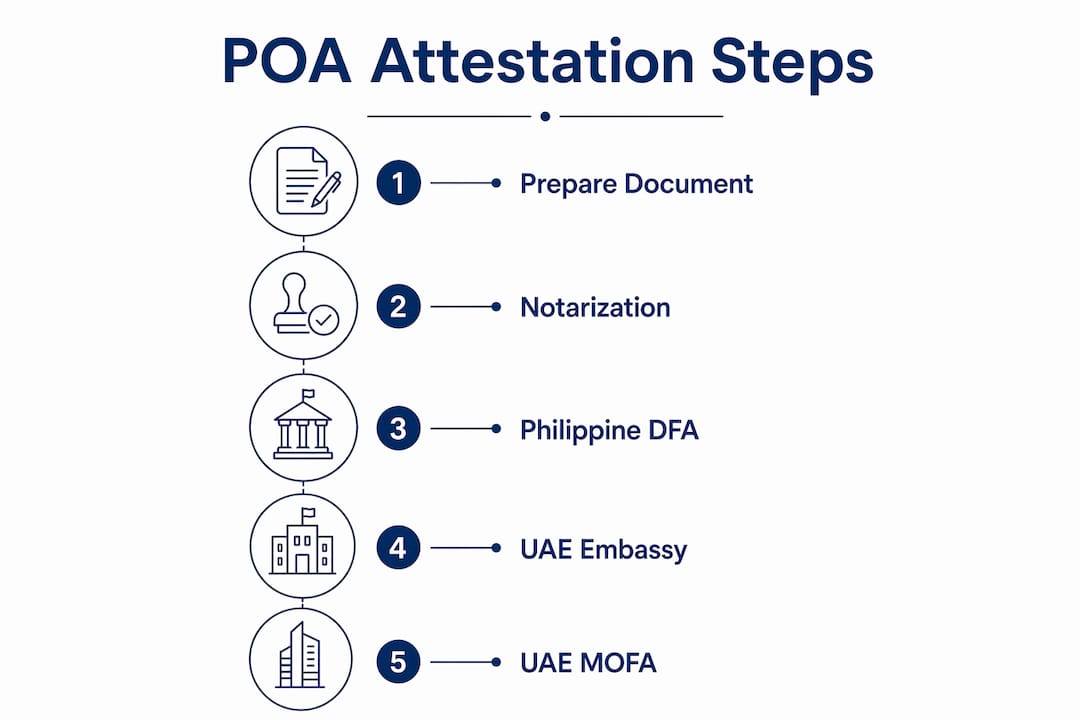
A foreign-issued POA must pass through four distinct stages before UAE authorities accept it. Each stage builds on the previous one, and skipping any step invalidates the chain.
The four-stage attestation chain
Notarization in the Philippines. A licensed Philippine notary public authenticates the POA. The notary confirms the identity of the signatory and the document’s legal form. This is the foundation of the entire chain.
Philippine Department of Foreign Affairs (DFA) authentication. The DFA authenticates the notary’s signature and seal. This step is called “apostille” for countries under the Hague Apostille Convention. The Philippines joined the Convention in 2019, which means Philippine documents now receive an apostille certificate rather than a traditional red ribbon. That apostille certificate is what UAE authorities recognize as the DFA’s authentication.
UAE Embassy attestation in the Philippines. The UAE Embassy in Manila verifies the DFA apostille and adds its own consular seal. This step confirms to UAE authorities that the document originated from a legitimate Philippine source.
UAE MOFA final attestation. Once the document arrives in the UAE, the Ministry of Foreign Affairs applies its final stamp. This is the step that makes the POA legally enforceable within the UAE.
Arabic legal translation is mandatory for foreign-issued POAs before UAE submission. The translation must come from a certified legal translator registered with UAE authorities. An uncertified translation, even an accurate one, will cause rejection.
Documents you typically need
Original POA with notary seal
DFA apostille certificate
Valid passport copies of the principal and the attorney-in-fact
Certified Arabic translation of the full document
UAE Embassy attestation receipt
Common pitfalls that cause delays
The most frequent mistake Filipino expats make is submitting the document without the Arabic translation. The second most common error is presenting a translation done by an unregistered translator. Both result in immediate rejection. A third issue is presenting a POA where the scope of authority is vague. UAE institutions want to see specific powers listed, not broad general authority.
Pro Tip: Use a certified legal translator registered with the UAE Ministry of Justice. Ask for their registration number before paying for the translation.
Stage | Authority | Purpose |
Notarization | Philippine notary public | Confirms document authenticity at origin |
DFA apostille | Philippine DFA | Authenticates the notary’s credentials |
UAE Embassy attestation | UAE Embassy in Manila | Verifies DFA authentication for UAE use |
UAE MOFA attestation | UAE Ministry of Foreign Affairs | Final legal recognition within the UAE |
What is the validity period of an attested POA in the UAE?
POAs are usually valid for 1–3 years under UAE law unless the document specifies a shorter period. That validity window starts from the date of execution, not the date of attestation. The gap between those two dates matters more than most expats realize.
Key validity issues to watch:
A POA executed in january but not attested until june has already consumed five months of its validity period before it reaches the receiving institution.
Banks and government offices track the execution date, not the attestation date, when assessing whether a POA is still current.
POA documents must often be re-executed after expiration, even if fully attested, due to internal validity limits set by banks and authorities.
Some institutions apply their own internal cutoff, treating any POA older than one year as expired regardless of what the document states.
A POA that expires mid-transaction creates serious legal complications, including the possibility that actions taken under an expired POA are void.
The practical fix is straightforward. Specify the exact validity period inside the POA itself. A document that states “this authority expires on december 31, 2027” gives the receiving institution a clear reference point. A document that relies on the default UAE law period leaves room for interpretation, and institutions tend to interpret conservatively.
Renewing an expired POA means repeating the full attestation chain. That process takes time and costs money. Monitoring your POA’s expiration date and starting the renewal process at least three months before it lapses is the most cost-effective approach.
Practical tips for Filipino expats attesting a power of attorney
Getting the attestation right the first time saves weeks of delays and avoids repeat fees. These practices reflect what actually works for Filipino expats navigating the UAE system.
Verify requirements before you start. Contact the receiving institution, whether a bank, real estate developer, or government office, and confirm exactly which attestation steps they require. Over-attestation wastes time and resources; confirm specific document requirements with beneficiaries before pursuing additional steps.
Prepare all documents before traveling to any office. Incomplete submissions are the leading cause of delays. Bring originals and certified copies of every document in the chain.
Use a professional attestation service familiar with Filipino expat needs. The OFW attestation process has specific nuances that general document services often miss, including the DFA apostille step and the UAE Embassy requirement.
Do not use general translation services. Only a UAE Ministry of Justice registered translator produces a translation that UAE authorities accept. Verify the translator’s registration before commissioning the work.
Keep certified copies of every stage. Retain the notarized original, the apostille certificate, the UAE Embassy attestation receipt, and the MOFA stamp. Losing any one of these means repeating that stage.
Check the scope of authority in the document. Broad general authority clauses often trigger additional scrutiny. Specific, clearly defined powers move through the system faster.
Pro Tip: If you are preparing attestation papers for the first time, create a checklist tied to the specific institution receiving the document. Generic checklists miss institution-specific requirements.
Key Takeaways
Attesting a Power of Attorney in the UAE is not optional for cross-border or sensitive transactions. It is the legal requirement that makes the document enforceable by UAE banks, courts, and government bodies.
Point | Details |
Attestation vs. notarization | Notarization confirms authenticity locally; attestation makes the document valid across UAE institutions and borders. |
Four-stage chain for Filipino expats | Philippine notarization, DFA apostille, UAE Embassy attestation, and UAE MOFA final stamp are all required. |
Arabic translation is mandatory | A certified Arabic translation from a UAE Ministry of Justice registered translator must accompany every foreign-issued POA. |
Validity is 1–3 years from execution | Monitor the execution date, not the attestation date, and start renewal at least three months before expiration. |
Verify before you start | Confirm the receiving institution’s exact requirements to avoid over-attestation and unnecessary costs. |
What I have learned from years of POA attestation work
The most common mistake I see Filipino expats make is assuming that a notarized POA from the Philippines is ready to use in the UAE. It is not. The Philippine notary’s seal means nothing to a UAE bank or court without the DFA apostille, the UAE Embassy stamp, and the MOFA final attestation. That misunderstanding costs people weeks of delays and repeat trips to government offices.
There is also a cultural dimension worth naming directly. Many Filipino expats rely on family members or kababayans to handle document preparation back home. That trust is understandable. But a well-meaning relative who skips the DFA apostille step, or uses a neighborhood translator instead of a certified legal translator, creates a document that will fail at the UAE end. The fix then requires starting the chain over from the Philippines, which means more time and more cost.
The other issue I see regularly is expats who over-attest. They add steps that the receiving institution never asked for, which wastes money and sometimes creates confusion about which stamp is the authoritative one. The solution is always the same: call the institution first, confirm the exact requirements, and then build your document chain to match.
Compliance with the full attestation process is not bureaucratic box-ticking. It is the legal foundation that protects your authority to act on behalf of someone else. A properly attested POA holds up in court, at the bank, and in front of any UAE government office. An improperly attested one does not.
— Harris
Harrisncharms: POA attestation support for Filipino expats
Filipino expats in the UAE deserve a document attestation service that understands the full chain from the Philippines to the UAE MOFA.

Harrisncharms specializes in document attestation services for Filipino expats, covering every stage of the POA attestation process. From DFA apostille coordination to certified Arabic translation and UAE MOFA submission, Harrisncharms handles the steps that most expats find confusing or time-consuming. The service is built around the specific requirements that Filipino expats face, including the nuances of the Philippine DFA apostille system and UAE Embassy procedures. Contact Harrisncharms to get your POA attested correctly the first time.
FAQ
Why does the UAE require POA attestation?
The UAE requires attestation to verify that a foreign-issued POA is authentic and legally valid. Banks, courts, and government entities reject unattested POAs even when notarized, particularly for property and financial transactions.
How long does an attested POA remain valid in the UAE?
An attested POA is typically valid for 1–3 years from the execution date under UAE law. Some banks apply their own internal validity limits, so always confirm with the receiving institution.
Do I need an Arabic translation for my Philippine POA?
Yes. Arabic legal translation is mandatory for all foreign-issued POAs submitted to UAE authorities. The translation must come from a translator registered with the UAE Ministry of Justice.
What does POA attestation cost in Dubai?
Notary fees in Dubai typically range from AED 250 to AED 350, with additional fees for UAE Embassy and MOFA attestation varying by document type. Total costs depend on the number of stages required.
Can I attest a POA inside the UAE if it was issued in the Philippines?
A Philippine-issued POA must complete the DFA apostille and UAE Embassy attestation steps before arriving in the UAE. The UAE MOFA final attestation is the last step and takes place inside the UAE. You cannot skip the overseas steps and attest only within the UAE.
Recommended
Comments