
What Is Diploma Attestation and Why It Matters

Bringing your diploma to a new country and assuming it will be accepted as-is is one of the most common and costly mistakes expats make. Diploma attestation is the official process that proves your educational document is genuine and was issued by a recognized institution, making it legally valid in a foreign country. Whether you are pursuing work in the UAE or enrolling in a university abroad, understanding what diploma attestation involves, and what it actually verifies, can save you weeks of delays and serious frustration.
Table of Contents
Key takeaways
Point | Details |
Attestation confirms authenticity | It verifies the signature and seal of the issuing authority, not your academic performance or completion. |
Country-specific steps are required | The exact sequence of notarization, HRD, MOFA, and embassy varies by destination country. |
Apostille vs. embassy legalization | Hague Convention countries use apostille; non-members like the UAE require full embassy legalization. |
Wrong documents cause rejections | Photocopies and incorrect document formats are among the top reasons attestation applications fail. |
Digital options are expanding | Platforms like HEC Pakistan’s online system now allow 24/7 applications without physical visits. |
What diploma attestation actually means
Many people assume that a diploma from an accredited university speaks for itself. Internationally, it does not. Foreign governments, employers, and universities cannot independently verify whether your document is genuine or forged. Diploma attestation solves this by putting official stamps and signatures on your document at each level of authority, confirming that the institution and the certifying officials are legitimate.
Here is the part most people get wrong: attestation confirms the signature and seal of the authority that issued or certified the document. It does not verify that you completed the program, earned the grades shown, or that the degree is equivalent to a foreign country’s standards. That distinction matters enormously. If your employer or university wants to evaluate your academic qualifications for equivalency, that is a separate process called credential evaluation.
Attestation tells the receiving country: “This document is real and was certified by a legitimate authority.” It does not say: “This person is qualified for this role.”
A few terms you will encounter during the diploma verification process:
Attestation: An official confirms the authenticity of a signature or seal on the document.
Authentication: Used interchangeably with attestation in some countries, but in the U.S. context it specifically refers to federal-level verification.
Apostille: A simplified certificate used between countries that have signed the Hague Convention of 1961.
Legalization: A multi-step process used for non-Hague countries, involving notarization, ministry approval, and embassy stamping.
Credential evaluation: A separate academic process that assesses the content and equivalency of your degree. Some employers and universities require this in addition to attestation.
Without completing the correct attestation process, your diploma can be rejected outright. Unattested degrees can cause visa refusals, employment rejections, and blocked academic registrations in countries that require verified documents.
Steps for diploma attestation
The diploma attestation process is not a single step. It is a chain, and that chain must be followed in the correct order. Skipping a step or doing them out of sequence is one of the most common reasons applications fail.
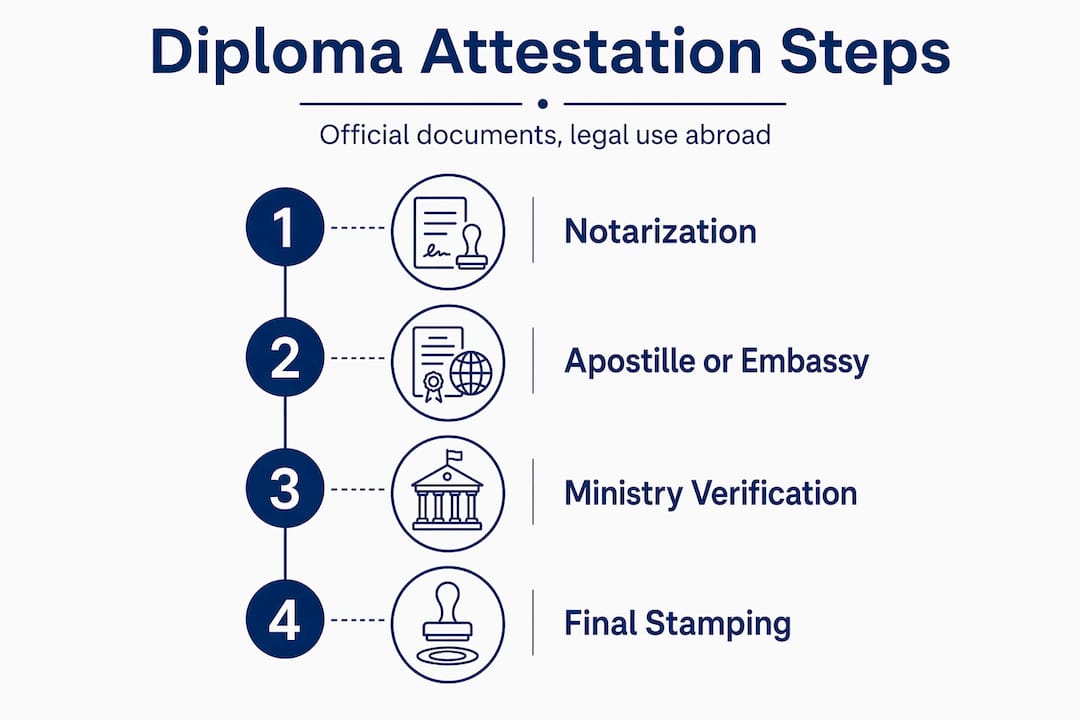
Here is the standard sequence for attesting a diploma for a non-Hague destination country such as the UAE:
Notarization: A licensed notary public certifies that the document is genuine.
State or regional authority verification: In many countries, a state education board or Human Resource Development (HRD) ministry authenticates the notarized document.
Ministry of Foreign Affairs (MOFA): The national foreign affairs ministry places its seal, confirming the state-level authentication.
Embassy or consulate attestation: The embassy of the destination country in your home country applies its final stamp, completing the legalization chain.
For Hague Convention member countries, the process is shorter. You only need a notarization and an apostille from the relevant state or national authority. The apostille authenticates the issuing official’s signature and seal, and that single certificate is recognized across all member states.
For U.S.-issued documents specifically, validation begins at the state level before federal authentication is requested using specific government forms. Each state has its own authentication office, and requirements vary slightly.
Pakistan has recently changed its approach. The Higher Education Commission (HEC) launched a fully online, paperless attestation system effective May 2026. Applicants can now apply 24/7, download their e-attestation certificate, and skip physical visits entirely. Original degrees are still required for scanning, but the process eliminates courier risks and long queues.
As for what documents are needed for attestation, the typical requirements include:
Original diploma or degree certificate (photocopies are generally rejected)
Copies of your valid passport
Completed application forms specific to each authority
Passport-size photographs
Payment receipts for applicable fees
Pro Tip: Before you begin the attestation chain, call or email the destination country’s embassy directly to confirm their current requirements. Requirements do change, and embassy websites are not always updated in real time.
Country-specific attestation requirements
The steps for diploma attestation vary significantly depending on where your diploma was issued and where you need it accepted. Here is a comparison of how different systems work:
Country of Destination | Required Steps | Key Authority | Apostille or Embassy? |
UAE | Notary → HRD → MOFA → UAE Embassy | Ministry of Foreign Affairs | Embassy legalization |
Saudi Arabia | Notary → HRD → MOFA → Saudi Embassy | MOFA + Saudi Embassy | Embassy legalization |
US (Hague member) | Notary → State apostille | Secretary of State | Apostille only |
UK (Hague member) | Notary → FCDO apostille | Foreign Commonwealth and Development Office | Apostille only |
Pakistan (HEC system) | Online submission via HEC portal | Higher Education Commission | HEC e-Attestation |
The UAE and Saudi Arabia are not members of the Hague Apostille Convention, which means an apostille alone is not sufficient. Filipino expats working in the UAE must complete the full embassy legalization chain. A detailed breakdown of the Philippine attestation pathways covers exactly what steps apply to documents issued in the Philippines.
One major shift worth knowing about is the rise of digital attestation. HEC’s e-Attestation system includes an online verification portal that employers and institutions can use to check authenticity directly, without a physical stamp. This reduces the risk of forged certificates and speeds up the verification process on the receiving end.
Pro Tip: If you hold a Philippine-issued diploma and are working in the UAE, check whether your document needs apostille from the Philippine Statistics Authority (PSA) or DFA before embassy attestation. The path depends on the document type and the specific UAE employer’s requirements.
Common mistakes that derail the process
Knowing the steps is not enough if you walk in with the wrong documents or misunderstand what each stage requires. These are the most frequent reasons attestation applications get delayed or rejected.
Submitting photocopies: Photocopies are rejected at most stages. You need to present the original document, or a certified true copy from the issuing institution.
Skipping the correct sequence: Breaking the attestation chain by going out of order means the next authority will refuse to stamp your document because the previous step has not been completed.
Confusing attestation with credential evaluation: Getting your diploma attested does not mean an employer recognizes your qualifications as equivalent to a local degree. These are two completely separate processes, and many applicants waste time expecting attestation to serve both purposes.
Using expired or damaged documents: Some authorities will refuse to attest documents that show visible damage, faded text, or expired validity periods.
Ignoring embassy-specific forms: Many embassies require their own application forms filled out in addition to the attested document. Arriving without these forms adds unnecessary wait time.
For Filipino expats in the UAE, preparing the right paperwork from the start is especially critical. A practical checklist for preparing attestation papers can prevent many of these common mistakes before they happen.
Using a professional attestation service is worth considering seriously, especially when you are dealing with a tight employment timeline. The importance of diploma attestation becomes painfully clear when a job offer is withdrawn because a document was rejected at the embassy stage.
Pro Tip: Keep digital copies of every document at every stage of the process. If a document gets lost in transit or a stamp is questioned, having timestamped copies gives you a paper trail that authorities can cross-reference.
My honest take on diploma attestation
I have seen clients go through the attestation process three times for a single diploma because nobody told them the rules for their specific destination. Not because they were careless. Because the information available online is often generic and does not account for where their document was issued, where they are going, or what their employer actually requires.
What surprises most people is the scope of what attestation does not cover. You finish the entire process, you have all the stamps, and then you find out your employer wants a credential evaluation on top of that. Attestation confirmed your document is real. That is all it did. Understanding this from the beginning saves both money and stress.
The digitization wave is genuinely useful. Pakistan’s HEC online platform is a meaningful shift, and I expect more countries to follow. But digital does not mean simple. You still need to understand the requirements, submit the right documents, and verify that your specific destination accepts digital certificates. Digital attestation options reduce logistical barriers significantly, but the preparation work on your end remains the same.
My advice: treat attestation like a legal filing, not a formality. Slow down, verify each step with the actual authority handling it, and do not assume that what worked for your colleague applies to your situation. Country-specific UAE attestation requirements for 2026 can differ from prior years, so always check the current rules.
— Harris
Let Harrisncharms handle the hard part
Diploma attestation for jobs and further education in the UAE involves multiple authorities, strict document requirements, and zero tolerance for errors. Getting one step wrong means starting over. Harrisncharms helps Filipino expats in the UAE get their diplomas and educational certificates properly attested without the confusion, the back-and-forth, or the costly mistakes.

Whether you need apostille, MOFA stamping, or full embassy legalization, the team at Harrisncharms knows exactly what each UAE employer and institution requires. Explore the full range of professional attestation services and find out how straightforward the process can be when someone who does this every day is on your side.
FAQ
What does diploma attestation verify?
Diploma attestation verifies the authenticity of the signature and seal on the document, confirming it was issued by a legitimate authority. It does not certify academic completion or assess the equivalency of your qualifications.
Who needs diploma attestation?
Anyone using a foreign-issued diploma for employment, university enrollment, or visa applications in a country that requires verified documents needs attestation. This includes overseas Filipino workers seeking jobs in the UAE.
What is the difference between apostille and embassy attestation?
Apostille is a simplified certificate recognized between Hague Convention member countries. Embassy attestation is the multi-step legalization process required by non-member countries like the UAE and Saudi Arabia.
What documents are needed for diploma attestation?
You typically need the original diploma, a valid passport copy, passport photos, completed embassy application forms, and payment receipts. Photocopies are rejected at most stages.
How long does the diploma attestation process take?
Processing times vary by country and authority, but the full chain from notarization to embassy attestation typically takes two to six weeks. Using a professional service can reduce this significantly by avoiding common documentation errors.
Recommended
Comments