
Third-Party Attestation Service: What You Need to Know

A third-party attestation service is defined as a formal engagement where an independent practitioner evaluates and reports on non-financial assertions made by an organization’s management. The practitioner, typically a Certified Public Accountant, follows standardized frameworks such as the Statements on Standards for Attestation Engagements (SSAEs) issued by the American Institute of Certified Public Accountants (AICPA). Three parties are always present: the responsible party (management), the independent practitioner, and the intended user. Unlike a financial audit, which focuses on financial statements, third-party attestation covers a wider range of claims, including cybersecurity controls, sustainability data, and internal process compliance. For Filipino expats in the UAE, understanding this distinction matters because document authentication often depends on exactly this kind of independent verification.
What is a third-party attestation service and how does it differ from an audit?
A third-party attestation engagement is a formal process where an independent CPA provides assurance on non-financial assertions, following SSAEs standards set by the AICPA. This is the industry’s recognized term for what many people loosely call “third-party verification services.” The core difference from a financial audit is scope. Audits focus on financial statements. Attestation covers almost any subject matter where management makes a claim and an outside party needs to trust it.
The three-party structure is not optional. Management prepares the assertion. The practitioner evaluates it against objective criteria. The intended user, such as a regulator, lender, or business partner, relies on the practitioner’s conclusion. Each role is distinct, and the practitioner must have no personal or financial stake in the outcome. Any conflict of interest invalidates the entire engagement.

This independence requirement is what gives attestation reports their weight. An outside expert’s conclusion carries more weight than management’s internal claims, which is why regulators and lenders increasingly require independent attestation before approving transactions or partnerships.
What are the types and levels of assurance in attestation engagements?
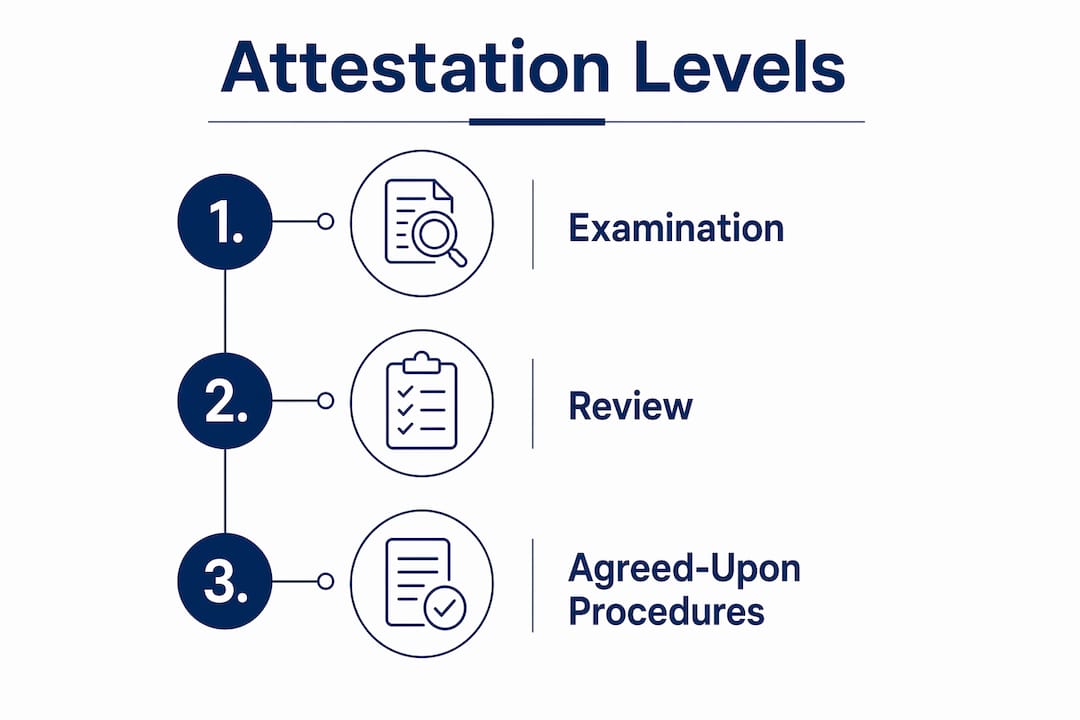
Attestation engagements come in three distinct levels, each providing a different degree of confidence to the intended user.
Engagement Type | Assurance Level | What the Practitioner Does |
Examination | Reasonable (highest) | Gathers extensive evidence; issues a positive opinion |
Review | Limited | Performs inquiry and analysis; issues a negative assurance statement |
Agreed-upon procedures | None (factual only) | Applies specific tests; reports findings without an opinion |
Examination is the most thorough option. The practitioner gathers enough evidence to issue a positive opinion, similar in rigor to a financial audit. Organizations use examinations when stakeholders need the highest level of confidence, such as in SOC 2 Type II reports for cybersecurity controls.
Review engagements provide limited assurance. The practitioner performs inquiry and analytical procedures, then states that nothing came to their attention suggesting the assertion is materially misstated. This costs less than an examination and suits situations where stakeholders need some comfort but not the full weight of a positive opinion.
Agreed-upon procedures are the most flexible option. The practitioner applies only the specific tests that the client and intended user agree on in advance, then reports factual findings without drawing any overall conclusion. This works well when the intended user has a very specific question and does not need a broad opinion.
Choosing the right engagement type depends entirely on what the intended user needs. A bank requiring proof of a borrower’s internal controls will typically demand an examination. A business partner checking a specific contract clause may be satisfied with agreed-upon procedures.
How does third-party attestation work in practice?
The attestation process follows a structured sequence that protects the integrity of the final report. Here is how a standard engagement unfolds:
Engagement acceptance. The practitioner confirms independence, assesses the subject matter, and agrees on the scope, criteria, and type of engagement with management.
Planning. The practitioner identifies risks, determines what evidence is needed, and designs procedures to gather it.
Evidence gathering. The practitioner tests controls, reviews documents, interviews personnel, and evaluates data against the agreed criteria.
Evaluation. Findings are assessed against the criteria. Any gaps or exceptions are documented and discussed with management before the report is finalized.
Report issuance. The practitioner issues a written report stating the conclusion, the criteria used, and any limitations on the engagement.
The practitioner’s independence is the single most important factor throughout this process. Any personal or financial stake in the client organization compromises the report’s credibility and renders it unreliable for intended users.
Attestation reports are used across a wide range of situations. Vendor due diligence, regulatory submissions, loan applications, and partner agreements all commonly require them. For Filipino expats in the UAE, attestation reports on personal documents serve a similar function: they give government authorities and employers an independent confirmation that the documents are genuine and accurately represent the facts.
Pro Tip: Ask your practitioner to walk you through the criteria they will use before the engagement begins. Knowing the exact standard being applied helps you prepare documentation and reduces the chance of exceptions appearing in the final report.
What are the benefits and common use cases of third-party attestation?
Third-party attestation services deliver value well beyond simple compliance. The benefits fall into several clear categories:
Stakeholder trust. Third-party attestation reports build confidence by providing objective verification, which can reduce insurance premiums and attract investment.
Risk reduction. Independent review identifies control gaps before they become costly problems.
Regulatory compliance. Regulators in sectors from finance to healthcare to sustainability require independent verification of specific claims.
Competitive advantage. Organizations with current attestation reports signal operational maturity to partners and clients.
Sustainability and ESG validation. Independent verification of emissions data and sustainability claims improves transparency and meets growing regulatory and market demands.
“Third-party attestations act as a critical bridge between an organization’s internal claims and external stakeholder trust, reducing risk and signaling operational maturity.” — BPM
SOC reports are the most recognized use case in the technology sector. A SOC 2 Type II report, for example, tells a prospective client that a software vendor’s security controls have been independently tested over a defined period. This single report can satisfy the due diligence requirements of dozens of enterprise customers simultaneously.
Sustainability attestation is growing rapidly. Independent assurance of sustainability data enhances data quality and mitigates risks linked to reliance on external environmental or operational claims. Investors and regulators now treat unverified sustainability reports with significant skepticism.
One underappreciated benefit is the internal improvement that attestation drives. The attestation process educates organizations by identifying control and operational gaps before the formal report is released. Companies that treat attestation as a continuous improvement tool, not just a compliance checkbox, consistently come out stronger.
Pro Tip: If your organization needs multiple certifications, such as SOC 1, SOC 2, and ISO 27001, ask a single firm to coordinate all three. Combining these reports uses a “test once, report many” approach that cuts audit fees and reduces internal disruption significantly.
What should you know before engaging a third-party attestation provider?
Selecting the right provider and approaching the process correctly makes a significant difference in both cost and outcome. Several practical points deserve attention before you sign an engagement letter.
Verify independence first. Confirm that the practitioner has no financial relationship, ownership interest, or employment connection to your organization. Independence is not just a formality. It is the legal and professional foundation of the report’s value.
Match the engagement type to your audience. If your intended user is a regulator, an examination is almost always required. If a business partner only needs answers to specific questions, agreed-upon procedures may be sufficient and far less expensive.
Start early. Waiting until a crisis to seek attestation is a common and costly mistake. Proactive attestation identifies risks before they escalate, giving your organization time to fix gaps before the report is finalized.
Consolidate where possible. Multiple overlapping attestations can be combined under one engagement to reduce cost and internal disruption.
Read the report carefully. The practitioner’s conclusion, the criteria used, and any exceptions or qualifications all carry meaning. A qualified opinion is not the same as a clean one.
For individuals navigating document authentication, such as Filipino expats in the UAE, the same principles apply. Know what the receiving authority requires, verify that your provider is recognized and independent, and start the process well before your deadline. Attestation delays are common and often avoidable with early planning. Understanding why attestation delays happen puts you in a much stronger position to avoid them.
Pro Tip: Request a sample report from your practitioner before the engagement begins. Reviewing the format and language in advance helps you understand exactly what the intended user will receive and whether it meets their requirements.
Key Takeaways
Third-party attestation is the most credible way to verify non-financial claims because it requires practitioner independence, standardized criteria, and a formal written conclusion that external stakeholders can rely on.
Point | Details |
Three-party structure | Every valid attestation involves management, an independent practitioner, and an intended user. |
Three assurance levels | Examinations, reviews, and agreed-upon procedures each provide a different degree of confidence. |
Independence is non-negotiable | Any financial or personal stake the practitioner holds in the client invalidates the report. |
Proactive beats reactive | Starting attestation early identifies control gaps before they become compliance failures. |
Consolidation saves money | Combining multiple attestations under one firm reduces fees and internal disruption. |
Why attestation is a strategic asset, not a formality
I have worked with enough individuals and organizations navigating attestation requirements to say this plainly: most people treat attestation as a box to check. They wait for a regulator, lender, or employer to demand it, then scramble to find a provider under pressure. That approach costs more, produces weaker results, and misses the real value of the process.
The organizations that benefit most from attestation treat it as a standing part of how they operate. They schedule engagements before they need the report, use the process to find and fix internal weaknesses, and arrive at the final report with clean controls and no surprises. That is not just good compliance practice. It is a signal to every stakeholder that the organization takes its responsibilities seriously.
For individuals, especially those managing document authentication across international borders, the same mindset applies. Knowing what attestation trends are shaping 2026 and understanding the legal implications of contract attestation before you need them puts you ahead of the process instead of behind it. Attestation done right is not a burden. It is proof that your information can be trusted.
— Harris
Harrisncharms: document attestation support for Filipino expats
Filipino expats in the UAE face a specific and often stressful challenge: getting personal and professional documents authenticated to meet UAE government and employer requirements.

Harrisncharms specializes in document attestation services designed for exactly this situation. From understanding which documents require independent verification to navigating the UAE’s authentication requirements, Harrisncharms provides clear, reliable support at every step. The process does not have to be confusing or slow. Visit the Harrisncharms accessibility statement to learn more about the services available and how to get started with your document authentication needs today.
FAQ
What is a third-party attestation service?
A third-party attestation service is a formal engagement where an independent practitioner evaluates and reports on non-financial assertions made by management, following standards such as the SSAEs issued by the AICPA. It involves three parties: the responsible party, the independent practitioner, and the intended user.
What is the difference between an audit and an attestation?
A financial audit focuses exclusively on financial statements, while an attestation engagement covers a broader range of subject matter, including cybersecurity controls, sustainability data, and internal processes. Both require independence, but attestation applies to non-financial information that stakeholders need to verify.
What are the three types of attestation engagements?
The three types are examinations, which provide reasonable assurance; reviews, which provide limited assurance; and agreed-upon procedures, which report factual findings without issuing an opinion. The right choice depends on what the intended user requires.
Why is practitioner independence so important in attestation?
Practitioner independence is the legal and professional foundation of an attestation report’s credibility. Any financial or personal stake the practitioner holds in the client organization invalidates the engagement and makes the report unreliable for intended users.
How can organizations reduce the cost of attestation services?
Organizations can reduce costs by consolidating multiple attestations under a single firm, using a “test once, report many” approach that combines SOC reports and ISO certifications into one coordinated engagement, cutting both fees and internal disruption.
Recommended
Comments