
What Is Degree Authentication for OFWs: A Practical Guide
- contact335627
- 4 days ago
- 9 min read
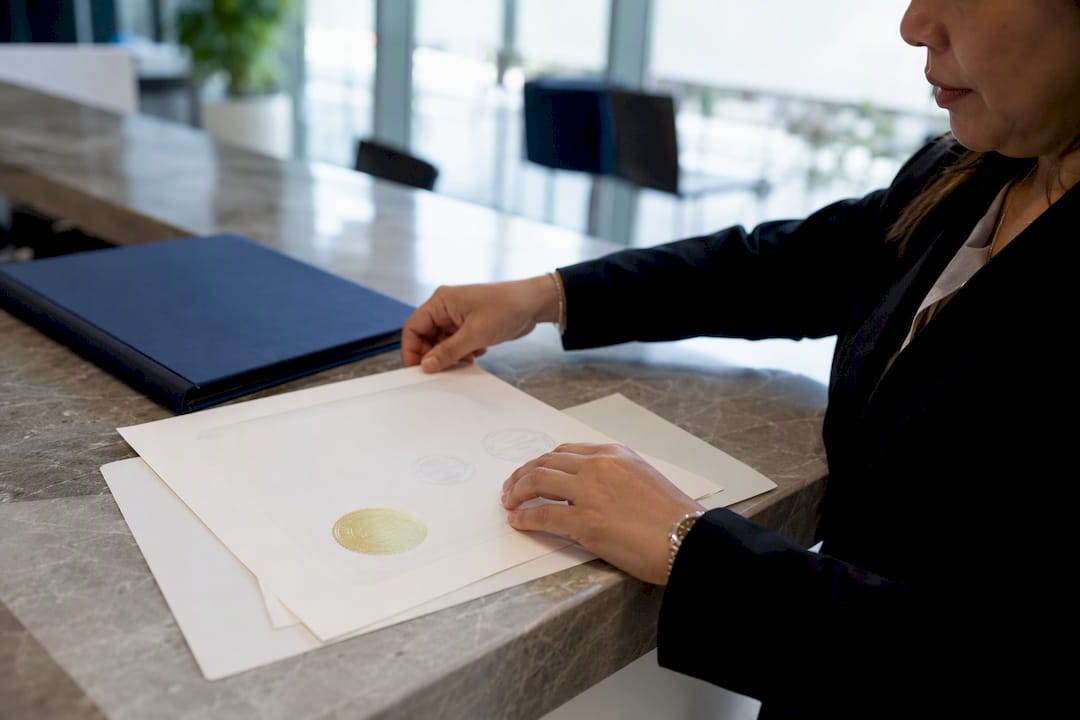
Degree authentication is the legal process that gets your Philippine diploma or transcript recognized by a foreign employer, school, or immigration office. It works by verifying the signatures and seals on your document, not your grades, so a government body abroad can trust that a real Philippine institution issued it. The Commission on Higher Education (CHED) certifies your records first, then the Department of Foreign Affairs (DFA) issues an Apostille under the Apostille Convention, or full legalization where required.
If you’re heading to the UAE, your next move is simple: find out whether your employer or the UAE requires just an Apostille, or an added attestation step from the UAE Ministry of Foreign Affairs (MOFA). Then ask your school to start preparing certified true copies now.
Authentication confirms the issuing school’s signature and seal are genuine.
CHED handles college-level credentials; DepEd handles secondary school records.
The DFA issues the Apostille that most foreign employers and embassies now accept.
UAE MOFA may still require a final attestation step after the Apostille
Key Takeaways
Degree authentication legally verifies your Philippine diploma’s signatures and seals so UAE employers, schools, and immigration offices can accept it as genuine.
Point | Details |
Authentication verifies signatures, not content | It confirms your school official’s signature and seal are real, not your grades or attendance. |
Follow the fixed authority chain | School certification leads to CHED or DepEd, then DFA Apostille or authentication. |
Confirm UAE-specific requirements early | Ask your employer or the UAE embassy whether MOFA attestation is needed after your Apostille. |
Watch for name mismatches and expired PSA copies | Keep your name identical across documents and renew PSA records older than six months. |
Consider a professional service for speed | Harris N Charms processes attestation, Apostille, and MOFA legalization for OFWs who can’t file in person. |
Table of Contents
What Degree Authentication Means and Why It’s Required
Authentication and academic verification aren’t the same thing. Authentication confirms that the school official who signed your diploma actually holds that position and that the seal is real. It says nothing about your GPA or whether you actually attended class, which is why some employers still call your school directly to confirm your records even after your documents are stamped.
Foreign governments require this step for several reasons tied directly to your ability to legally work, study, or reside abroad:
Employment visa applications, where HR and immigration need proof your credentials are legitimate.
Professional license transfers through bodies connected to the Professional Regulation Commission (PRC).
University admissions for graduate study abroad.
Residency and long-term work permit renewals.
Since May 14, 2019, the Philippines has been a member of the Hague Apostille Convention, and that changed everything about this process. Documents bound for other member countries now get a DFA Apostille instead of the older “red ribbon” authentication, cutting out a full embassy legalization step for many destinations
Who Handles What in the Authentication Chain
Each authority in this chain does one specific job, and skipping a link almost always means starting over. Here’s how the responsibility passes from your school all the way to the UAE.
Issuing school or registrar: produces your certified true copies, original diploma, and transcript of records (TOR), often sealed for direct submission.
CHED or DepEd: certifies that your school’s documents and signatories are legitimate. CHED covers college and graduate credentials; DepEd covers secondary school records.
PRC: authenticates board exam results or professional license documents when your job in the UAE requires a licensed profession.
DFA: issues the Apostille for Hague member countries, or full authentication for the small number of countries that aren’t Convention members.
UAE MOFA or destination embassy: in some cases, adds a final attestation layer after your DFA Apostille, depending on what your employer’s home country requires.
Pro Tip: Call your school’s registrar before you call CHED or DepEd. Most higher education institutions now route the CHED endorsement themselves, and showing up as an individual applicant often gets you turned away at the counter.
Steps to Authenticate Your Philippine Degree for UAE Work
The process runs in a fixed order, and each stage depends on the one before it. Skipping ahead, or trying to submit documents out of sequence, is the fastest way to lose weeks.
Request your original diploma and TOR from your school. Ask specifically for certified true copies, and confirm whether they’ll be sealed for direct submission to CHED or DepEd.
Let the school coordinate CHED or DepEd certification. Many institutions now handle this internally rather than accepting walk-in requests from graduates, since school-channel coordination helps prevent falsified submissions.
Get PRC authentication if your UAE job requires a licensed profession, such as nursing, engineering, or accountancy.
Submit your CHED or DepEd-certified documents to the DFA for an Apostille if the UAE accepts it, or for full authentication if it does not.
Confirm with your employer or the UAE embassy whether MOFA attestation is still required after your DFA Apostille. Some UAE-based employers still ask for this extra layer regardless of the Apostille.
Before you submit anything, ask your school two questions that prevent almost every delay: does my name appear identically on every document, and will you sign a certification letter dated within the last few weeks? A mismatched middle name or an outdated signature date can bounce your whole file back to step one.
Stage | Who Handles It | What You Need |
School certification | Registrar’s office | Original diploma, TOR, request letter |
CHED/DepEd authentication | School coordinates with agency | Certified school documents |
PRC authentication (if applicable) | PRC office | License, board exam results |
DFA Apostille/authentication | DFA regional office | CHED/DepEd-certified documents |
UAE attestation (if required) | UAE MOFA or embassy | Apostilled documents, employer request |
Pro Tip: Start this chain at least two months before your target deployment date. CHED endorsement alone can take several weeks during peak hiring seasons.
Documents, Timelines, and Costs to Expect
Beyond your diploma and TOR, keep a few supporting documents ready before you start: your PSA birth certificate, a valid passport copy, NBI clearance if your employer asks for it, your PRC license if relevant, and an authorization letter if a relative or agency is filing on your behalf.
Original diploma and TOR, plus at least two certified true copies of each.
PSA birth certificate, ideally issued within the last six months, since older copies are often rejected by receiving agencies.
Passport copy, NBI clearance (if required), and PRC license (if applicable).
A signed authorization letter if someone else is submitting documents for you.
Processing time varies by stage: school certification can take some days, CHED or DepEd endorsement often takes several weeks, and DFA Apostille processing usually takes a few business days once your file is complete. Build in a buffer of sufficient weeks before your UAE start date. Fees are modest at each stage, covering school certification charges, CHED or DepEd service fees, and DFA Apostille fees, plus courier costs if you’re not filing in person. Treat these as approximate. Actual amounts shift by region and by how many documents you’re processing at once.
Common Mistakes That Delay Degree Authentication
Most delays trace back to the same handful of avoidable errors. Recognizing them early saves you weeks of resubmission.
Applying to CHED or DepEd directly as an individual when your school is supposed to coordinate that step.
Name mismatches across your diploma, TOR, passport, and PSA birth certificate.
Submitting a PSA birth certificate older than the typical six-month acceptance window.
Using unnotarized photocopies where certified true copies were required.
If you can’t be physically present for any step, a notarized authorization letter or power of attorney lets a relative or representative file on your behalf. And if you’re using a third-party attestation service, insist on an official receipt, a written timeline, and proof of submission at each stage. Legitimate services will always give you paperwork proving your documents actually moved through the chain.
Pro Tip: Photograph or scan every document the moment you receive it back from an agency, before you hand it off to the next office. If a physical copy ever gets lost mid-chain, you’ll have proof of what you already submitted.

Apostille vs. Legalization: What UAE-Bound OFWs Need to Know
An Apostille is a single certificate that the DFA attaches to your document, and it’s accepted at face value by every other country that has joined the Hague Convention. That’s the whole point of the system: one stamp replaces what used to be a multi-step embassy legalization chain.
But the Apostille only replaces embassy legalization between countries that are both Convention members. For destinations that object to the Convention or aren’t members, the older DFA-plus-embassy legalization process still applies. In the UAE’s case, many employers accept the Apostille outright, but some Middle Eastern destinations still ask for UAE MOFA attestation on top of it.
Always confirm directly with your employer or the UAE embassy which standard applies to your specific case.
Don’t assume your Apostille is the final step just because it was for a colleague’s paperwork last year. Requirements shift by sector and by employer.
How to Verify and Store Your Authenticated Documents
Once your documents come back stamped, verify before you file them away. Request a stamped receipt or confirmation copy at each stage, and if MOFA attestation was involved, get a confirmation email or reference number from the office that processed it.
Keep at least two certified physical copies, and scan every document to secure cloud storage as a backup.
Carry notarized photocopies for day-to-day use, reserving your original diploma for situations where the original is explicitly required.
Re-authenticate if you change your legal name through marriage or a legal process, since supporting evidence and extra processing time will be needed either way.
Replace lost documents by starting the school certification step over. There’s no shortcut around a missing original.
Why Authentication Belongs at the Top of Your Pre-Departure List
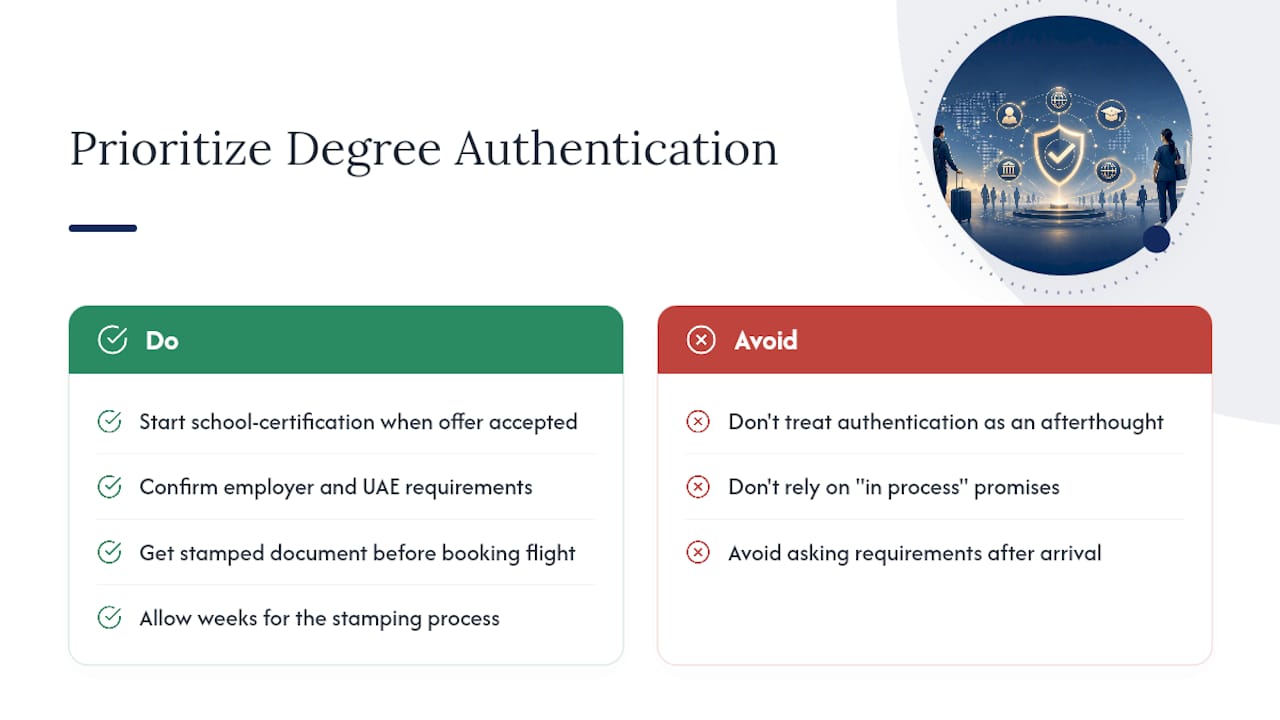
Treating degree authentication as an afterthought is the single biggest reason OFWs hit last-minute visa snags. Employers and immigration officers don’t accept promises that your paperwork is “in process.” They want the stamped document in hand, and that stamp takes weeks to produce, not days.
Start the school-certification step the moment you accept a job offer, not after you’ve booked your flight. Confirm exactly what your employer and the UAE authorities require before you leave the Philippines, because asking after arrival puts you in a much weaker position to fix a gap.
Let Harris N Charms Handle the Chain for You
If coordinating school certifications, CHED endorsements, and DFA Apostille filings from inside the UAE sounds like more back-and-forth than you have time for, that’s exactly the gap Harris N Charms fills. We process Philippine document attestation, Apostille requests, embassy and MOFA legalization, and certified translations for Filipino expats who can’t fly home to sit in a DFA line.
Working through a licensed courier and service partner also matters if you’re already employed and can’t leave your job to chase paperwork. Missing signatures, name mismatches, and expired PSA copies are the most common reasons documents bounce back, and catching those errors before submission is where a dedicated attestation service earns its fee. If your degree, TOR, or professional license needs to move through the CHED, DFA, and UAE MOFA chain, visit the Harris N Charms landing page to book a consultation and get a clear timeline for your specific documents.
Frequently Asked Questions
What is degree authentication for OFWs, exactly? It’s the process of legally verifying that your Philippine diploma or transcript was issued by a genuine institution, using certified signatures and seals recognized through CHED, DepEd, PRC, and the DFA, so foreign employers and immigration offices accept it.
Do I need an Apostille or embassy legalization for the UAE? It depends on your employer and the specific UAE authority involved. Many accept the DFA Apostille directly, while others still require UAE MOFA attestation on top of it. Always confirm before you assume either path applies.
How long does the whole authentication process take? Plan for several weeks from school certification through DFA Apostille, longer if PRC authentication or UAE MOFA attestation is also required.
Can I apply for CHED or DepEd certification myself? Usually not directly. Most schools now coordinate this step internally rather than accepting individual walk-in requests, which helps prevent fraudulent submissions.
How long is an authenticated degree valid before I need to redo it? The Apostille or authentication itself doesn’t expire, but supporting documents like your PSA birth certificate typically need to be reissued if they’re older than about six months at the time of submission.
Does authentication differ for a bachelor’s degree versus a master’s degree? The chain is largely the same, though graduate credentials sometimes require additional verification from the university’s graduate school office before CHED endorsement.
Sources
Recommended
Comments