
What Is Contract Attestation? a Clear Legal Guide

If you’ve ever signed a formal agreement and wondered what the witness’s signature actually proves, you’ve already stumbled onto the core question behind what is contract attestation. Most people assume attestation confirms that a contract is fair, accurate, or legally binding in content. That’s a misconception. Attestation confirms something far more specific: that the signing happened, that the right people were present, and that the parties understood what they were signing. Understanding that distinction can change how you approach every significant document you ever put your name on.
Table of Contents
Key takeaways
Point | Details |
Attestation confirms execution | A witness certifies that signatures were made freely and in their presence, not that the contract’s terms are valid. |
Witnesses must be impartial | Attestors must be adults with no personal or financial interest in the agreement’s outcome. |
Attestation differs from notarization | Notarization involves state-commissioned officials who verify identity and administer oaths, carrying greater legal weight. |
Digital attestation is growing | Cryptographic and blockchain-based methods now verify contract execution for digital agreements. |
Improper attestation risks invalidation | Failure to attest critical documents like wills correctly can render them legally unenforceable. |
What contract attestation means legally
Contract attestation is a legal act in which a third-party witness certifies the genuineness of signatures and confirms that the signing parties understood what they were agreeing to. Notice what is not included in that definition: there’s no evaluation of whether the contract terms are fair, accurate, or enforceable. Attestation confirms execution, not truth. The witness is not vouching for the content of the agreement. They are vouching for the circumstances of the signing.
This matters more than most people realize. In a dispute, the first question a court may ask is not “Is this contract fair?” but rather “Was this contract actually signed by these parties, under these conditions?” Attestation answers that question.
Attestation is required or strongly recommended in a number of high-stakes situations:
Wills and testaments: Most jurisdictions require two independent witnesses who can confirm the testator signed voluntarily.
Real estate deeds: Property transfers often require attested signatures to complete the chain of legal ownership.
Employment contracts: Some jurisdictions require witnessed signatures on agreements that include significant restrictions, such as non-compete clauses.
Power of attorney documents: These grant broad legal authority and typically demand strict attestation standards.
The witness must meet specific legal criteria. Witnesses must be impartial adults with no personal or financial interest in the contract’s outcome. This typically means age 18 or older, no family relationship with the signing parties (in many jurisdictions), and no stake in the agreement’s benefits. A witness who stands to inherit from a will they attest, for example, may invalidate that attestation entirely.
Pro Tip: Never ask a family member or business partner to serve as your attestation witness, even if the law in your area doesn’t explicitly prohibit it. An impartial witness removes any future argument about undue influence or conflict of interest.
The role of the witness is to be present at the moment of signing, observe that the signing party appears to do so freely and with understanding, and then add their own signature as confirmation. That’s the contract attestation process in its most traditional form.

Attestation vs. notarization: what’s the real difference
People use these terms interchangeably all the time, but they represent two distinct legal processes. Individuals often confuse witness attestation with notarization, and the confusion has real consequences. Here’s a direct comparison:
Factor | Attestation | Notarization |
Who performs it | Any eligible adult witness | State-commissioned notary public |
Identity verification | Not required | Required (ID checked by notary) |
Oath administration | Not standard | Often included |
Legal weight | Moderate, context-dependent | Higher presumptive weight in disputes |
Cost | Typically free | Usually involves a fee |
Notarization involves a state-commissioned official who verifies identity and may administer oaths, giving it greater presumptive legal weight in disputes. A notary is not just watching. They are checking who you are, confirming your identity against official documents, and applying their official seal as a state-recognized endorsement.
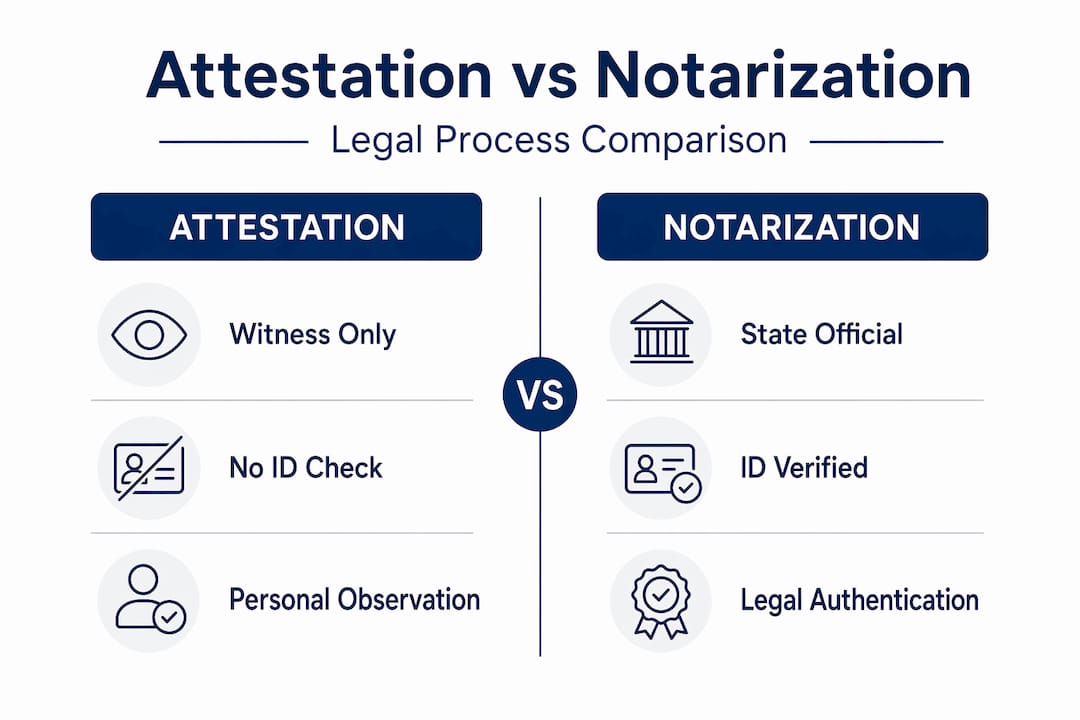
Attestation, by contrast, relies on the witness’s personal observation. There’s no identity check built into the process. The witness knows you signed because they were there. That’s powerful evidence, but it does not carry the same institutional weight as a notary’s certification.
Some contracts require both. In certain jurisdictions, a deed of sale or a mortgage agreement must be both notarized and witnessed by independent parties. Understanding attestation versus legalization is equally important when your document crosses international borders, where additional verification layers often apply.
Digital contract attestation and modern verification
The concept of attestation has migrated into the digital world, and it’s worth understanding how that works because it’s increasingly relevant for contracts signed online. Traditional attestation relies on physical presence. Digital attestation replaces physical presence with cryptographic proof.
Digital contract attestation uses cryptographic techniques like DSSE (Dead Simple Signing Envelope) and blockchain signatures to verify provenance and prevent blind signing. In practical terms, this means a digital system creates a mathematically verifiable record of exactly what document was signed, by whom, and when. Altering the document after signing breaks the cryptographic chain, making tampering detectable.
Blockchain-based attestation takes this further. Blockchain oracles enable verifiable attestation within minutes of trigger events like code merges, making them especially valuable in automated contract environments where human witnesses are not present.
One of the biggest problems digital attestation solves is blind signing. Blind signing means a person signs a document without fully understanding or even seeing the complete terms they’re agreeing to. It’s surprisingly common in digital workflows where contracts load as PDFs that few people actually read. Frameworks like ERC-8176 provide cryptographic attestation to ensure consent to the exact contract terms, tying the signer’s identity cryptographically to the specific document metadata.
The key benefits of digital attestation compared to traditional paper-based methods include:
Tamper-evident records that are mathematically verifiable
Timestamped signing events that can be audited independently
Elimination of geographic barriers (no need to be in the same room)
Reduced risk of signature disputes in cross-border agreements
Pro Tip: If you’re signing contracts digitally, check that the platform you use generates a cryptographically signed audit trail, not just an email confirmation. An email can be deleted; a cryptographic signature cannot be altered without detection.
How to attest a contract: the steps involved
Understanding the steps for contract attestation helps you avoid the common mistakes that create problems down the line. The process is more deliberate than most people expect.
Review the contract before signing. Pre-sign QA checklists help prevent risks related to ambiguous contract clauses before attestation. Read every clause. Check that names, dates, and figures are correct. A witness can only attest that you signed. They cannot fix an error you missed.
Select a qualifying witness. The witness must meet legal requirements for your jurisdiction. Typically this means an adult with no financial or personal stake in the contract. For UAE-based documents, who can attest documents varies based on the type of document and the authority involved.
Sign in the witness’s physical presence. Do not pre-sign the document and then ask the witness to sign later. The entire purpose of attestation is that the witness personally observes the act of signing. Signing beforehand defeats the legal basis for their testimony.
The witness signs immediately after. The witness adds their signature, full name, address, and sometimes their identification number or occupation, depending on the document type and local requirements.
Record any additional details required. Some documents require the date and place of signing to be formally noted. High-stakes documents, like wills or property deeds, may also require the witness to affirm that the signing party appeared to be of sound mind.
Pro Tip: If you’re preparing attestation papers for use in the UAE, confirm in advance whether your document type requires a single witness, two witnesses, or notarization in addition to attestation. Getting this wrong means starting over.
The most common pitfall is treating attestation as an afterthought. People focus on negotiating the contract and then rush the signing process. A challenged signature on a poorly attested document can cost far more in legal fees than the professional service that would have done it right the first time.
Why contract attestation actually protects you
The importance of contract attestation is not abstract. It produces concrete legal protections that matter when things go wrong.
Proper attestation strengthens enforceability and provides strong court evidence if authenticity is ever challenged. If someone claims they never signed an agreement, an attested document gives you a witness who can testify under oath about the circumstances of signing. That’s a fundamentally different position to be in compared to presenting an unwitnessed digital signature.
Contract attestation also reinforces that both parties understood what they were agreeing to at the time of signing. Courts have used the presence of a witness as supporting evidence that signing was not done under duress or confusion. For employment contracts, property transactions, and personal legal arrangements, this matters enormously.
Contract attestation doesn’t make an agreement unbreakable. What it does is remove the easiest avenues of attack. A properly attested contract closes the door on “I never signed that” and “I didn’t know what I was signing.” That’s not a small thing.
For Filipino expats navigating contracts in the UAE, attestation services for expats provide an additional layer of security by ensuring your documents meet the specific requirements of UAE authorities, not just the standards you’re familiar with from home.
My honest take on what people get wrong
I’ve worked with document attestation for a long time, and the most persistent mistake I see is people treating attestation as a formality rather than a safeguard. They rush through it. They ask whoever is nearby to sign. They assume the content of the contract is what protects them.
What I’ve learned is that the signing process itself is where legal protection actually gets built or destroyed. The content of a contract tells you what was agreed. Attestation tells you that agreement was real, deliberate, and made by the right people under clear conditions. Those are two different things, and both matter.
I’ve also watched people discover, too late, that a document they signed abroad does not meet the attestation requirements of the country where they’re trying to use it. A will attested in the Philippines, for example, does not automatically satisfy UAE legal standards. The requirements are specific, and the consequences of getting them wrong are severe.
My honest advice: treat attestation like you treat the contract itself. Give it proper attention, use qualified witnesses, and if you’re dealing with cross-border documents, get professional help. The cost of doing it right is always less than the cost of fixing it later.
— Harris
Get your contracts properly attested with Harrisncharms
Knowing what contract attestation means is one thing. Getting it done correctly for use in the UAE is another challenge entirely, especially for Filipino expats who may be navigating unfamiliar legal requirements for the first time.

Harrisncharms specializes in document attestation services for Filipino expats living and working in the UAE. Whether you’re dealing with employment contracts, property documents, or personal legal agreements, the team at Harrisncharms understands the specific requirements UAE authorities expect and knows how to meet them accurately. You don’t have to guess whether your attestation will hold up. Reach out to Harrisncharms and have your documents reviewed and processed by people who do this every day.
FAQ
What does contract attestation mean?
Contract attestation is the process of having a qualified third-party witness observe the signing of a contract and certify that the signing was genuine. It confirms the execution of a document, not the truth or validity of its contents.
Why is contract attestation needed?
Attestation is needed because it provides legal evidence that a contract was signed by the right parties under clear and voluntary conditions. It strengthens enforceability and gives courts a factual record if signature authenticity is ever disputed.
How is attestation different from notarization?
Attestation involves an impartial adult witness confirming they observed the signing. Notarization involves a state-commissioned notary who also verifies the signer’s identity and may administer an oath, making it carry greater legal weight.
Who can serve as a witness for contract attestation?
Witnesses must generally be adults aged 18 or older with no personal or financial interest in the contract’s outcome. Specific eligibility requirements vary by jurisdiction and document type.
Does digital contract attestation carry the same legal weight as traditional attestation?
Digital attestation using cryptographic methods is increasingly recognized in legal frameworks, though acceptance varies by jurisdiction. Blockchain-based systems provide tamper-evident records that can serve as strong evidence in disputes involving digitally executed agreements.
Recommended
Comments