
Why Attestation Delays Happen: A Guide for Expats

Attestation delays occur primarily because authorities require complete, accurate documents and a strict sequential verification process before they validate any certificate. For Filipino expats in the UAE, understanding why attestation delays happen is the difference between a smooth visa or employment process and weeks of frustrating restarts. The core problem is not bureaucracy alone. It is that each verification step depends on the one before it, so a single error early in the chain invalidates everything that follows. Knowing the specific causes puts you in control.
Why attestation delays happen: documentation errors
Incomplete or inaccurate documentation is the single most common cause of attestation delays. Missing pages, unclear photocopies, or data mismatches immediately halt the process until the applicant corrects and resubmits. This is not a technicality. Attestation officers are trained to reject anything that does not match exactly.
The most damaging errors are often the smallest ones. Spelling mistakes or mismatches in personal data, such as a name spelled differently across a passport, birth certificate, and degree, trigger secondary verification. That secondary check adds days or weeks to your timeline. Authorities apply strict matching standards, and even one character difference counts.

Outdated or physically damaged certificates create a separate problem. Some institutions refuse to attest documents that show visible wear, fading, or unofficial corrections. Handwritten amendments on printed certificates are almost always rejected outright.
Incomplete preparation and missing supporting papers hold up the process for days, and applicants outside major cities face even longer waits when they need to obtain replacement documents quickly. The distance from a government office or courier hub compounds every documentation error.
Pro Tip: Before submitting anything, lay all your documents side by side and cross-check every name, date, and ID number against your passport. One inconsistency across any document restarts the clock.
How does the sequential verification process cause delays?
The attestation process is a verification chain, not a checklist of independent tasks. Each office in the chain verifies the seal of the previous authority, not the document itself. That distinction matters enormously. If any earlier step is skipped or improperly completed, the next authority has nothing valid to verify and rejects the submission entirely.
The typical attestation workflow for Filipino expats moves through several stages, each with its own processing time.
Stage | Authority | Typical Processing Time |
1. University verification | Issuing institution | 3–10 business days |
2. State or national authentication | Home country government body | 5–15 business days |
3. Ministry of External Affairs | National foreign affairs office | 3–7 business days |
4. UAE Embassy attestation | UAE Embassy in home country | 5–14 business days |
5. UAE Ministry of Foreign Affairs | UAE MOFA | 2–5 business days |
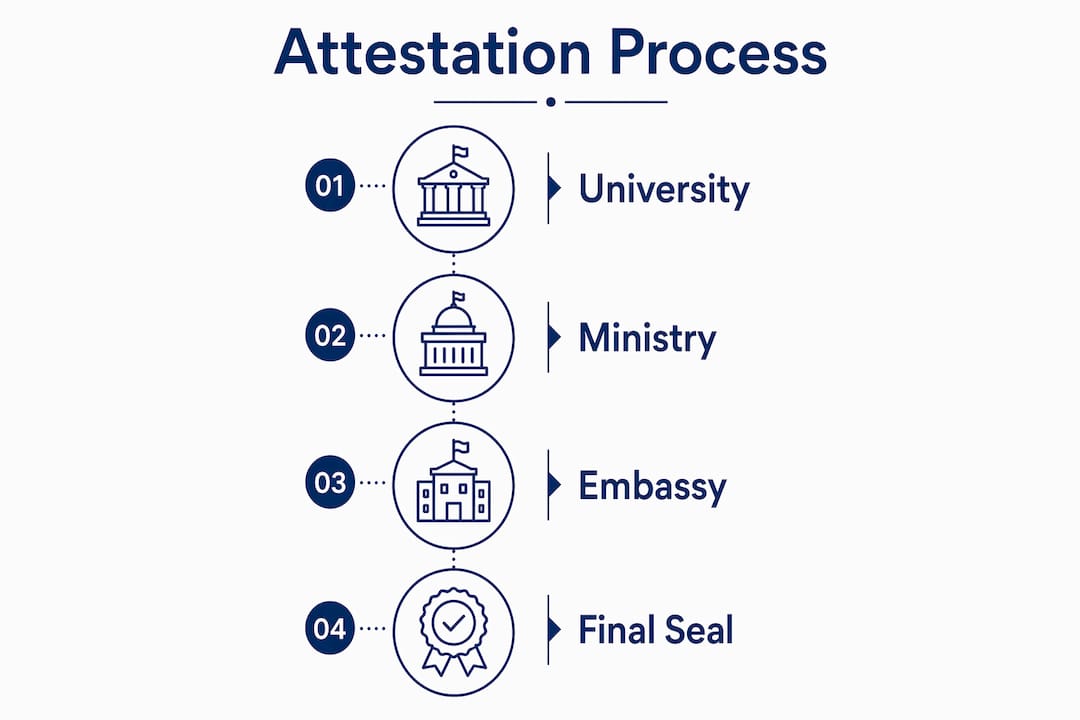
Most attestation delays occur at the university verification and UAE Embassy stages. University non-responsiveness is a well-documented bottleneck. Some institutions take weeks to confirm a degree, especially during semester breaks or administrative transitions. Embassy background verifications add another layer of unpredictability.
Missing prior verification such as Ministry of Foreign Affairs attestation prevents further processing entirely. Submitting documents to the UAE Embassy without the correct prior clearance does not just slow things down. It stops the process cold and forces a full restart from the stage where the sequence broke.
Formatting and sequence errors are flagged by attestation officers as grounds for rejection. A document submitted out of order, or with an authority’s stamp in the wrong position, gets sent back regardless of how accurate the underlying content is.
Pro Tip: Always confirm the exact required sequence with the UAE Embassy or a trusted attestation service before you submit. One phone call or email at the start saves weeks at the end.
What external and systemic factors cause attestation delays?
Some causes of frequent attestation delays are entirely outside your control. Understanding them helps you plan realistic timelines and avoid last-minute panic.
Peak season backlogs. High application volume during academic admissions cycles and foreign recruitment drives overwhelms government offices. Processing times that normally take one week can stretch to three or four during these periods.
University blacklisting or non-responsiveness. Institutions that are not recognized or are under review by UAE authorities create a separate category of delay. If your issuing university is flagged, the entire attestation process stalls pending additional investigation.
Digital system failures. HEC’s digital attestation system has been reported to cause tracking difficulties and slow processing for applicants. Digital platforms promise speed but introduce new failure points when they experience technical issues or lack real-time transparency.
Courier and logistical delays. Physical documents still move through postal and courier networks for many stages. Applicants in cities without a UAE Embassy or major government office face added transit time on every submission and return.
No expedited options. Not every attestation authority offers an emergency or priority processing lane. When urgent processing is unavailable, last-minute applications face unavoidable hold-ups with no workaround.
These systemic factors stack on top of documentation errors. A document with a minor name mismatch submitted during peak season, through a slow courier, to a university with a backlog, creates a compounding delay that can stretch from weeks into months.
How can you minimize or navigate attestation delays?
Preventing attestation delays requires preparation before you submit a single document. These steps address the most common causes directly.
Prepare complete, consistent documentation. Gather every required document and verify that names, dates, and ID numbers match exactly across all of them. Use clear, high-quality photocopies. Never submit a document with visible damage or handwritten corrections.
Verify institutional accreditation in advance. Confirm that your issuing university or institution is recognized by UAE authorities before starting the process. A quick check with the UAE attestation requirements for your document type prevents wasted effort.
Follow the exact attestation sequence. Treat the verification chain as non-negotiable. Submit to each authority in the prescribed order and collect each stamp before moving to the next stage. Skipping ahead always results in rejection.
Apply early. Build in a buffer of at least four to six weeks beyond your actual deadline. Peak seasons and institutional backlogs are predictable. Applying early is the only reliable way to absorb unexpected delays without missing critical dates.
Use a trusted service provider. Professional attestation services know the current requirements, accepted formats, and processing timelines for each authority. They catch errors before submission and manage follow-up communication on your behalf.
Track your application actively. Maintain contact with each verification authority. If a stage has been pending for longer than the typical processing window, follow up directly rather than waiting.
Pro Tip: Keep at least three certified copies and a full set of digital scans of every document. When a correction request comes in, you can respond the same day instead of waiting days for a new copy.
Key Takeaways
Attestation delays are almost always preventable when you understand the verification chain and prepare complete, consistent documentation before submission.
Point | Details |
Documentation accuracy is critical | Name mismatches, missing pages, and unclear copies halt the process immediately. |
Sequence cannot be skipped | Each authority verifies the previous seal; skipping a step forces a full restart. |
External factors add unpredictable time | Peak seasons, digital system failures, and courier delays compound any existing errors. |
Early submission prevents most crises | Applying four to six weeks ahead of your deadline absorbs institutional backlogs. |
Professional help reduces error risk | Experienced attestation services catch mistakes before submission and manage follow-up. |
What I’ve learned from watching attestation go wrong
The most frustrating cases I see are not the complicated ones. They are the straightforward applications that stall because of a single character difference in a name, or because someone submitted to the UAE Embassy before completing the Ministry of Foreign Affairs step. These are not obscure rules. They are the foundation of how the attestation verification chain works, and yet they catch people off guard constantly.
What I find genuinely useful to tell people is this: the attestation process is not designed to be difficult. It is designed to be sequential and verifiable. Every authority in the chain is confirming that the authority before it did its job correctly. When you understand that logic, the rules stop feeling arbitrary and start making sense.
The anxiety around attestation delays comes from uncertainty. People do not know where their documents are, why they were rejected, or how long the fix will take. That uncertainty is the real problem, not the process itself. Applicants who go in with a clear checklist, a realistic timeline, and a backup set of documents handle rejections as minor corrections rather than disasters.
For complicated cases, particularly those involving universities with slow verification departments or documents that have crossed multiple countries, professional assistance is not a luxury. It is the practical choice. The cost of a service provider is almost always less than the cost of a missed employment start date or a visa application restart.
— Harris
How Harrisncharms helps you avoid attestation setbacks
Filipino expats in the UAE face a specific set of attestation requirements that differ from other nationalities, and getting them wrong is costly.

Harrisncharms specializes in document attestation for Filipinos in the UAE, handling the full verification sequence from start to finish. The team reviews your documents for completeness and consistency before anything is submitted, which eliminates the most common causes of rejection. Harrisncharms also manages communication with verification authorities and tracks each stage on your behalf. If you are facing a delay right now or want to avoid one entirely, visit Harrisncharms to get started with a team that knows this process inside out.
FAQ
What is the most common reason for attestation delays?
Incomplete or inaccurate documentation is the leading cause. Missing pages, data mismatches, and unclear copies halt the process immediately until corrected.
Why does a small name spelling error cause such a long delay?
Attestation authorities apply strict matching standards across all documents. A spelling difference triggers secondary verification, which adds days or weeks to your processing time.
Can I skip a step in the attestation sequence to save time?
No. Each authority verifies the previous seal, not the document itself. Skipping a step invalidates the chain and forces a full restart from the point of the error.
How do peak seasons affect attestation processing times?
High application volumes during academic admissions and foreign recruitment periods overwhelm government offices. Processing times that normally take one week can extend to three or four weeks during these periods.
How early should I start the attestation process?
Start at least four to six weeks before your actual deadline. That buffer absorbs institutional backlogs, courier delays, and any correction requests without putting your visa or employment timeline at risk.
Recommended
Comments