
UAE Visa Attestation Guide for Filipino Expats 2026

UAE visa attestation is the official process of verifying and authenticating your documents to meet UAE government standards, and it is required for any Filipino expat seeking a valid work, residence, or family visa. The UAE Ministry of Foreign Affairs (MOFA) oversees this process, which confirms that signatures and official seals on your documents are genuine. Without completed attestation, your visa application will not move forward. This guide breaks down every step of the UAE visa attestation process, from home country authentication to final MOFA submission, so you know exactly what to do and in what order.
1. Understanding the UAE visa attestation guide: what it means and why it matters
UAE MOFA attestation verifies the authenticity of signatures and official seals on official documents through either a digital or courier process. This is not a formality. It is a legal requirement that UAE immigration authorities use to confirm your documents are real and issued by recognized institutions.
For Filipino expats, attestation applies to a wide range of documents: educational certificates for employment visas, birth and marriage certificates for family visas, and commercial documents for business-related permits. Each document type follows its own authentication path, which is why understanding the full process before you start saves you significant time and money.
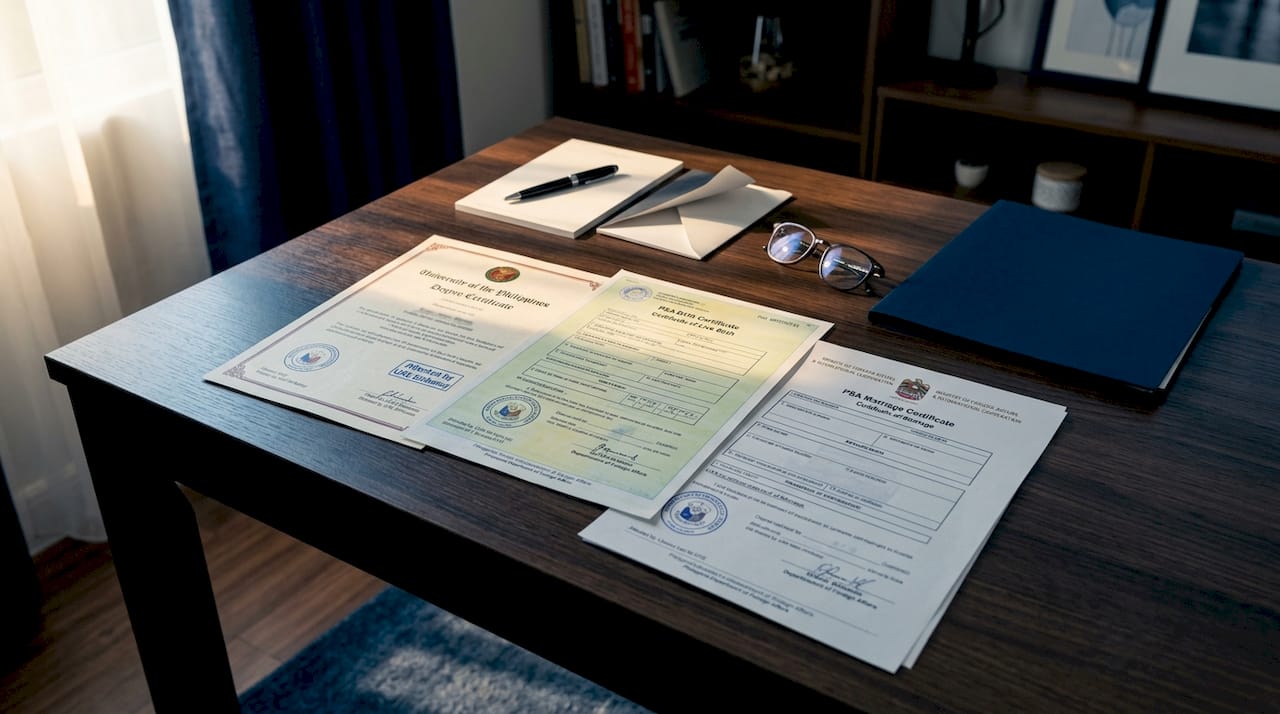
The two main bodies involved are MOFA and the UAE embassy or consulate in the Philippines. Both play distinct roles in the attestation chain, and skipping either one will result in rejection.
2. Two attestation methods: digital vs. courier
Digital attestation is restricted to UAE-issued digital documents that include a verification feature such as a QR code, barcode, or reference number. This is a critical distinction. If your document was issued outside the UAE or does not carry a digital verification mechanism, it does not qualify for digital attestation.
Courier-based attestation covers physical and non-digital documents. This is the route most Filipino expats will use for documents issued in the Philippines, including degrees, birth certificates, and marriage certificates. Here is how to determine which method applies to you:
Check the document’s origin: Was it issued by a UAE government body? If yes, check for a QR code or barcode.
Confirm the verification feature: A document without a scannable code or reference number is not digitally eligible.
Register via UAE Pass: Both methods require a UAE Pass account for registration and electronic payment.
Choose your route: Digital if eligible; courier if the document is physical or foreign-issued.
Pro Tip: Confirm digital eligibility before you pay any fees. Submitting a non-eligible document through the digital channel wastes your payment and delays your visa application.
3. Step-by-step guide to the attestation process for Filipino expats
The full attestation workflow for employment or family visas follows a multi-level authentication chain. Each step must be completed in sequence.
Notarize your document in the Philippines. Have your document notarized by a licensed Philippine notary public. This is the foundation of the entire chain.
Authenticate with the Philippine government. Submit your notarized document to the Department of Foreign Affairs (DFA) in the Philippines for authentication. The DFA places an apostille or red ribbon certification on eligible documents.
Attest at the UAE Embassy in Manila. Bring your DFA-authenticated document to the UAE Embassy in Manila for embassy attestation. This step confirms the document meets UAE diplomatic standards.
Register on the MOFA portal using UAE Pass. Once in the UAE, log in to the MOFA attestation portal using your UAE Pass account. UAE Pass is the official digital identity platform for UAE residents.
Pay the attestation fee online. The standard MOFA fee is AED 150, payable via credit card, debit card, Samsung Pay, or Apple Pay. Fee amounts can vary by document type, so check the MOFA portal for your specific document.
Submit your document. For digital attestation, upload your document through the portal. For courier-based attestation, send your physical document to the designated MOFA service center.
Receive your reference number. After submission, MOFA sends a confirmation message with a reference number. Keep this number. You will need it to track your application.
Wait for processing. Digital attestation is completed within 2 hours during official working hours. Courier-based attestation takes 1 to 3 working days, sometimes longer depending on document volume.
Collect or receive your attested document. Digital attestation results are delivered electronically. Courier-based documents are returned via the same courier service used for submission.
Pro Tip: Save your MOFA reference number in a dedicated folder or notes app. Filipino expats managing multiple document submissions often lose track of individual reference numbers, which makes follow-up calls to MOFA much harder.
4. Which documents require attestation for UAE visa purposes
Both personal and educational documents are commonly attested for UAE visa purposes, and each category follows a tailored attestation path. Knowing which category your document falls under prevents you from submitting it through the wrong channel.
Educational documents include:
University degrees and diplomas
Academic transcripts
Professional certificates and trade qualifications
Personal documents include:
Birth certificates (required for dependent and family visas)
Marriage certificates (required for spouse visas)
Divorce decrees (if applicable for legal status changes)
Commercial and legal documents include:
Power of attorney documents
Business registration certificates
Employment contracts requiring legal authentication
Filipino expats also need to account for Arabic translation requirements. Any document not originally in Arabic must be translated by a UAE-approved legal translator before MOFA will process it. Using an unapproved translator is one of the most common reasons for rejection.
Watch out for these frequent mistakes:
Submitting laminated originals (MOFA cannot process laminated documents)
Skipping the DFA authentication step in the Philippines
Using expired documents or documents with outdated personal information
Submitting documents without the required Arabic translation
For a full breakdown of 2026 attestation requirements tailored to Filipino expats, including updated document checklists, that resource covers the latest changes in detail.
5. Digital vs. courier attestation: a direct comparison
Choosing between digital and courier attestation comes down to your document type, your timeline, and your tolerance for logistics. Here is a side-by-side comparison:
Factor | Digital attestation | Courier-based attestation |
Eligible documents | UAE-issued digital docs with QR/barcode | Physical or foreign-issued documents |
Processing time | Within 2 hours (working hours) | 1 to 3 working days or more |
Document handling | Fully paperless | Physical document required |
Fee | AED 150 (varies by document) | AED 150 plus courier costs |
Delivery method | Electronic | Physical return via courier |
Best for | UAE-issued certificates, digital records | Philippine-issued degrees, certificates |
The MOFA eDAS 2.0 platform uses AI to process compatible digital attestation requests within minutes, which makes it significantly faster than any manual process. For Filipino expats, however, most documents originate in the Philippines and are physical, which means the courier route remains the practical reality for the majority of submissions.
Courier attestation requires planning. Factor in shipping time to and from the MOFA service center, plus the 1 to 3 day processing window. If you are working against a visa application deadline, start the courier process at least two weeks before you need the attested document in hand.
6. Fees, payment, and tracking your attestation status
The standard MOFA attestation fee is AED 150 per document, payable through the MOFA portal using credit cards, debit cards, Samsung Pay, or Apple Pay. Some document categories carry different fees, so always verify the exact amount on the MOFA portal before submitting payment.
After payment, MOFA generates a reference number tied to your submission. This number is your tracking tool. You can use it on the MOFA portal to check the current status of your attestation. For courier submissions, your courier tracking number works alongside the MOFA reference number to monitor physical document movement.
If your attestation is rejected, MOFA will notify you with a reason. Common rejection reasons include missing authentication steps, incorrect document format, and non-compliant translations. Addressing the specific rejection reason and resubmitting is faster than starting the process over from scratch.
7. How to avoid the most common attestation delays
Skipping home country authentication, submitting incorrect document formats, sending laminated originals, and using unapproved translators are the four leading causes of attestation delays. Each one is entirely preventable with preparation.
The MOFA attestation portal separates digital and courier routes clearly, but many applicants choose the wrong route because they did not check document eligibility first. Confirming eligibility before registration takes five minutes and can save you weeks of back-and-forth.
For Filipino expats preparing documents from the Philippines, the DFA authentication step adds time to the process. DFA processing in the Philippines can take several days to several weeks depending on the volume of applications and whether you use the regular or expedited service. Build this into your timeline before you even register on the MOFA portal.
For a detailed walkthrough on preparing your attestation papers correctly from the Philippine side, that guide covers the DFA process and common formatting errors in full.
Key takeaways
UAE visa attestation requires completing a sequential authentication chain from Philippine notarization through DFA, UAE Embassy, and final MOFA submission, with document type determining whether digital or courier processing applies.
Point | Details |
Choose the right method first | Confirm digital eligibility before registering to avoid wasted fees and delays. |
Follow the full authentication chain | Philippine notarization, DFA authentication, UAE Embassy attestation, then MOFA submission. |
Know your document category | Educational, personal, and commercial documents each follow different attestation paths. |
Track with your reference number | Save your MOFA reference number immediately after submission to monitor status. |
Plan for courier timelines | Courier-based attestation takes 1 to 3 working days plus shipping time on both ends. |
What I have learned from years of watching Filipino expats navigate attestation
The single most expensive mistake I see Filipino expats make is starting the MOFA process before their Philippine documents are fully authenticated. They register on the portal, pay the fee, and then realize their DFA step is incomplete. The fee is not refunded. The process restarts. That is a week or more lost, sometimes right before a visa deadline.
The second pattern I notice is overconfidence about digital eligibility. People assume that because a document looks official and has a stamp, it qualifies for digital attestation. It does not. The document must be UAE-issued and carry a scannable verification feature. Philippine-issued documents, no matter how official, go through the courier route. Every time.
My honest advice: treat the attestation process like a project with a checklist, not a single task. Map out every step, confirm the document type, verify translation requirements, and build in buffer time for the Philippine authentication leg. If you are managing multiple documents for a family visa application, track each one separately with its own reference number and submission date.
One more thing: use only the official UAE Pass channel for registration and payment. Fraudulent attestation services targeting Filipino expats do exist, and they collect fees without submitting anything to MOFA. If a service asks you to pay outside the official MOFA portal, walk away.
— Harris
Let Harrisncharms handle your attestation paperwork
Navigating the UAE visa attestation process while managing work and family responsibilities is genuinely difficult. Harrisncharms specializes in document attestation services for Filipino expats in the UAE, covering everything from document verification and Arabic translation coordination to MOFA portal submission and status tracking.

Whether you need help with a single degree certificate or a full set of family visa documents, Harrisncharms provides hands-on support at every stage of the attestation process. The team follows up directly with MOFA on your behalf and keeps you updated so you are never left guessing about your document status. Reach out to Harrisncharms today for a personalized consultation and get your attestation done right the first time.
FAQ
What is UAE visa attestation?
UAE visa attestation is the official process of verifying and authenticating documents to confirm their legitimacy for UAE immigration purposes. MOFA oversees the process, which applies to educational, personal, and commercial documents.
How long does UAE attestation take?
Digital attestation is completed within 2 hours during official working hours. Courier-based attestation takes 1 to 3 working days, not counting shipping time.
What documents do Filipino expats need to attest?
Filipino expats commonly attest university degrees, birth certificates, and marriage certificates for work and family visas. Each document type follows a specific authentication path through the DFA, UAE Embassy, and MOFA.
What is the MOFA attestation fee?
The standard MOFA attestation fee is AED 150 per document, payable via credit card, debit card, Samsung Pay, or Apple Pay through the official MOFA portal.
Can I attest a Philippine-issued document digitally?
No. Digital attestation applies only to UAE-issued digital documents with a QR code, barcode, or reference number. Philippine-issued documents must go through the courier-based attestation process.
Recommended
Comments