
UAE academic certificate attestation guide for Filipino expats
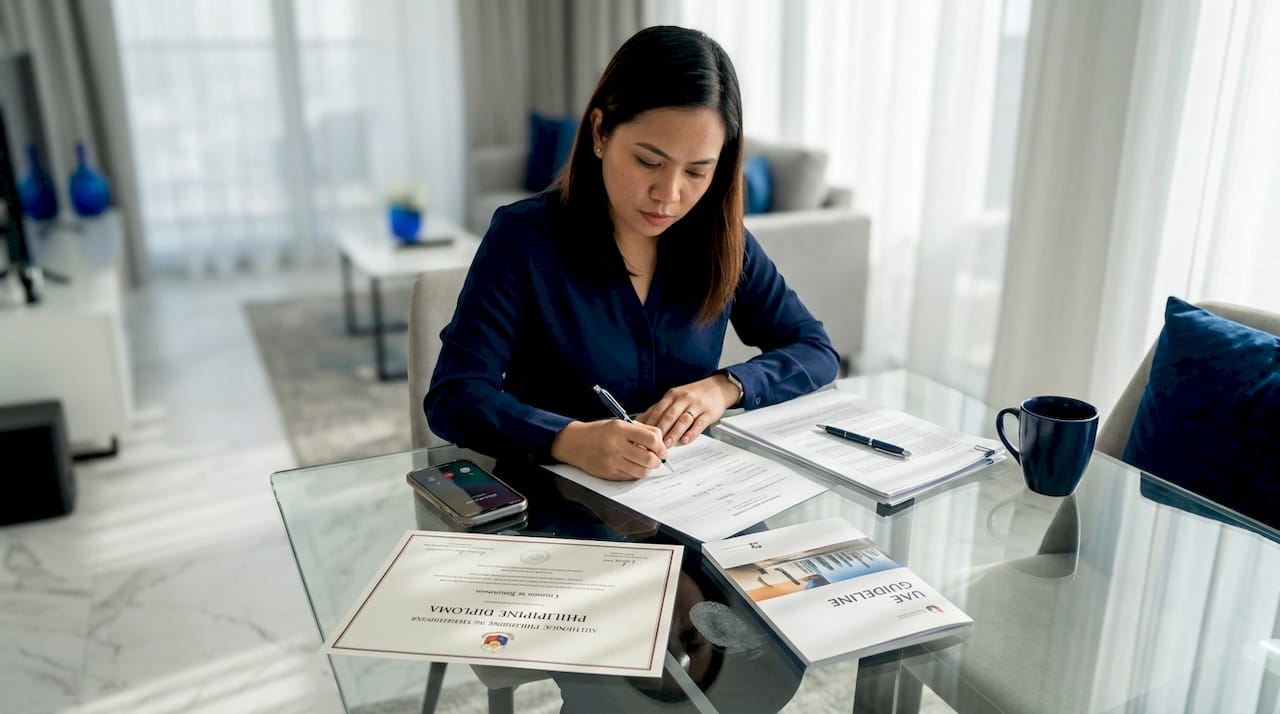
Many Filipino expats arrive in the UAE with a degree, a diploma, and the assumption that a quick apostille stamp back home is all they need. Then reality hits: the employer asks for MOFA attestation, the university requires embassy verification, and suddenly a process that seemed simple becomes a maze of offices, fees, and waiting periods. Attestation of Philippine-issued degrees, diplomas, and transcripts is a multi-step chain, and skipping even one link in that chain can cost you a job offer or a university admission.
Table of Contents
What is academic certificate attestation and why does it matter?
Step-by-step guide: Attesting your Philippine-issued academic documents
Apostille vs. full attestation: Why the UAE still requires more
Where to get your documents attested: Offices, consulates, and practical tips
What most Filipino expats get wrong about attestation—and how to avoid it
Key Takeaways
Point | Details |
Attestation is essential | Proper academic certificate attestation is required for Filipino expats aiming to work or study in the UAE. |
The process is multi-step | Attestation usually involves several authorities, including DFA, UAE Embassy, and MOFA. |
Apostille isn’t always enough | Even after the Hague Convention, UAE employers often need embassy and MOFA stamps on Philippine documents. |
Start attestation in the Philippines | For Philippine academic certificates, the process must begin in the Philippines, not at UAE consulates. |
What is academic certificate attestation and why does it matter?
At its core, academic certificate attestation is the official process of getting your educational documents verified and recognized by the relevant authorities so they carry legal weight in a foreign country. In the UAE context, this means getting your Philippine school, college, or university credentials validated through a series of government bodies before an employer or school here will accept them.
UAE employers take this seriously. When a hospital hires a Filipino nurse, or a construction company brings in a Filipino engineer, or a school recruits a Filipino teacher, they need proof that the degree is genuine and that it came from an accredited institution. Without proper attestation, there is no reliable way to confirm this. The UAE government requires this process to protect both employers and the integrity of its labor market.
The consequences of skipping or improperly completing attestation are real. Your job application can be rejected outright. A university may deny your enrollment. In some professions, working without properly attested credentials can even create legal complications under UAE labor law. It is not a bureaucratic formality you can skip and fix later.
The major types of documents that typically require attestation include:
Bachelor’s degree or master’s degree certificates from Philippine universities
Diplomas from vocational schools or colleges (TESDA certificates included in some cases)
Official transcripts of records required by UAE universities for admission
Senior high school diplomas when required for entry-level positions
As this attestation guide for UAE expats explains, the process differs depending on what type of document you have and what purpose it will serve.
A note on apostille: Many Filipinos assume that because the Philippines joined the Hague Convention and the UAE did too, an apostille stamp is the finish line. In reality, for most employment and education cases in the UAE, apostille is just the beginning.
Now that you know why this process is so important, let’s look at how it actually works.
Step-by-step guide: Attesting your Philippine-issued academic documents
The process for getting your Philippine academic documents attested for use in the UAE follows a specific sequence. You cannot rearrange the steps. Doing them out of order means starting over, which wastes both time and money.
Here is the correct sequence:
Get your document authenticated by your school or university. The institution that issued your degree or diploma must first certify that it is genuine. For older graduates, this may require contacting your school’s registrar office in the Philippines.
Authenticate through the Philippine government (DFA Apostille). The Department of Foreign Affairs (DFA) in the Philippines issues an apostille stamp, which is the official authentication that your document is a genuine Philippine government or school record. You can do this in person at a DFA regional office or through an authorized courier service.
Submit to the UAE Embassy in Manila. After the DFA apostille, your document goes to the UAE Embassy in the Philippines for their authentication stamp. This step confirms the UAE’s recognition of the Philippine government’s authentication.
Final MOFA attestation in the UAE. Once you arrive in the UAE (or through a representative), the document goes to the Ministry of Foreign Affairs (MOFA) for the final stamp. This is the last step and the one that makes your credential fully recognized by UAE employers and institutions.
Here is a realistic breakdown of processing times at each stage:
Stage | Authority | Typical Processing Time |
School/university certification | Issuing institution | 1 to 5 business days |
DFA Apostille (Philippines) | Department of Foreign Affairs | 3 to 15 business days |
UAE Embassy authentication (Manila) | UAE Embassy Philippines | 5 to 25 business days |
MOFA attestation (UAE) | Ministry of Foreign Affairs UAE | 3 to 7 business days |
Total estimate | All stages combined | 2 to 8 weeks |
The wide range in total time depends heavily on how busy each office is, whether you use express services, and whether your documents have any issues that require correction.
Pro Tip: Request multiple certified true copies of your diploma and transcript from your school before starting the process. Attestation involves original documents being handled by multiple offices, and having extras means you are protected if something gets delayed or lost.
Before you begin, review the school document attestation steps to make sure you have everything organized. Also, read up on preparing attestation papers so you do not show up at any office missing a required form or photocopy.
Common pitfalls that trip up first-time applicants include submitting documents with a missing signature from the registrar, going to the UAE Embassy before completing the DFA apostille step, or bringing photocopies when originals are required. These mistakes do not just cause delays. They can reset the entire process.
With the process outlined, it is important to understand nuances that trip up many applicants.
Apostille vs. full attestation: Why the UAE still requires more
This is where a lot of Filipino expats get confused, and honestly, the confusion is understandable. The UAE officially joined the Hague Apostille Convention in 2022. The Philippines has been part of it for years. So logically, you might think: apostille from the Philippines should be enough, right?
Not always. And this is a critical distinction.
The Hague Convention makes it easier to authenticate documents between member countries by replacing lengthy embassy chains with a single apostille stamp. In theory, a Philippine DFA apostille should be accepted in the UAE without further embassy verification. But in practice, UAE-specific rules, especially those from the Ministry of Education (MOE) and certain employers, still require the full chain including UAE Embassy authentication and MOFA attestation.
Here is a side-by-side comparison to make it clearer:
Factor | Apostille only | Full attestation (Embassy + MOFA) |
Required by UAE universities | Often not sufficient | Usually required |
Required by UAE employers | Depends on the sector | Required in most regulated sectors |
Processing complexity | Simpler, fewer steps | More steps, more time |
Legal standing in UAE | Limited in practice | Full recognition |
Post-2022 rule changes | Partial applicability | Still required in most cases |
As Gulf News reported on degree recognition, while the apostille system technically applies after the UAE joined the Hague Convention, full embassy and MOFA attestation is still required for the majority of Philippine-to-UAE credential cases due to specific UAE institutional rules.
Pro Tip: Do not assume the rules from two years ago still apply today. UAE MOFA and the Ministry of Education update their requirements regularly. Before starting your attestation process in 2026, confirm the current rules directly with MOFA or through a trusted service provider who tracks these changes.
The safest approach is to always complete the full chain: DFA apostille, UAE Embassy Manila, then MOFA UAE. Even if an apostille alone might technically be sufficient in a specific case, going the full route protects you from rejection and avoids the need to redo steps later.
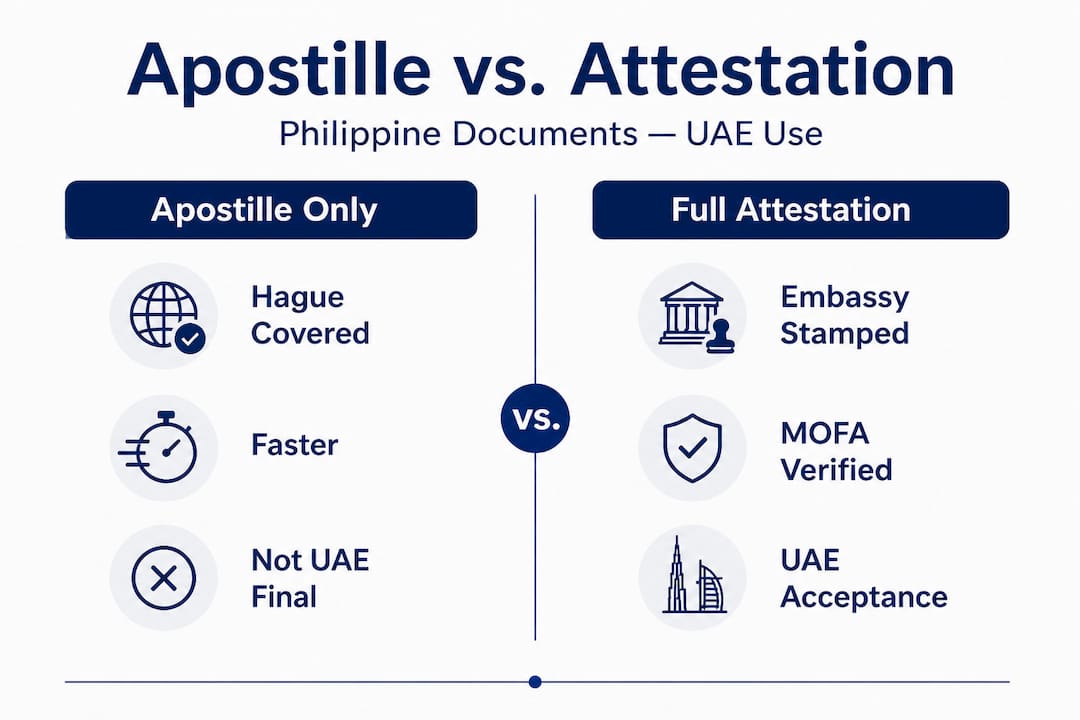
If you want a clear breakdown of apostille vs. attestation and what each one actually covers, that resource breaks down the practical differences in plain language.
Once you understand the required steps and why they are needed, knowing where to go locally in both the Philippines and the UAE is next.
Where to get your documents attested: Offices, consulates, and practical tips
One of the most persistent misconceptions among Filipino expats in the UAE is thinking they can walk into the Philippine Consulate General in Dubai or Abu Dhabi and get their Philippine degree attested for UAE use. This is not how it works.
Here is the role each office plays:
DFA (Philippines): Issues the apostille stamp on your Philippine-issued documents. This is your starting point for all Philippine academic credentials.
UAE Embassy in Manila: Authenticates documents that already carry the DFA apostille. This step happens in the Philippines before you bring your documents to the UAE.
UAE MOFA (in the UAE): The final authentication step once you are in the UAE. This is what makes your document officially recognized by UAE authorities and institutions.
Philippine Consulate in Dubai or Abu Dhabi: Handles notarial services and attestation of UAE-issued documents for use in the Philippines, not the other way around.
As the DFA Dubai PCG makes clear, Philippine Consulates in UAE primarily attest UAE-originated documents for Philippine purposes. If you are trying to use a Philippine degree in the UAE, the attestation chain starts in the Philippines, not here.
Important: Do not waste a trip to the consulate in Dubai expecting them to stamp your diploma for your UAE employer. It will not work, and you will have to restart the process from Manila.
Practical tips for navigating these offices:
Schedule DFA appointments early. DFA regional offices in Manila and other cities are often booked weeks in advance. Use their online system as soon as possible.
Bring complete document sets. Each office typically requires the original document plus two to three photocopies, a valid ID, and sometimes a cover letter stating the purpose of attestation.
Factor in travel time if you are already in the UAE. Most of the early steps require someone physically present in the Philippines. Many expats coordinate with a family member or use a document processing agency to handle the Manila-side steps.
Budget realistically. Each stage has fees. The DFA apostille, UAE Embassy authentication, and MOFA attestation all carry separate charges, plus courier fees if you are not in the Philippines yourself.
For a complete breakdown of who can attest documents in the UAE and what each authority can and cannot do, that guide is worth reading before you make any trips.
You have learned the process, the differences, and where to go. Now let us wrap with a focus on successful applications and key reminders.
What most Filipino expats get wrong about attestation—and how to avoid it
We have processed and guided hundreds of attestation cases for Filipino expats across the UAE. The most avoidable mistakes are not the complicated ones. They are the simple assumptions that nobody bothered to verify.
The biggest one: “My apostille is enough.” This assumption is responsible for more rejected job applications than any other single mistake. Apostille is a legitimate and important part of the process, but it is the beginning, not the end. Walking into a UAE employer’s HR department with only a DFA apostille stamp on your diploma and expecting it to be accepted is like bringing half a completed application and wondering why it was not approved.
The second most common mistake is doing the steps out of sequence. Some applicants, trying to save time, submit documents to UAE MOFA before completing the UAE Embassy stage in Manila. MOFA will not process documents that have not gone through the proper prior authentication. You end up going back to the start, losing weeks in the process.
There is also a real cost to not checking for updates. UAE attestation requirements are not static. What was accurate in 2023 or 2024 may have specific differences in 2026. The Ministry of Education and MOFA do issue updated circulars. If you are relying on advice from a friend who went through the process two years ago, you could be following outdated steps. Checking the latest attestation rule changes before you start saves you from unpleasant surprises mid-process.
The honest truth is that the attestation process is manageable. It is not impossibly complex. But it does require you to follow the sequence correctly, bring the right documents, and verify requirements at each stage. Cutting corners does not make the process faster. It makes it longer, because you have to repeat steps. The Filipinos who complete attestation smoothly are the ones who prepared thoroughly, confirmed the current rules, and either did it properly themselves or worked with people who knew the process well.
Need expert help with your attestation journey?
Navigating the attestation process on your own is possible, but it takes time, careful coordination between offices in two countries, and constant checking that requirements have not changed. For many Filipino expats juggling work and family responsibilities here in the UAE, that is a significant challenge.

Our team at harrisncharms.com specializes in document attestation support for Filipino expats across the UAE. We stay on top of the latest 2026 MOFA and UAE Embassy requirements so you do not have to. Whether you need guidance on exactly what to prepare, help coordinating the Manila-side steps, or full end-to-end attestation support services, we are here to make the process straightforward. Reach out today to avoid the delays that come from guesswork, and get your credentials recognized faster.
Frequently asked questions
How long does academic certificate attestation take for Filipinos in the UAE?
With standard processing, attestation typically takes 2 to 8 weeks depending on the authority, current queue times, and whether you use express or standard services.
Is an apostille enough for my diploma to be used in the UAE?
In most cases, no. Despite the UAE joining the Hague Convention in 2022, UAE-specific rules still require full embassy and MOFA attestation for Philippine academic documents, so always verify with MOFA or the Ministry of Education before assuming apostille alone is sufficient.
Can I attest my Philippine degree at the Philippine Consulate in Dubai or Abu Dhabi for UAE use?
No. Philippine Consulates in UAE handle UAE-issued documents for Philippine use, not the attestation of Philippine academic credentials for employment or study in the UAE. That process begins with the DFA in the Philippines.
What documents need to be attested for jobs or university in the UAE?
Typically, your degrees, diplomas, and transcripts from Philippine institutions must all be attested if you are applying for regulated employment or university enrollment in the UAE.
Recommended
Comments