
The Role of Notary in Attestation: UAE 2026 Guide
- contact335627
- Jun 5
- 8 min read

A notary public is a government-appointed officer who verifies signer identities, witnesses signatures, and authenticates documents as the legally required first step in the UAE attestation process. Without this foundational act, no document can advance through the legalization chain that ends with UAE Ministry of Foreign Affairs (MOFA) approval. For Filipino expats and businesses operating in the UAE, understanding the role of notary in attestation is not optional. It is the difference between documents that work and documents that get rejected.
What the role of notary in attestation actually covers
The notary public’s responsibilities in the attestation process are precise and legally defined. A notary verifies signer identity, witnesses signatures, and certifies document copies. These are not administrative formalities. Each act carries legal weight that downstream authorities, including MOFA and foreign embassies, rely on entirely.
Identity verification and personal appearance
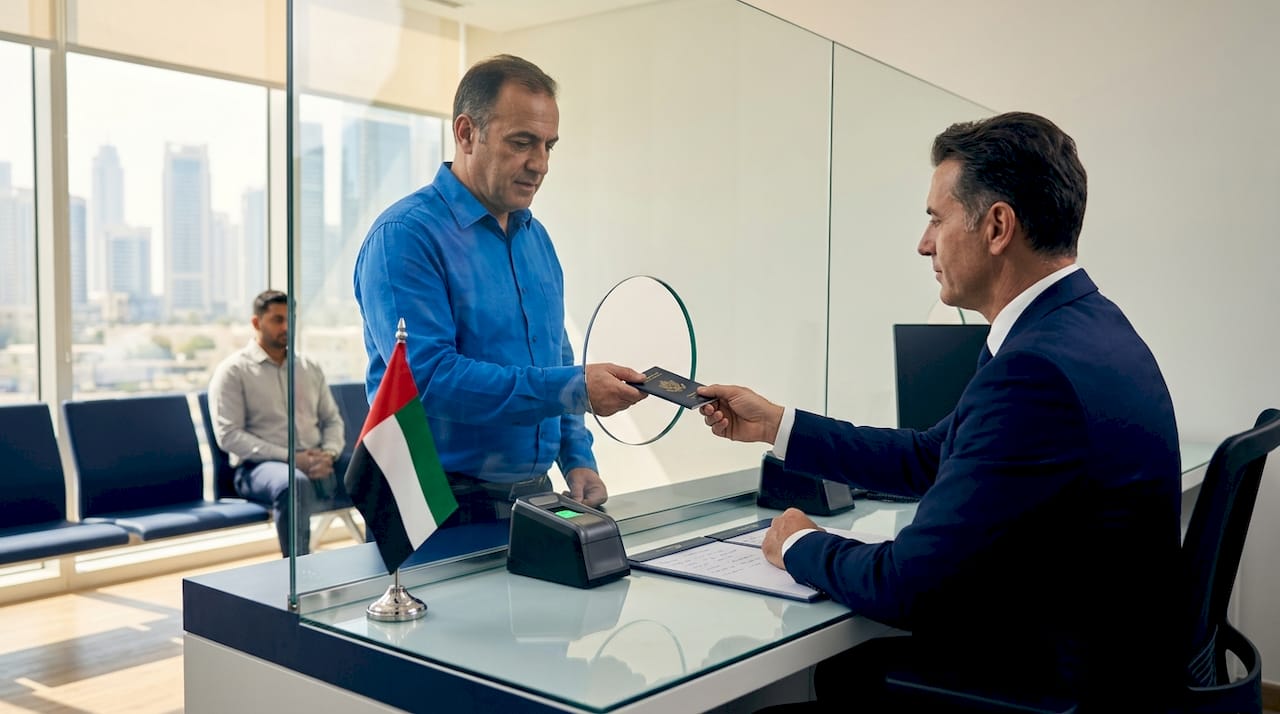
The notary’s first duty is confirming that the person signing a document is exactly who they claim to be. This requires the signer to appear in person before the notary. The notary examines government-issued identification, checks that the person is signing willingly, and confirms they understand what they are signing. This personal appearance requirement is what separates notarization from a simple signature witnessed by a colleague or friend.
Types of notarial acts: acknowledgments vs. jurats
Two notarial acts cover most attestation situations, and choosing the wrong one can invalidate a document entirely.
Acknowledgment: The signer confirms to the notary that a signature on the document is their own. The signature may have been made earlier. The notary certifies the signer’s identity and voluntary act, not the truthfulness of the document’s contents.
Jurat: The signer must sign in the notary’s presence and swear or affirm that the document’s contents are true. This is used for affidavits and sworn statements.
Certified true copy: The notary compares an original document to a copy and certifies the copy is accurate. This is common for passports, diplomas, and birth certificates submitted for UAE attestation.
Pro Tip: You, not the notary, must specify which notarial act you need. A notary cannot decide the act type for you, as doing so would constitute unauthorized legal advice. If you are unsure, consult a legal professional or a document attestation specialist before your notary appointment.
The notary’s impartiality is the foundation of their authority. They have no stake in the transaction, no relationship with either party, and no interest in the document’s outcome. This neutrality is precisely why government bodies and foreign authorities accept notarized documents as credible.
How does notarization differ from attestation in the UAE?
These two terms are used interchangeably in casual conversation, but they describe distinct legal acts with different scopes and authorities involved.
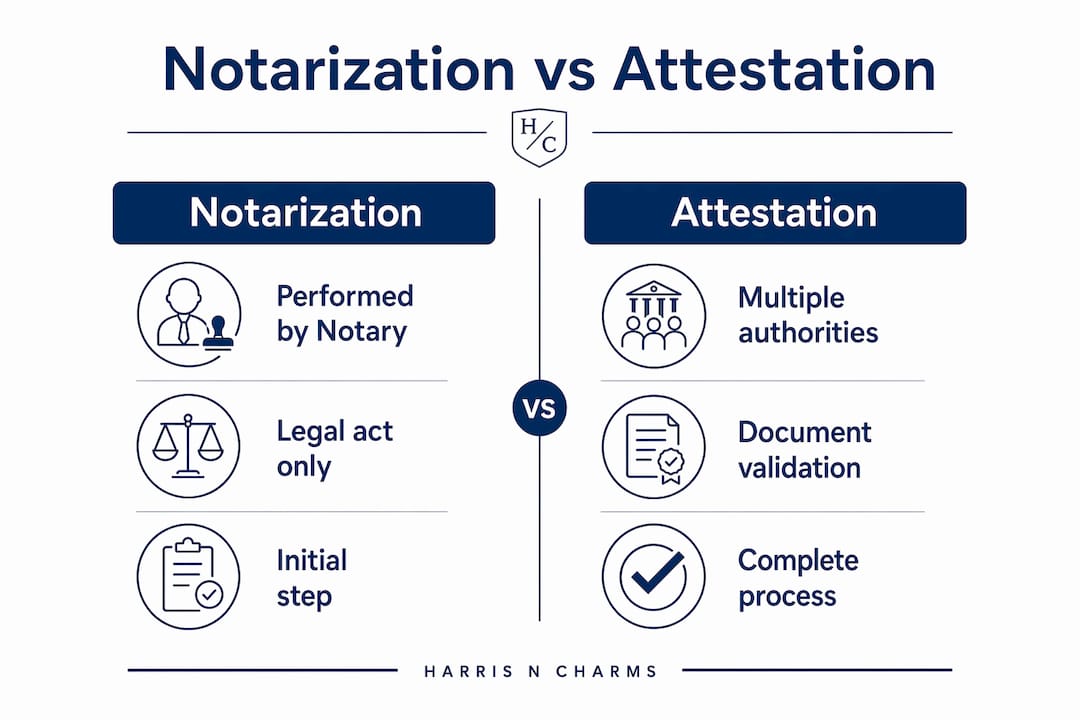
Notarization is a specific legal act performed exclusively by a government-appointed notary public. Attestation is a broader process of certifying a document’s authenticity, and it can be performed by multiple authorities across multiple countries. In the UAE context, attestation is the entire multi-step chain. Notarization is step one of that chain.
Feature | Notarization | Attestation |
Who performs it | Government-appointed notary public only | Notaries, government departments, embassies, MOFA |
Scope | Verifies signer identity and signature authenticity | Certifies overall document authenticity for official use |
Legal act type | Single, specific act with defined certificate wording | Multi-layered process involving sequential validations |
Sufficient for UAE use | No. It is the first step only | Yes, when all required layers are completed |
Common documents | Affidavits, powers of attorney, certified copies | Educational certificates, birth certificates, commercial documents |
The UAE attestation sequence follows a fixed order. A document is notarized in the home country first. It then goes through home country government authentication, followed by UAE embassy or consulate legalization in that country. The final step is MOFA attestation in the UAE. MOFA cannot validate a document without the prior notary and embassy steps already completed. Each layer depends on the one before it.
This distinction matters practically. A Filipino expat submitting a birth certificate for family visa purposes cannot simply have it notarized and present it to UAE authorities. The document must travel through the full chain: notarization, Philippine Statistics Authority authentication, UAE Embassy in Manila legalization, and then MOFA attestation in the UAE. Skipping or misordering any step means starting over.
For commercial documents, the sequence is similar but may involve the Department of Trade and Industry or the Philippine Chamber of Commerce before embassy legalization. The notary step remains the starting point regardless of document type.
What is the step-by-step notarization and attestation workflow?
The UAE attestation process in 2026 follows a structured sequence that begins with the notary and ends with MOFA. Here is how it works in practice for personal documents originating from the Philippines:
Notarization in the Philippines. You appear before a notary public with your original document and valid identification. The notary performs the appropriate notarial act, affixes their seal, and signs the notarial certificate. This is the foundational step that all subsequent authorities rely on.
Authentication by the Department of Foreign Affairs (DFA) in the Philippines. The DFA verifies the notary’s credentials and authenticates the document for international use. This step confirms the notary was legitimate and properly commissioned.
Legalization by the UAE Embassy in Manila. The UAE Embassy reviews the DFA-authenticated document and applies its own legalization stamp, confirming the document meets UAE requirements for foreign documents.
MOFA attestation in the UAE. Once the document arrives in the UAE, it is submitted to the Ministry of Foreign Affairs for final attestation. MOFA’s digital portal now allows online attestation certificate issuance, reducing processing time significantly.
Submission to the requesting authority. The fully attested document is now accepted by UAE government departments, courts, employers, and educational institutions.
Pro Tip: Bring certified true copies of your documents to the notary appointment rather than originals whenever possible. If an original is required, keep a notarized copy as a backup. Lost originals mid-process can delay your attestation by weeks.
One common pitfall is assuming that a document notarized in the UAE by a UAE notary public is equivalent to one notarized in the Philippines. For documents originating in the Philippines, the notarization must happen there first. UAE notaries handle documents that originate in or are intended for use within the UAE legal system. Mixing up jurisdiction is one of the most frequent errors Harrisncharms encounters with new clients.
The attestation guide for Filipino expats covers document-specific sequences in detail, including which documents require full attestation versus which may qualify for simplified legalization routes.
Why is the notary’s role essential in preventing fraud?
The notary functions as the first and most critical fraud prevention checkpoint in the entire attestation chain. Every authority that handles the document after the notary trusts that the notary’s verification was thorough and accurate.
Identity fraud prevention. By requiring personal appearance and government-issued ID, the notary eliminates the possibility of someone signing on another person’s behalf without authorization.
Signature fraud prevention. The notary witnesses signatures or verifies that existing signatures belong to the identified person. Forged signatures cannot pass this check.
Document alteration prevention. The notary’s seal and certificate are tied to the document at a specific point in time. Any alteration after notarization is detectable and invalidates the notarial certificate.
Incorrect act prevention. Using the wrong notarial act, such as an acknowledgment when a jurat is required, can render a document legally invalid. A qualified notary explains the difference and ensures the correct certificate wording is used.
“Only a government-appointed notary public can perform notarization, and this appointment carries direct legal responsibility for the accuracy of every act performed.”
The legal consequences of improper notarization are serious. A document with an incorrect notarial act or a notary who failed to verify identity properly can be challenged in court, rejected by MOFA, or refused by a UAE employer or educational institution. For Filipino expats whose visa status, employment, or family reunification depends on attested documents, a rejected document is not just an inconvenience. It can mean months of delays and significant financial cost.
Pro Tip: Always verify a notary’s commission status before your appointment. In the Philippines, the Integrated Bar of the Philippines maintains records of commissioned notaries. In the UAE, notaries are appointed through the UAE Ministry of Justice. Using an unregistered or lapsed notary produces documents that no authority will accept.
The document legalization vs. attestation guide explains how each step in the chain depends on the integrity of the notary’s work.
Key takeaways
The notary public is the foundational authority in the UAE attestation chain, and no document can achieve full legal recognition without a properly executed notarial act as its first step.
Point | Details |
Notary is step one | Notarization precedes all other attestation steps, including DFA, embassy, and MOFA. |
Two core notarial acts | Acknowledgments confirm identity; jurats require signing in the notary’s presence and swearing to content. |
Notarization is not attestation | Notarization alone is insufficient for UAE legal use. Full attestation requires multiple sequential authorities. |
Fraud prevention is primary | The notary’s identity verification and witnessing duties protect every authority that handles the document afterward. |
Jurisdiction matters | Documents originating in the Philippines must be notarized there first, not in the UAE. |
What I have learned from watching attestation go wrong
After working with hundreds of Filipino expats and businesses through the UAE attestation process, the pattern I see most often is this: people treat notarization as a box to check rather than a legal act with real consequences. They rush the appointment, bring incomplete identification, or use a notary they found through an informal referral without verifying credentials.
The second most common mistake is confusing notarization with full attestation. I have spoken with clients who believed their document was “done” after the notary signed it. They were genuinely surprised when MOFA rejected it weeks later because the DFA and embassy steps were missing. This confusion costs people time they cannot afford, especially when visa renewals or employment contracts are waiting.
What actually works is treating the notary appointment as the most important step in the process, not the easiest one. Arrive with the correct identification, know which notarial act your document requires, and use a notary whose commission you have verified. The rest of the attestation chain is largely procedural once the notary step is done correctly.
The UAE has moved toward digital attestation certificates through the MOFA portal, which is a genuine improvement. But the notary step remains entirely human and in-person. No digital shortcut replaces it. Understanding this distinction saves clients from chasing the wrong solution when their documents stall.
— Harris
How Harrisncharms can help you get it right
Navigating the notary and attestation process without guidance is where most delays and rejections happen. Harrisncharms specializes in document attestation services for Filipino expats and businesses in the UAE, covering every step from initial notarization coordination to final MOFA attestation.

The team at Harrisncharms handles the sequencing, document preparation, and authority submissions so you do not have to track multiple deadlines across multiple countries. Whether you need a single personal document attested or a full set of commercial papers legalized for business registration, Harrisncharms provides end-to-end support with clear timelines and no guesswork. Reach out today to get your documents moving through the right channels from the start.
FAQ
What does a notary do in the attestation process?
A notary public verifies the signer’s identity, witnesses or acknowledges signatures, and certifies document copies as the first required step in the UAE attestation chain. Without this step, no subsequent authority including MOFA can validate the document.
Is notarization the same as attestation in the UAE?
No. Notarization is a single legal act performed by a government-appointed notary. Attestation is the full multi-step process that includes notarization, home country authentication, embassy legalization, and MOFA approval.
Can I get a document notarized in the UAE instead of the Philippines?
Only if the document originates in or is intended for use within the UAE legal system. Documents originating in the Philippines must be notarized there first, then authenticated through the DFA and UAE Embassy before MOFA can process them.
What happens if the wrong notarial act is used?
An incorrect notarial act, such as using an acknowledgment when a jurat is required, can invalidate the document entirely. MOFA and other authorities may reject it, requiring the entire process to restart from the notary step.
Who can perform notarization in the Philippines for UAE attestation?
Only a notary public commissioned by the Integrated Bar of the Philippines and currently within their commission period can perform valid notarization. Documents notarized by lapsed or unregistered notaries are rejected at every subsequent attestation step.
Recommended
Comments