
The Role of Government in Attestation for UAE Expats
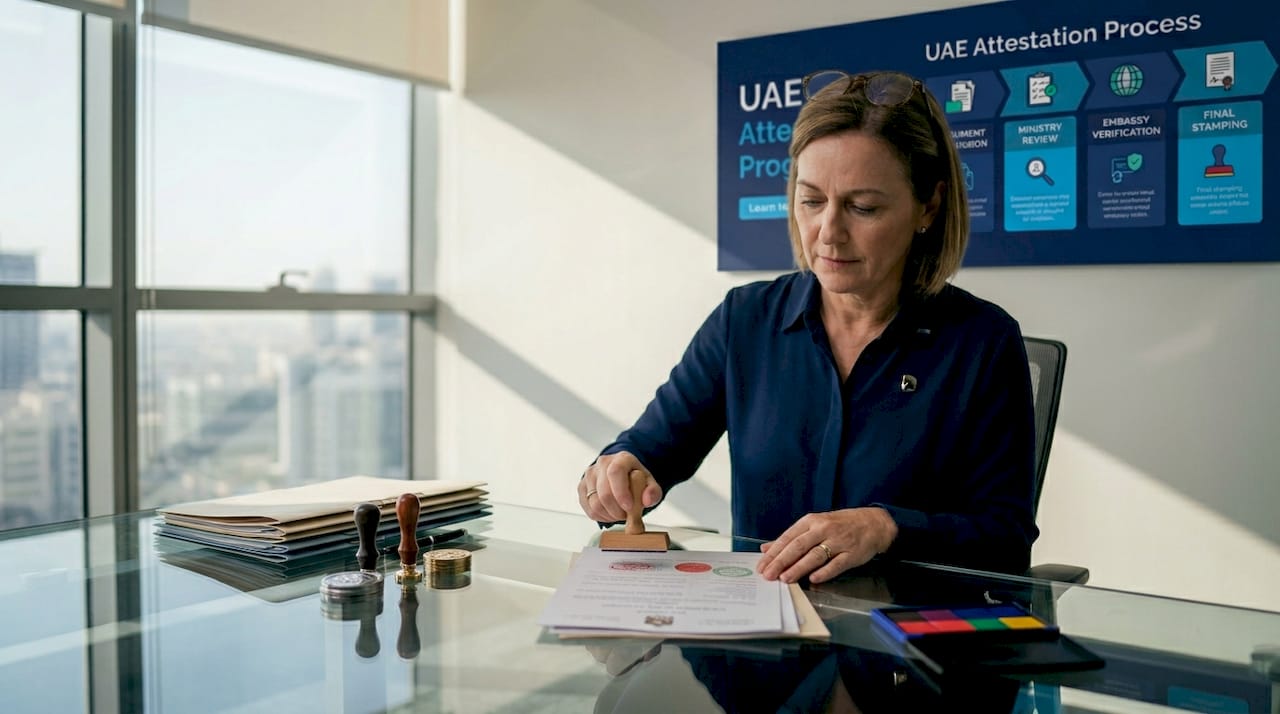
Government attestation is the official process by which authorized state bodies verify that a document is genuine, legally issued, and recognized for use in a foreign country. For Filipino expats in the UAE, this process is not optional. Every major document you submit to a UAE employer, bank, or immigration office must pass through a chain of government authorities before it carries legal weight. Understanding which agencies are involved, what they verify, and how the process has changed in 2026 saves you time, money, and serious legal headaches.
What is the role of government in attestation?
The role of government in attestation is to serve as a trusted third party that confirms a document’s origin, authenticity, and legal validity. Think of it as a chain of custody. Each government authority in the chain adds its stamp to confirm that the previous step was legitimate, creating a paper trail that foreign institutions can trust without question.
For Filipino expats, this chain typically starts in the Philippines and ends in the UAE. The attestation chain runs from home country notarization and government authentication, through UAE Embassy or Consulate legalization, and finally to UAE MOFA attestation. Each link in that chain is a government body performing a specific verification function. Without any one of those links, the document fails.

Government involvement in document verification also prevents fraud. A diploma printed at home looks identical to a real one without official seals. Government attestation forces every document through a system where trained officials cross-check signatures, seals, and issuing authority records. This protects UAE employers from hiring based on fake credentials and protects you from being accused of submitting forged documents.
Documents that commonly require attestation for Filipino expats include:
Educational certificates (diplomas, transcripts, degrees)
Birth and marriage certificates
Police clearance certificates
Employment contracts and experience letters
Commercial documents like board resolutions and trade licenses
Power of attorney documents
Pro Tip: Always check with the specific UAE authority requesting your document whether they need MOFA attestation or just DFA authentication. Requirements vary by document type and the institution receiving it.
Which government agencies handle attestation, and what do they do?
Three distinct layers of government handle the attestation workflow for Filipino expats in the UAE. Each has a defined role, and none can substitute for another.
Agency | Country | Role in Attestation |
Philippine Notary Public | Philippines | Notarizes documents to confirm signatures and identity |
Department of Foreign Affairs (DFA) | Philippines | Authenticates the notary’s seal and confirms the document is legitimate for international use |
UAE Embassy or Consulate | Philippines | Legalizes the DFA-authenticated document for acceptance in the UAE |
UAE Ministry of Foreign Affairs (MOFA) | UAE | Provides the final government stamp required for legal recognition across all UAE emirates |
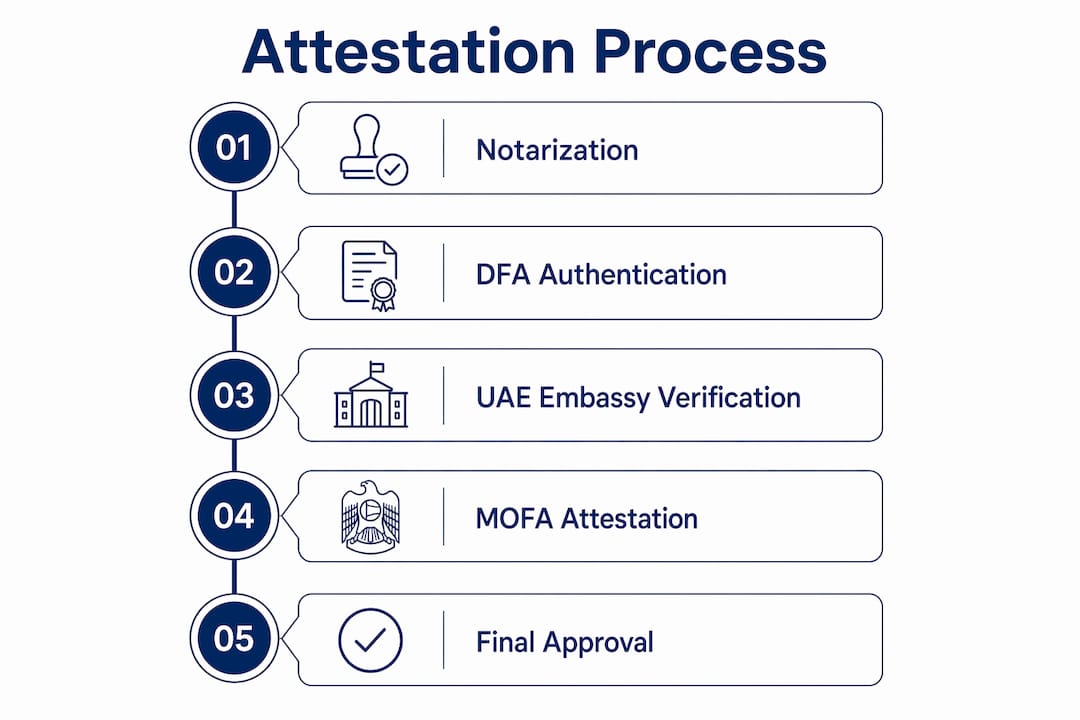
Notarization and DFA authentication in the Philippines form the foundational steps before any UAE legalization can happen. The DFA does not verify document content. It confirms that the notary who signed the document is a registered, authorized officer. That distinction matters because it clarifies what each agency is actually certifying.
The UAE Embassy or Consulate in Manila then verifies that the DFA seal is genuine. This step bridges the Philippine government’s certification with UAE legal standards. Some UAE consulates now offer a combined legalization stamp that incorporates MOFA attestation, which can eliminate the need for a separate MOFA step once you arrive in the UAE. However, you must examine the returned document carefully to confirm the MOFA seal is actually present.
The UAE Ministry of Foreign Affairs is the final and most critical authority. Without MOFA attestation, documents are not recognized by UAE government agencies, employers, immigration offices, or educational institutions. MOFA’s stamp is the government’s final declaration that a document is valid within UAE jurisdiction.
Pro Tip: When submitting documents to the UAE Embassy in Manila, ask specifically whether their legalization stamp includes MOFA recognition. Getting written confirmation prevents costly surprises after you arrive in the UAE.
How has the government attestation process changed in 2026?
The UAE government has made significant updates to attestation procedures in 2026, and Filipino expats need to know exactly what changed.
The most significant digital shift is the eDAS 2.0 platform and its integration with UAE Pass, the country’s national digital identity system. For eligible digital certificates, MOFA attestation approvals now process in as little as three minutes. The system uses AI to reduce manual processing and provides real-time tracking. This is a dramatic improvement from the weeks-long wait times that were standard just two years ago.
Fee structures have also been formalized. The official MOFA fee for commercial document attestation in 2026 is AED 2,000 per document, excluding courier costs and prior embassy fees. This applies to business documents like board resolutions, trade licenses, and power of attorney. Personal documents carry different fee structures, so verify the current schedule on the official MOFA portal before submitting.
Key 2026 updates that directly affect Filipino expats:
UAE Pass integration allows digital identity verification for MOFA submissions, reducing in-person visits
Combined legalization at UAE consulates may eliminate a separate MOFA step for some document types
AI-assisted processing on eDAS 2.0 speeds up approvals for digitally issued certificates
Documents not in English or Arabic still require certified legal translation approved by the UAE Ministry of Justice before attestation proceeds
Physical document submissions still require courier tracking for status verification
Document Type | Estimated Processing Time | Key 2026 Change |
Digital certificates via eDAS 2.0 | As little as 3 minutes | UAE Pass integration |
Commercial documents (physical) | 5 to 10 business days | AED 2,000 MOFA fee formalized |
Personal documents (physical) | 3 to 7 business days | Combined consulate stamp option |
What steps should Filipino expats follow to comply with attestation requirements?
Compliance with government attestation requirements follows a clear sequence. Skipping or reordering any step causes rejection and forces you to restart from the beginning.
Notarize your document with a licensed Philippine notary public. This confirms the signatures and identity of the signing parties.
Submit to the DFA for authentication. The DFA verifies the notary’s credentials and applies its official seal. Processing times vary by DFA branch, so book an appointment early.
Submit to the UAE Embassy or Consulate in Manila for legalization. Bring the DFA-authenticated original plus photocopies. Ask whether their stamp includes MOFA recognition under the 2026 combined format.
Arrange certified translation if your document is not in English or Arabic. The translator must be accredited by the UAE Ministry of Justice.
Submit to UAE MOFA through the eDAS 2.0 portal or an authorized typing center if a separate MOFA step is still required. Use UAE Pass for faster digital processing.
Track your submission using the reference number provided. For physical documents, use a courier service with tracking to avoid loss.
For OFWs navigating this process, the OFW attestation guide covers MOFA requirements and legal necessity in detail. Understanding the distinction between legalization and attestation also prevents confusion when different UAE authorities use different terminology for the same chain of steps.
Pro Tip: Request multiple certified copies of your documents at the DFA stage. UAE employers, banks, and immigration offices often each require their own attested original, and re-attesting costs time and money.
How does government involvement protect Filipino expats in UAE legal contexts?
Government attestation acts as trusted third-party validation, preventing fraud and ensuring the legal enforceability of documents within UAE official systems. This protection operates in both directions. It protects UAE institutions from accepting fraudulent documents, and it protects you from legal liability when your documents are questioned.
The practical benefits for Filipino expats are concrete:
Employment contracts signed on the basis of attested credentials carry legal weight in UAE labor courts. Without attestation, disputes over qualifications become difficult to resolve in your favor.
Bank account applications for non-residents often require attested personal documents. Banks use MOFA-stamped documents to confirm identity and legal status.
Visa applications and renewals processed by UAE immigration require attested documents for dependents, especially birth and marriage certificates.
Property transactions involving Filipino expats require attested power of attorney documents when a representative acts on your behalf.
Educational enrollment for children requires attested school records and birth certificates before UAE schools accept them.
The risk of skipping government attestation is not just rejection. Submitting unattested documents to UAE authorities can be treated as an attempt to use fraudulent paperwork, which carries legal penalties. The government certification process exists precisely to remove that risk by creating a verifiable, official record of every document’s authenticity.
Key takeaways
Government attestation for Filipino expats in the UAE requires completing a verified chain through Philippine DFA, UAE Embassy, and UAE MOFA before any document carries legal force in the UAE.
Point | Details |
Government role is verification | Each authority confirms the previous step’s legitimacy, not the document’s content. |
MOFA is the final authority | Without MOFA attestation, documents are rejected by UAE employers, banks, and immigration. |
2026 digital updates matter | eDAS 2.0 and UAE Pass reduce MOFA processing to minutes for eligible digital documents. |
Combined consulate stamps exist | Some UAE consulates now include MOFA recognition, but always verify the seal on return. |
Translation is mandatory | Non-English, non-Arabic documents require Ministry of Justice-approved translation before attestation. |
What I’ve learned from watching Filipino expats navigate this process
I’ve seen the same mistake repeated more times than I can count. Someone arrives in the UAE with a stack of documents that look perfectly official. DFA seal, notary stamp, everything. Then they find out the UAE Embassy legalization step was skipped because a relative told them it wasn’t necessary for their document type. The entire stack is useless until they restart.
The government attestation chain is not bureaucratic excess. Every step exists because a specific authority is confirming something the previous one could not. The DFA cannot confirm what the UAE Embassy confirms. The UAE Embassy cannot substitute for MOFA. These are distinct legal functions, not redundant paperwork.
What I also find underappreciated is the 2026 combined legalization format at UAE consulates. This is genuinely useful for Filipino expats who want to complete as much of the chain as possible before leaving the Philippines. But the key word is “verify.” I have seen documents returned with a combined stamp that, on closer inspection, did not include the MOFA seal. Always read the stamp. Ask the consulate officer directly. Get it in writing if you can.
Digital tools like UAE Pass and eDAS 2.0 are real improvements, not just government marketing. If your documents are digitally issued, use the digital pathway. Three-minute approvals are not an exaggeration for eligible certificates. The system works when you use it correctly.
Patience matters too. The process has multiple steps across two countries. Build in at least four to six weeks before your document is needed. Rushing creates errors, and errors mean starting over.
— Harris
Let Harrisncharms handle your attestation from start to finish
Navigating the Philippine DFA, UAE Embassy, and MOFA attestation chain takes time, precision, and up-to-date knowledge of 2026 procedural changes. Harrisncharms specializes in document attestation services built specifically for Filipino expats in the UAE.

Harrisncharms manages every step of the government certification process on your behalf, from DFA authentication in the Philippines to MOFA submission in the UAE. The team stays current on combined legalization formats, eDAS 2.0 requirements, and official fee structures so you don’t have to. Whether you need personal documents attested for a visa application or commercial documents for a UAE business setup, Harrisncharms delivers accurate, timely results without the guesswork. Contact Harrisncharms today to get your documents moving.
FAQ
What is the role of government in attestation?
The government’s role in attestation is to officially verify that a document is genuine, legally issued, and recognized for use in a foreign jurisdiction. Each government authority in the chain, from the Philippine DFA to UAE MOFA, confirms a specific aspect of the document’s authenticity.
Which Philippine government body handles attestation first?
The Department of Foreign Affairs (DFA) handles the foundational Philippine government step by authenticating the notary’s seal on your document before it proceeds to UAE Embassy legalization.
Is MOFA attestation always required in the UAE?
MOFA attestation is required for most documents used in the UAE, but some UAE consulates now offer a combined legalization stamp that includes MOFA recognition, potentially eliminating a separate MOFA step. Always verify the seal on your returned document to confirm.
How long does MOFA attestation take in 2026?
For eligible digital certificates submitted through the eDAS 2.0 platform with UAE Pass, MOFA attestation can process in as little as three minutes. Physical document submissions typically take three to ten business days depending on document type.
What happens if I skip government attestation for UAE documents?
Submitting unattested documents to UAE authorities risks rejection and potential legal liability for presenting unverified paperwork. UAE employers, banks, immigration offices, and educational institutions all require properly attested documents before processing any official request.
Recommended
Comments