
Step by Step Filipino Apostille Process: 2026 Guide
The Filipino apostille process is the official method for authenticating Philippine public and private documents for international use through the Department of Foreign Affairs (DFA). An apostille certifies the signature and seal of the issuing authority on your document, making it legally recognized in any country that is a member of the 1961 Hague Apostille Convention. The Philippines joined this convention in 2019, replacing the old red ribbon system. This guide walks you through every stage of the step by step Filipino apostille process, including the updated eApostille digital service now available for select documents in 2026.
What is the step by step Filipino apostille process?
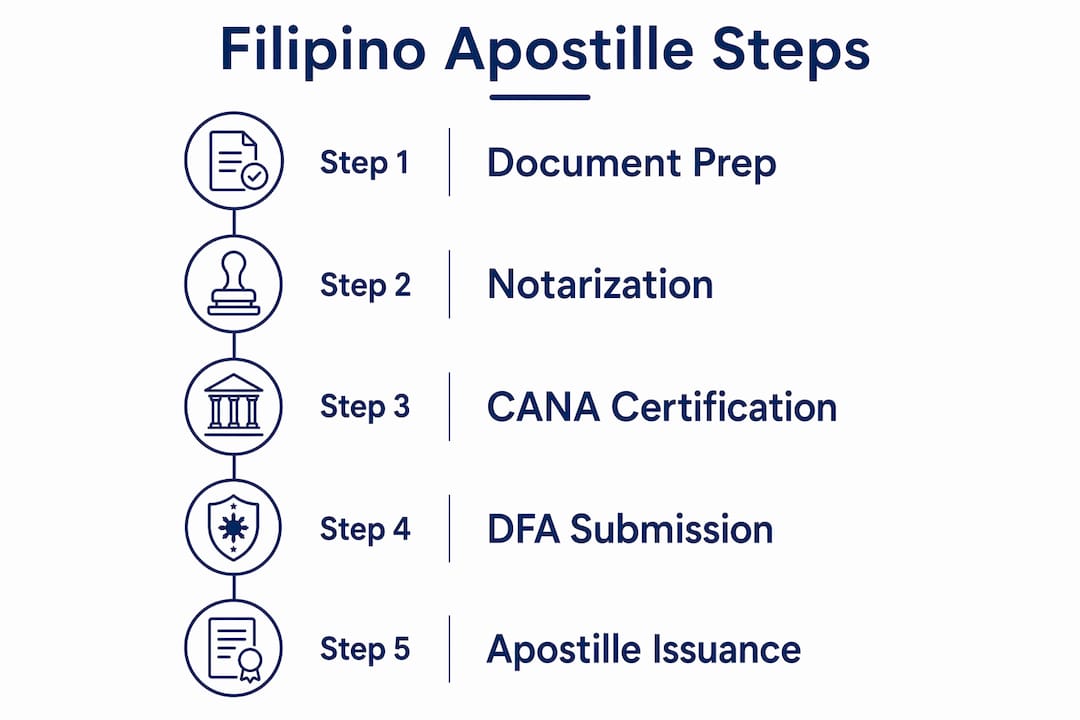
The DFA is the sole competent authority in the Philippines for issuing apostilles. Before you book any appointment, you need to understand that the apostille process is layered: the DFA only validates the final seal on your document, so every intermediate authentication step must be completed first. Skipping even one stage invalidates your entire application. This is the single most important fact to internalize before you start.
Which documents need apostille and how to prepare them
Not all documents go through the same preparation path. The DFA separates documents into two categories: public and private. Getting this distinction right before you book your appointment saves you from rejection.
Public documents are issued by government agencies and typically require intermediate endorsements before the DFA will accept them. Here is what each type needs:
PSA-issued documents (birth certificates, marriage certificates, death certificates): These are already government-issued, so they generally go directly to the DFA without additional endorsement.
Academic records from state universities or public schools: Require endorsement from the Commission on Higher Education (CHED) or the Department of Education (DepEd) before DFA submission.
SEC-registered corporate documents: Require certification from the Securities and Exchange Commission (SEC).
Court documents: Require certification by the responsible court officer, followed by signature certification from the Supreme Court before the DFA will accept them. This is stricter than standard notarization and applies only to judicial papers.
Private documents (special powers of attorney, affidavits, contracts) follow a different path. They must be notarized first, and the notary’s Certificate of Authority for a Notarial Act (CANA) must be attached. This CANA requirement is the most commonly overlooked step and the leading cause of application rejection at the DFA counter.
Pro Tip: Before booking your DFA appointment, contact the issuing institution directly to confirm whether your specific document needs an intermediate endorsement. A five-minute call to CHED, DepEd, or SEC can prevent a wasted trip and a rejected application.
The most common rejection cause is submitting incorrect document types or missing intermediate certifications. Verify your document’s eligibility chain before you spend money on fees or travel.
How to book your DFA apostille appointment online
The DFA operates a strict online appointment-only policy with over 1,000 daily slots available. Walk-ins are not accepted except for persons with disabilities (PWDs), senior citizens, and pregnant women, who must present proper documentation to qualify for on-site service. Everyone else books online at apostille.gov.ph.
Follow these steps to secure your appointment:
Go to apostille.gov.ph. Create an account or log in if you already have one. The portal is the only official booking channel.
Select your preferred DFA office and date. Slots fill quickly, especially at DFA Manila and Aseana. Book at least two weeks in advance during peak months.
Enter your document details. You will specify the document type, the issuing agency, and the purpose of the apostille. Accuracy here matters because discrepancies between your entry and the actual document trigger verification delays.
Pay the processing fee. The regular processing fee is approximately ₱100 per document. Payment is made through the portal’s accredited payment channels, including GCash, PayMaya, and over-the-counter bank options. Save your payment receipt.
Print your appointment confirmation slip. The DFA requires a printed copy. A screenshot on your phone is not accepted at most DFA offices.
Prepare your documents for appointment day. Bring the original document, a government-issued ID, your printed appointment slip, and your payment receipt. Processing typically takes 5 working days for regular service.
Pro Tip: Double-check that the name on your government-issued ID exactly matches the name on the document you are submitting. Even a middle name abbreviation discrepancy can cause the DFA officer to flag your application.
For Filipino expats in the UAE, Harrisncharms has a detailed breakdown of apostille requirements for expats that covers DFA policies and legal compliance specific to your situation abroad.
What happens on your DFA appointment day
Arriving prepared makes the submission process fast and straightforward. Here is the sequence of events at the DFA office:
Present your appointment slip and ID at the entrance. Security staff verify your booking before you enter the building. Arrive at least 15 minutes before your scheduled time.
Proceed to the document submission counter. A DFA officer reviews your documents for completeness. They check that all intermediate endorsements are present and that the notarization or CANA is attached for private documents.
Receive your claim stub. Once your documents pass verification, you receive a stub with your tracking number and the expected release date.
Pay any remaining fees at the cashier. If you paid online, present your receipt. Some DFA offices require on-site payment for expedited processing upgrades.
Return on your release date to claim your apostilled documents. Bring your claim stub and a valid ID. You may authorize a representative to claim on your behalf by providing a signed authorization letter and a photocopy of your ID.
Common mistakes to avoid during submission include bringing photocopies instead of originals, forgetting the CANA for notarized documents, and submitting documents with torn or damaged pages. The DFA will reject documents with physical defects that obscure the issuing authority’s seal or signature.
What is the eApostille system and when should you use it?
The Philippines introduced a digital eApostille system for select PSA and CHED documents. The eApostille delivers an encrypted PDF certificate within 24 hours, verified by a QR code. These electronic apostilles are official originals, not copies. This distinction matters because some foreign institutions initially questioned digital apostilles, but the QR verification system resolves authenticity concerns instantly.
Here is what you need to know about eApostille eligibility and the ordering process:
Eligible documents: PSA-issued civil registry documents (birth, marriage, death certificates) and CHED-authenticated academic records are currently covered.
How to order: Visit the PSA Serbilis portal or the CHED online system, select the eApostille option during your document order, and pay the fee online.
Fees: eApostille fees range from ₱500 to ₱560 per document, which is higher than the standard apostille fee but eliminates the need for a physical DFA visit.
Delivery: The encrypted PDF is sent to your registered email address, typically within 24 hours of payment confirmation.
Limitation: The eApostille is only valid in countries that are party to the Hague Apostille Convention. If your destination country is not a member, you still need embassy or consular legalization instead.
Feature | Traditional apostille | eApostille |
Processing time | 5 working days | Within 24 hours |
Physical visit required | Yes | No |
Fee per document | ~₱100 | ₱500 to ₱560 |
Format | Physical stamp on document | Encrypted PDF with QR code |
Eligible documents | All apostille-eligible types | PSA and CHED documents only |
The eApostille system reduces the need for physical visits and speeds up authentication significantly. For Filipinos in the UAE who need PSA documents authenticated urgently, the eApostille is the fastest legal option available. You can also review the PSA DFA apostille guide from Harrisncharms for a deeper look at notarization requirements before DFA submission.
Pro Tip: If you are ordering a PSA birth certificate for use in the UAE, choose the eApostille option at checkout on the PSA Serbilis portal. You will receive a legally valid document in your inbox within a day, which you can forward directly to your employer or government authority in the UAE.
Key takeaways
The Filipino apostille process requires completing all intermediate authentications before DFA submission, and skipping any step invalidates the application entirely.
Point | Details |
Pre-authentication is mandatory | Private documents need notarization plus CANA; public documents need agency endorsements before DFA accepts them. |
Book online at apostille.gov.ph | Walk-ins are not accepted except for PWDs, senior citizens, and pregnant women with proper documentation. |
Regular processing takes 5 days | Expedited options exist; bring originals, ID, appointment slip, and payment receipt on your appointment day. |
eApostille is faster for PSA and CHED docs | Encrypted PDF delivered within 24 hours for ₱500 to ₱560; no DFA visit required. |
Apostille validates the seal, not the content | It only certifies the issuing authority’s signature; it does not confirm the accuracy of the document’s information. |
What I’ve learned from watching Filipinos navigate this process
After working with Filipino expats on document authentication for years, the pattern I see most often is this: people treat the DFA appointment as the starting point. It is not. The DFA appointment is the final step in a chain that begins weeks earlier with the issuing institution.
The layered nature of the authentication approval sequence is what trips most applicants up. Someone will spend ₱100 on the apostille fee, travel to the DFA, wait in line, and then get turned away because their academic transcript from a private university was not endorsed by CHED first. That is a preventable loss of time and money.
My honest advice: treat the document preparation phase with more seriousness than the appointment itself. Call the issuing institution. Confirm the endorsement chain. Attach the CANA to every notarized document without exception. Keep both digital and physical copies of every certified document you receive along the way.
One more thing most guides do not say clearly enough: an apostille does not make your document accurate. It only confirms that the signature and seal on it are genuine. If there is an error in your PSA birth certificate, the apostille will not fix it. Correct the source document first, then authenticate it. That sequence matters more than any appointment slot.
— Harris
Let Harrisncharms handle your apostille process
Navigating the DFA’s requirements from abroad is genuinely difficult, especially when you are working across time zones and cannot easily make calls to Philippine government offices during business hours.
Harrisncharms specializes in document attestation services for Filipino expats in the UAE. The team coordinates directly with DFA requirements, verifies your document’s pre-authentication chain before submission, and manages the process so you do not have to take leave from work to sort out paperwork. Whether you need a single PSA birth certificate apostilled or a full set of employment documents authenticated, Harrisncharms handles it end to end. Visit Harrisncharms to get started or learn more about the real benefits of apostille services for Filipinos living and working in the UAE.
FAQ
What is an apostille in the Philippines?
An apostille is an official authentication certificate issued by the DFA that verifies the signature and seal of the authority who signed your document. It is recognized in all countries that are members of the 1961 Hague Apostille Convention.
How long does the Filipino apostille process take?
Regular DFA apostille processing takes 5 working days from submission. The eApostille for PSA and CHED documents is delivered within 24 hours via encrypted PDF.
Can I walk in to the DFA for apostille without an appointment?
Walk-ins are only accepted for PWDs, senior citizens, and pregnant women who present proper documentation on-site. All other applicants must book online at apostille.gov.ph.
What documents do I need to bring to my DFA apostille appointment?
Bring the original document, a government-issued ID, your printed appointment confirmation slip, and your payment receipt. Private documents must also include the notary’s CANA attached to the notarized document.
Does an apostille confirm that my document’s information is correct?
No. An apostille only authenticates the signature and seal of the issuing authority. It does not verify or certify the accuracy of the document’s content.
Recommended
Comments