
Role of Civil Registrar in Apostille: Avoid Rejection

The civil registrar issues the certified vital record — birth, marriage, death, or divorce — and provides the signature and seal that the Secretary of State will authenticate with an Apostille. That’s the whole chain. The registrar does not issue the Apostille itself; that step belongs to the Secretary of State for state documents, or the U.S. Department of State for federal ones.
Two things to do right now:
Request a fresh certified copy with the registrar’s current seal and signature, and explicitly state it’s for international use.
Confirm with the registrar that their specimen signature is on file and current with your state’s Secretary of State office.
Table of Contents
What does a civil registrar do in the apostille process?
In the U.S., a civil registrar is typically the county clerk, county recorder, or local registrar — the office varies by state. Their authority covers vital records: the official documents that record life events. The registrar’s job in the apostille workflow is to issue a properly certified copy of that record, complete with an official seal and the registrar’s own signature. Without both, the Secretary of State has nothing to authenticate.
Document Type | Typical Issuing Office | Notes |
Birth certificate | County clerk or state vital records office | Long-form version often required for apostille |
Marriage certificate | County clerk or recorder | Must be certified, not a photocopy |
Death certificate | Local registrar or state health department | Certified copy with seal required |
Divorce decree (civil record) | County court clerk | Certified court copy; check if state or court apostille applies |
Adoption records | County court clerk | May require additional court certification |
Federal documents — think FBI background checks or federal court orders — do not go through a local registrar at all. Those go directly to the U.S. Department of State for authentication.
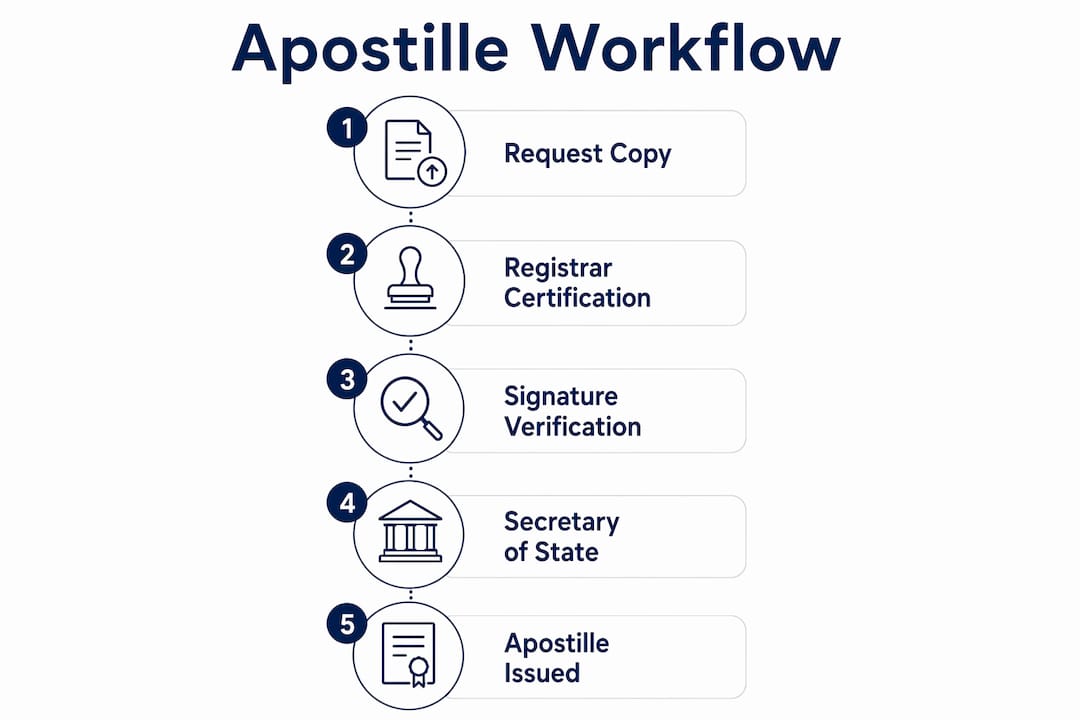
How the apostille workflow actually unfolds, step by step
The sequence is linear, and skipping a step or doing them out of order is the fastest way to a rejection.
Identify your document type. State-issued vital records go through the state; federal documents go through the U.S. Department of State.
Request a certified copy from the civil registrar. Ask specifically for a copy intended for international use. Some registrars issue long-form certified copies that include the full seal and wording the Apostille office needs.
Verify the registrar’s specimen signature is current. The Secretary of State’s office keeps a file of registrar specimen signatures. If the registrar’s signature on your document doesn’t match what’s on file, your application gets rejected.
Submit to the correct authority. State-issued records go to the Secretary of State of the issuing state. Federal documents go to the U.S. Department of State’s Office of Authentications.
Receive the Apostille. The Apostille is attached to or accompanies your certified copy. It confirms the registrar’s signature and seal are genuine — nothing more, nothing less.
Document origin | Authentication authority | Who to contact first |
State-issued vital records | Secretary of State (issuing state) | Your county registrar |
Federal documents | U.S. Department of State | Federal issuing agency |
Foreign documents for U.S. use | Issuing country’s authority | That country’s equivalent office |
Pro Tip: Before you mail anything, call the Secretary of State’s apostille office and ask: “Is the specimen signature for [registrar name/county] current in your records?” One phone call can save weeks.
Why signature mismatches are the leading cause of apostille rejection
The Secretary of State’s office doesn’t just stamp your document. It verifies the registrar’s signature against the specimen on file — and if those two don’t match, the document comes back rejected. No exceptions.
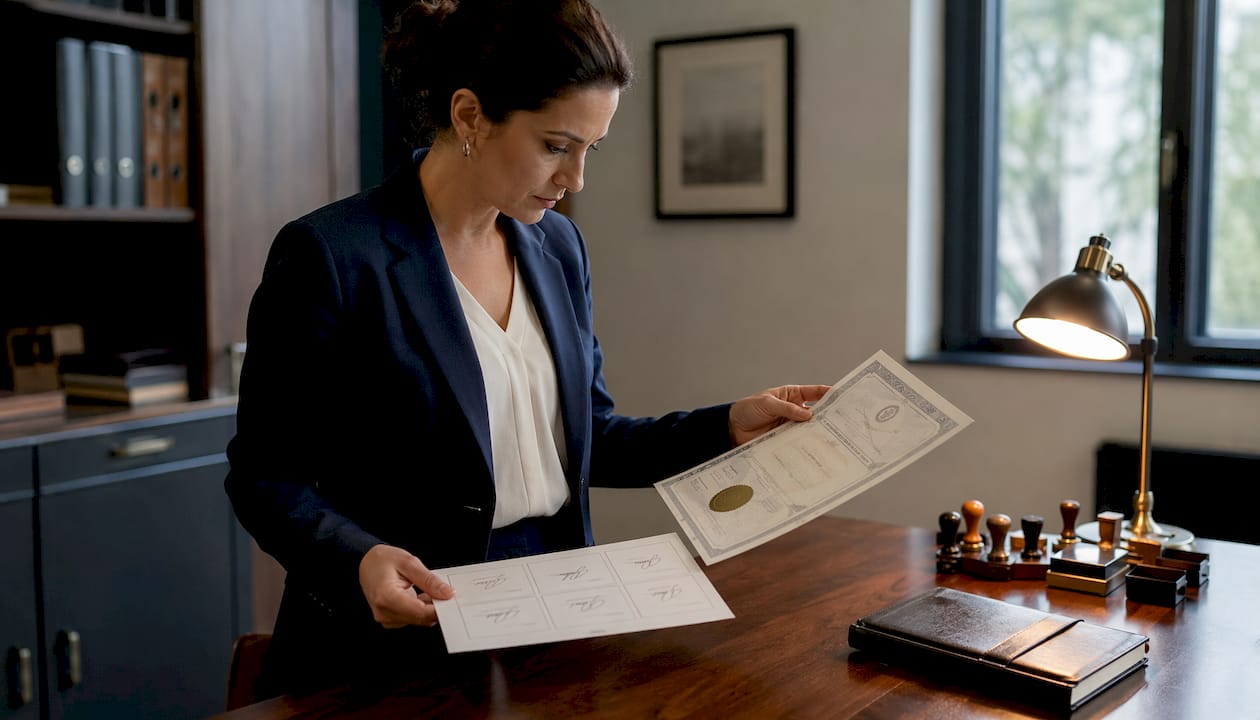
Mismatches happen more often than most people expect. A registrar who recently took office, changed their signature style, or replaced a predecessor may not yet have an updated specimen on file with the state. Altered seals, laminated documents, and older document versions are all common culprits too.
Getting a fresh certified copy right before you submit — not one you pulled from a drawer six months ago — is the single most effective way to avoid this problem. The apostille verification process depends entirely on that match being clean. You can read more about how verification offices check seals and signatures in Harrisncharms’s apostille verification guide.
Notarization vs. registrar certification: what actually matters
Here’s a misconception that causes real damage: notarizing a state-issued vital record is not a substitute for registrar certification. U.S. government guidance is explicit — adding a notary to an Apostilled document can invalidate it for international use. The Apostille office authenticates the registrar’s signature, not a notary’s.
A notary public serves a different function entirely: they verify the identity of a signer on a private document. They have no authority over state-issued vital records, and their stamp on a birth certificate or marriage certificate doesn’t make it more valid. It often makes things worse.
Common myths worth correcting:
“More stamps make it more official.” Wrong. Extra stamps from unauthorized parties can trigger rejection.
“Laminating protects the document.” Laminated documents are commonly rejected by state Apostille offices because they can’t verify the seal.
“A photocopy with a notary stamp works.” It doesn’t. The Apostille office requires an original certified copy with the registrar’s seal and signature.
For a deeper look at where attestation, notarization, and apostille actually differ, Harrisncharms covers the distinctions in their attestation vs. apostille guide.
How to request a certified copy from a U.S. civil registrar
Walk in (or write in) with the right request and you’ll avoid the most common delay: getting the wrong document version.
Ask for a “certified copy for international use” and state that it will be submitted for an Apostille.
Bring valid government-issued photo ID.
Have the exact full legal names and dates (birth date, marriage date, etc.) ready.
Complete the registrar’s signed request form.
Bring payment — fees vary by county and state.
If you’re not the subject of the record, bring proof of relationship or legal authority.
Here’s sample wording you can adapt:
On fees and timing: local registrar fees for certified copies typically run from a few dollars to around $30 per copy, depending on the county. Secretary of State apostille fees vary by state. California’s Secretary of State, for example, offers both standard and expedited processing, with fees and courier options that add to the total cost. Ask the registrar directly about expedited options if you’re working against a deadline.
Secretary of State, U.S. Department of State, or consular legalization?
The decision rule is straightforward. State-issued vital records — birth, marriage, death certificates — go to the Secretary of State of the state that issued them. Federal documents like FBI background checks or federal court orders go to the U.S. Department of State’s Office of Authentications.
There’s a third scenario: if the destination country is not a member of the 1961 Hague Convention, an Apostille won’t be accepted at all. You’ll need consular legalization instead, which is a separate process involving the destination country’s embassy or consulate. Check the Hague Conference’s member country list before you start. Harrisncharms has a practical breakdown of apostille versus consular legalization worth reading if you’re unsure which route applies.
One more nuance: an Apostille confirms that a document is an official public document. It does not guarantee the receiving country’s civil registrar or authority will accept it without additional materials — translations, proof of finality for divorces, or other supporting documents may still be required.
What do timelines and fees actually look like?
Processing times range from same-day (in-person, expedited) to several weeks for mail-in requests, especially when specimen verification takes extra time.
Step | Typical timeframe | Typical fee range |
Certified copy from registrar | Same day to 2 weeks | $5–$30 per copy |
Secretary of State apostille | 1 day (in-person) to 4+ weeks (mail) | $5 per document |
Expedited/courier options | 1–3 business days | Varies by state and service |
State-by-state variability is real. A state with a backlog of specimen verification requests can add weeks to a routine application. Registrar offices in rural counties may have longer turnaround times than urban ones. If your deadline is firm, go in person or use an expedited service.
Common mistakes that cause apostille rejection
Wrong document version: Submitting a short-form or abstract birth certificate instead of the long-form certified copy. Remedy: ask the registrar explicitly for the long-form version.
Outdated registrar signature: The document’s signature doesn’t match the specimen on file. Remedy: get a fresh certified copy immediately before submission.
Laminated documents: Lamination is grounds for rejection at most state apostille offices. Remedy: request a new unlaminated certified copy.
Photocopies: Even notarized photocopies won’t pass. Remedy: always submit original certified copies with the registrar’s seal.
Name mismatches: The name on the document doesn’t match the name on your ID or the receiving country’s records. Remedy: verify spelling across all documents before submitting.
Untranslated documents: Some destination countries require a certified translation alongside the apostilled document. Remedy: order a certified translation before final submission.
Wrong authentication authority: Sending a state document to the U.S. Department of State, or vice versa. Remedy: confirm document origin first, then route accordingly.
When in doubt, contact the registrar’s office, then the Secretary of State’s apostille division. If the issue is complex, a qualified attestation service can review your documents before you submit.
Key Takeaways
The civil registrar’s certified copy — with a current seal and matching specimen signature — is the foundation of every successful apostille application; everything else depends on getting that step right.
Point | Details |
Registrar issues, not apostilles | The civil registrar provides the certified record; the Secretary of State issues the Apostille. |
Specimen matching is critical | A signature mismatch between your document and the Secretary of State’s file causes rejection. |
Fresh copies reduce risk | Request a certified copy immediately before apostille submission to ensure the signature is current. |
Notarization can invalidate | Adding a notary to a state-issued vital record can complicate or invalidate apostille processing. |
Route determines authority | State documents go to the Secretary of State; federal documents go to the U.S. Department of State. |
A practitioner’s perspective on avoiding the most common delay
The single most overlooked step in the entire apostille process is confirming specimen status before you submit anything. Most people assume the Secretary of State already has an up-to-date signature on file for their county registrar. Often, they don’t — especially after a registrar election, a staff change, or a county office reorganization. By the time the rejection letter arrives, weeks have passed.
The fix is simple: call the Secretary of State’s apostille division, give them the county and the registrar’s name, and ask directly whether the specimen is current. If it isn’t, the registrar needs to file an updated specimen before your document can be processed. That one call, made before submission, can cut weeks off your timeline.
If you’re preparing U.S. documents for use abroad — particularly for UAE authorities or Philippine civil registrars — the routing and document condition requirements add another layer of complexity. Harrisncharms specializes in exactly this kind of case. Before you contact them, have your document type, issuing county, and destination country ready. That information determines which authentication path applies and whether additional steps (translations, consular legalization) are needed. Visit Harrisncharms to get case-specific guidance.
Authoritative sources and what to ask each office
Before you submit, verify requirements directly with the relevant office. Here’s where to go and what to ask:
Your county civil registrar: “Do you issue a long-form certified copy for international use? Is your specimen signature current with the Secretary of State?”
State Secretary of State (apostille division): “Is the specimen signature for [registrar name/county] current in your records? What is the current processing time and fee for an apostille?”
U.S. Department of State (Office of Authentications): “Does my document qualify for federal authentication, or should it go through the state Secretary of State?”
USA.gov authentication guide: Use this to confirm whether your destination country is a Hague Convention member and which authority handles your document type.
Contact the registrar first if you have a state-issued vital record. Contact the U.S. Department of State first if your document was issued by a federal agency. When the destination country’s requirements are unclear, check with that country’s embassy or consulate before starting the process.
Recommended
Comments