
Record Validation Process for UAE: Filipino Expat Guide

The record validation process for UAE is the multi-step authentication of official documents through a legalization chain involving the UAE Ministry of Foreign Affairs (MOFA), UAE embassies, and Ministry of Justice (MOJ) accredited translators. Filipino expats need validated documents for employment contracts, family visa applications, and legal registrations. Skipping any step in the chain results in rejection. This guide covers every stage of the process, including the UAE Verify digital platform, so you can get your documents accepted the first time.
What are the prerequisites for the UAE record validation process?
Preparation determines whether your documents pass or fail. Before you submit anything, you need the right originals, the right translations, and the right notarization.
Required documents typically include:
Original documents with certified true copies (birth certificates, marriage certificates, academic diplomas, employment records)
Notarized copies from a recognized notary in your home country
Arabic translations by MOJ-accredited translators
Valid passport copies for identity verification
The translation requirement is non-negotiable. MOFA requires Arabic translations from MOJ-accredited translators only. Non-accredited translations cause instant rejection, regardless of how accurate the translation appears.
One critical distinction Filipino expats must understand: the UAE does not accept apostilles. The UAE is not a member of the Hague Convention, which means the full legalization chain is mandatory for all foreign documents. An apostille stamp from the Philippines does not replace embassy attestation or MOFA verification.
Prerequisite | Common error to avoid |
Original documents with certified copies | Submitting photocopies without notarization |
MOJ-accredited Arabic translation | Using a freelance or non-accredited translator |
Home country notarization | Using a notary not recognized by the UAE embassy |
UAE embassy legalization | Assuming apostille replaces embassy attestation |
Final MOFA UAE attestation | Submitting without completing all prior steps |
Pro Tip: Before you visit a notary in the Philippines, confirm that the notary’s seal is registered with the UAE embassy in Manila. An unregistered notary seal stalls the entire chain at the embassy stage.
How does the step-by-step attestation chain work?
Document legalization in the UAE follows a fixed sequence. Each authority in the chain verifies the step before it. Skipping one stage invalidates every step that follows.
Step 1: Notarization in the Philippines
A licensed notary public in the Philippines authenticates your original document. The notary’s seal must be officially registered and recognized by the UAE embassy in Manila. The notary’s seal must be registered with the UAE embassy, or the attestation chain stalls at the embassy stage.

Step 2: Department of Foreign Affairs (DFA) authentication
The Philippine Department of Foreign Affairs authenticates the notary’s signature. This is the home country Ministry of Foreign Affairs verification step. Without DFA authentication, the UAE embassy will not process your document.
Step 3: UAE embassy attestation
The UAE embassy in Manila reviews the DFA-authenticated document and applies its own attestation stamp. This is the critical middle step. The embassy confirms that the document and its prior authentications are legitimate. Processing times at this stage typically range from a few business days to two weeks, depending on document type and current volume.
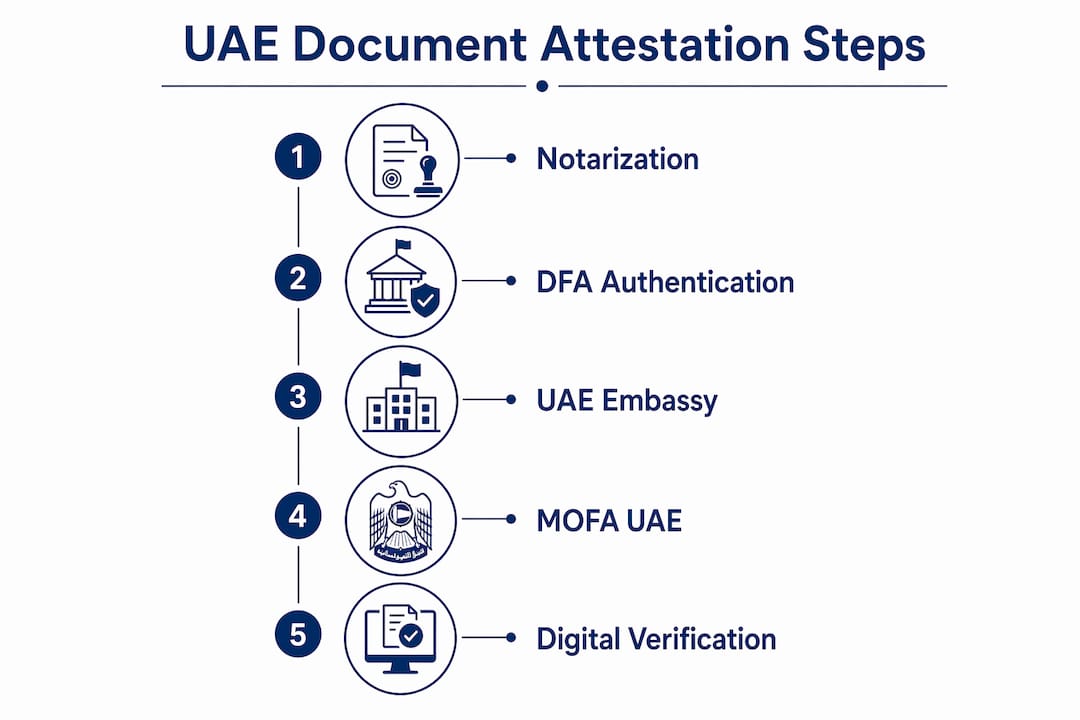
Step 4: MOFA UAE final attestation
After arriving in the UAE, you submit the embassy-attested document to the UAE Ministry of Foreign Affairs for final verification. MOFA’s stamp is the last and most recognized seal for official use inside the UAE. Without it, your document is not considered fully validated for employment and visa purposes.
Pro Tip: Bring multiple certified copies of every document to each stage. Authorities sometimes retain originals, and having extras prevents costly delays if you need to restart a step.
Warning: Failure to submit valid attested documents can lead to visa rejections, employment difficulties, and legal non-compliance. Do not assume a partially attested document will be accepted provisionally.
How does UAE Verify work for digital document authentication?
UAE Verify is the UAE government’s blockchain-powered digital authentication platform. It converts officially attested documents into verified digital records that can be shared instantly with employers, government agencies, and banks.
UAE Verify has authenticated over 34.5 million digital documents as of may 2026. The platform connects 29 government entities and supports 78 document types. That scale reflects how central digital verification has become to UAE compliance.
How to use UAE Verify
Log in using your UAE Pass digital identity account.
Select the document type you want to authenticate.
Upload the attested document or request digital issuance from a connected government entity.
Share the verified digital record directly with the requesting party via a secure link.
UAE Verify uses blockchain technology as an encrypted ledger to protect document authenticity and traceability. This eliminates the risk of forged paper copies.
Advantages of UAE Verify:
Instant verification without physical paper copies
Secure sharing with third parties through encrypted links
Real-time audit trail for compliance purposes
Accepted by connected government entities and many private employers
Reduces the cost and time of physical document submission
Limitations to know:
Only documents issued or attested by connected UAE entities are eligible
Foreign documents must complete the full legalization chain before digital conversion
UAE Pass registration is required before accessing the platform
Pro Tip: Check whether your specific document type is listed among the 78 supported categories on UAE Verify before assuming it qualifies for digital authentication. Not all foreign documents convert automatically after MOFA attestation.
Verified digital documents also support UAE government digitization goals and reduce paper-based fraud risks. For Filipino expats managing multiple documents across employment and visa applications, UAE Verify saves significant time.
What mistakes cause rejection in the UAE document verification process?
Most rejections are preventable. The errors below account for the majority of delays and resubmissions Filipino expats face.
Common mistakes and how to fix them:
Using a non-accredited translator. Non-accredited translation services cause frequent attestation delays and rejections. Always verify your translator holds MOJ accreditation before paying for the service.
Submitting an apostille instead of full legalization. The UAE does not recognize apostilles. A Philippine Statistics Authority document with an apostille stamp still requires DFA authentication, UAE embassy attestation, and MOFA verification.
Unrecognized notary seal. If your notary is not registered with the UAE embassy in Manila, the embassy will reject the document at the legalization stage. Verify notary registration first.
Incomplete legalization chain. Presenting a DFA-authenticated document directly to MOFA without UAE embassy attestation is a common and costly mistake.
Expired documents. Some document types have validity windows. A birth certificate issued years ago may require a fresh certified copy from the Philippine Statistics Authority.
Troubleshooting rejected documents
If your document is rejected at the UAE embassy, request a written reason. Most rejections cite a specific deficiency, such as an unrecognized notary or missing translation. Fix only the identified issue and resubmit. Do not restart the entire chain unless the embassy specifically requires it.
If MOFA rejects a document, the most common cause is a translation issue. Return to an MOJ-accredited translator and have the document retranslated and re-attested from the embassy stage onward.
How does record validation support UAE compliance requirements?
Validated records are the foundation of legal standing in the UAE for both individuals and businesses. For Filipino expats, this means your employment contract, family visa, and any legal filings depend on documents that have completed the full authentication process.
The UAE’s AML law requires entities to maintain records for a minimum of 5 years, with electronic records held to high standards of security and retrievability. Businesses that employ expats must also maintain validated employment and identity records for audit purposes.
Compliance area | Document retention requirement |
AML and financial records | Minimum 5 years, electronic format preferred |
VAT and tax records | 5 to 15 years depending on record type |
Employment and visa records | Duration of employment plus applicable statutory period |
Legal filings and contracts | As required by the relevant UAE authority |
The Federal Tax Authority mandates that VAT and tax records be kept electronically with high standards of retrieval and security. For expats running businesses or working as contractors, this means your validated records must be accessible and audit-ready at any time.
Validated documents also protect you personally. If a dispute arises over your employment contract or residency status, a fully attested and MOFA-verified document carries legal weight. An unvalidated document does not.
Key Takeaways
The record validation process for UAE requires completing a fixed legalization chain through MOFA, the UAE embassy, and MOJ-accredited translators, with no shortcuts accepted.
Point | Details |
Apostilles are not accepted | The UAE requires full legalization; apostille stamps do not replace embassy or MOFA attestation. |
MOJ-accredited translation is mandatory | Non-accredited translations cause instant rejection at MOFA regardless of translation quality. |
UAE Verify supports digital authentication | The platform has authenticated over 34.5 million documents and supports 78 document types. |
Notary registration must be verified early | An unregistered notary seal stalls the entire chain at the UAE embassy stage. |
Records must be retained for compliance | UAE AML law requires a minimum 5-year retention period for official records. |
What I’ve learned from helping Filipino expats validate documents in the UAE
The single biggest mistake I see is treating the UAE like any other country that accepts apostilles. Filipino expats often arrive with PSA documents bearing an apostille stamp and assume the hard work is done. It is not. The UAE sits entirely outside the Hague Convention framework, and that changes everything about how you prepare.
Early preparation is the only real protection. Verify your notary’s registration with the UAE embassy in Manila before you leave the Philippines. Confirm your translator holds current MOJ accreditation. These two checks alone eliminate the majority of rejections I have seen.
UAE Verify is genuinely useful once your documents complete the legalization chain. I recommend registering for UAE Pass as soon as you arrive in the UAE, even before you need it. When the time comes to share a verified document with an employer or government office, having your UAE Pass ready saves days of back-and-forth.
The legalization versus attestation distinction also trips up many expats. These are not interchangeable terms in the UAE context. Understanding the difference before you start saves you from submitting the wrong type of document to the wrong authority.
— Harris
How Harrisncharms can help with your UAE document attestation
Filipino expats managing the UAE record validation process on their own often hit delays that cost weeks of time and significant money. Harrisncharms specializes in document attestation services for Filipino expats in the UAE, handling the full legalization chain from Philippine notarization through MOFA final attestation.

Harrisncharms works with MOJ-accredited translators and guides you through UAE Verify registration for digital document authentication. Whether you need help with employment documents, family visa paperwork, or legal filings, the team handles the details so your documents clear every stage without rejection. Visit the Harrisncharms services page to get started with professional document validation support tailored to Filipino expats in the UAE.
FAQ
What is the record validation process for UAE?
The record validation process for UAE is the multi-step legalization chain that authenticates foreign documents through notarization, home country Ministry of Foreign Affairs verification, UAE embassy attestation, and final MOFA UAE approval.
Does the UAE accept apostille certificates from the Philippines?
No. The UAE is not a member of the Hague Convention, so apostille certificates are not accepted. Filipino expats must complete the full legalization chain regardless of apostille status.
What documents need MOJ-accredited Arabic translation?
All foreign documents submitted to MOFA require Arabic translation by a Ministry of Justice accredited translator. Using a non-accredited translator causes instant rejection at the MOFA stage.
What is UAE Verify and who can use it?
UAE Verify is a blockchain-powered government platform that converts attested documents into verified digital records. It requires a UAE Pass account and supports 78 document types connected to 29 government entities.
How long must validated records be kept in the UAE?
UAE AML law requires a minimum retention period of 5 years for official records. VAT and tax records may need to be kept for up to 15 years depending on the record type and applicable audit requirements.
Recommended
Comments