
Process for Acceptance of Attested Documents in the UAE

The process for acceptance of attested documents is a legally mandated verification chain where each authority confirms the authenticity of the previous authority’s stamp, culminating in final recognition by the UAE Ministry of Foreign Affairs. For Filipino expats in the UAE, this chain covers employment contracts, educational certificates, marriage records, and family sponsorship papers. Skipping even one stage voids the entire chain and forces a full restart. Knowing the exact sequence, the acceptance criteria for documents, and the role of each authority saves you weeks of delays and unnecessary costs.
What documents need attestation before you start?
Not every document you carry requires attestation, but the ones that do follow strict acceptance criteria. The UAE recognizes four main categories that Filipino expats regularly submit.
Personal documents include birth certificates, marriage certificates, divorce decrees, and death certificates. These are most commonly needed for family sponsorship and residency applications with the General Directorate of Residency and Foreigners Affairs (GDRFA).

Educational documents include degrees, diplomas, transcripts, and professional licenses. The Ministry of Human Resources and Emiratisation (MOHRE) and UAE universities require these for employment and enrollment purposes.
Commercial documents cover trade licenses, power of attorney, and company incorporation papers. These are needed when setting up a business or signing contracts with UAE entities.
Affidavits and legal declarations are notarized statements used for a wide range of legal and administrative purposes in the UAE.
Before you begin, confirm two things. First, documents must bear original, recognizable signatures and official seals. Photocopies and documents with unverifiable seals are rejected at the first authentication stage. Second, check with the specific UAE institution receiving your document. Acceptance criteria vary by institution, and confirming requirements upfront prevents redundant attestations and processing delays.
One more distinction worth knowing: Apostille and traditional attestation are not the same. Apostille applies to countries that are members of the Hague Convention. The Philippines is a member, but the UAE is not. This means Filipino documents destined for UAE use require traditional multi-step attestation, not an Apostille stamp alone.
Pro Tip: Check the attestation requirements guide for your specific document type before gathering originals. Requirements differ between GDRFA, MOHRE, and private employers.
Step-by-step process for acceptance of attested documents
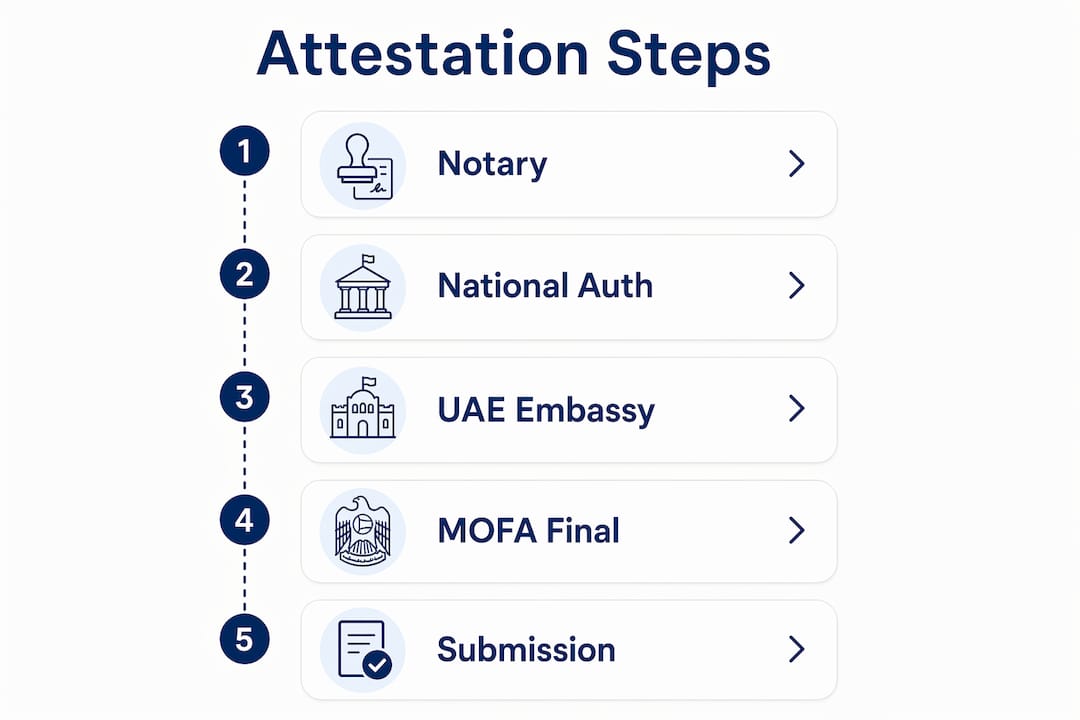
The full workflow moves through five sequential stages. Each stage authenticates the stamp from the stage before it. Miss one, and the chain breaks.
Step 1: Notary public attestation
Your document starts at a notary public in the country where it was issued. For Philippine-issued documents, this means a notary public accredited by the Integrated Bar of the Philippines or the relevant government agency. The notary confirms the document’s authenticity at the local level. This is the foundation of the entire chain.
Step 2: Authentication by the issuing country’s national authority
For Philippine documents, this step involves the Department of Foreign Affairs (DFA) in Manila. The DFA authenticates the notary’s signature and seal. This is the Philippine government’s official confirmation that the document is genuine. Without DFA authentication, no foreign authority will accept the document.
Step 3: UAE Embassy or Consulate legalization
After DFA authentication, the document goes to the UAE Embassy or Consulate in the Philippines. The UAE Embassy stamps the document to confirm it recognizes the Philippine government’s authentication. This step bridges the home country verification with UAE recognition. Processing timelines at this stage typically run several business days, depending on document volume at the mission.
Step 4: Final attestation by UAE MOFA via the MOFAIC app
The final stage is attestation by the UAE Ministry of Foreign Affairs and International Cooperation (MOFA). Applicants register and apply via the MOFAIC mobile app using UAE Pass. Payment is completed electronically, and you can track your application status directly in the app. MOFA confirms that both the home country authorities and the UAE Embassy have verified the document before granting final legal recognition in the UAE.
Foreign documents require prior attestation from the home country and the UAE Embassy before MOFA approval. The MOFA stage alone takes 1–3 weeks for foreign documents. Plan your timeline accordingly.
Pro Tip: When uploading documents in the MOFAIC app, select the correct document category before submitting. A wrong category selection triggers an automatic rejection, and you will need to resubmit from scratch.
The table below summarizes each stage, the responsible authority, and the typical processing time.
Stage | Authority | Typical Timeline |
1. Local notarization | Notary public (Philippines) | 1–3 business days |
2. National authentication | DFA Philippines | 3–10 business days |
3. UAE Embassy legalization | UAE Embassy, Manila | 3–7 business days |
4. MOFA final attestation | UAE MOFA via MOFAIC app | 1–3 weeks |
Note on digital attestation: UAE-issued digital documents with verification features like a QR code can be attested fully electronically through the MOFAIC app. This digital path applies only to UAE-issued documents. Philippine-issued documents always require the physical multi-step chain described above.
How to handle rejections during the attestation acceptance process
Rejections happen, and they are not the end of the road. The key is knowing exactly why a document was rejected and which stage to fix.
MOFA provides a digital notification specifying exactly which verification link failed. This notification tells you which authority’s stamp or step is deficient. Use it as your correction roadmap, not as a reason to panic.
The most common rejection reasons include:
Missing or incorrect UAE Embassy stamp. The UAE Embassy in Manila must stamp the document after DFA authentication. If the stamp is absent, illegible, or from the wrong mission, MOFA rejects the document.
Unverifiable seals or signatures. If the notary’s seal or the DFA authentication mark is unclear, the document fails at the first review point.
Wrong document category in the MOFAIC app. Selecting “personal document” when submitting an educational certificate, for example, triggers an automatic rejection.
Photocopies submitted instead of originals. Authentication authorities require original documents with original signatures and seals.
Unauthorized attestation services. Applicants who use unofficial “online-only” attestation services end up with documents that do not comply with UAE legal requirements, causing processing failures.
When a document is rejected at any stage, the entire chain’s validity is voided. You must rebuild the chain starting from the specific failed step. Depending on the issuing country, this can take weeks. The legal implication is clear: skipping any step invalidates the process and requires a full restart.
Pro Tip: Screenshot the MOFAIC app rejection notification immediately. It contains the exact deficiency description, which you will need when contacting the DFA or UAE Embassy to correct the issue.
How to submit attested documents and confirm acceptance
Getting your documents attested is only part of the work. Submitting them correctly to the right UAE institution is what completes the process for document approval.
The MOFAIC app handles submission, fee payment, and status tracking in one place. Log in with your UAE Pass, upload clear scanned images of your attested documents, select the correct document category, and enter your personal details accurately. Errors in data entry are a common cause of delays that have nothing to do with the documents themselves.
Acceptance criteria differ across UAE institutions. The table below outlines common document types, the attestation chain required, and the receiving institution.
Document type | Attestation chain | Receiving institution |
Educational certificate | Notary, DFA, UAE Embassy, MOFA | MOHRE, universities |
Birth/marriage certificate | Notary, DFA, UAE Embassy, MOFA | GDRFA |
Power of attorney | Notary, DFA, UAE Embassy, MOFA | Courts, legal entities |
Commercial documents | Notary, DFA, UAE Embassy, MOFA | Department of Economic Development |
For physical document delivery, two options exist. Courier-based delivery works for expats outside the UAE who need to send documents to a service center. Digital submission through the MOFAIC app works for eligible documents and is faster. Confirm with the receiving institution which format they accept before choosing your delivery method.
Confirming institutional requirements before submitting avoids redundant attestations. A document attested for MOHRE may not satisfy GDRFA without additional steps. Always ask the receiving institution directly.
Key Takeaways
The process for acceptance of attested documents in the UAE is a sequential, multi-authority verification chain where each stage must be completed correctly before the next one begins.
Point | Details |
Sequential chain is mandatory | Skipping any stage voids the entire chain and forces a restart from the failed step. |
Original documents only | Photocopies and documents with unverifiable seals are rejected at the first authentication stage. |
MOFAIC app is the final gateway | Submit, pay, and track your MOFA attestation through the MOFAIC app using UAE Pass. |
Rejection notices are specific | MOFA digital notifications identify exactly which step failed, so corrections are targeted. |
Confirm institutional requirements first | Acceptance criteria differ across GDRFA, MOHRE, and universities, so verify before submitting. |
What I’ve learned watching Filipino expats navigate attestation
The single biggest mistake I see Filipino expats make is treating attestation as a one-time errand rather than a structured legal process. They rush through the DFA step, skip confirming UAE Embassy requirements, and then wonder why MOFA rejects their documents three weeks later.
Patience at each stage is not optional. The verification chain exists because the UAE needs to confirm that every authority in the chain has done its job. When you skip a step or use an unofficial service, you are not saving time. You are guaranteeing a restart.
I have also noticed that many expats do not use the MOFAIC app to its full potential. The app shows you exactly where your application stands. It tells you when a rejection occurs and why. That level of transparency is genuinely useful, but only if you check it regularly and act on the notifications quickly.
My strongest recommendation: use only official government channels. The DFA in Manila, the UAE Embassy, and the MOFAIC app are the only legitimate pathways. Any service that promises attestation without these steps is not compliant with UAE law. The short-term convenience is not worth the weeks of rework.
Finally, confirm requirements with the receiving UAE institution before you start the attestation chain. A phone call or email to MOHRE or GDRFA takes ten minutes. Getting the wrong document attested for the wrong institution costs you weeks.
— Harris
Harrisncharms is here to help with your attestation process
Filipino expats in the UAE deal with tight deadlines, unfamiliar procedures, and documents issued across multiple countries. Getting every step right the first time matters.

Harrisncharms specializes in document attestation support for Filipino expats in the UAE. The team helps with document preparation, compliance checks, and submission tracking so nothing falls through the cracks. Whether you are attesting educational certificates for a new job, personal documents for family sponsorship, or commercial papers for a business setup, Harrisncharms guides you through each stage of the process. Visit the website to learn about available service options and get expert guidance tailored to your specific document needs.
FAQ
What is the process for acceptance of attested documents in the UAE?
The process is a sequential verification chain: notarization in the issuing country, national authentication (DFA for Philippine documents), UAE Embassy legalization, and final MOFA attestation via the MOFAIC app. Each stage confirms the previous authority’s stamp before the document is legally recognized in the UAE.
How long does the full attestation process take?
The home country steps (notarization, DFA, UAE Embassy) typically take 1–3 weeks combined. MOFA attestation for foreign documents adds another 1–3 weeks, making the full process roughly 4–6 weeks when planned correctly.
What happens if my document is rejected at MOFA?
MOFA sends a digital rejection notification specifying exactly which step or stamp failed. You must correct the identified deficiency and rebuild the chain from that failed stage before resubmitting.
Can I submit attested documents digitally in the UAE?
UAE-issued digital documents with QR code verification features can be attested fully electronically through the MOFAIC app. Philippine-issued documents require the traditional physical multi-step chain before MOFA finalization.
Do acceptance criteria differ across UAE institutions?
Yes. GDRFA, MOHRE, and UAE universities each have specific document requirements. Confirming requirements with the receiving institution before starting the attestation chain prevents redundant processing and costly delays.
Recommended
Comments