
Legal Documents for Expats: UAE Guide for Filipinos

Legal documents for expats are official papers required to legally reside, work, and manage personal affairs in a foreign country. For Filipino expats in the UAE, these documents fall into four core categories: residency, employment, personal records, and financial credentials. The UAE’s regulatory framework, overseen by UAE Immigration, the Dubai Health Authority (DHA), and the Ministry of Foreign Affairs, makes document compliance non-negotiable. Missing even one required paper can delay your visa, block your Emirates ID, or trigger monthly fines. This guide covers every document you need, how to prepare it, and how to keep it valid in 2026.
What are legal documents for expats in the UAE?
Legal documents for expats are the official papers that prove your right to live, work, and conduct formal affairs in a host country. In the UAE, four documents are mandatory for every resident: a valid residence visa, an Emirates ID, DHA-compliant health insurance, and a medical fitness certificate. These are not optional extras. They are the legal foundation of your life in the UAE.
Your passport must also be valid for at least six months beyond your entry date. UAE Immigration enforces this rule strictly, and airlines will deny boarding if your passport falls short. Filipino expats should check their passport expiration date before booking flights or starting any visa application.

The Emirates ID is central to daily life in the UAE. You need it for banking, leasing, and healthcare access. Its validity spans 5 to 10 years depending on your age, and fees vary by applicant category. Applications go through the official ICP portal or approved service centers.
Health insurance aligned with DHA standards is mandatory for all UAE residents. Failing to maintain coverage incurs a monthly penalty of about $136 and can block your visa renewal. That penalty applies to each uncovered person, including dependents, so do not assume your employer plan covers your family automatically.
Core residency and employment documents you must have
Every Filipino expat entering the UAE for work needs a specific set of documents before and after arrival. Here is what the UAE requires:
Valid passport. Minimum six months validity beyond your entry date. Renew at the Philippine Consulate in Dubai or Abu Dhabi before it lapses.
Residence visa. Issued by UAE Immigration after your employer or sponsor files the application. Categories include employment, family, and investor visas.
Emirates ID. Apply through the ICP portal after your residence visa is stamped. Carry it at all times.
Medical fitness certificate. Visa applicants aged 18 and older must complete a medical test at a government-approved center. Failing tests for communicable diseases results in visa denial and possible deportation.
DHA-compliant health insurance. Required for all residents. Employer plans often cover employees but not dependents. Arrange separate coverage for your spouse and children before their visas are processed.
Employment contract. Your contract is governed by UAE labor law, which overrides home country policies on termination rights and severance. Read it carefully before signing.
Pro Tip: Ask your employer in writing whether your health insurance covers dependents. UAE law requires separate coverage for family members, and the monthly fine for a lapse is about $136 per uncovered person.
Your employer handles most residency paperwork, but the responsibility for keeping documents valid is yours. Visa renewals, Emirates ID renewals, and health insurance renewals all have separate timelines. Track each one independently.
How to prepare and authenticate personal documents for UAE use
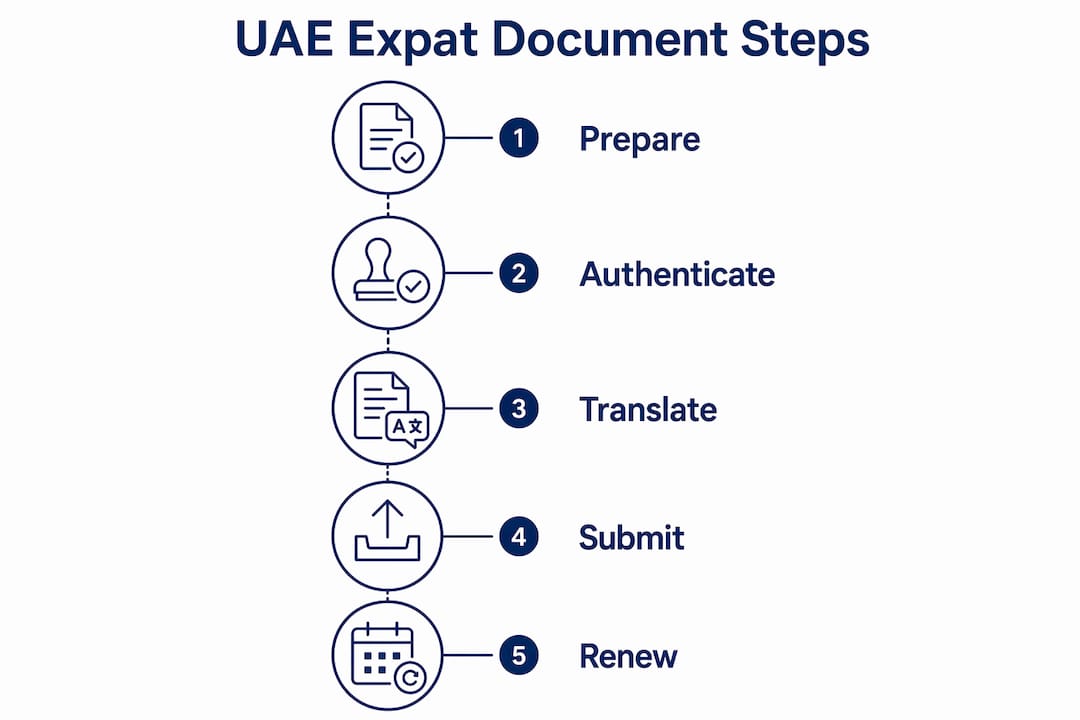
Personal records like birth certificates, marriage certificates, and divorce decrees require authentication before UAE authorities will accept them. The formal term for this process is attestation, and in some cases, apostille certification. Understanding the difference matters because using the wrong process wastes time and money.
Attestation is a chain of official endorsements. For Filipino expats, the chain starts in the Philippines and ends at the UAE Embassy. Vital records require attestation or apostille for legal acceptance in UAE visa and residency applications. Starting this process before you leave the Philippines prevents delays once you are already in the UAE.
The standard authentication steps for Philippine documents are:
Obtain a certified copy of the document from the Philippine Statistics Authority (PSA) or the issuing agency.
Get it authenticated by the Department of Foreign Affairs (DFA) in the Philippines.
Submit it to the UAE Embassy in Manila for final attestation.
Have it translated by a certified translator if the document is not in English or Arabic.
Submit to the relevant UAE authority such as the Ministry of Foreign Affairs or the court, depending on the document’s purpose.
Processing times vary by document type and volume at each office. Starting attestation before departure avoids visa renewal delays that can cost you your job or your family’s residency status.
The difference between legalization and attestation is a common source of confusion. Attestation confirms a document’s authenticity through a chain of official stamps. Legalization is a broader term that sometimes refers to the same process but can also include additional steps required by specific UAE courts or government bodies. Check the legalization vs. attestation requirements for your specific document type before you begin.
Pro Tip: Keep the original PSA-certified copy separate from your attested copy. UAE authorities sometimes require both, and replacing a lost original takes weeks.
Missing an apostille or submitting inconsistent document versions are the two most common mistakes Filipino expats make during attestation. Double-check that the name spelling on every document matches your passport exactly.
Which financial, medical, and professional documents should you maintain?
Beyond residency papers, Filipino expats need a second layer of documents covering finances, health, and professional credentials. These records support visa renewals, employment applications, and emergency situations.
Financial documents to keep current and accessible include:
Bank statements from the last three to six months, required for visa renewals and lease agreements.
Tax returns from the last three years, especially if you have income sources outside the UAE.
Proof of remittances if you send money to the Philippines regularly, as this can support financial compliance records.
Medical records are equally critical. Keep your vaccination history, prescription records, and any specialist reports in both physical and digital form. Retaining the last three years of medical and tax records is the standard recommendation for expats managing cross-border obligations. These records also speed up health insurance claims and medical consultations in the UAE.
Professional credentials require the same attention. Diplomas, licenses, and certifications often need attestation before UAE employers or licensing bodies will recognize them. Your employment contract is a legal document governed by UAE labor law. Statutory notice periods and severance protections under the UAE labor code apply regardless of what your home country employer originally agreed to.
Legal residence and tax residence are two different statuses. Holding a UAE residence visa does not automatically exempt you from tax obligations in the Philippines or other jurisdictions. Consult a tax advisor if you have income from multiple countries.
Store physical copies in a secure folder and digital copies in an encrypted cloud service. Give a trusted family member in the Philippines access to the digital folder for emergencies.
What steps keep your documents valid and compliant in the UAE?
Staying compliant is an ongoing process, not a one-time task. Filipino expats who track renewal dates proactively avoid fines, visa rejections, and gaps in coverage.
Key steps to maintain document validity:
Passport renewal. Start the renewal process at least six months before expiration. The Philippine Consulate in Dubai processes renewals, but appointment slots fill quickly.
Residence visa renewal. Begin the renewal process 30 days before expiration. Late renewals trigger overstay fines.
Emirates ID renewal. Renew through the ICP portal or approved typing centers. Carry your ID at all times, as it is required for most government and private services.
Health insurance renewal. Review your policy 60 days before it expires. Confirm that dependents are covered under a separate plan to avoid the $136 monthly penalty per uncovered person.
Document copies. Keep certified copies of your passport, visa, Emirates ID, and health insurance card in a separate location from the originals.
Home country legal documents like Wills and Powers of Attorney do not automatically carry legal authority in the UAE. Expats must harmonize estate planning documents with UAE regulations to avoid conflicts over asset access. A UAE-registered Power of Attorney requires its own attestation process before local authorities will recognize it.
Report address changes to your employer and to the relevant UAE government portal. Your Emirates ID and visa records must reflect your current address. Failure to update this information can complicate renewals and official correspondence.
Pro Tip: Set calendar reminders 60 days before every document expiration date. One missed renewal can trigger a chain of compliance problems that takes months to resolve.
Key Takeaways
Filipino expats in the UAE need four mandatory documents at all times: a valid residence visa, Emirates ID, DHA-compliant health insurance, and a medical fitness certificate, and every personal record must be attested before UAE authorities will accept it.
Point | Details |
Four mandatory documents | Residence visa, Emirates ID, DHA health insurance, and medical fitness certificate are required for all UAE residents. |
Attestation starts in the Philippines | PSA-certified documents must go through DFA and UAE Embassy authentication before UAE use. |
Dependents need separate coverage | Employer health plans rarely cover family members; lapses cost about $136 per person per month. |
Financial and professional records matter | Keep three years of tax returns, bank statements, and attested credentials for renewals and employment. |
Home country legal documents need local validation | Wills and Powers of Attorney from the Philippines are not automatically recognized in the UAE. |
What I’ve learned about document preparation after years of working with Filipino expats
The single biggest mistake I see Filipino expats make is treating document preparation as something they will handle after they arrive in the UAE. By then, the pressure is already on. Your employer is waiting for your Emirates ID. Your family’s visa is pending. Your health insurance window is closing. Every delay compounds the one before it.
Attestation timelines in the Philippines are longer than most people expect. The DFA alone can take several weeks during peak periods. Add the UAE Embassy processing time, and you are looking at a process that easily runs six to eight weeks if you start late. I always tell people: begin your attestation before you book your flight.
The health insurance gap for dependents catches families off guard more than any other issue. Most Filipino expats assume their employer plan covers everyone. It does not. UAE law requires separate coverage for each dependent, and the fines for a lapse add up fast. Check your policy documents the day you receive them.
The other area where I see real problems is estate planning. Filipino expats rarely think about Wills or Powers of Attorney until something goes wrong. A Will written in the Philippines has no automatic legal standing in the UAE. If you own assets here or have dependents relying on you, get proper legal advice and have your documents validated under UAE law. It is not a complicated process, but it must be done correctly.
Document management is not glamorous work. But getting it right is what keeps your life in the UAE running without interruption.
— Harris
How Harrisncharms supports Filipino expats with document attestation
Filipino expats navigating UAE document requirements do not have to figure it out alone. Harrisncharms specializes in document attestation services for Filipino expats in the UAE, covering everything from birth and marriage certificate authentication to apostille processing and visa document support.

Whether you need help with your UAE apostille and attestation requirements or want to confirm the right steps for your specific documents, Harrisncharms handles the process so you avoid costly errors and processing delays. The team understands the full authentication chain from Philippine government offices to UAE authorities, and works with Filipino expats at every stage of their residency. Visit Harrisncharms to get started with a consultation.
FAQ
What are the mandatory legal documents for expats in the UAE?
Every UAE expat must hold a valid residence visa, Emirates ID, DHA-compliant health insurance, and a medical fitness certificate. Your passport must also be valid for at least six months beyond your entry date.
Do Filipino expats need to attest documents from the Philippines?
Yes. Personal records like birth and marriage certificates must be authenticated through the DFA in the Philippines and then attested at the UAE Embassy before UAE authorities will accept them.
Does employer health insurance cover dependents in the UAE?
Employer plans typically cover only the employee. UAE law requires separate health insurance for each dependent, and failing to maintain coverage incurs a monthly penalty of about $136 per uncovered person.
Is a Philippine Will or Power of Attorney valid in the UAE?
Not automatically. Home country legal documents do not carry legal authority in the UAE without local validation. Expats must have these documents attested and registered under UAE law to be recognized by local authorities.
What is the difference between attestation and apostille for UAE documents?
Attestation is a chain of official endorsements from the issuing country to the UAE Embassy. Apostille is a single internationally recognized certification used under the Hague Convention. The UAE accepts both, but the required process depends on the document type and its intended use.
Recommended
Comments