
Police Clearance Attestation: A Guide for Filipinos in UAE

Police clearance attestation is the government-led process that certifies your Police Clearance Certificate (PCC) as authentic and legally valid for use in another country. For Filipinos living and working in the UAE, understanding what is police clearance attestation is not optional. It is the difference between a job offer moving forward and a visa application stalling for months. The process runs through multiple verification layers, from notarization to Ministry of Foreign Affairs authentication to embassy legalization, and each layer confirms that your criminal background check is genuine and issued by a recognized authority.
What is police clearance attestation and why does it matter?
Police clearance attestation officially verifies your criminal record check through a chain of government authorities, making it legally recognized for employment, residency, or study abroad. Think of it as a chain-of-custody stamp. Each authority in the chain confirms that the previous one was legitimate, so by the time your document reaches a UAE employer or government office, there is no question about its origin.
One detail that surprises many Filipinos: even English-language PCCs require formal attestation. Attestation focuses on confirming document origin, not language. A certificate written in English still needs the full verification chain before a foreign government will accept it as legally binding.

The UAE is not a signatory to the Hague Apostille Convention. That distinction matters because countries outside the Hague Convention require complete attestation and embassy legalization rather than a simpler apostille stamp. Filipinos targeting UAE employment cannot shortcut this with an apostille. You need the full process. Understanding the difference between attestation and apostille before you start saves you from submitting the wrong documents entirely.
What documents do you need for police clearance attestation?
Preparation is where most applications succeed or fail. Having the right documents ready before you start prevents costly delays mid-process.
The core requirements for police clearance attestation include:
Original Police Clearance Certificate (PCC): Issued by the Philippine National Police (PNP) or the relevant authority in any country where you have lived. The certificate must be recent, typically issued within the last 6–12 months.
Valid passport copy: A clear copy of your passport’s data page, showing your full name, nationality, and validity dates.
Government-issued identification: A secondary ID may be required depending on the issuing authority.
Notarized authorization letter: Required if you are using a third-party agent or document service. Proper legal authorization is mandatory for successful third-party processing. Without it, ministries will refuse to accept the submission.
Multi-country clearances if applicable: All countries where you lived for 12 or more months since age 16 must be covered by certified clearances. This catches many Filipinos who worked in a third country before moving to the UAE.
Pro Tip: Check the issue date on your PCC before submitting anything. Many embassies reject certificates older than 6 months at the time of submission, which means you may need to apply for a fresh PCC before starting attestation.
Jurisdiction matters too. Your PCC must come from the authority that covers the area where you actually lived, not just any police office. A certificate issued by the wrong jurisdiction will be flagged during Ministry of Foreign Affairs verification.
How to secure police clearance attestation: the step-by-step process
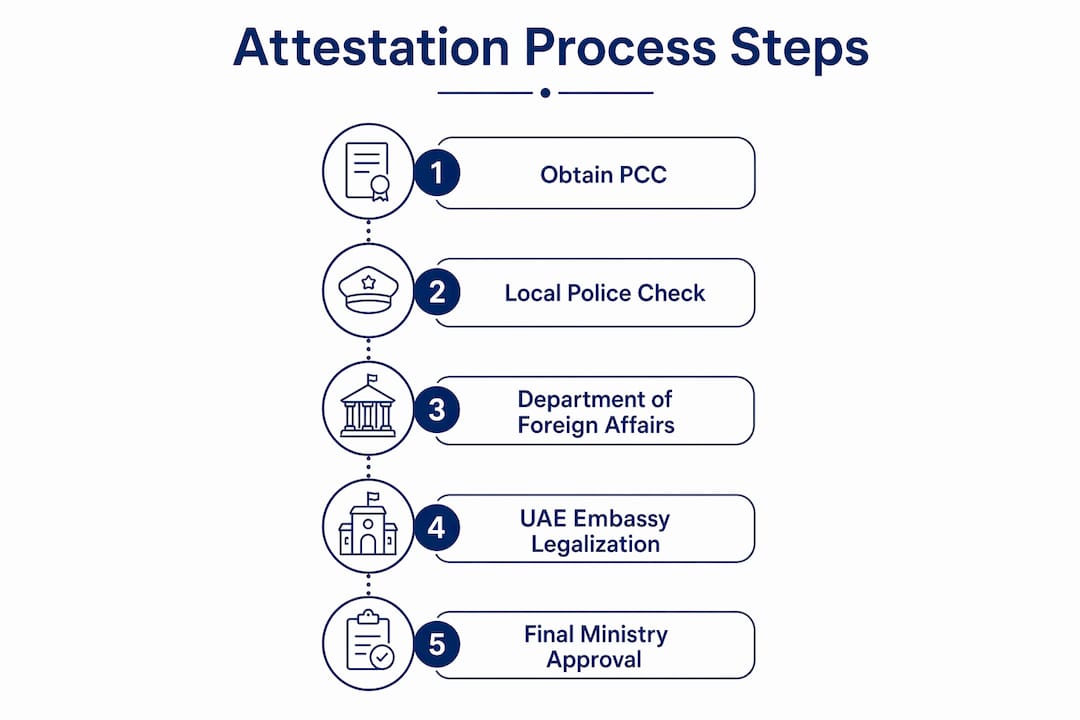
The attestation process for non-Hague countries like the UAE follows a structured four-step verification sequence. Skipping or reordering steps causes rejection.
Notarization. A licensed notary public confirms the authenticity of the PCC and the identity of the signatory. Notarization confirms personal identity and signature authenticity locally, while attestation confirms document legitimacy for international use. These are legally distinct steps, and notarization must come first.
Home Department or issuing authority verification. The relevant government department in the Philippines, such as the Department of Justice (DOJ) or the National Bureau of Investigation (NBI) depending on the certificate type, verifies that the document is genuine and was issued through proper channels.
Ministry of Foreign Affairs (MOFA) authentication. The Philippine Department of Foreign Affairs (DFA) authenticates the document, confirming it meets the standards required for international use. In the UAE, the Ministry of Foreign Affairs also plays a role in accepting and recognizing the document on the receiving end.
Embassy or consulate legalization. The UAE Embassy in the Philippines, or the Philippine Embassy in the UAE depending on the direction of the process, applies the final legalization stamp. This is the step that makes the document legally usable within the UAE.
Background checks from local police can be completed in 2–3 days, but the full attestation process involving ministries and embassies typically takes 2–4 weeks. Embassy backlogs can push that timeline further. Applying at least two months before your deadline is the standard advice, and it is advice worth following.
Pro Tip: Track your application at each stage. Ask for a reference number or receipt at every submission point. If a document gets lost or delayed at one ministry, you need proof of submission to resolve it quickly.
For Filipinos with residence history in multiple countries, coordinate your clearances before starting attestation. Each country’s clearance may need its own notarization and verification before the Philippine DFA will accept the full package.
Common mistakes that cause police clearance attestation to fail
Knowing where the process breaks down is as useful as knowing the steps themselves. These are the errors that consistently cause rejections.
Submitting an outdated PCC. Submitting out-of-date certificates is the top error leading to attestation rejection. Many embassies refuse PCCs older than 3–6 months at the time of submission. This forces a full reapplication, including getting a new PCC.
Jurisdiction mismatch. Mismatch between the issuing authority and the Ministry of Foreign Affairs recognized jurisdiction is the main cause of embassy-level document rejection. Your PCC must come from the authority that covers your actual place of residence, not a convenient nearby office.
Missing notarized authorization letter. If you use an agent or document service, the authorization letter must be notarized and must specifically state the agent’s rights to submit and collect documents. A general letter or an unnotarized one will not pass.
Incomplete multi-country coverage. Filipinos who lived in Saudi Arabia, Qatar, or another country before the UAE often forget to include clearances from those countries. Visa and employment applications require coverage for every country of residence for 12 or more months since age 16.
Choosing apostille instead of attestation. The UAE requires full attestation and legalization, not an apostille. Selecting the wrong process wastes time and fees. Review why attestation gets rejected before submitting to avoid this mistake.
How police clearance attestation supports employment and legal processes in the UAE
An attested PCC is a certified legal record confirming no criminal background. UAE employers, government departments, and immigration authorities treat it as proof that your background check is genuine and internationally verified.
The practical impact shows up in several key situations:
Work visa and residency permit applications. UAE immigration authorities require an attested PCC as part of the standard documentation package for new work visas and residency permits.
Employment contracts in regulated industries. Healthcare, education, finance, and security sectors in the UAE routinely require attested PCCs before finalizing contracts. An unattested certificate is not accepted as a substitute.
Sponsorship transfers and visa renewals. Changing employers or renewing a long-term residency often triggers a fresh PCC requirement. Keeping your clearance current prevents delays in these transitions.
Legal proceedings and court documentation. Attested PCCs carry legal standing in UAE courts and government offices. An unattested copy does not.
The importance of police clearance in this context goes beyond compliance. An attested PCC signals to employers and authorities that you have completed a verified, internationally recognized background check. That credibility matters in a competitive job market. Filipinos who understand attestation service options available in the UAE are better positioned to move through these processes without unnecessary delays.
Renewing your PCC before it expires is also worth planning. If your residency or employment situation changes, a current attested PCC keeps you ready for any documentation request without scrambling at the last minute.
Key Takeaways
Police clearance attestation is a mandatory, multi-step government verification process that makes your criminal background check legally valid for employment, residency, and legal use in the UAE.
Point | Details |
Attestation vs. apostille | The UAE requires full attestation and embassy legalization, not an apostille stamp. |
Document freshness | Your PCC must be issued within 6–12 months; embassies reject older certificates at submission. |
Four-step process | Notarization, Home Department verification, MOFA authentication, and embassy legalization are all required. |
Multi-country coverage | Clearances from every country where you lived 12 or more months since age 16 must be included. |
Authorization letters | Third-party agents must carry a notarized authorization letter or ministries will refuse the submission. |
What I have learned from watching attestation go wrong
The most common thing I see is Filipinos treating police clearance attestation like a single errand. They get the PCC, hand it to someone, and expect it to come back stamped and ready. That is not how this works.
Attestation is a chain. Every link in that chain has its own requirements, its own timeline, and its own reasons to reject your document. I have seen applications stall for weeks because the issuing police station did not match the jurisdiction listed on the DFA’s records. I have seen agents turned away at ministry counters because the authorization letter was signed but not notarized. These are not rare edge cases. They happen regularly.
My honest advice: start earlier than you think you need to. Two months of lead time sounds like a lot until you are waiting on a ministry appointment during a holiday period. Verify your issuing authority before you get the PCC, not after. And if you are using an agent, confirm that their authorization letter meets the exact legal standard required, not just a general consent form.
The role of government in attestation is more involved than most people expect. Each agency is checking the one before it. That is the point of the chain. Respecting that structure, and preparing for it properly, is what separates a smooth application from a frustrating one.
— Harris
How Harrisncharms helps Filipino expats with document attestation
Harrisncharms specializes in document attestation services for Filipino expats in the UAE, including police clearance certificate attestation. The process has multiple steps, strict document requirements, and tight timelines. Getting one detail wrong means starting over.

Harrisncharms handles the coordination between Philippine and UAE authorities, checks your documents for compliance before submission, and manages the process so you are not chasing ministry counters on your own. For Filipinos navigating employment or residency requirements in the UAE, professional support reduces errors and keeps your application moving. Visit Harrisncharms to find out how the team can assist with your specific attestation needs.
FAQ
What is police clearance attestation?
Police clearance attestation is the official government process that verifies a Police Clearance Certificate as authentic and legally valid for use in another country. It involves notarization, Ministry of Foreign Affairs authentication, and embassy legalization.
Does the UAE require attestation or apostille for a PCC?
The UAE requires full attestation and embassy legalization. The UAE is not a member of the Hague Apostille Convention, so an apostille stamp is not accepted as a substitute.
How long does police clearance attestation take?
The full process typically takes 2–4 weeks, depending on embassy workloads and ministry processing times. Applying at least two months before your deadline is strongly recommended.
What happens if my PCC is older than 6 months?
Most embassies reject PCCs older than 3–6 months at the time of submission. You will need to obtain a new certificate and restart the attestation process from the beginning.
Do I need clearances from every country I have lived in?
Yes. All countries where you lived for 12 or more months since age 16 must be covered by certified clearances. Missing a country from your residence history is a common reason for visa and employment application rejection.
Recommended
Comments