
OFW guide to document attestation in the UAE

Many Filipino expats in the UAE assume a DFA Apostille is the finish line. It isn’t. This ofw guide to document attestation exists because that single misunderstanding costs thousands of workers rejected visa applications, delayed job starts, and unnecessary stress every year. The UAE is not a member of the Hague Apostille Convention, which means Philippine-issued documents need to pass through a multi-step legalization chain before any UAE authority will recognize them. Whether you are renewing a residency visa, sponsoring a family member, or starting a new job, knowing every step of this process protects both your time and your career.
Table of Contents
Understanding why document attestation matters for OFWs in the UAE
Step 1: Source verification and DFA Apostille process explained
Step 2: UAE Embassy attestation via VFS Global and procedural timelines
Step 3: Final UAE MOFAIC attestation and certified Arabic translation requirements
Common pitfalls and expert tips for smooth document attestation
The hidden complexity OFWs face: why attestation is more than just stamps
Key Takeaways of ofw guide to document attestation
Point | Details |
Multi-step legalization | UAE requires documents to complete DFA Apostille, UAE Embassy stamp, and MOFAIC attestation for legal use. |
Correct source verification | Verify documents with the proper Philippine issuing authority before DFA Apostille to avoid rejections. |
Certified Arabic translation | Judicial or corporate documents need certified Arabic translations to be accepted by UAE authorities. |
Plan ample processing time | Expect approximately 2 to 3 weeks for full attestation including VFS Global and MOFAIC steps. |
Professional support advised | Using expert attestation services helps avoid costly mistakes and ensures compliance with 2026 UAE regulations. |
Understanding why document attestation matters for OFWs in the UAE
Document attestation is the process by which authorities verify that a document issued in one country is genuine and legally acceptable in another. For Filipino expats, this is not optional. Document legalization is mandatory for residency, employment, and family sponsorship for the over 700,000 Filipinos residing in the UAE.
The core issue is jurisdictional. The Philippines uses the Apostille system, which works between member countries of the Hague Convention. The UAE is not one of them. So a DFA Apostille is not an endpoint. It is just the first step in a longer chain of verification that UAE authorities require.
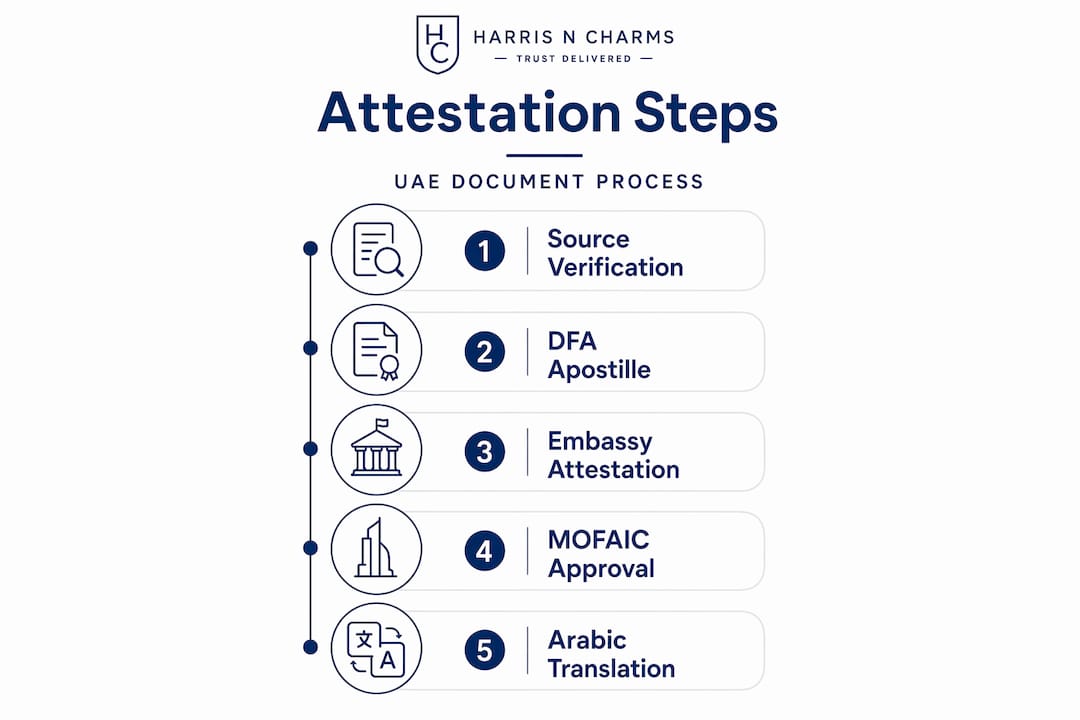
Here is what the full legalization chain looks like for most Filipino documents:
Source verification by the correct Philippine issuing authority (PSA, CHED, or PRC depending on document type)
DFA Apostille from the Department of Foreign Affairs in Manila
UAE Embassy attestation in Manila, routed through VFS Global
MOFAIC attestation once you arrive in the UAE, confirming final legitimacy within the Emirates
Skipping or misunderstanding any of these stages does not just slow down your application. It can trigger outright rejection, forcing you to restart the entire process from the beginning.
The cost of not knowing this is real. Workers have missed job offer deadlines because their documents were rejected at MOFAIC. Families have faced delayed reunification because a sponsor’s marriage certificate was missing the VFS Global stamp. Every stage matters.
Step 1: Source verification and DFA Apostille process explained
With the legal reasons clear, the next step is obtaining your DFA Apostille, starting with correct source verification.
This is where most people make their first mistake. Before the DFA can issue an Apostille, your document must be verified by the correct Philippine authority. Use the wrong one and the DFA will reject your application outright.
Here is how it breaks down by document type:
Civil registry documents (birth certificates, marriage certificates, death certificates): Must come from the Philippine Statistics Authority (PSA).
Educational documents (diplomas, transcripts): Must be verified by the Commission on Higher Education (CHED) before DFA submission.
Professional licenses (nursing, engineering, teaching): Must first be authenticated by the Professional Regulation Commission (PRC).
Other government-issued documents: Check the specific issuing agency requirements before submitting to DFA.
Once your document passes source verification, you book an appointment through the DFA Authentication Division. That system handles over 1,000 daily slots and accepts no walk-ins except for seniors, pregnant women, or persons with disabilities who have supporting medical documentation.
Regular processing takes four working days. Expedited processing is available for a higher fee and is worth considering if your employment or residency deadline is tight. Always check available slots early since high-demand periods around peak hiring seasons can push appointment availability back by weeks.

Understanding the PSA and DFA Apostille requirements in detail before you submit will save you from the most common first-stage rejection.
Pro Tip: Print a copy of your source document before submitting it for DFA Apostille. If the DFA finds a discrepancy, you need a reference point to trace where the error originated. Having that copy saves days of backtracking.
Step 2: UAE Embassy attestation via VFS Global and procedural timelines
Once your DFA Apostille is secured, the next critical step is Embassy attestation managed through VFS Global.
As of May 1, 2024, all UAE Embassy submissions in Manila go through VFS Global, adding 5 to 7 working days to your total processing window. This was a significant procedural change that many OFWs are still unaware of, and missing it causes costly bottlenecks.
What you need to bring to VFS Global for UAE Embassy attestation:
Original DFA Apostille document
Photocopies of the Apostille certificate
Your valid Philippine passport (some document types require it)
Completed application form from the VFS Global portal
Applicable attestation fees (check the current VFS schedule as fees are updated periodically)
Key stat: The VFS Global processing window is 5 to 7 working days. This does not include the time needed to book a VFS appointment, which can itself take several days during busy periods.
Factor this window carefully into your planning. If your UAE employer expects you to start within 30 days and you have not started your attestation process, 5 to 7 days for Embassy processing alone could become the bottleneck that costs you the offer.
Pro Tip: Check the VFS Global portal every morning. Appointment slots are released daily and fill quickly. Setting a calendar reminder to check at 8 a.m. on weekdays significantly improves your chances of booking within your target week.
The Philippines document attestation process at this stage is primarily logistical. The documents either meet the requirements or they don’t. There is no appeal window once rejected. Prepare thoroughly before you walk in.
Step 3: Final UAE MOFAIC attestation and certified Arabic translation requirements
After securing the Embassy stamp, your documents need final MOFAIC attestation and possibly Arabic translation to be fully accepted.
The UAE Ministry of Foreign Affairs and International Cooperation (MOFAIC) provides the last attestation stamp confirming that your document is legitimate within the Emirates. This is the stage most often overlooked by newly arrived expats who assume their documents are ready to use after Embassy attestation. They are not.
Additionally, if your documents are intended for judicial use, court proceedings, corporate registration, or business licensing, you will also need a certified Arabic translation from a licensed translator recognized by UAE authorities. The certified Arabic translation requirement is mandatory for judicial or corporate documents and is not something you can substitute with an informal translation.
Here is a side-by-side comparison of what each track requires:
Requirement | Standard attestation | Attestation plus Arabic translation |
DFA Apostille | Required | Required |
UAE Embassy stamp via VFS | Required | Required |
MOFAIC attestation | Required | Required |
Certified Arabic translation | Not required | Mandatory |
Typical use case | Visa, residency, employment | Court, corporate, business registration |
Estimated total timeline | 10 to 15 working days | 14 to 20 working days |
Additional cost | Standard fees apply | Higher due to translation fees |
The Arabic translation must be completed by a licensed professional, not a bilingual colleague or an online service. UAE government offices and courts verify translator credentials. An uncertified translation will get your document rejected at MOFAIC or the relevant authority.
Pro Tip: Confirm in writing with your employer or the relevant UAE government entity whether they accept digital Apostille copies or require physical stamps before you finalize your submission. Some entities, particularly private companies, accept digital copies. Government offices almost always require originals.
Common pitfalls and expert tips for smooth document attestation
Understanding the steps is crucial, but avoiding common errors is equally critical for a smooth attestation experience.
Three mistakes show up again and again in failed attestation cases. The first is using the wrong issuing authority. The most common rejection cause is failing to verify that a document originates from the correct Philippine issuing authority before DFA Apostille submission. Sending a diploma straight to DFA without CHED verification, for example, results in an automatic rejection.
The second is missing certified Arabic translations for documents that need them. If you are unsure whether your specific document requires Arabic translation, ask before submitting, not after.
The third is typographical errors. A single wrong character in a name, a transposed date, or a mismatched middle name between your passport and your documents can force you to restart the entire process. This resets your timeline and can delay visa approvals, job start dates, and family sponsorship by weeks.
Key practices to protect yourself:
Cross-reference all three documents before submission: your source document, your DFA Apostille, and your Embassy stamp must all be consistent.
Check expiry on your source documents before submitting. PSA documents have validity periods. An expired PSA certificate will fail at DFA.
Keep photocopies at every stage. If a document is lost by a service provider, you need proof of where it was in the chain.
Prepare attestation papers systematically, treating each stage as a separate checklist rather than one long to-do list.
“Every stage must meet exact specifications to guarantee professional growth in the UAE.”
Pro Tip: Create a document tracker spreadsheet with columns for document type, issuing authority, DFA Apostille date, VFS submission date, Embassy stamp date, and MOFAIC date. Tracking each stage prevents gaps and makes it easy to spot when a document is behind schedule.
The hidden complexity OFWs face: why attestation is more than just stamps
Most people think about document attestation as an administrative inconvenience, a few stamps to collect before the real work begins. After years of working with Filipino expats navigating UAE legalization, we see it differently.
The legalization process functions as a rigid procedural protocol where the integrity of each stage depends on the technical precision of the preceding one. Think of it less like collecting stamps at a post office and more like a load-bearing structure where removing or weakening one element compromises everything above it.
This framing matters because it changes how you prepare. You cannot afford to treat any single stage as “probably fine.” A small error at source verification does not just affect step one. It invalidates every stamp that follows. You end up redoing the entire chain.
The other hidden complexity is jurisdictional timing. Philippine agencies operate on Philippine government schedules. The UAE Embassy in Manila operates on UAE and Philippine holidays. VFS Global has its own submission windows. MOFAIC has processing queues that fluctuate with UAE public holidays and peak demand. All of these timelines are running simultaneously, and none of them wait for you to catch up.
This is precisely why professional attestation services for Filipino expats offer something beyond convenience. They offer risk management. When you have a job offer with a 30-day clock running and documents that need to clear four stages across two countries, having a professional team tracking each step is not a luxury. It is the difference between arriving on time and losing the offer entirely.
Get expert attestation support for your UAE journey
Knowing the steps is valuable. Having someone manage them for you is better. The attestation process involves coordinating across multiple Philippine government agencies, two countries, and shifting processing timelines, all while your employment or residency clock is running.

Harris N Charms specializes in document attestation for Filipino expats in the UAE, covering every stage from DFA Apostille to MOFAIC completion. The team handles source verification guidance, VFS Global submissions, certified Arabic translation coordination, and MOFAIC filing, with transparent fixed-fee pricing and real-time status updates so you always know where your documents stand. Whether you are starting fresh with a new employment visa or navigating family sponsorship, the full range of attestation services is built specifically for the Filipino expat experience in the UAE. Review the attestation guide for Filipino expats to understand what documents you need before getting started.
Pro Tip: Engage attestation support before you receive your job offer letter, not after. Aligning your document readiness with your visa timeline means you arrive in the UAE ready to work, not waiting on paperwork.
Frequently asked questions
Is a DFA Apostille alone enough for document use in the UAE?
No. Since the UAE is not a member of the Hague Apostille Convention, documents must also be attested by the UAE Embassy in Manila through VFS Global and then by the UAE Ministry of Foreign Affairs before they are legally recognized in the Emirates.
How do I book an appointment for the DFA Apostille service?
All applicants must book online at apostille.gov.ph. Walk-ins are not accepted except for senior citizens, pregnant women, or persons with disabilities who can present supporting medical documentation.
Do I always need a certified Arabic translation of my documents for UAE attestation?
Not always. Certified Arabic translations are mandatory for judicial or corporate documents, but standard employment and residency documents typically do not require translation unless specifically requested by the relevant UAE authority.
How long does the entire document attestation process usually take?
Expect roughly four working days for DFA Apostille, 5 to 7 working days for UAE Embassy attestation via VFS Global, and 1 to 3 days for MOFAIC attestation, which puts the full timeline at approximately 2 to 3 weeks, assuming no rejections or verification delays.
Can I use the DFA e-Apostille service for my UAE visa documents?
The DFA e-Apostille currently applies only to PSA-issued civil registry documents, and it is not universally accepted by all UAE authorities. Confirm with your specific employer or UAE government agency before relying on a digital copy.
Recommended
Comments