
NBI Renewal Process: A Step-by-Step Guide for 2026
- contact335627
- 2 days ago
- 7 min read

If your NBI clearance was issued in 2016 or later, your personal details haven’t changed, and you didn’t get flagged with a “hit,” you can renew fully online without setting foot in a branch. Start at Clearance or through the eGovPH Super App, enter your old NBI ID number, pay the fee, and choose home delivery. Most Metro Manila applicants receive their clearance within a few days.
If you don’t meet those conditions, you’ll need to file a new application, which means booking an appointment for biometrics at a branch.
Here’s the fast version of who goes where:
Renew online: clearance issued 2016 or later, no name or biometric changes, no prior “hit.”
File new application: clearance issued before 2014, name or personal data changed, lost your old reference number entirely, or you’re clearing a previous hit that requires fresh biometrics.
Abroad: mailed clearance through your embassy or consulate is often available for clearances issued from 2014 onward.
Key Takeaways
Eligible applicants can renew their NBI clearance entirely online through clearance.nbi.gov.ph or eGovPH, while everyone else needs a new biometric application at a branch.
Point | Details |
Check your issuance year first | Clearances from 2016 onward typically qualify for online renewal; pre-2014 clearances need a new application. |
Have your old NBI ID ready | The renewal system auto-populates your data once you enter this number correctly. |
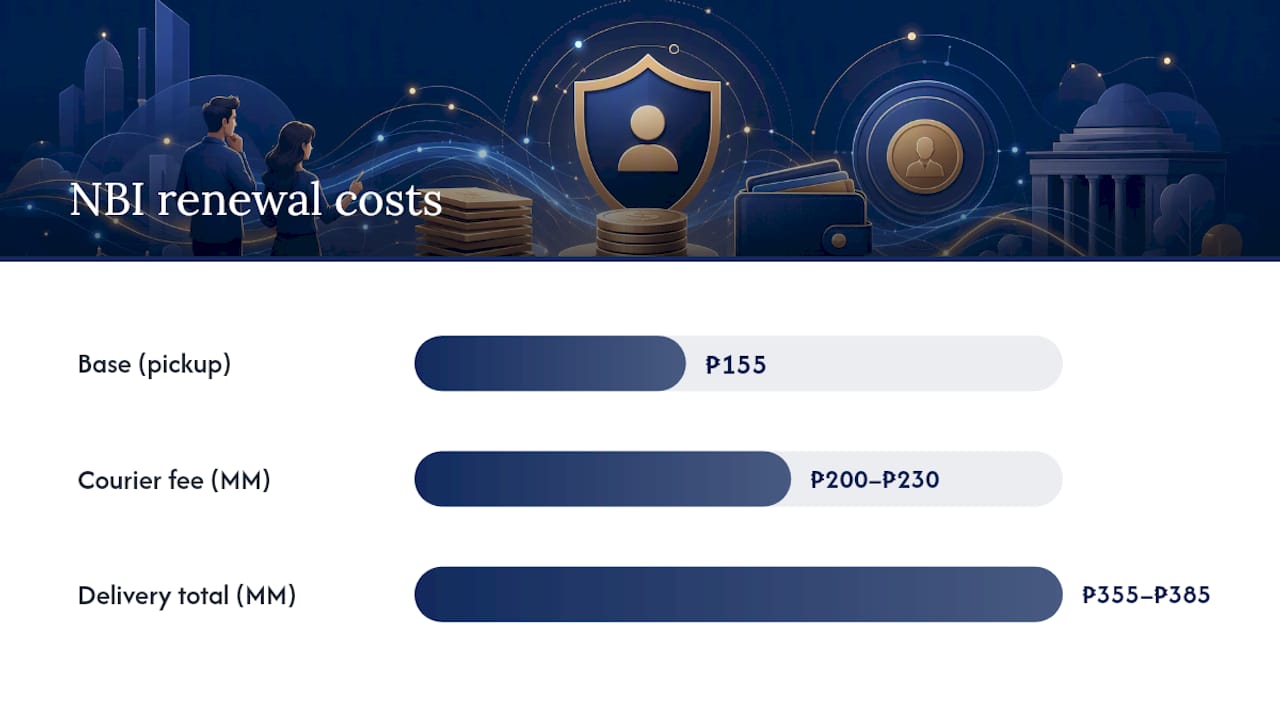
Budget ₱155 plus delivery | The base fee is ₱130 clearance plus ₱25 service fee, with courier fees adding roughly ₱200 to ₱230 in Metro Manila. |
Pay within 24 hours | Payment references expire after a day, canceling the transaction if you miss the window. |
Get post-renewal paperwork sorted | Harrisncharms handles attestation, apostille, and legalization once your renewed clearance is in hand. |
Table of Contents
Who Qualifies for the NBI Renewal Process Online?
The eligibility rules hinge almost entirely on when your last clearance was issued and whether your personal information has stayed the same.
Check the issuance year. Clearances from 2016 onward generally qualify for the quick online renewal path. Anything issued before 2014 gets routed automatically into a new application, since the NBI’s mailed-clearance guidelines treat pre-2014 documents as outdated for renewal purposes.
Confirm your personal data hasn’t changed. A legal name change, a corrected birth date, or a new civil status (like a recent marriage that changed your surname) will force a new application because the system needs fresh biometric verification to match the updated record.
Know what happens if you lost your old certificate. You don’t need the physical paper. You need the NBI ID number printed on it. If you genuinely can’t recall or locate that number, the portal will usually default you into the new-application flow since there’s nothing to auto-populate against.
The portal itself tells you which lane you’re in. Enter your old ID, and the official NBI clearance system will either show a “Renew” button or push you toward a fresh application, depending on what it finds in its records.
How Do You Complete the NBI Renewal Process Step by Step?
Once you’ve confirmed you’re eligible, the actual mechanics are straightforward if you follow the sequence in order.
Log in or register on clearance.nbi.gov.ph, or open the NBI service inside the eGovPH Super App if you’ve already verified your account there.
Locate the “Renew” option and enter your old NBI ID number exactly as it appears on your previous clearance. Typos here are the single biggest cause of failed renewals, so double check every digit.
Verify your personal data on screen. Your name, birth date, and address need to match what’s on file. If anything looks off, correcting it may bump you into a new application instead, so review carefully before confirming.
Choose your release method. Pick pickup at a branch or door-to-door delivery. If you choose delivery, enter your address precisely, including unit numbers and landmarks, since courier partners can’t call to clarify a vague address.
Pay through your chosen channel. Note that payment references expire after 24 hours. Miss that window and the transaction cancels outright, forcing you to generate a new reference from scratch.
Save your confirmation. Keep the reference number and any email or SMS confirmation. If you chose delivery, watch for courier tracking details; if you chose pickup, note the date you’re cleared to appear at the branch.
Pro Tip: Photograph or scan your old clearance before you start, especially the section showing your NBI ID number. It’s the one detail the entire renewal hinges on, and hunting for a misplaced document mid-application wastes time you don’t need to lose.
When Do You Need a New NBI Application Instead?
Some situations simply don’t qualify for renewal, no matter how carefully you follow the online steps.
Your clearance was issued before 2014.
You’ve legally changed your name, corrected your birth date, or updated your civil status.
You’ve completely lost your old NBI ID number with no record of it anywhere.
You have a prior “hit” that requires new biometric verification to clear.
For any of these, you’ll register an account, pay the applicable fee, and book an appointment for fingerprinting and photo capture at a branch. Bring at least one valid government-issued ID, and bring a PSA-issued birth certificate or marriage certificate if your application involves a name change. Branches don’t enforce a strict dress code, but arriving in something presentable avoids awkward looks at the photo booth. Same-day release is common if you don’t get flagged. If you do, expect the process to stretch several extra days while NBI staff verify your record against similar names in their database.
What Does the NBI Renewal Process Cost, and How Long Does It Take?
The base government fee is fixed, but your total cost depends on how you choose to receive your clearance.
Base fee: ₱130 clearance fee plus a ₱25 e-payment or service fee, totaling ₱155.
Delivery add-on: courier fees typically run an additional ₱200 to ₱230 within Metro Manila, with provincial shipping costing somewhat more depending on the destination.
Pickup: no extra courier fee, and it’s often the faster option if you’re near a branch and want your clearance the same day.
If you’re eligible for renewal and choose delivery, expect your clearance in about 2 to 7 days within Metro Manila, with provincial deliveries running longer depending on courier coverage. Same-day pickup is realistic if your record comes back clean with no hit.
Remember that 24-hour payment window. If your reference lapses before you pay, the system cancels the transaction and you’ll need to start the payment step over, though your earlier data entry usually isn’t lost.
How Do You Resolve a ‘Hit’ During NBI Renewal?
A “hit” happens when your name closely matches someone else’s record in the NBI database, or when there’s a pending case tied to a similar name. It doesn’t mean you did anything wrong. It means the system needs a human to confirm you’re not that other person.
Bring a PSA-issued birth certificate and marriage certificate if applicable, since these confirm your exact identity against the flagged record.
If the hit involves a court case, bring a Certificate of Finality or other court disposition showing the case was dismissed or resulted in acquittal. Without this, NBI won’t release a clean clearance.
Resolution typically takes several working days, though complicated cases involving multiple court records can stretch to a few weeks.
If your case sits unresolved far longer than expected, escalate through NBI’s internal affairs channels or the Department of Justice.
Pro Tip: If you’re an OFW dealing with a hit from abroad, authorize a trusted representative through a notarized Special Power of Attorney early. Hit resolution almost always requires someone to physically submit documents, and waiting until you’re already stuck adds weeks to an already slow process.
Can You Renew Your NBI Clearance While Working Abroad?
Yes, and the embassy or consulate route is built specifically for this. Philippine embassies generally accept mailed-clearance renewals for clearances issued from 2014 onward, following the same logic as the domestic eligibility rules.
Check your embassy’s specific mailed-clearance procedure. Requirements vary slightly by post, so confirm current instructions with your local Philippine embassy or consulate before submitting anything.
Prepare a Special Power of Attorney if you want a representative in the Philippines to submit or collect documents on your behalf. Your representative will need the SPA, your old NBI ID number, and a valid ID of their own.
Coordinate fingerprinting if it’s required. Some cases still need biometric capture, which certain embassies can facilitate directly, while others will direct you to complete this step once you’re back in the Philippines.
Why Trust This Guide’s NBI Renewal Advice?
Harrisncharms specializes in document attestation, apostille, and legalization for Filipino expats, so the paperwork that follows an NBI renewal is our daily work.
Police clearance attestation guidance for UAE-based Filipinos
What Actually Matters Most in This Process
Most advice online treats the 2014 and 2016 cutoffs as trivia. They’re not. They’re the single fork in the road that decides whether you spend ten minutes on your phone or an entire morning at a branch, so get that detail right before you touch anything else.
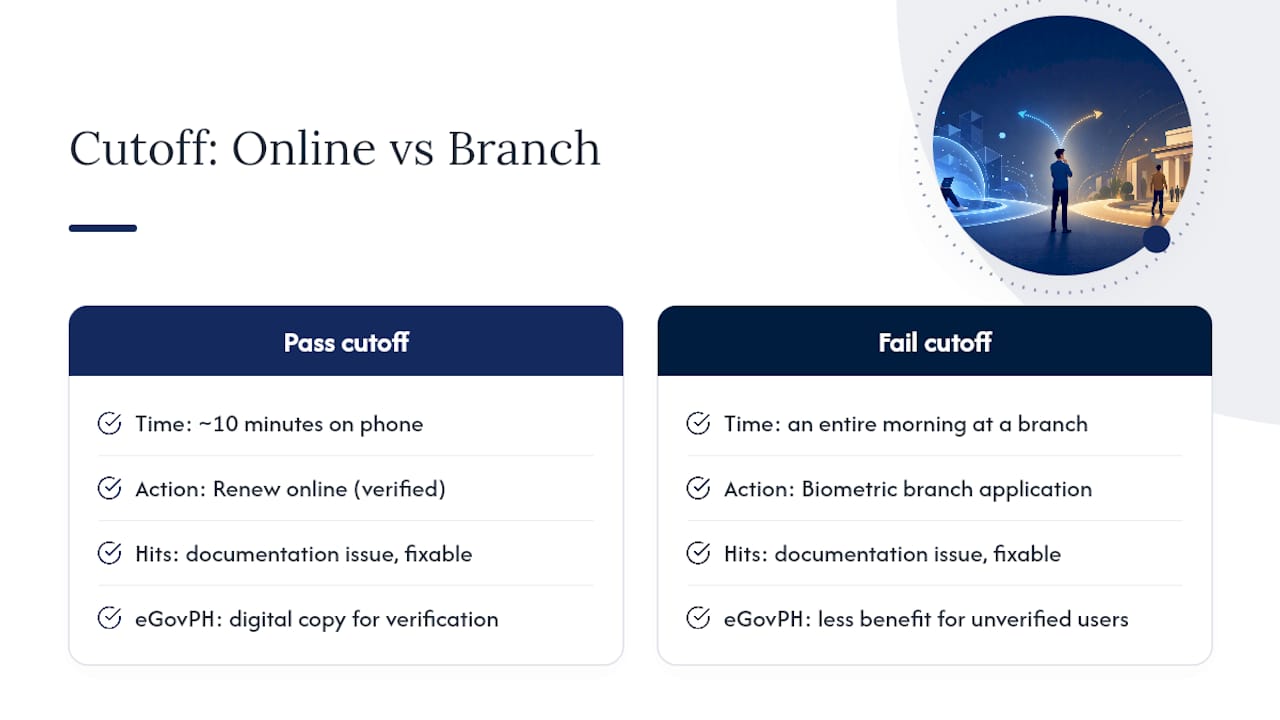
The overrated advice, in my view, is the constant warning about “hits” scaring people away from renewing online in the first place. A hit is a documentation problem, not a personal failure, and it’s resolvable with the right paperwork in hand. What’s underrated is how much smoother the eGovPH integration has made the entire flow for verified users, giving them a digital copy that works for employer or visa verification without waiting on a courier.
If you’re overseas, don’t wait until a job offer or visa deadline is bearing down on you. Set up your Special Power of Attorney now, confirm your embassy’s mailed-clearance rules, and treat the paperwork that follows renewal (attestation, apostille) as part of the same project, not an afterthought you’ll deal with later.
After Your NBI Renewal: What Comes Next
Getting your renewed NBI clearance is only half the job if you’re using it in the UAE. That document usually needs attestation, apostille, or legalization before any UAE authority, employer, or visa office will accept it, and that’s where the paperwork tends to stall for people juggling work schedules abroad.

Harrisncharms handles attestation, apostille, notarization, and courier coordination for Filipino expats who don’t have time to chase government offices between shifts. We work regularly with OFWs facing urgent visa deadlines, complex hit-resolution logistics from overseas, and employers who need documents legalized fast. If your renewed clearance needs to be recognized outside the Philippines, start your document attestation with Harrisncharms and skip the guesswork of navigating it solo.
Sources
Recommended
Comments