
What Is CAV Authentication for Philippine School Documents?
- contact335627
- 3 days ago
- 8 min read
Certification, Authentication, and Verification (CAV) confirms that your Philippine school record is genuine and issued by a real institution. Start at the correct agency for your document type:
Higher education records (college diploma, TOR): apply through the CHED eCAV portal
Basic education records (elementary, junior/senior high, ALS/PEPT): apply through your regional DepEd office
Pick your lane first. Everything else in this guide builds from that one decision.
Key Takeaways
CAV succeeds when applicants match their document to the correct agency, submit certified true copies with correct registrar signatures, and follow each portal’s exact upload or appointment rules.
Point | Details |
Match agency to document | Use CHED eCAV for college records and your regional DepEd office for basic education records. |
Get certified copies early | Request certified true copies from your registrar weeks ahead; some schools take several business days. |
Follow upload order exactly | CHED rejects unclear scans and wrong page order, a leading cause of processing delays. |
Check regional appointment rules | Some DepEd regions, like Region III, now require online scheduling and no longer accept walk-ins. |
Consider a managed service for overseas filing | Harrisncharms handles registrar pickup, CHED/DepEd transmittal, DFA apostille follow-up, and courier delivery to the UAE. |
Table of Contents
What Does CAV Cover, and When Do You Actually Need It?
CAV verifies that a school record, your transcript, diploma, or Form 137, matches what the issuing school actually has on file. It is not a translation, and it is not the same as an apostille. Think of it as the government putting its signature next to the school’s, confirming “yes, this document is real.”
You will typically need CAV for:
Overseas employment applications, including OFW processing
Immigration or visa petitions abroad
Credential evaluation for foreign universities
Professional licensing outside the Philippines
School transfers between institutions
Scholarship or grant applications requiring verified academic history
You generally do not need CAV if you are just handing a copy to another Philippine school for internal records or requesting a duplicate for personal filing. CAV becomes essential the moment a document has to cross a border or satisfy a foreign government’s paperwork, which is also where it connects to a longer chain involving document verification and, eventually, apostille.
Who Issues CAV, and What Does Each Agency Do?
Three agencies split the work, and knowing which one owns your document saves real time.
CHED issues CAV for college and university records: diplomas, transcripts, and special orders. Applications run through the CHED eCAV portal.
DepEd handles CAV for basic education records, elementary through senior high, plus ALS and PEPT certificates, with rules that vary somewhat by region.
DFA does not issue CAV. It handles the apostille or consular legalization that usually comes after CAV, when a document is headed abroad.
Your school registrar sits at the front of this chain. They certify true copies, sign transmittals, and forward the paperwork that CHED or DepEd will authenticate. DepEd’s own guidance lists exactly which forms come from the school versus the school division office.
How Do You Apply for CAV Step by Step?
The CHED eCAV process follows a fixed sequence, and skipping a step is the fastest way to get bounced back to square one.
Request certified true copies from your registrar first. Before you touch the eCAV portal, secure a certified true copy (CTC) of your transcript and diploma, signed by your school’s current registrar. Institutions like Mapúa University publish their own request procedures, and many registrars need several business days to process CTCs, so build that lead time in.
Create your eCAV account and select your applicant type. CHED separates requirements slightly for graduates, undergraduates, and unit earners, so pick the correct category before uploading anything.
Scan your documents cleanly. CHED wants clear PDF scans in the correct page order; blurry photos or scrambled page sequences are a top cause of rejection, according to CHED’s own eCAV upload guidelines.
Upload in the order CHED specifies, pay the processing fee online, and submit.
Track your application and download the completed CAV document once it clears, or arrange pickup if a physical copy is required.
For basic education records, the flow looks similar but runs through your regional DepEd office instead of an online portal in most cases. One major shift: DepEd Region III now requires online appointment scheduling for all CAV applications starting August 18, 2025, and walk-ins are no longer accepted there. Other regions may follow similar rules, so check your local DepEd page before showing up in person.
Pro Tip: Open your certified true copy and your scanned PDF side by side before uploading. A missing registrar signature or a page out of order is invisible on a phone screen but obvious on a desktop monitor, and it is the single most common reason eCAV submissions get sent back.
What Documents Do You Need for CHED vs. DepEd CAV?
The checklist splits cleanly by education level, and mixing them up wastes an application cycle.
For CHED (higher education):
Certified true copy of your Transcript of Records, signed by the current registrar
Certified true copy of your diploma
Clear, correctly ordered PDF scans (no phone-camera photos of paper)
Valid government ID matching the name on your records
For DepEd (basic education):
Form 137 or SF10 (student permanent record)
Diploma or certificate of graduation
Relevant CAV forms (Form 4, Form 5 transmittal, and others depending on your case)
PSA birth certificate
Passport-size photos
If someone is applying on your behalf, add an authorization letter or a Special Power of Attorney. If you’re overseas, that SPA needs notarization and authentication by the nearest Philippine embassy, according to DepEd’s representative requirements. Skip that embassy step and expect rejection at intake.
Pro Tip: Never submit a scanned photo taken at an angle. Use a flatbed scanner or a scanning app that corrects perspective, and save files as PDF, not JPEG, unless the portal explicitly asks for images.
How Long Does CAV Take, and What Does It Cost?
Processing time depends heavily on which agency you’re dealing with and whether your paperwork is clean on the first try. One commentary on the full authentication chain reports an end-to-end estimate of 20 to 25 working days for CAV plus DFA apostille combined, though the 2025 rollout of DFA’s e-Apostille option has reduced processing time for some applicants.
Fees vary by agency and applicant type, so confirm current amounts directly on the CHED eCAV portal or your regional DepEd page rather than relying on a number you saw somewhere else last year.
The most common causes of delay or outright rejection:
Incorrectly ordered or low-resolution file uploads
Missing or outdated registrar signatures on certified true copies
Incomplete transmittal forms between school and school division office
Showing up as a walk-in where your region now requires online appointments
If your application gets held or rejected, go back to the source document first. Nine times out of ten, it’s a signature, a scan quality issue, or a missing form, not a systemic problem with the agency.
How Does CAV Relate to Apostille for Documents Used Abroad?
CAV authenticates the record at the source, CHED or DepEd confirming your school actually issued it. Apostille or consular legalization is a separate, later step that makes the document legally recognized in another country.
The typical sequence for documents headed overseas:
School issues certified true copy
Registrar signs and notarizes (private school records sometimes need judge verification first)
CHED or DepEd completes CAV
DFA applies an apostille, standard for Hague Convention member countries since May 2019, or arranges consular legalization for non-member destinations
Before you start, check what the receiving country actually requires. Some accept apostille, others still demand embassy legalization, and getting that backward means redoing the whole chain. Our guide on apostille versus consular legalization breaks down which countries fall into which category. If you’re applying from overseas, prepare your documents for courier handling early. Loose or unsealed papers are a common reason couriers or receiving offices refuse a package.
How Can a UAE-Based Service Help With CAV and Apostille?
If you’re a Filipino expat in the UAE, coordinating pickup from a Philippine registrar, tracking a CHED or DepEd submission, and following up on a DFA apostille from thousands of miles away eats time you probably don’t have.
A managed attestation service can handle:
Pickup of certified true copies from your Philippine school or registrar
Transmittal to CHED or DepEd for CAV
Follow-up on DFA apostille processing
Courier delivery to the UAE
Certified translation where the receiving authority requires it
This works best for overseas applicants juggling tight deadlines, multi-document batches, or a representative authorization that needs to be handled correctly the first time. You still need to supply your original IDs, original certificates, and a notarized SPA if someone else is filing on your behalf. The service manages the paperwork trail; you provide the source documents.
Common Pitfalls We See in CAV Applications
Unsigned pages, low-resolution scans, and mismatched file names cause more rejections than any actual eligibility problem. Most applicants lose time on formatting, not qualification.
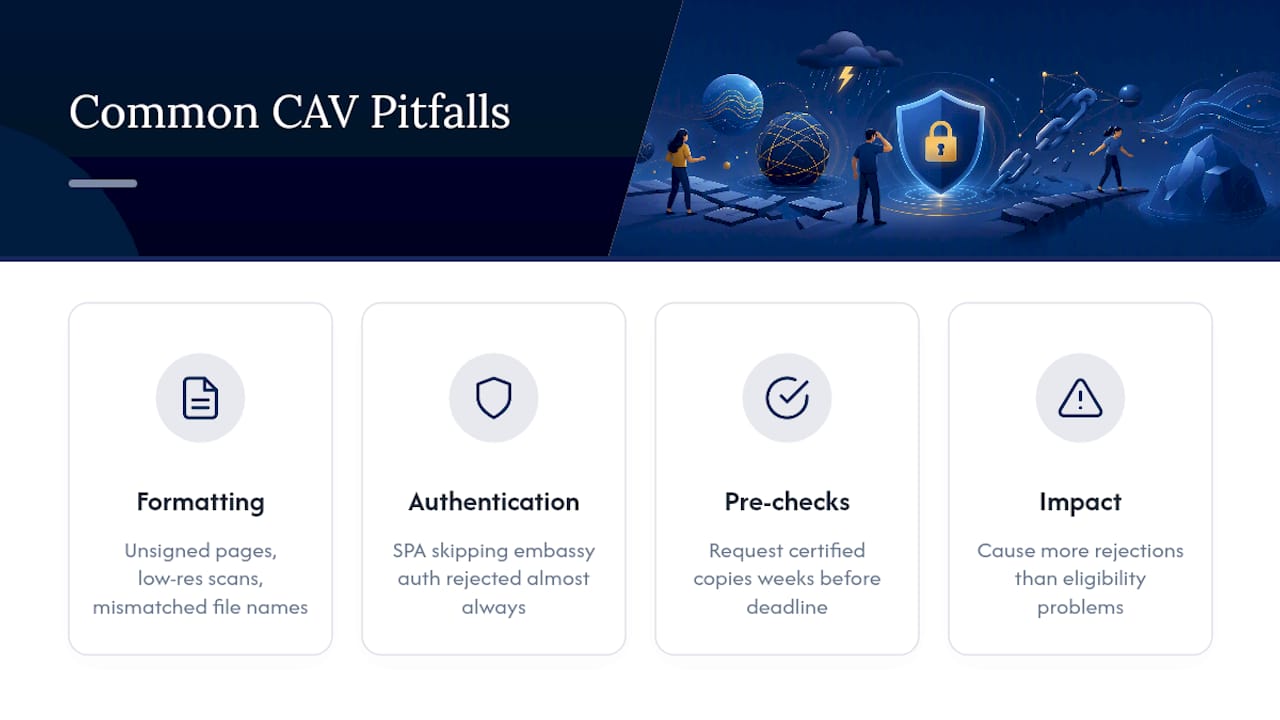
The fix is almost always the same: request certified true copies weeks ahead of any deadline, follow the exact upload order your agency specifies, and confirm your region’s appointment rules before you assume walk-ins still work.
One thing overseas applicants underestimate: a Special Power of Attorney that skips embassy authentication gets rejected almost every time, even when everything else is perfect.
Skip the Runaround, Let Harrisncharms Handle Your CAV and Apostille Chain
Harrisncharms picks up where the government portals leave off, handling pickup from your Philippine registrar, CHED or DepEd transmittal, DFA apostille follow-up, and courier delivery straight to you in the UAE, plus certified translation if your receiving country requires it.

If you’ve read this far, you already know how many places a CAV application can stall: a signature, a scan, an appointment rule that changed last year. Harrisncharms tracks those moving parts so you don’t have to chase three government offices from a different time zone. For students specifically, our step-by-step apostille guide for the UAE walks through what to expect. Ready to start? Request a quote and tell us which documents you need processed, we’ll map out the timeline and handle the rest.
Frequently Asked Questions
Where do I get CAV for my school documents? Higher education records go through the CHED eCAV portal. Basic education records go through your regional DepEd office, which may require an online appointment depending on your region.
What are the DepEd requirements for CAV? You generally need Form 137 or SF10, your diploma or certificate of graduation, relevant CAV transmittal forms, a PSA birth certificate, and passport-size photos, as outlined in DepEd’s basic education CAV guidance.
Is CAV required before getting an apostille? Yes, in most cases. DFA typically requires the school record to carry a valid CHED or DepEd CAV before it will apply an apostille for use abroad.
How do I verify that a CAV document is authentic? Check the CAV seal, signature, and reference number against the issuing agency’s records, and confirm the document was returned through the official eCAV portal or DepEd office rather than a third party you haven’t vetted.
What’s the difference between CAV and apostille? CAV confirms your school record is genuine at the source. Apostille, handled by DFA, makes that already-authenticated document legally recognized in another country. Our guide on apostille versus consular legalization explains which one your destination country requires.
Sources
Recommended
Comments