
Finish the MOFAIC Step in 1–3 Days for UAE Marriage Certificates: Marriage Certificate Attestation
Updated: 7 days ago
If your marriage certificate was issued outside the UAE, it needs a full chain of authentication ending with a stamp from the Ministry of Foreign Affairs and International Cooperation (MOFAIC) before any UAE authority will accept it. Start in the issuing country: get your document authenticated there and stamped by the UAE embassy or consulate. MOFAIC will not process a document that skips that embassy stamp. The MOFAIC fee is approximately AED 150 per document, and processing inside the UAE typically takes about two to three business days once the prior steps are completed.
TL;DR:
The marriage certificate must be authenticated through a chain starting with home-country approval, followed by UAE embassy or consulate attestation, and ending with MOFAIC final approval.
Using an apostille is suitable only in Hague Convention countries; non-member countries require full legalization, and skipping any step causes delays.
Only certificates issued outside the UAE need full attestation; certificates from UAE authorities do not require further validation for domestic use.
Laminated, damaged, or improperly translated certificates often cause rejection; original documents must be in good condition without lamination and accompanied by recognized translations.
Completing the UAE embassy stamp step abroad is crucial; errors like incorrect consular district or mismatched names lead to costly rejections and delays.
Table of Contents
Who Actually Needs Marriage Certificate Attestation in the UAE?
Not every marriage certificate needs this treatment. If yours was issued by a UAE authority, it generally doesn’t need further domestic attestation to be valid for use inside the country, according to the UAE’s civil personal status framework. The requirement kicks in specifically for foreign-issued certificates being used for official purposes here.
You need the full attestation of marriage certificate UAE process if your document supports any of the following:
A spouse or dependent visa application
Family sponsorship for children or a partner
School registration for your kids
Property transactions requiring proof of marital status
Inheritance claims or other legal proceedings
Before you do anything else, confirm three things: whether your home country uses an apostille or full legalization (this depends on its Hague Convention status), which UAE consular district covers your place of registration, and whether your original certificate is still in its raw, unlaminated form. Lamination is a bigger problem than people expect. More on that shortly.
How Do You Attest a Marriage Certificate for UAE Use?
The attestation of a foreign marriage certificate happens in three fixed stages, and skipping the order defeats the whole process.
Home-country authentication. Depending on where your certificate was issued, this means notarization, a state or federal ministry verification, or an apostille. Hague Convention member countries use the apostille route; non-members require full legalization instead.
UAE embassy or consulate attestation. Once your home country has signed off, the UAE mission in that country adds its own stamp. This is the step that officially bridges your document to the UAE system, and legal commentary consistently flags it as the most common point of failure in the entire chain.
MOFAIC final attestation. Once you’re physically in the UAE (or working through an agent there), you submit the document to MOFAIC through Smart Attestation or courier.
Country specifics matter more than most guides admit, especially when you understand the documents required for international repatriation. Filipino nationals go through the Philippine Statistics Authority (PSA) first, then the Department of Foreign Affairs (DFA), before reaching the UAE embassy in Manila. Indian citizens route through their state home department, then the Ministry of External Affairs. UK and US documents get an apostille first, but that apostille still doesn’t replace the UAE embassy stamp. Every one of these paths ends at the same MOFAIC counter.
Pro Tip: Call the UAE embassy in your home country before shipping anything. Consular districts are strict, and a document sent to the wrong one gets bounced back, adding weeks to a process that should take days.
What Documents and Translations Do You Need?
Getting the paperwork right the first time saves you a return trip to your home country, which is the single most expensive mistake in this entire process.
You’ll typically need:
The original marriage certificate, never laminated, in good physical condition
A clear, unaltered copy for submission alongside the original
Photocopies of both spouses’ passport bio pages
A copy of your Emirates ID or UAE residence visa, where applicable
If your certificate isn’t in Arabic or English, you need a certified legal translation. MOFAIC will not accept a translation from just anyone. The translator has to be recognized by UAE authorities, and this is where a lot of otherwise-complete applications stall out. Scan everything at high resolution, keep documents free of staples or lamination, and never submit a copy that’s been altered or resized. MOFAIC’s own guidance is explicit that originals must not be laminated, which trips up more applicants than any other single rule in the entire submission process.
How Do You Submit Attestation Requests Inside the UAE?
Once your document carries the UAE embassy stamp from the issuing country, the final MOFAIC step happens inside the UAE, and you have two practical routes.
Smart Attestation is the online path. You log in with UAE PASS, submit your application, pay the fee, and arrange either courier pickup or a service-center drop-off. MOFAIC’s own attestation guidance confirms this digital route determines automatically whether your document qualifies for a fast digital pass or needs courier handling, though digital attestation mainly applies to eligible UAE-issued digital documents rather than foreign paper certificates.
Here’s what to expect on cost and timing:
MOFAIC’s official fee for personal documents is approximately AED 150
Courier-based MOFAIC processing normally completes in about 1 to 3 business days from receipt
Total end-to-end cost, including home-country fees, embassy charges, certified translation, courier, and any agency convenience fee, typically varies depending on your issuing country, generally ranging from moderate to higher amounts.
Express handling exists for urgent cases (visa deadlines, court dates), but you need to request it directly through MOFAIC or your service provider rather than assuming it’s automatic.
What Mistakes Cause Attestation Delays and Rejections?
The single costliest error is arriving at MOFAIC without the UAE embassy stamp already on the document. That step can’t be completed from inside the UAE. It has to happen in the issuing country, so if you missed it, the document goes back home before anyone here can touch it.
Other frequent problems:
Submitting laminated, damaged, or the wrong copy of the certificate
Using an uncertified or unrecognized translator
Name spelling mismatches between the certificate and your passport
For US documents, getting the apostille from the wrong state’s Secretary of State office
Pro Tip: Lay your certificate, passport, and Emirates ID side by side before you submit anything. A single letter mismatch in a name, a transliteration difference between Arabic and English spelling, is enough to trigger a rejection.
When Should You Handle Attestation Yourself vs. Hire a Specialist?
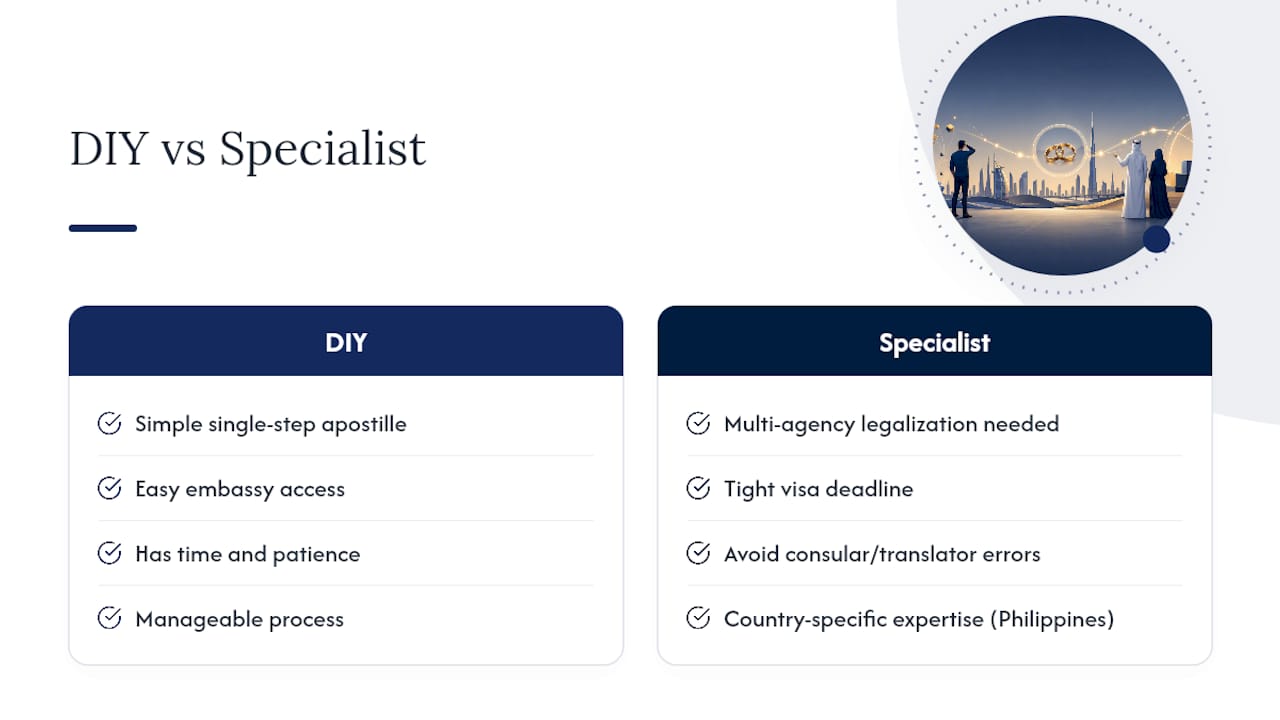
DIY works fine if your home country runs a simple, single-step apostille system and you have easy access to your UAE embassy. That’s a manageable process for someone with time and patience.
It stops being simple the moment your document needs multi-agency legalization, like PSA to DFA to embassy for Philippine certificates, or when your visa deadline doesn’t leave room for a mistake. I’ve seen how often a wrong consular district or an uncertified translator turns a three-day process into a six-week one. Country-specific expertise, especially for Philippine document chains, is where a specialist earns its fee.
— Harris
Get Your Marriage Certificate Attested Without the Guesswork
Harrisncharms exists because the embassy-to-MOFAIC chain punishes small mistakes with big delays, and most people only learn the rules after their first rejection.

We manage the parts that trip people up most: coordinating home-country authentication where it’s still outstanding, arranging certified legal translation, handling courier logistics to and from the right consular district, and filing the final submission with MOFAIC on your behalf. This matters most for Filipino expats working through the PSA to DFA to embassy sequence, and for anyone whose visa or sponsorship deadline doesn’t leave room for a returned document. Turnaround depends on how far along your certificate already is in the chain. If you’ve already got your home-country authentication and just need the UAE-side work done, that’s a much faster path than starting from zero.
Reach out through Harrisncharms for a quote on your specific document, and we’ll tell you exactly which stage you’re at and what it takes to finish. For Philippine-issued documents specifically, our OFW attestation guide breaks down the PSA to DFA to embassy sequence in more detail before you start.
Sources
Recommended
Comments