
AED 25,000 to 50,000? Mainland Company Setup in UAE, Filipino Apostille Plan
Updated: 11 hours ago

Yes, you can set up a mainland company in the UAE, and for most founders selling to local customers or bidding on government work, it’s the right call. Pick your exact economic activity and issuing emirate first. That single decision determines your ownership structure, which approvals you’ll chase, what kind of office you need, and how much the whole process costs.
TL;DR:
Foreign investors can now own 100% of most mainland companies in the UAE, but some strategic sectors still have ownership restrictions or require local approvals.
Setting up a mainland company involves choosing the emirate, activity, legal form, and securing approvals, with external regulator sign-offs often being the main delay factor.
Philippine documents must be apostilled and translated into English or Arabic before submission, making early processing crucial to avoid lengthy delays.
Total startup costs typically range from AED 25,000 to AED 50,000 in the first year, with timelines from a few days for instant licenses to several weeks for activities needing regulator approval.
Post-licensing steps include registering for visas, labor permits, and taxes, with paperwork delays often caused by unregistered tenancy or incomplete external approvals.
Table of Contents
What Is a UAE Mainland Company Setup and When Should You Choose It?
A mainland company is licensed by an emirate’s own economic department rather than a free zone authority, and that license lets you trade anywhere in the UAE without restriction. Mainland licenses suit businesses selling directly to UAE residents, bidding on government contracts, or opening retail and hospitality locations across multiple emirates. Free zones work well for pure export businesses or online-only operations that never touch a local walk-in customer, but they can’t sign contracts with mainland clients without a distributor or extra registration.
Mainland licensing makes sense if your business fits any of these:
Retail or F&B with a physical storefront serving walk-in customers
Government tenders or supply contracts with federal or emirate entities
Services delivered on-site across Dubai, Abu Dhabi, or other emirates
Import-export operations needing direct UAE market access
The ownership picture changed dramatically under Federal Decree-Law No. 26 of 2020, which took effect in June 2021. It scrapped the old rule requiring a UAE national to hold 51% of most mainland companies. Foreign investors can now own 100% of the majority of mainland activities. Check your specific activity against the current list before you assume this applies to you. A short set of strategic sectors still carries different ownership or approval conditions.
How Do You Set Up a Mainland Company Step by Step?
The UAE government’s own guidance lays out a fairly linear path, and skipping steps almost always costs you time later, not less of it.
Choose your emirate and exact activity. Dubai runs this through the Department of Economy & Tourism, Abu Dhabi through ADDED, and Sharjah through SEDD. Each authority maintains its own activity catalog, fee schedule, and office rules.
Pick your legal form and ownership split. LLC is the default for most trading businesses.
Reserve your trade name and request initial approval. This confirms the government has no objection to your business existing.
Prepare and notarize your Memorandum of Association. Most emirates now process this as an E-MOA through UAE PASS, with all shareholders signing electronically.
Secure a tenancy and register it through Ejari or Tawtheeq (Dubai or Abu Dhabi). Some activities qualify for an instant license using a temporary or flexi-desk arrangement, with a permanent tenancy required at renewal.
Get sector-specific regulator sign-off early if you’re in health, education, finance, or telecom. These approvals often run in parallel with everything else, so start them the day you know your activity.
Submit your final file to the emirate’s DED and pay the fees. License issuance follows once the file is complete, not before.
Collect your license and open your Establishment Card. That card is what unlocks visa sponsorship and labor registration next.
Pro Tip: Request external approvals (health authority, civil defense, KHDA, etc.) the same week you get initial approval. These regulator sign-offs are the single biggest variable in how long the whole process takes, and they run independently of your MOA and tenancy paperwork.
Which Legal Form Fits Your Mainland Business?
Most founders default to an LLC, and for good reason: it caps liability at your capital contribution, allows multiple shareholders, and covers nearly every commercial and industrial activity. A civil company structure suits professional services like consulting, legal, or accounting practices where partners carry personal liability by design. A branch office lets an existing foreign parent company operate in the UAE without forming a new local entity, though it stays tied to the parent’s activities. General partnerships are rare among foreign investors, largely because they carry unlimited liability for all partners.
The 2021 ownership reform under Federal Decree-Law No. 26 of 2020 opened 100% foreign ownership across most of these forms. That said, a handful of activities tied to security, certain energy operations, and specific professional licenses still carry restrictions or require a local service agent. Confirm your activity’s status directly with your chosen emirate’s DED before you commit to a structure, because the exceptions list gets updated and generic guides online often lag behind it.
LLC: best default for trading, retail, and most services
Civil company: fits professional practices with personal liability
Branch: extends an existing foreign company’s operations locally
Restricted sectors: verify directly with DET, ADDED, or SEDD before filing
What Documents Do You Need, and What About Philippine Paperwork?
Your file needs the reserved trade name confirmation, initial approval certificate, notarized MOA, registered tenancy (Ejari or Tawtheeq), passport copies for all shareholders, and any external regulator approvals your activity requires. If you’re a UAE resident, you’ll also submit a copy of your current visa.
For Filipino founders and shareholders, the paperwork gets an extra layer. Any document issued in the Philippines, whether a birth certificate, marriage certificate, police clearance, or a corporate document from a Philippine parent company, needs apostille certification before UAE authorities will accept it. Documents that aren’t in English or Arabic also need certified legal translation, and translation quality matters more than most founders expect. A poorly translated corporate document can bounce a filing back weeks later.
Passport copies for all shareholders and managers
Notarized MOA and trade name reservation
Registered tenancy contract (Ejari/Tawtheeq)
Apostilled Philippine civil or corporate documents, where applicable
Certified translations of any non-English, non-Arabic documents
Pro Tip: Start your Philippine document apostille process before you file your UAE license application, not after. Apostille processing has its own timeline entirely separate from your DED filing, and running them in parallel saves weeks. Some service providers specialize in this kind of document attestation for Filipino expats and business owners across the UAE.
How Much Does Mainland Company Setup Cost and How Long Does It Take?
Costs vary by emirate, activity, and how many visas you need, so treat any number here as a planning range, not a quote. First-year setup costs commonly fall between roughly AED 25,000 and AED 50,000, covering trade name reservation, initial approval, license issuance, notarization, and a basic tenancy.
Indicative first-year cost range: AED 25,000 to AED 50,000+, depending on premises type, visa count, and whether your activity needs regulator approval.
A flexi-desk arrangement runs cheaper than a dedicated office but typically caps how many visas you can sponsor. Retail, hospitality, and industrial activities need physical premises with a registered tenancy, not just a desk. Timeline wise, instant licenses issued through emirate online portals can take a matter of days once your file is complete, while activities needing external regulator sign-off often stretch to several weeks.
MOA notarization and trade name: fast, usually same-week
Ejari/Tawtheeq registration: hinges on tenancy availability
Regulator approvals: the widest variable, days to weeks
Bank account opening: a separate timeline, often the longest single item
What Happens After You Get Your Mainland License?
Getting the license is the milestone everyone celebrates. It’s also the point where a second set of deadlines starts.
You’ll register an Establishment Card with GDRFA and ICP, which is the prerequisite for sponsoring any employee visa. The visa sequence runs entry permit, then medical test, then Emirates ID application, then visa stamping. If you’re hiring, you’ll also register with MOHRE, which issues labor cards and tracks your quota of sponsored employees. Separately, most mainland companies now need to register for corporate tax with the Federal Tax Authority, and getting your bookkeeping structured from day one saves real pain at filing time.
Establishment Card via GDRFA/ICP: unlocks visa sponsorship
MOHRE registration: required once you start hiring staff
Federal Tax Authority registration: corporate tax compliance from day one
Bank account opening: expect due diligence requests even after your license is issued, since banks apply their own discretionary review regardless of how clean your DED file was
What Are the Biggest Red Flags During Mainland Setup?
Most delays trace back to the same handful of causes: an incomplete or unregistered tenancy, a pending external regulator approval nobody chased early, an MOA with a signature or clause error, or shareholder documents that weren’t apostilled correctly. If a consultant offers you a nominee shareholder arrangement to work around ownership rules that no longer exist, walk away. That’s an outdated fix for a problem the 2021 reform mostly solved.
Before signing with any setup consultant, ask directly:
Which activity code will you register, and does it match what I actually do?
Which regulator approvals apply to my activity, and who’s chasing them?
What’s the government fee versus your service fee, itemized separately?
Have you handled bank account opening for a similar business type recently?
Pro Tip: Get every fee quote broken into “government” and “service” line items before you pay a deposit. Vague, bundled pricing is the most common way founders overpay.
A Founder’s Note on What Actually Trips People Up
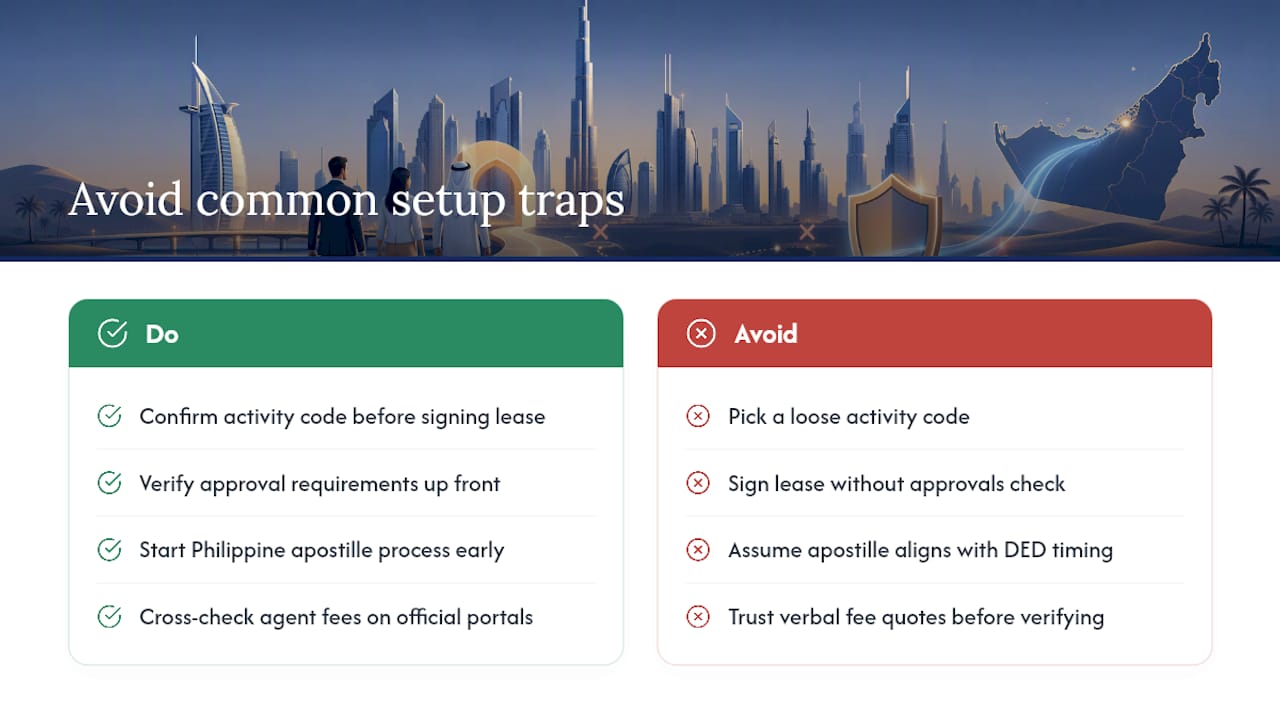
The founders who struggle aren’t the ones with complicated businesses. They’re the ones who picked an activity code loosely, then discovered three months in that it doesn’t match what they’re actually doing on the ground. Confirming your activity and its approval requirements before you sign a lease is the single best-spent hour in this whole process.
Philippine document attestation is where I see the most avoidable friction, mainly because apostille timelines don’t run on the same clock as your DED filing. Start that thread early. And before you pay for anything, cross-check what an agent tells you against the official DET, ADDED, or u.ae portals directly. Most disputes I hear about trace back to someone trusting a verbal fee quote over the published one.
— Harris
How Harrisncharms Cuts Through the Paperwork Delays
Harrisncharms exists for the exact bottleneck most founders hit halfway through mainland setup: paperwork that stalls in translation or attestation limbo while everything else waits on it. If you’re a Filipino entrepreneur or shareholder, getting a Philippine birth certificate, marriage certificate, or corporate document apostilled and legally translated shouldn’t be the thing that pushes your license issuance back a month.

Harrisncharms handles document attestation and apostille, legal translation, business setup support, and visa assistance under one roof, which means your notarization, translation, and attestation steps move on one coordinated timeline instead of three disconnected ones. That same document expertise also covers Filipinos already living in the UAE who need Philippine paperwork legalized for corporate tax registration, marriage registration, or Golden Visa applications. Check the full services list and get your attestation timeline sorted before it becomes the reason your license issuance slips.
Sources
FAQ
Can a foreigner own 100% of a mainland company in the UAE?
Yes, in most activities. Federal Decree-Law No. 26 of 2020 removed the old requirement for 51% UAE national ownership across the majority of commercial and industrial activities. A short list of strategic sectors still carries different ownership conditions, so verify your specific activity with the relevant DED first.
How long does mainland company setup take in the UAE?
It depends heavily on your activity and whether it needs external regulator approval. Some instant licenses issue within days, while activities needing health, education, or financial sector sign-off can take several weeks.
What is the difference between mainland and free zone company setup?
A mainland license lets you trade anywhere in the UAE and bid on government tenders, while a free zone license restricts you to operating within that zone or internationally unless you add a distributor. Mainland suits retail, hospitality, and government-facing businesses; free zones suit export-focused or online operations.
Do I need a physical office for a mainland company?
It depends on your activity. Retail, hospitality, and industrial activities need a registered tenancy with Ejari or Tawtheeq, while many service-based activities can start with a flexi-desk arrangement, though a permanent tenancy is usually required at license renewal.
Do Philippine documents need special certification for UAE business setup?
Yes. Any document issued in the Philippines, including birth certificates, marriage certificates, and corporate paperwork, needs apostille certification before UAE authorities accept it, plus certified translation if it’s not in English or Arabic. Harrisncharms handles this attestation and translation process for Filipino founders and expats across the UAE.
How much does Harrisncharms charge for document attestation?
Pricing depends on the document type and service required, and current rates are listed on the Harrisncharms services page.
Recommended
Comments