
Document Legalization in 2026: U.S. Apostille vs Consular
Updated: Sep 1

If your destination country is a member of the Hague Apostille Convention, you need an Apostille from the issuing state’s Secretary of State office. If it is not a Hague member, you follow the consular legalization chain: notarize or obtain a certified copy, authenticate at the state level, certify through the U.S. Department of State Office of Authentications, then legalize at the destination country’s embassy or consulate. That single fork in the road determines everything about your timeline, your costs, and which offices you contact.
Your immediate next step: check the HCCH country list to confirm whether your destination is a Hague Contracting Party. Do that before you notarize a single page.
If the destination is on the Hague list, identify the Secretary of State office in the U.S. state that issued your document.
If it is not on the list, contact the destination country’s embassy in Washington, D.C., to confirm their current legalization requirements, including translation and chamber of commerce steps.
If your document is federal (FBI background check, federal court record), the U.S. Department of State Office of Authentications handles authentication regardless of which route you take.
Pro Tip: Vietnam acceded to the Apostille Convention effective September 11, 2026, meaning documents previously requiring full consular legalization for Vietnam now only need an Apostille. Always verify HCCH status before you start, not after.
Table of Contents for legalization of documents
What is an Apostille and how does it differ from consular legalization?
Who issues apostilles and authentications in the U.S., and where does your document start?
How do you get an Apostille or complete consular legalization from the U.S. in 2026?
What changed in 2026, and how do you check your destination’s current status?
What are the typical 2026 timelines and fees for apostille and consular legalization?
What mistakes delay or invalidate legalization, and how do you fix them?
Harrisncharms: professional document legalization support for Filipino expats
What is an Apostille and how does it differ from consular legalization?
An Apostille is a standardized certificate issued under the 1961 Hague Apostille Convention. It certifies the authenticity of the signature, stamp, or seal on a document — not the document’s content. A U.S. birth certificate with an Apostille attached tells the receiving country: “The registrar’s signature on this document is genuine.” The receiving country accepts that at face value without further verification from U.S. authorities.

Consular legalization serves the same end goal but through a longer chain. It exists because countries outside the Hague Convention have no mutual agreement to accept a single certificate. Each link in the chain authenticates the signature of the previous official, building a verified trail from the original document all the way to the destination country’s embassy stamp.
The practical difference in 2026 is significant. An Apostille can often be obtained in a single step at the state level and is accepted immediately by Hague-member institutions. Consular legalization routinely involves three to five separate offices, appointment scheduling at embassies, and weeks of additional processing time.
Dimension | Apostille | Consular Legalization |
What it certifies | Authenticity of signature, stamp, or seal | Same, but verified through a sequential chain of officials |
Who issues it in the U.S. | State Secretary of State (state docs); U.S. Dept of State Office of Authentications (federal docs) | U.S. Dept of State Office of Authentications + destination embassy/consulate |
Destination requirement | Hague Convention member country | Non-Hague country |
Typical timeline | A few days to a few weeks depending on the state | Several weeks or longer; industry guidance in 2026 recommends starting federal authentication and consular legalization processes at least 6–8 weeks before travel or filing deadlines due to variable processing windows |
Extra steps | Certified copy or notarization (for private docs) | Notarization, state authentication, federal certification, embassy legalization, often translation and chamber of commerce step |
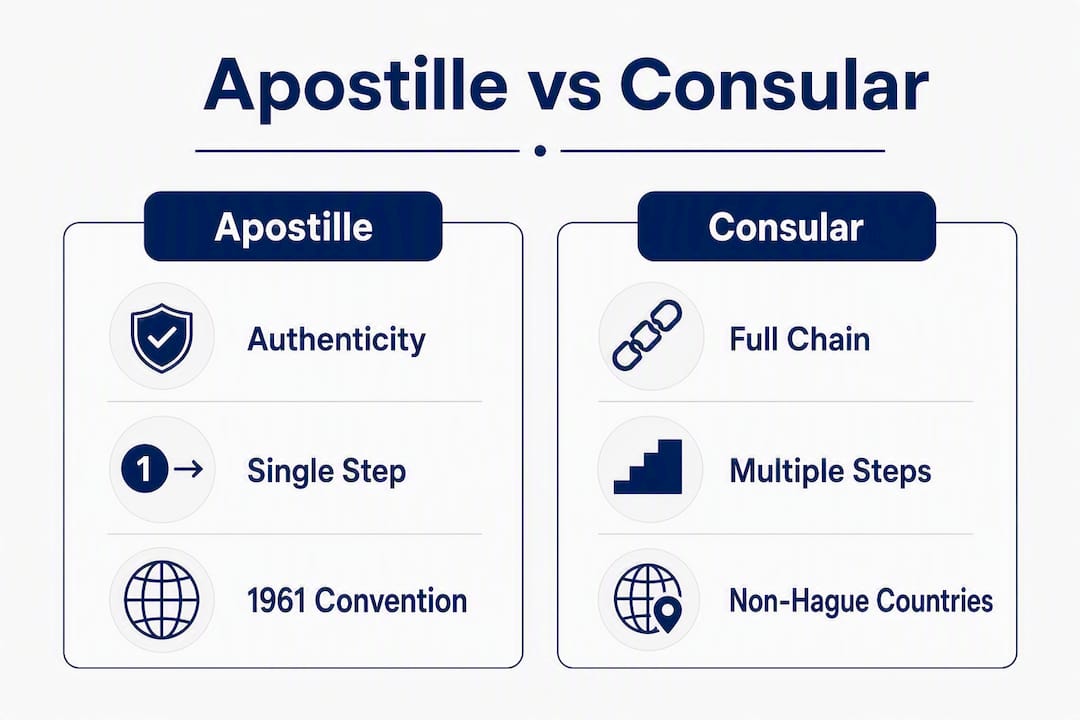
The U.S. Department of State’s apostille guidance makes clear that the Apostille route is only available when the destination country is a Hague Contracting Party. For everyone else, the consular chain is the only recognized path. Understanding the difference between attestation and apostille matters especially for Filipino expats navigating both Philippine and UAE requirements simultaneously.
Who issues apostilles and authentications in the U.S., and where does your document start?
The starting point depends on who originally issued your document, not where you live now.

Document Type | Issuing Authority | Common 2026 Caveats |
Birth, death, marriage certificates | State Secretary of State (or equivalent) in the issuing state | Must be a certified copy from the vital records office, not a photocopy |
Educational diplomas and transcripts | State Secretary of State where the institution is located | Some states require a notarized copy from the institution first |
Court orders and judgments | State court clerk (state courts) or federal court clerk (federal courts) | Certified copy required; check whether state or federal SOS handles the apostille |
Corporate documents (articles of incorporation, powers of attorney) | State Secretary of State where entity is registered | May need notarization and chamber of commerce step for non-Hague destinations |
FBI background checks | U.S. Department of State Office of Authentications | Federal route only; cannot go through a state SOS |
Military notary / judge advocate signatures | U.S. Department of State Office of Authentications | Federal authentication required before consular step |
Federally issued documents (naturalization, federal agency records) | U.S. Department of State Office of Authentications | Do not notarize originals; certified copies required |
The U.S. Department of State’s authentication certificate guidance is explicit: federal documents and certain official signatures must go through the Office of Authentications, not a state apostille office. Sending a federal document to a state Secretary of State is one of the most common errors applicants make.
For state-issued vital records, the role of the civil registrar in producing a properly certified copy is the step that determines whether the entire chain succeeds or fails. A photocopy, even a notarized one, is not a certified copy.
Private documents (contracts, affidavits, powers of attorney) must be notarized by a commissioned notary public before going to the state Secretary of State.
Vital records (birth, marriage, death certificates) must be certified copies issued directly by the state or county vital records office.
Federal documents skip the state level entirely and go straight to the U.S. Department of State Office of Authentications.
How do you get an Apostille or complete consular legalization from the U.S. in 2026?
Hague route: Apostille step-by-step
Obtain the correct document form. Get a certified copy from the issuing authority (vital records office, court clerk, institution). For private documents, have a licensed notary public notarize the document.
Identify the correct state apostille office. The Secretary of State office in the state that issued the document handles the Apostille. Each state has its own submission process, fees, and turnaround options.
Submit to the Secretary of State. Options vary by state: walk-in, mail, or online submission where available. Utah, for example, offers digital authentication delivery with in-person and mail options, with digital submissions planned for August 2026.
Receive the Apostille. The certificate is attached to or issued alongside your document. Verify the issuing official’s name and seal match the document.
Confirm acceptance by the destination authority. Some institutions require the Apostille to be accompanied by a certified translation. Confirm this before submitting to the foreign authority.
For federal documents (FBI checks, federal court records, federally issued records), replace steps 1–3 with submission directly to the U.S. Department of State Office of Authentications.
Pro Tip: Do not notarize original vital records or certified copies before sending them to a state SOS. The official signature being verified must be the one on the primary document. Adding a notary layer to a certified copy can invalidate the chain entirely.
Non-Hague route: consular legalization step-by-step
State authentication — Submit to the Secretary of State in the issuing state for a state-level authentication certificate (not an Apostille).
U.S. Department of State federal certification. Submit the state-authenticated document to the Office of Authentications for federal certification.
Chamber of commerce certification (if required). For commercial documents going to certain Middle Eastern, African, or Asian destinations, a local chamber of commerce must certify the document before the embassy step. This is a destination-driven requirement, not a U.S. legal requirement, and applicants frequently miss it.
For authorized couriers and logistics between steps, especially for embassy submissions, using a tracked courier service with signature confirmation protects against lost documents at the most expensive point in the chain.
Are e-Apostilles ready to use in 2026?
The HCCH electronic Apostille Programme (e-APP) allows participating authorities to issue Apostilles as digital certificates, often as PDFs with embedded verification data or QR codes. The appeal is obvious: faster delivery, instant transmission to multiple recipients, and a digital verification trail.
The catch is acceptance. The HCCH e-APP is growing in 2026, but adoption is uneven. Many foreign government offices, universities, and employers still require wet-ink physical documents and will reject an e-Apostille PDF outright, not because it is invalid, but because their internal systems cannot process it.
Before choosing the e-Apostille route, work through this decision flow:
Contact the receiving institution directly. Ask specifically whether they accept e-Apostilles and whether they can verify them through the issuing authority’s online register.
Check the HCCH e-APP participant list. Confirm that both the issuing U.S. state and the destination country’s verification system are listed.
Confirm technical compatibility. Some institutions can accept a PDF but cannot access the verification portal. That gap causes rejection even when the e-Apostille itself is valid.
Get confirmation in writing. An email from the receiving institution confirming e-Apostille acceptance is worth keeping. Verbal confirmation is not.
Relying on an e-Apostille without early recipient confirmation is one of the primary causes of rejections in 2026. The apostille verification methods available in 2026, including QR codes and state verification portals, are only useful when the receiving end can actually use them.
What changed in 2026, and how do you check your destination’s current status?
HCCH membership is not static. Countries accede to the Apostille Convention on a rolling basis, and the effective date of accession is the date that changes which authentication route you must use. Checking the HCCH list once and filing it away is not enough if your submission is months away.
Vietnam is the clearest 2026 example. Vietnam acceded to the Apostille Convention with an effective date of September 11, 2026. Documents that previously required the full consular legalization chain for Vietnam now only need an Apostille from the issuing state office. That is a meaningful reduction in time and cost for anyone submitting documents to Vietnamese authorities after that date. Documents submitted before September 11, 2026, still required the old consular chain.
The broader lesson: mis-identifying a destination’s Hague status is the most common 2026 error in the document legalization process. Choosing the wrong route means completing all prior steps correctly and still getting rejected at the final stage.
Steps to verify your destination’s current status:
Go to the HCCH Apostille Section and check the current list of Contracting Parties, including effective dates.
Check the destination country’s embassy website in the U.S. for any additional requirements layered on top of the Apostille (some Hague members still require translations or specific certified copy formats).
Confirm the following destination-specific requirements before starting:
Freshness window: some countries reject documents issued more than 3–12 months before submission.
Translation type: sworn translation (by a court-certified translator) vs. certified translation (by any certified translator) are not interchangeable.
Notarization of translator: some destinations require the translator’s signature to be notarized.
Chamber of commerce certification for commercial documents.
What are the typical 2026 timelines and fees for apostille and consular legalization?
Timelines vary more than most applicants expect, and fees change without notice. Treat every figure below as a planning estimate, then verify current amounts on the relevant state and federal websites before paying anything.
State-level apostille (Hague route):
Walk-in or same-day service: available in some states, typically $10–$25 per document, but not universally offered.
Standard mail processing: several business days in most states, with fees generally in the $5–$20 range per document depending on the state.
Expedited mail or online options: where available, 2–5 business days, with higher fees.
Federal authentication (U.S. Department of State Office of Authentications):
Standard processing runs several weeks. For FBI background checks and other federal documents, industry guidance recommends starting the federal authentication process well in advance of your travel or filing deadline to account for variable processing times to account for variable processing windows.
The Office of Authentications fee schedule is published on the State Department website and should be confirmed before submission.
Consular legalization (non-Hague route):
Add the consular step to the federal timeline above. Embassy appointment availability varies widely by country and season. Some embassies require documents to be submitted by courier; others require in-person presentation.
Translation costs depend on language pair and document length. Sworn translation for legal documents typically costs more than standard certified translation.
Chamber of commerce certification adds a separate fee and processing time, usually 1–3 business days, when required.
The cumulative timeline for a full consular legalization chain, from notarization through embassy stamp, commonly runs several weeks under normal conditions. Complex documents or high-demand embassies can significantly extend processing time.
Always verify current fees on the USAGov authentication page and on your specific state Secretary of State’s website before submitting payment.
What mistakes delay or invalidate legalization, and how do you fix them?
The most damaging errors in the document legalization process share a common trait: they surface at the last step, after all earlier fees and time have been spent.
Over-notarizing is the first trap. Applicants who notarize a certified copy of a birth certificate before sending it to the state Secretary of State often invalidate the document for apostille purposes. The state is certifying the registrar’s signature on the certified copy. When a notary adds their own signature and seal on top, the chain of verification breaks. The fix is to start over with a fresh certified copy and submit it directly, without the notary layer. The U.S. Department of State’s apostille requirements address this directly.
Choosing the wrong route is the second major failure mode. An applicant who sends documents through the Apostille chain for a non-Hague destination will receive a completed Apostille that the destination country simply will not accept. The embassy will reject it. The fix requires restarting the entire chain through the consular legalization path. Checking HCCH status before starting costs nothing. Restarting costs weeks and duplicate fees.
Missing the chamber of commerce step catches commercial document applicants off guard. For destinations in parts of the Middle East, Africa, and Asia, the chamber of commerce certification is a required step before the federal authentication stage. Skipping it means the embassy will reject the document at the final stage. The fix is to back up to the chamber step, recertify, and resubmit to the federal and consular offices.
Translation errors are subtler. A certified translation and a sworn translation are not the same thing. Some countries require a sworn translation by a court-certified translator, with the translator’s signature notarized. Submitting a standard certified translation to an embassy that requires sworn translation results in rejection. Always confirm the exact translation type required by the destination authority, not just “translation required.”
Freshness windows catch applicants who prepare documents too early. A birth certificate issued 14 months before submission may be outside the destination country’s 12-month freshness window, making it invalid regardless of how perfectly the authentication chain was completed. Request certified copies as close to the submission date as your processing timeline allows.
When to hire a professional service: multi-document sets, tight deadlines, or destinations with complex layered requirements (translation type, chamber step, specific embassy procedures) are the clearest cases. A document service or channeler who knows the current requirements for your specific destination can prevent a final-stage rejection that costs more to fix than the service fee would have cost upfront. For Filipino expats navigating both Philippine document requirements and UAE destination rules, understanding the full legalization vs. attestation distinction for UAE is worth doing before starting any chain.
Key Takeaways
Getting the legalization of documents right in 2026 comes down to one decision made correctly at the start: confirm your destination’s Hague status before touching a single document.
Point | Details |
Apostille vs. consular route | Check the HCCH country list first; Hague members need an Apostille, non-Hague countries require the full consular legalization chain. |
Federal documents go federal | FBI checks, federal court records, and federally issued documents must go through the U.S. Department of State Office of Authentications, not a state SOS. |
Start federal processing early | Start federal authentication and FBI check processes at least 6–8 weeks before your deadline, as 2026 guidance recommends, due to variable processing times. |
Vietnam changed in 2026 | Vietnam’s Apostille Convention accession took effect September 11, 2026, replacing the previous consular legalization requirement. |
Harrisncharms handles the chain | For Filipino expats managing Philippine documents for UAE use, Harrisncharms processes apostille, legalization, and translation so you avoid the errors that cause final-stage rejections. |
The part most guides skip about staying current in 2026
The conventional advice on document legalization treats the process as static: follow the steps, check the boxes, done. What that misses is that the rules themselves are moving targets. Vietnam’s September 2026 Apostille accession is not an edge case. It is a preview of how quickly the correct path for a specific destination can shift, and how badly a document prepared under last year’s rules can fail under this year’s requirements.
The e-Apostille situation illustrates the same problem from a different angle. The technology exists. The legal framework supports it. But the gap between what an issuing authority can produce and what a receiving institution can actually verify is wide enough to cause real rejections on valid documents. Choosing the digital route without recipient confirmation is not a time-saver. It is a gamble.
What actually works in 2026 is treating destination verification as a live task, not a one-time lookup. Check the HCCH list. Check the embassy page. Then check again if your submission date is more than a few weeks out. The applicants who run into trouble are almost always the ones who verified once and assumed nothing changed.
Harrisncharms: professional document legalization support for Filipino expats

Navigating the apostille and consular legalization chain is straightforward when you have one document and a clear destination. Add multiple document types, a UAE submission deadline, Philippine-origin records, and destination-specific translation requirements, and the margin for error shrinks fast.
Harrisncharms specializes in exactly this situation: apostille, legalization, and document attestation for Filipino expatriates and workers in the UAE, processing Philippine documents for use in the UAE and internationally. The team tracks HCCH updates, e-APP developments, and embassy-specific requirements so you are not relying on outdated information when your deadline is real.
Whether you need a single document apostilled or a full set of records legalized and translated for UAE submission, Harrisncharms handles the chain from certified copy through final attestation. Get in touch at harrisncharms.com to confirm what your specific documents require and start the process with the right path from day one.
Authoritative sources to verify rules in 2026
Before paying any fee or submitting any document, confirm current requirements directly with the primary sources. Rules, fees, and processing times change, and a third-party guide (including this one) can lag behind official updates.
HCCH Apostille Section: current list of Contracting Parties, effective accession dates, and e-APP participant information.
U.S. Department of State — Apostille Requirements: official guidance on preparing documents for apostille, including the federal vs. state distinction.
U.S. Department of State — Authentication Certificate Requirements: federal authentication process for non-Hague destinations and federal document types.
USAGov — Authenticate a U.S. Document: plain-language overview of apostille vs. authentication certificate, with links to state offices.
Your state Secretary of State’s website: current fees, submission options, and turnaround times for state-level apostilles.
The destination country’s embassy or consulate website in the U.S.: the only authoritative source for that country’s current translation requirements, freshness windows, and consular legalization procedures.
Always verify the effective date of any rule or accession you find online. A country listed as a Hague member may have an accession date in the future, meaning the Apostille route is not yet valid for current submissions. Vietnam’s September 11, 2026 effective date is a recent example of why this check matters.
For readers who want professional help navigating the 2026 process, Harrisncharms offers document legalization and apostille services for Filipino expats in the UAE.
Recommended
Comments