
Role of Legal Translation in Attestation: Guide for Filipino Expats in UAE

Most Filipino expatriates in the UAE arrive with a stack of documents and the assumption that getting them “attested” is a single, straightforward process. It is not. The role of legal translation in attestation is where most people get stuck, because translation and attestation are two separate legal requirements that must happen in a specific order. Mix them up, skip one, or use the wrong type of translator, and UAE authorities will reject your documents outright, sending you back to square one.
Table of Contents
Why legal translation is essential before or during attestation
The attestation process for Filipino expatriates and the translation sequence
Common challenges and expert tips for smooth legal translation and attestation
Comparing translation needs for different document types and purposes
Why many Filipino expats still struggle with legal translation and attestation, and how to avoid it
How Harris N Charms can simplify your legal translation and attestation journey
Key Takeaways of role of legal translation in attestation
Point | Details |
Legal translation necessity | Arabic legal translation by certified translators is mandatory before or during attestation for non-Arabic documents in UAE. |
Clear process steps | Filipino documents follow a four-step attestation including notarization, DFA authentication, UAE Embassy attestation via VFS Global, and MOFA final attestation. |
Correct sequencing | Legal translation must be done after home country attestation but before MOFA attestation to avoid delays and rejection. |
Certified translators only | Only translations by Ministry of Justice licensed certified translators are accepted, ensuring document approval and legal validity. |
Avoid common pitfalls | Confirm requirements early, use expert services, and anticipate VFS Global processing times to ensure smooth attestation. |
Understanding attestation and legal translation in the UAE
Before anything else, let’s establish what each term actually means, because attestation and legal translation are frequently treated as interchangeable when they are anything but.
Attestation is the process by which government authorities verify that a document is genuine. Think of it as a chain of official stamps: each authority in the chain confirms the one before it is legitimate. Attestation does not change what a document says. It confirms that the document itself is real.
Legal translation, on the other hand, converts the content of a document from one language into another, and a certified legal translator takes legal responsibility for the accuracy of that conversion. In the UAE, many people confuse attestation with legal translation because both are often required at the same time, for the same document. But they serve completely different legal functions.
Here is when each process is typically required for Filipino expats in the UAE:
Attestation is required when you need to prove a Philippine-issued document is authentic to a UAE government body, employer, school, or court.
Legal translation is required when the document is in English or Filipino and must be submitted to a UAE authority that operates in Arabic.
Both together are required for most official purposes, including employment visas, school enrollment, court proceedings, and family residency applications.
Understanding this distinction is the foundation. Everything else builds from here.
Why legal translation is essential before or during attestation
The UAE’s official language is Arabic. That single fact drives nearly every legal translation requirement you will encounter as a Filipino expat. UAE authorities require legal translation into Arabic by Ministry of Justice licensed translators before or during attestation for all non-Arabic documents submitted to UAE entities.

This is not a bureaucratic preference. It is a legal requirement. Courts, government ministries, and immigration offices will not process a document they cannot read in their official language.
Here is the critical sequence most expats get wrong:
Complete all home country attestation steps first (more on this in the next section).
Get your certified Arabic legal translation done after home country attestation.
Submit the translated and attested document for MOFA (Ministry of Foreign Affairs) attestation in the UAE.
The timing matters enormously. Incorrect sequencing causes rejection; experts recommend confirming requirements with the requesting authority before you begin.
Remember: Not all translators are equal under UAE law. Only translators licensed by the UAE Ministry of Justice can produce translations that UAE government offices will accept. A translation from a bilingual friend, a general translation app, or an uncertified agency is legally worthless in this context.
Pro Tip: Before you start any attestation or translation, call or email the specific UAE authority, school, or employer requesting your documents. Ask them exactly which documents they need, whether Arabic translation is required, and at what stage. This one step can save you weeks of rework.
The importance of legal translation extends beyond compliance. A precise Arabic translation protects you legally. If the Arabic version of your employment contract, degree certificate, or marriage certificate contains an error, that error becomes the official record. The stakes are real.
For a full overview of Philippines document attestation requirements specific to Filipino expats, it helps to have the complete picture before you begin.
The attestation process for Filipino expatriates and the translation sequence
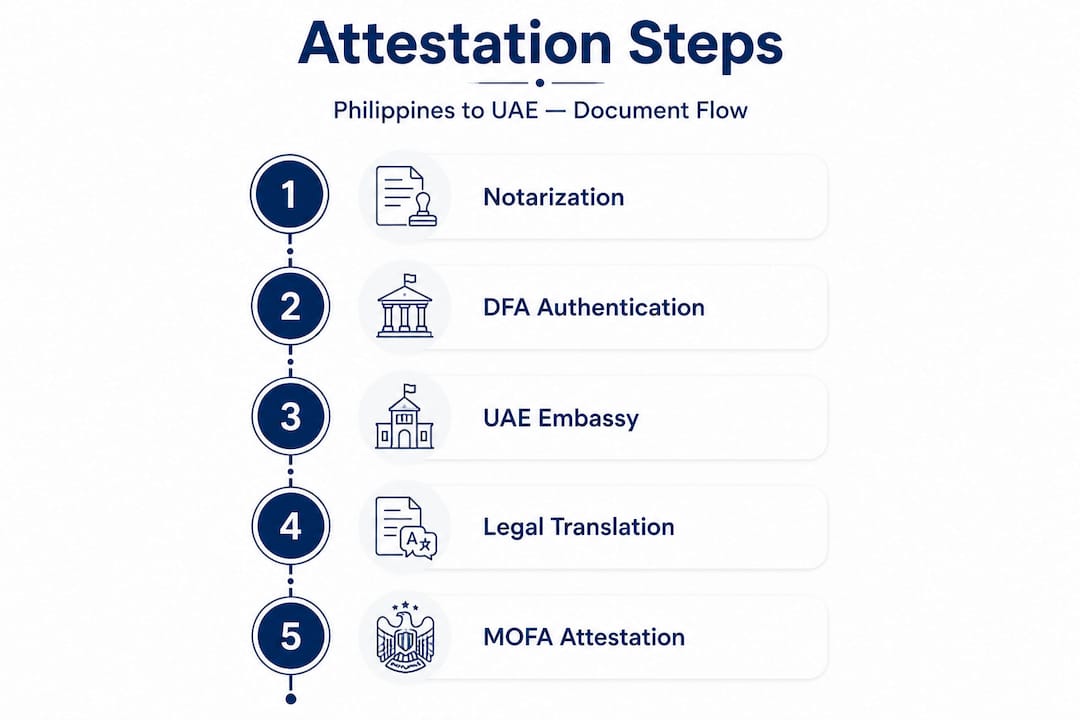
Let’s map out exactly how this works for Philippine-issued documents. The attestation process for Philippine documents requires four distinct steps, and Arabic legal translation is mandatory for courts and the Ministry of Education.
Here is the full sequence:
Philippine notary public notarizes your original document to confirm its authenticity at the local level.
Department of Foreign Affairs (DFA) authentication confirms the notary’s signature is legitimate and issues a red ribbon or apostille.
UAE Embassy attestation via VFS Global verifies the DFA authentication. Since May 2024, all submissions go through VFS Global, which adds 5 to 7 working days to processing time.
MOFA UAE attestation is the final step, completed inside the UAE, and this is where your certified Arabic translation must be ready.
After step 3 and before step 4 is the window for legal translation. Documents must bring originals, photocopies, valid ID, and fees at each stage, and translation occurs after home attestation but before MOFA when Arabic is needed.
Stage | Location | Who handles it | Translation needed? |
Notarization | Philippines | Philippine notary public | No |
DFA authentication | Philippines | Department of Foreign Affairs | No |
UAE Embassy via VFS Global | Philippines (Manila) | VFS Global + UAE Embassy | No |
Certified Arabic translation | UAE | MOJ licensed translator | Yes, at this stage |
MOFA attestation | UAE | Ministry of Foreign Affairs | Required before this step |
Pro Tip: The VFS Global routing introduced in May 2024 catches many Filipino expats off guard. Factor in that extra 5 to 7 working days when planning your timeline, especially if you have a visa, enrollment, or employment start date with a hard deadline. Start at least 6 to 8 weeks before you need the documents.
For more detail on what you need to gather before you begin, this guide to preparing attestation papers covers the specifics.
Common challenges and expert tips for smooth legal translation and attestation
Knowing the process and executing it without errors are two different things. Here is where Filipino expats most commonly run into problems:
Forgetting the VFS Global routing. Many expats still attempt to submit documents directly to the UAE Embassy in Manila. Practitioners reveal this is among the most common pitfalls, along with recommending online notary services to speed up affidavit processing.
Using uncertified translators. Self-translations are rejected outright. The UAE only accepts translations from certified services licensed by the Ministry of Justice.
Translating before DFA authentication. The Arabic translation of a document that has not yet been authenticated can cause MOFA to request you restart the process.
Not verifying requirements with the end authority. Requirements vary between an employer, a Ministry of Education office, a court, and an immigration department. Assuming they are all the same is a costly mistake.
Pro Tip: If you need an affidavit notarized and you are already in the UAE, use an online notary service. It eliminates the need to fly back to the Philippines for a single signature, and many UAE authorities accept these for straightforward personal documents.
The best advice anyone can give you is this: treat legal translation as part of the attestation process, not something separate you deal with later. Filipino expats who plan for both together move through the system far faster than those who treat them as two independent tasks.
This agency attestation guide for Filipino expats also covers how working with a specialized agency reduces these friction points significantly.
Comparing translation needs for different document types and purposes
Not every document requires Arabic translation. The requirement depends on the document type and how you plan to use it.
Document type | Purpose | Arabic translation required? |
University degree / diploma | Ministry of Education equivalency | Yes, mandatory |
Birth certificate | Family visa, court proceedings | Yes, mandatory |
Marriage certificate | Spouse visa, legal matters | Yes, mandatory |
Police clearance | Visa applications, employment | Yes, for official use |
Employment contract | Labor registration | Strongly recommended |
Passport copy | Employment visa processing | Typically not required |
Legal translation into Arabic is mandatory for documents submitted to UAE judicial courts, the Ministry of Justice, or Ministry of Education equivalency. Some employment visa processes accept documents in English, but this varies by employer and free zone.
Here is what this looks like in practice:
A Filipino nurse applying to a UAE hospital for license equivalency through the health authority must have her nursing diploma translated into Arabic and attested through MOFA.
A Filipino worker sponsoring a family member needs birth certificates and marriage certificates translated into Arabic before the family visa application moves forward.
A Filipino professional submitting a degree for Ministry of Education equivalency cannot proceed without a certified Arabic translation, regardless of how clear the English original is.
For a full breakdown of which documents fall under UAE apostille versus standard attestation, this guide on documents for UAE apostille and attestation is worth reviewing before you start.
Why many Filipino expats still struggle with legal translation and attestation, and how to avoid it
Here is what the process guides do not tell you: most failures are not caused by ignorance of the steps. They are caused by underestimating the complexity of each step and treating the process as linear when it is actually relationship-dependent.
The UAE’s attestation and legal translation system involves multiple authorities across two countries, each with their own timelines, requirements, and updates. The introduction of VFS Global in 2024 changed the process mid-stream for many expats who had already started. That kind of change is not an anomaly; it is the nature of bureaucratic systems.
What we have seen repeatedly is that Filipino expats who engage certified translators and attestation specialists early in the process, before they have a deadline, navigate it without major problems. Those who start late, assume they can manage it alone, or rely on informal advice from friends who went through the process two years ago are the ones who end up restarting from step one.
The other underappreciated factor is proactive verification. Why attestation services matter is not just about convenience. It is about having someone who knows which specific authority needs what specific version of a document, so you are not submitting a general-purpose attested document to an entity that needs something slightly different.
Plan for legal translation as a core step in attestation, not an add-on. Confirm requirements directly with the receiving authority. Use only Ministry of Justice licensed translators. And start earlier than you think you need to.
How Harris N Charms can simplify your legal translation and attestation journey
Navigating legal translation and attestation correctly is the difference between getting your documents accepted on the first submission and spending months in back-and-forth with government offices.

Harris N Charms provides certified Ministry of Justice licensed legal translation and full attestation support for Filipino expatriates in the UAE. From notarization guidance in the Philippines through DFA authentication, UAE Embassy submission via VFS Global, and final MOFA attestation, our team handles every step with the accuracy and local knowledge the process demands. We confirm your exact requirements upfront based on your employment, education, or family situation, so nothing is missed. Explore our full range of attestation and translation services and get your documents right the first time.
Frequently asked questions
Is legal translation required for all documents being attested in the UAE?
Certified Arabic legal translation is required before or during attestation for all non-Arabic documents submitted to UAE government entities, courts, or immigration, though some employment-related documents may be accepted in English depending on the specific authority.
What is the correct sequence for translation and attestation of Philippine documents for use in the UAE?
Philippine documents go through notarization, DFA authentication, UAE Embassy attestation via VFS Global, and then MOFA UAE attestation. Translation occurs after home attestation but before MOFA to comply with UAE requirements and avoid rejection.
Can Filipino expatriates use uncertified translations for document attestation in the UAE?
No. UAE authorities only accept translations from certified translation services licensed by the Ministry of Justice, and self-translations or uncertified agency translations are rejected during attestation processing.
How does the introduction of VFS Global affect the attestation timeline for Philippine documents?
Since May 2024, all attestation submissions to the UAE Embassy in Manila are routed through VFS Global, which adds a 5 to 7 working day window to the overall attestation timeline that Filipino expats must account for when planning ahead.
Recommended
Comments