
How to legalize Philippine documents for use in the UAE
Getting a Philippine document recognized in the UAE is not just a formality. It can determine whether you get the job, finalize your marriage, enroll your child in school, or process a visa. For Filipino expats navigating this process from thousands of miles away, the stakes are real and the steps are often confusing. The good news is that as of 2026, certain documents can be apostilled fully online through the DFA’s digital system, cutting down on the back-and-forth that used to make this process so exhausting. This guide walks you through everything you need to know.
Table of Contents
Key Takeaways
Point | Details |
Digital apostille available | Pinoy expats can apostille some official documents online using the DFA e-Apostille system. |
Right documents, right method | Check eligibility to see if your certificate can be apostilled digitally or requires manual attestation. |
Follow each step | Carefully follow the step-by-step process to avoid rejections and delays. |
Troubleshoot common issues | Fix mistakes early to prevent document rejections and repeated submissions. |
Professional help available | Expert services are on hand to simplify and speed up legalization for UAE requirements. |
Understanding document legalization, apostille, and attestation
Before you start gathering paperwork, it helps to understand what you’re actually trying to accomplish. These three terms get used interchangeably, but they are not the same thing, and mixing them up can send you down the wrong path entirely.
Legalization is the broad term for making a document officially recognized in a foreign country. It’s the umbrella process. Apostille is a specific type of legalization used between countries that are part of the Hague Convention of 1961. The Philippines joined this convention, which means Philippine documents can carry an apostille certificate that other member countries automatically accept. Attestation, on the other hand, is the process used when the receiving country is not part of the Hague Convention, or when it requires additional verification beyond the apostille. The UAE, while it has its own attestation requirements, generally accepts apostilled Philippine documents for most official purposes.
Here’s a quick comparison to help you decide which process applies to your situation:
Process | Used when | Who issues it | Accepted by UAE? |
Apostille | Philippines to Hague member countries | DFA Philippines | Yes, for most purposes |
Attestation | Non-Hague countries or extra verification | Embassy or MOFA UAE | Required for some documents |
Legalization | General term for both processes | Varies | Depends on document type |
For most Filipino expats in the UAE, the apostille route is the standard path. You can read more about the PSA DFA apostille overview to get a deeper look at how the two agencies work together. Understanding the apostille service benefits can also help you see why this route saves significant time compared to full manual attestation.
Why do expats need apostilled or attested documents in the first place? UAE employers often require authenticated educational credentials before finalizing job contracts. UAE courts and immigration authorities need authenticated civil documents like birth certificates and marriage certificates for family visa applications. Schools and universities ask for authenticated transcripts. Without proper legalization, your documents are just paper, and UAE institutions have every right to reject them.
What documents you need and key requirements
With the process differences clear, the next step is to identify which documents you’ll need and confirm you have everything required.
Not all Philippine documents qualify for online apostille. The DFA’s digital system currently covers a specific set of electronic documents. Here’s what you need to know:
Documents eligible for online apostille:
PSA electronic birth certificates
PSA electronic marriage certificates
PSA electronic death certificates
PSA Certificate of No Marriage Record (CENOMAR) in electronic format
CHED eCAV (electronic Certification, Authentication, and Verification) for college diplomas and transcripts
Documents that still require in-person or manual processing:
NBI clearance (requires separate NBI authentication first)
PRC-issued professional license documents
Court-issued documents (annulment decrees, adoption papers)
Documents from private institutions not connected to DFA’s digital system
Older civil registry documents not yet digitized by PSA
Applicants can use the DFA e-Apostille portal for PSA and CHED documents specifically. If your document falls outside this list, you’ll need to go through the traditional route, which involves either a DFA appointment in the Philippines or coordinating through a trusted representative.
Here’s a quick reference table for requirements by document type:
Document type | Format required | Additional requirement |
PSA birth certificate | Electronic (e-copy) | None if PSA-issued digitally |
PSA marriage certificate | Electronic (e-copy) | None if PSA-issued digitally |
CHED eCAV | Electronic | Must be from accredited school |
NBI clearance | Physical | Separate NBI authentication needed |
PRC documents | Physical | PRC authentication first |
For school-related documents specifically, the school document apostille process outlines the exact steps for getting educational credentials authenticated. If you’re dealing with multiple document types, the attestation paper checklist is a practical resource to make sure nothing gets missed.
Pro Tip: Always request the electronic version of your PSA documents directly from the PSA website or through authorized resellers. Physical copies issued at local civil registry offices are not compatible with the DFA’s online apostille system.
Step-by-step: How to legalize Philippine documents from the UAE
Once your documents and requirements are organized, you’re ready to begin the legalization process itself.
For documents eligible for online apostille:
Obtain your electronic PSA or CHED document. Purchase directly from the PSA Serbilis portal or the CHED online system. Save the digital file securely.
Create an account on the DFA e-Apostille portal. Go to the official DFA website and register. You’ll need a valid email address and personal identification details.
Upload your electronic document. The system will verify the document’s authenticity against the PSA or CHED database. This is why only official electronic copies work.
Pay the apostille fee online. Fees are payable via credit card or other accepted payment methods. Keep your receipt.
Receive your apostilled document digitally. Once processed, the DFA issues a digital apostille certificate attached to your document. This fully digital apostille system means you never have to mail anything or visit a DFA office.
Submit to UAE authorities. Download and present the apostilled document as required. Some UAE institutions may ask you to print and present a physical copy.
For documents not eligible for online apostille:
If your document requires manual processing, you have two main options. First, you can authorize a trusted family member or representative in the Philippines to handle the DFA appointment on your behalf using a Special Power of Attorney (SPA). Second, you can use a reputable document service agency that specializes in Philippine document legalization. The complete attestation guide covers the manual route in detail.
After apostille or attestation, what happens in the UAE?
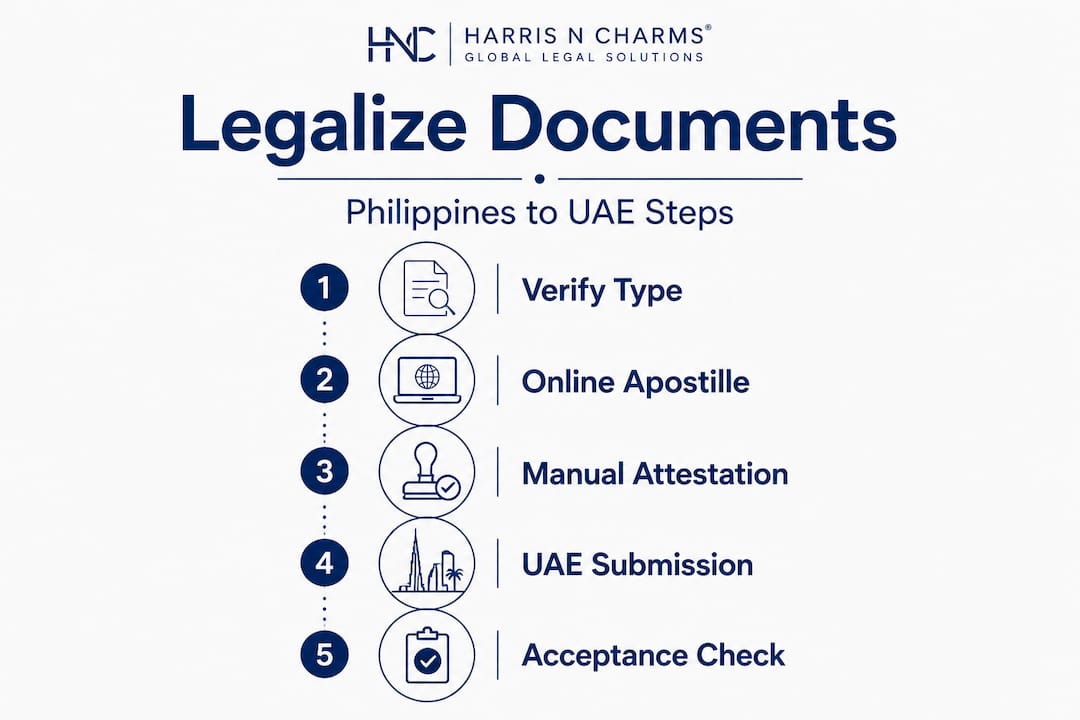
Some UAE government bodies, particularly the Ministry of Human Resources and Emiratisation (MOHRE) and the Ministry of Foreign Affairs and International Cooperation (MOFAIC), may require an additional layer of verification called UAE attestation. This means your already-apostilled document gets stamped by UAE MOFAIC. Not all documents need this extra step, but it’s worth checking with the specific UAE authority requesting your document. You can find out who can attest in UAE to understand the local verification landscape better.
Pro Tip: Before submitting any document to a UAE institution, call ahead and ask specifically whether they accept apostilled documents or require UAE MOFAIC attestation on top. This one call can save you weeks of back-and-forth.
Troubleshooting and common mistakes Filipino expats make
Even with good preparation, pitfalls happen. Here’s how to address and prevent them.
The most frequent reason for rejected applications is submitting the wrong document format. Many Filipinos submit scanned copies of physical PSA documents thinking they qualify for online apostille. They don’t. The DFA e-Apostille portal only accepts documents that were generated electronically by PSA or CHED, not scans of printed copies.
Common mistakes and how to fix them:
Using a photocopy instead of an official electronic file. Fix: Order a fresh electronic copy directly from PSA Serbilis or the CHED portal.
Submitting an expired document. Some UAE employers require documents issued within the last six months. Fix: Check the document’s validity requirements before ordering.
Missing the authentication step for NBI or PRC documents. These need to be authenticated by their issuing agency before going to DFA. Fix: Always check the pre-DFA requirements for non-PSA documents.
Apostilling a document that actually needs UAE MOFAIC attestation. Fix: Confirm with the UAE institution what they specifically require.
Incorrect personal details on the document. A name mismatch between your PSA birth certificate and your passport will cause problems everywhere. Fix: Correct the civil registry record first before requesting apostille.
“The most expensive mistake is not the wrong document. It’s the wasted time waiting for a rejection you could have avoided with one phone call or a quick check of the requirements list.”
For more detailed guidance on avoiding agency-related errors, the agency attestation tips page covers what to watch out for when using third-party services. If you’re dealing specifically with civil status documents, the CENOMAR guide explains the full process for that particular document, which trips up many expats applying for UAE family visas.
Pro Tip: Create a document checklist before you start any application. Write down the document name, the format required (electronic or physical), the agency that issues it, and whether it needs pre-authentication before DFA. This simple habit eliminates most common errors.
What to expect after legalization: Acceptance and next steps in the UAE
After successfully legalizing your documents, you’ll need to understand how they are used and accepted in the UAE.
Documents apostilled online through DFA are valid for use abroad and are recognized by UAE institutions in 2026. That said, acceptance can vary depending on the specific institution and the purpose of the document.
What to expect when submitting to UAE authorities:
UAE employers and HR departments generally accept apostilled documents for employment contracts and visa processing without additional steps.
UAE universities and schools typically accept apostilled transcripts and diplomas, though some may ask for a certified translation into Arabic.
UAE courts and family law matters may require UAE MOFAIC attestation on top of the apostille, especially for marriage and birth certificates.
Real estate and banking institutions in the UAE usually accept apostilled civil documents for account opening and property transactions.
If a UAE authority asks for further verification:
Don’t panic. Ask them to specify exactly what additional step they need. In most cases, it’s simply UAE MOFAIC attestation, which can be done at MOFAIC service centers across the UAE. Bring the original apostilled document and a copy of your Emirates ID.
Keeping your documents safe for future use:
Store digital apostille files in a secure cloud folder with clear naming conventions (e.g., “PSA_BirthCert_Apostille_2026”).
Keep at least two printed copies of each apostilled document in a secure physical location.
Note the apostille reference number. UAE institutions can sometimes verify the apostille online using this number, which speeds up processing.
Check expiry requirements. Some UAE institutions consider documents older than six to twelve months as outdated and may request fresh copies.
What most guides miss: Why your strategy matters when legalizing documents
Most articles on this topic treat document legalization as a checklist. Complete step one, move to step two, done. But that framing misses something important: the order and timing of your actions matter as much as the actions themselves.
We’ve seen Filipino expats spend weeks waiting for a manually processed apostille, only to find out the UAE employer needed UAE MOFAIC attestation on top, adding another two weeks. If they had asked the right question upfront, they could have started both processes in parallel or chosen a faster route. The apostille advantages are real, but only if you use the digital system for the right documents and confirm UAE-side requirements before you begin.
There’s also a hidden cost to relying on outdated methods. Sending documents by courier to the Philippines, waiting for a DFA appointment, and shipping them back can easily cost AED 500 to 1,000 in courier fees alone, plus the opportunity cost of weeks of delay. The digital apostille system eliminates most of that for eligible documents. For documents that still require manual processing, using a specialist agency with established DFA connections can cut processing time significantly compared to doing it yourself from abroad.
The expats who handle this process smoothly are not necessarily the ones who know the most about bureaucracy. They’re the ones who ask the right questions first, use the right tools for the right documents, and don’t assume that what worked two years ago still works today. Requirements change. Portals get updated. Agencies shift their processes. Staying current is part of the strategy.
Get professional help with document legalization in the UAE
Navigating the legalization process from the UAE is manageable, but it’s rarely simple. Between identifying the right document format, choosing the correct process, and meeting UAE-specific requirements, there are a lot of moving parts that can slow you down or cost you money if handled incorrectly.
At Harris N Charms, we specialize in document attestation and apostille services for Filipino expats in the UAE. Whether you need help with PSA documents, educational credentials, or documents that require UAE MOFAIC attestation, our team knows exactly what each UAE institution needs and how to get your documents there faster. We stay updated on the latest DFA portal changes and UAE authority requirements so you don’t have to. Visit harrisncharms.com to learn more about how we can support your legalization needs from start to finish.
Frequently asked questions
Which Philippine documents are eligible for online apostille in 2026?
As of 2026, selected PSA electronic certificates (birth, marriage, death, CENOMAR) and CHED eCAV documents may be apostilled fully online through the DFA e-Apostille portal without visiting a DFA office.
Are online apostilled documents accepted by UAE authorities?
Yes, documents apostilled online by DFA are valid and widely accepted by UAE employers, schools, and government institutions, though some may require an additional UAE MOFAIC attestation step.
What should I do if my document can’t be apostilled online?
If your document is not eligible for the DFA e-Apostille portal, follow the manual DFA appointment process through an authorized representative in the Philippines or use a specialist document service agency.
How long does the online apostille process take?
The DFA digital apostille system is generally faster than traditional methods, with processing times often measured in days rather than weeks, depending on document type and current portal demand.
Recommended
Comments