
True Original Documents Explained: When a Copy Will Do
- contact335627
- Aug 18
- 8 min read

A true original document is the first-generation record created or issued at the exact moment of the event it represents, and no, a certified true copy cannot always take its place. Certified copies are usually accepted for routine administrative tasks, but originals are still required whenever a court, land registry, or immigration office says so explicitly.
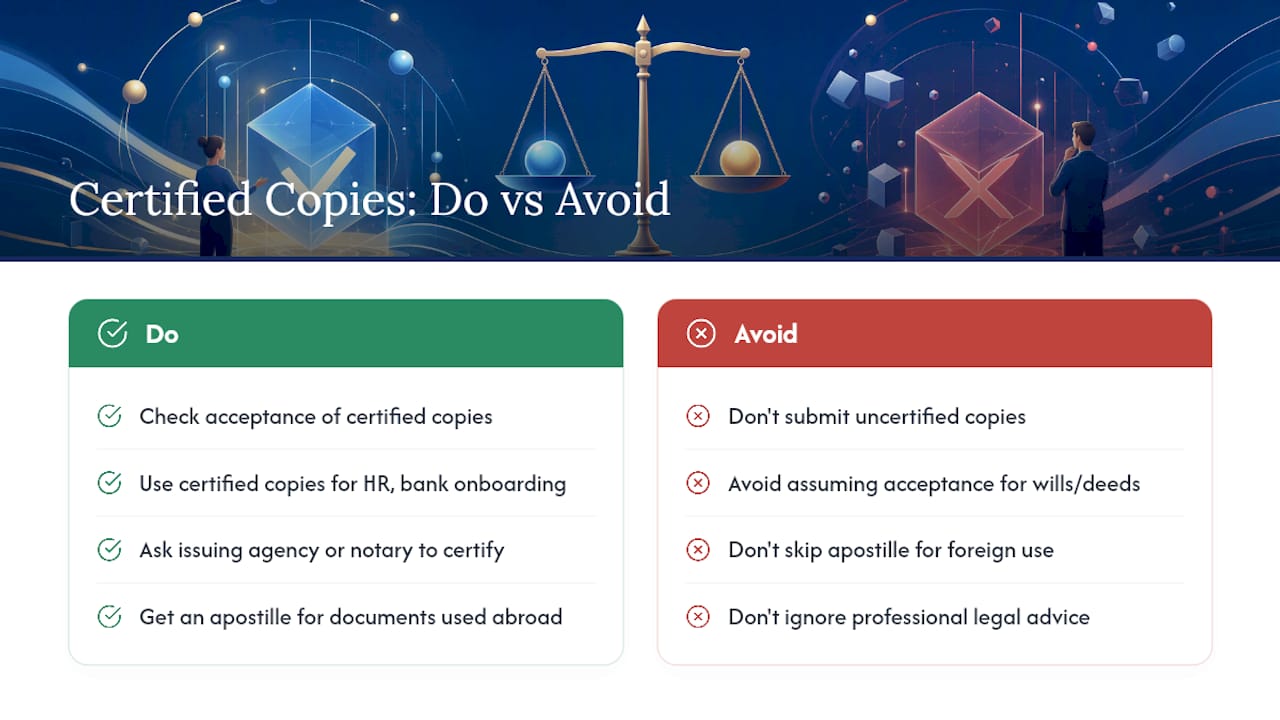
Bring the original when a receiving authority names it specifically, especially for wills, property deeds, or court exhibits.
A certified true copy generally works for HR files, bank onboarding, and most visa or licensing paperwork.
Always confirm requirements with the receiving office before submitting anything, since the Best Evidence Rule leaves room for judgment calls on duplicates.
Key Takeaways
A true original document is a first-generation record with physical security features, and a certified true copy replaces it only when the receiving authority explicitly permits it.
Point | Details |
Know the physical markers | Wet-ink signatures, embossing, watermarks, and microprinting distinguish originals from reproductions. |
Certified copies need a real certifier | Issuing agencies, notaries, and courts carry more weight than an informal stamp. |
Duplicate originals are equal in law | Multiple copies signed at the same time count as originals, unlike a later photocopy. |
High-stakes matters need originals | Wills, land deeds, and court exhibits usually require the real document. |
Confirm before you submit | Call the receiving office to verify whether a certified copy will actually be accepted. |
Table of Contents
What Exactly Counts as an Original Document
An original is the first-generation version of a record, produced or issued at the time the underlying event happened. A birth certificate printed by the civil registry the week a child is born is an original. A photocopy of that same certificate, no matter how crisp, is not, unless someone with authority attests to it.
Officials look for physical markers that a scanner or printer struggles to fake:
A wet-ink signature with visible pen pressure and slight indentation in the paper
An embossed or raised seal you can feel with a fingertip
A watermark visible only when held to light
Microprinting readable under magnification
UV-reactive fibers that glow under specific light
Common examples include birth certificates, land deeds, diplomas, signed contracts, and wills. One wrinkle worth knowing: some records are issued as duplicate originals, meaning multiple copies were created and signed at the same time, each carrying equal legal weight. That’s different from a photocopy made later.
What a Certified True Copy Actually Is
A certified true copy is a reproduction that an authorized person has compared line by line against the original and then stamped, signed, and formally attested as accurate. It’s not a photocopy someone signed casually. It carries a paper trail back to a specific certifier who takes responsibility for the match.
Typical certifiers include:
The government agency or registrar that issued the original record
A court clerk, for judicial documents
An authorized notary public
Consular or embassy officials, when the document needs to travel internationally
In the UAE, attestation offices and authorized notary channels that compare and stamp copies for local acceptance
Don’t confuse the three related terms. A certified true copy confirms the copy matches an original. A notarized copy is a specific form of certification performed by a notary. An apostille is a further international authentication layer, added on top of a certification, for use in another Hague Convention country. Each does a different job.
Original vs Certified True Copy: A Side-by-Side Look
Factor | Original | Certified true copy |
Legal weight | Highest, generally accepted without question | Strong, but conditional on the certifier’s authority |
Security features | Wet-ink signature, embossing, watermark | None inherent, relies on the certifier’s stamp |
Who issues it | The originating authority at time of creation | Registrar, notary, or authorized official |
Typically accepted for | Wills, court exhibits, land transfers | HR files, visa applications, bank onboarding |
Rejection risk | Very low | Moderate if wrong certifier or missing legalization |
Favor the original when the receiving authority names it explicitly or when the stakes involve inheritance, land title, or active litigation. A certified copy usually clears everyday administrative hurdles. When you’re unsure, call the receiving office directly. Don’t guess.
When You Must Use the Original vs When a Copy Works
Some processes flatly demand the real thing:
Court filings and litigation exhibits often require originals so opposing counsel can inspect authenticity directly.
Wills and probate matters almost always require the original will; a copy can trigger a legal presumption that the original was revoked.
Property registration and land transfers typically need original deeds at the point of transfer.
Visa and immigration applications vary by embassy, but many accept certified copies for supporting documents while requiring the original passport.
Employment credentialing and bank account openings generally accept a certified true copy of diplomas or ID documents.
The rule of thumb: high-stakes, irreversible transactions lean toward originals. Routine administrative steps lean toward certified copies. Always get the receiving authority’s requirement in writing before you travel across town, or across an ocean, with the wrong paperwork.
How to Spot an Original: A Quick Checklist
Run through this before you accept or submit any document as an “original”:
Feel the surface for embossing or raised seals near signature blocks.
Hold the paper to light and look for a watermark pattern.
Inspect the signature for pen indentation, not just visible ink.
Check for microprinting near borders or seals, legible only under magnification.
Compare paper stock and weight against a known genuine sample.
Confirm official numbering or serial codes match the issuing agency’s format.
Beyond the physical checks, ask about chain of custody: who issued the document, how it’s been stored, and whether anyone besides the original signer has handled it. A document-analysis framework built for archivists, essentially meet the document, observe its parts, make sense of it, then use it as evidence, works just as well for everyday verification.
Pro Tip: If you’re ever in doubt, skip the guesswork and ask the issuing authority for a fresh certified copy directly from their office. It costs a small fee, but it eliminates the risk of a rejected submission weeks later.
Step-by-Step: Getting a Certified True Copy in the UAE
Make a clear, legible photocopy of the document you need certified. Blurry scans get rejected outright.
Bring both the original and the copy to an authorized certifier, this could be the issuing agency, a notary public, or an attestation office.
The certifier compares the two side by side, checking every page and signature against the original.
They sign, stamp, and record the attestation, sometimes issuing a reference number tied to their internal log.
Collect a receipt or acknowledgment slip confirming the certification date and certifier’s details.
If the document needs to work outside the UAE, plan for an extra layer. Many countries require an apostille or consular legalization on top of local certification, depending on whether the destination country participates in the Hague Convention. That second step can add days to your timeline, so build in buffer time rather than booking travel around a same-day turnaround.
Pro Tip: Ask upfront whether the receiving authority wants a color scan or a black-and-white copy, and whether the signature needs to appear in blue ink specifically. Small formatting mismatches cause more rejections than people expect.
For readers dealing specifically with attestation sequencing, true copy attestation and apostille verification each walk through the follow-on steps in more detail.
Can a Copy Legally Replace the Original? The Best Evidence Rule Explained
Legal systems generally follow some version of the Best Evidence Rule, which historically demanded the original document as proof of its own contents. Modern versions are more flexible: duplicates are usually admissible unless someone raises a genuine question about authenticity or it would be unfair to rely on the copy instead of the original.
This is where “duplicate originals,” multiple copies signed at the same time as legally equivalent counterparts, differ from a certified copy made later from a single signed original. Courts tend to accept duplicate originals freely. A certified true copy of a lost original will, by contrast, often faces heavy scrutiny, since many jurisdictions presume a missing will was deliberately destroyed.
To reduce risk: get certifications directly from the issuing authority whenever possible, add notarization when a receiving party asks for it, and secure apostille or legalization early for anything crossing borders.
How Harris N Charms Helps You Avoid Costly Mistakes
Coordinating custodian contact, certifier appointments, and embassy legalization handoffs takes real legwork, and mistakes compound fast when documents travel between the Philippines and the UAE. Harris N Charms manages that chain directly, contacting custodians, booking certifier appointments, handling legalization handoffs, and returning your originals securely.
Common pitfalls this prevents:
Using the wrong certifier for a document type
Skipping a required apostille or legalization step
Submitting an incomplete or improperly stamped copy
Visit Harris N Charms to start your attestation process with fewer surprises.
A Practical Take on Originals vs Copies
Most people overvalue convenience and undervalue confirmation. Bringing a certified copy when an office wanted the original costs you a wasted trip; bringing the original when a copy would’ve done costs you nothing but a little extra caution. Favor originals whenever the stakes involve property, inheritance, or court proceedings, and lean on properly issued certified copies for the rest.
One habit worth adopting: always get a dated receipt from whoever certifies your copy, along with their direct contact information, in case a receiving office later questions the attestation.
Frequently Asked Questions
What is the difference between an original document and a certified true copy? An original is the first-generation record created at the time of the event. A certified true copy is a reproduction an authorized person has verified against that original and formally stamped as accurate.
Can a certified true copy be used instead of an original in the UAE? Often yes, for routine administrative processes like HR files or bank onboarding. Wills, land deeds, and court exhibits usually still require the original.
Who can certify a true copy? The issuing government agency, a court clerk, a notary public, or an authorized attestation office, depending on the document type and where it needs to be used.
Does a certified true copy need an apostille too? Only if the document is traveling to another country. Local certification and international apostille or legalization are separate steps.
What happens if I submit an uncertified copy when an original is required? The receiving office will likely reject your submission outright, causing delays and possibly extra fees for reprocessing.
This article is general information, not a substitute for advice from a qualified lawyer. Consult a qualified legal professional about your own circumstances before acting on anything here.
Sources
Recommended
Comments