
Dubai Freelance Visa: How to Apply and Live Legally in the UAE
- contact335627
- Aug 13
- 14 min read
A Dubai freelance visa is the combination of a mandatory MOHRE Freelance Work Permit (Type 12) plus a UAE residence visa. Together, they let qualified self-employed professionals live and work in the UAE without an employer sponsor. According to U, typical all-in first-year costs for a standard 2-year freelance visa fall between AED 12,500 and AED 18,000, with premium packages reaching AED 30,000.
Two practical routes dominate:
Free-zone freelance permit: Fastest to set up. A recognized free zone sponsors your 2-year residence visa. Best for freelancers who want a quick, affordable start and whose profession appears on the zone’s permitted activity list.
MOHRE Type 12 + ICP Green Visa: A 5-year self-sponsored residence visa for established freelancers. Requires a bachelor’s degree or specialized diploma and proof of at least AED 360,000 in annual freelance income for the two preceding years (or evidence of financial solvency), per GDRFA Dubai.
The core administrative sequence is the same for both routes: secure your permit, then obtain an entry permit, complete a medical fitness test, register for Emirates ID biometrics, arrange health insurance, and get your visa stamped.
Key Takeaways
A Dubai freelance visa requires both a MOHRE Freelance Work Permit (Type 12) and a UAE residence visa, with the Green Visa route requiring AED 360,000 in annual income and an attested degree for five-year self-sponsored residency.
Point | Details |
Two main routes | Free-zone permit (2-year visa) or MOHRE Type 12 + Green Visa (5-year, self-sponsored). |
Green Visa income threshold | AED 360,000 annual freelance income for two preceding years is required to qualify. |
Realistic first-year cost | Budget AED 12,500–18,000 for a standard package; premium setups can reach AED 30,000. |
Document attestation is critical | Philippine degrees and police clearances must be DFA-authenticated and UAE MOFA-attested before submission. |
Harrisncharms attestation services | Harrisncharms handles DFA apostille, certified translation, and NBI clearance for Filipino freelancers in the UAE. |
Table of Contents
What are the official application routes, and which one fits you?
How much does a Dubai freelance visa cost, and how long does it take?
Can freelance visa holders sponsor family members and open bank accounts?
How Harrisncharms helps with document attestation for your freelance visa
The route that actually fits you matters more than the cheapest price
Who qualifies for a Dubai freelance visa?
Eligibility splits cleanly between the two main routes. Knowing which one fits your profile before you start saves weeks of wasted effort.
MOHRE Type 12 + Green Visa eligibility
The Green Visa is the most attractive option for established freelancers because it gives you five years of self-sponsored residency. To qualify:
Hold a bachelor’s degree or a specialized diploma recognized by UAE authorities.
Prove annual freelance income of at least AED 360,000 for the two years immediately before applying, OR provide evidence of financial solvency acceptable to GDRFA.
Hold a valid MOHRE Type 12 Freelance Work Permit for your profession.
Maintain valid health insurance throughout the visa period.
Present a clean immigration record and a valid passport with at least six months’ remaining validity.
The degree requirement is specific to the Green Visa. The MOHRE Type 12 work permit itself does not always mandate a degree, but without one, you cannot upgrade to the Green Visa later. Confirm your profession is on MOHRE’s approved list at mohre.gov.ae before investing in attestation.
Free-zone freelance permit eligibility
Free zones set their own rules, but the baseline requirements are consistent:
Minimum age of 18, with a passport valid for at least six months.
Your professional activity must appear on the free zone’s permitted activity list.
A CV or portfolio demonstrating relevant experience in your field.
Proof of qualifications — some zones require a degree or diploma for regulated professions; others accept a strong portfolio.
Proof of address (inside or outside the UAE depending on whether you apply from within the country).
Zone-specific application forms and any Establishment Card paperwork.
Pro Tip: Before paying any free-zone fee, download the zone’s current activity list and confirm your exact profession is listed. Activity lists change, and a mismatch means a rejected application with no refund.
Key figure: The AED 360,000 annual income threshold for the Green Visa is the single most important eligibility number to verify before choosing your route. If your freelance income falls below that level, a free-zone permit is your realistic starting point.
What are the official application routes, and which one fits you?
Three paths exist. Each has a different cost profile, sponsorship model, and ceiling for growth.
Free-zone freelance permit
A free zone issues you a freelance permit and sponsors your 2-year UAE residence visa. You operate under your own name (not a company trade name in most zones), and the free zone handles the administrative relationship with immigration. The Dubai Development Authority (DDA) offers a Freelancer License (Sole Professional License) that lets professionals register under their birth name, which is useful for creatives, media professionals, and consultants. GoFreelance (TECOM) and other zones serve technology and media sectors.
This route suits freelancers who are new to the UAE, whose income is below AED 360,000, or who want a fast, lower-cost entry point. The 2-year visa must be renewed, and you cannot sponsor employees under most freelance permits.
MOHRE Type 12 + ICP Green Visa
This is the self-sponsorship route. You hold the MOHRE work permit and sponsor your own 5-year residence visa through ICP (Federal Authority for Identity, Citizenship, Customs and Port Security) or GDRFA Dubai. No free zone is involved in the sponsorship chain, which gives you more flexibility: you can live anywhere in the UAE, open personal and business bank accounts more easily, and sponsor eligible family members as dependants.
The tradeoff is the income threshold and the degree requirement. If you clear both, this route is worth the extra paperwork.
Investor/company alternatives (Meydan Fawri and single-owner LLCs)
Meydan Free Zone positions its Fawri investor license as an alternative to a standalone freelance permit for solopreneurs who want a trade name, faster trade license issuance, and investor visa benefits. Meydan does not issue freelance visas directly; the residence visa comes through immigration authorities once the investor license is in place.
A single-owner LLC or investor-licensed entity makes sense when you need a trade name for client contracts, full corporate banking, or the ability to hire staff. The setup cost is higher, but the operational ceiling is much wider. For a deeper look at the free-zone vs. mainland tradeoffs, ViaUAE’s breakdown is worth reading before you commit.
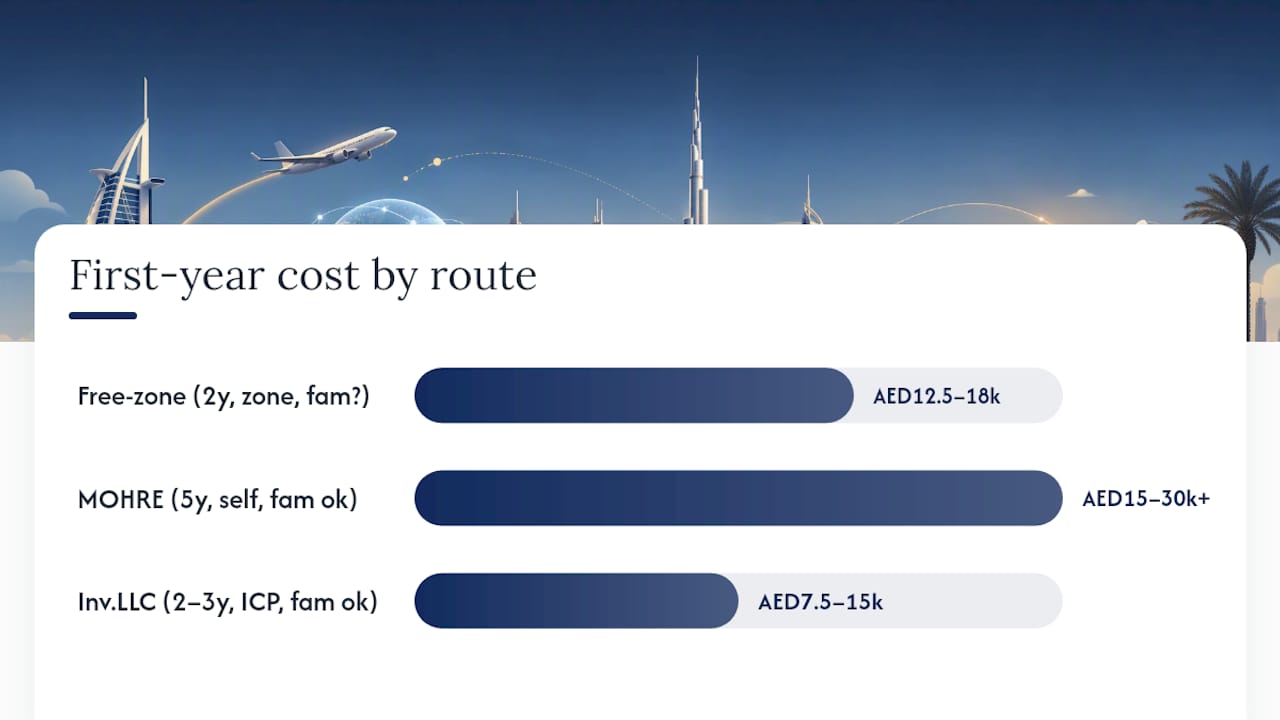
Route | Visa duration | Sponsorship | Family sponsorship | Typical first-year cost |
2 years | Free zone | Varies by zone | AED 12,500–18,000 | |
Investor/LLC (e.g., Meydan Fawri) | 2–3 years | Free zone / ICP | Generally allowed | AED 7,500–15,000 |
How do you apply for a Dubai freelance visa, step by step?
The sequence below applies to both the free-zone and Green Visa routes, with route-specific notes at each step.
Confirm your route and activity fit. Check your profession against the free zone’s activity list (free-zone route) or MOHRE’s approved professions list (Green Visa route). Do this before spending money on attestation.
Apply for the freelance permit. Free-zone applicants submit through the zone’s online portal with their documents. MOHRE Type 12 applicants apply via mohre.gov.ae. The MOHRE Work Bundle has reduced processing time for some permits to as little as 5 working days. Free-zone processing typically runs 5–15 working days depending on the zone and document completeness.
Obtain an entry permit. Once the freelance permit is approved, the free zone or ICP issues a residence entry permit. Applicants outside the UAE enter on this permit; those already inside may change status.
Complete the medical fitness test. Attend an approved medical center in the UAE. The standard government fee is approximately AED 320, per GoFreelance guidance.
Register for Emirates ID biometrics. Submit your biometrics at an ICP service center. The Emirates ID fee is approximately AED 370.
Arrange mandatory health insurance. Dubai law requires active health insurance before visa stamping. Costs vary by provider and coverage level.
Get your visa stamped. GDRFA Dubai or ICP stamps the residence visa into your passport. Free-zone applicants coordinate this through the zone’s PRO services or directly with GDRFA.
Pro Tip: If you are applying from outside the UAE, confirm with your chosen free zone whether they handle the entry permit remotely or require an in-person visit. Most major zones manage the full process online, but the medical test and biometrics must be completed inside the UAE.
Processing note: The MOHRE Work Bundle has cut some permit processing times to 5 working days. Full residence processing (entry permit through visa stamping) typically adds another 2–4 weeks, so budget 4–6 weeks total for the complete process.
What documents do you need to prepare?
Getting your paperwork right before you apply is the single biggest factor in avoiding delays. The two routes have overlapping but distinct checklists.
Green Visa applicant checklist
Document | Notes |
Valid passport (6+ months validity) | Color copy of all pages |
Recent passport-size photos | White background, UAE specification |
Attested bachelor’s degree or specialized diploma | Must be attested by home country authorities and UAE MOFA |
Proof of freelance income (2 years) | Bank statements, tax records, or audited accounts showing AED 360,000+ annually |
CV or professional portfolio | Demonstrating freelance activity in your field |
Police clearance certificate | From your home country, attested |
Valid health insurance | Active policy required before visa stamping |
MOHRE Type 12 work permit approval | Issued before the Green Visa application |
Free-zone permit applicant checklist
Document | Notes |
Valid passport (6+ months validity) | Color copy |
Recent passport-size photos | White background |
CV or professional portfolio | Zone-specific format may be required |
Proof of qualifications | Degree or diploma if required by the zone for your activity |
Proof of address | Utility bill or tenancy contract (inside or outside UAE) |
Zone application forms | Downloaded from the zone’s portal |
Establishment Card paperwork | Issued by the zone after permit approval |
Pro Tip: Philippine documents — degrees, birth certificates, police clearances — require DFA authentication and UAE MOFA attestation before UAE authorities will accept them. Starting this process early is critical; DFA apostille and embassy legalization can take 2–6 weeks depending on the document type. Harrisncharms handles this exact workflow for Filipino expats, including pre-departure attestation steps and UAE free-zone document requirements.

How much does a Dubai freelance visa cost, and how long does it take?
Advertised “from” prices almost always cover only the permit portion. A realistic first-year budget includes the permit fee, Establishment Card, entry permit, medical test, Emirates ID, health insurance, and any service or agency fees.
Free-zone freelance permit fee: AED 7,500–15,000 per year depending on the zone. Meydan typically falls around AED 7,500–9,000; GoFreelance/TECOM packages run AED 9,500–14,000; DMCC and premium zones are higher.
Establishment Card: Issued by the free zone; fee varies by zone, typically AED 500–1,500.
Entry permit and visa stamping: Government fees vary; budget AED 1,000–2,000 for this stage.
Medical fitness test: Approximately AED 320 (standard government rate).
Emirates ID: Approximately AED 370.
Mandatory health insurance: AED 600–3,000+ depending on coverage level and provider.
Service or agency fees: AED 1,000–5,000 if you use a PRO or agency to manage the process.
Total realistic range: AED 12,500–18,000 for a standard 2-year package; premium setups or Green Visa applications can reach AED 30,000.
Processing timeline: Free-zone permit approval runs 5–15 working days. Add 2–4 weeks for the full residence process (entry permit, medical, biometrics, visa stamping). Plan for 4–6 weeks total from application submission to a stamped visa in hand.
Always ask any agency or free zone for an itemized, all-in quote that explicitly includes Establishment Card, medical, Emirates ID, health insurance, and attestation costs. A low headline number that excludes these items is not a low price.
Can freelance visa holders sponsor family members and open bank accounts?
Yes, with conditions that vary by route.
Green Visa holders can generally sponsor eligible dependants (spouse, children, and in some cases parents) because the visa is self-sponsored and carries the same family sponsorship rights as an employment residence visa. Income and accommodation requirements apply; confirm current thresholds with GDRFA or ICP before applying for dependant visas.
Free-zone freelance permit holders may or may not be able to sponsor dependants depending on the specific zone’s rules and the income level on record. Some zones explicitly allow it; others require a minimum salary threshold that a freelance permit holder must demonstrate. Check directly with your zone’s PRO team.
Emirates ID sequence: Medical fitness test → biometrics at an ICP service center → Emirates ID issuance → visa stamping. The Emirates ID is not issued until biometrics are registered, and the visa is not stamped until the ID application is in process. The standard government fees are approximately AED 320 for the medical test and AED 370 for the Emirates ID, per GoFreelance.
Banking: Once your Emirates ID is active and your residence visa is stamped, you can open a personal bank account at most UAE banks. Corporate or business accounts require additional documentation (Establishment Card, trade license, or company documents). The Green Visa and investor/LLC routes tend to produce smoother corporate banking experiences than a basic freelance permit.
Practical benefits: An active Emirates ID lets you register a tenancy contract (Ejari), access government services online, obtain a UAE driving license, and sign up for utilities. Without it, day-to-day life in Dubai is significantly more complicated.
For a full walkthrough of the UAE visa requirements procedure, Harrisncharms has a dedicated guide for Filipino expats covering the end-to-end residency process.
What are the renewal rules and compliance requirements?
Freelance permits and residence visas do not renew automatically. Missing a renewal window means overstay fines and potential permit cancellation.
Free-zone permits typically run for one or two years and must be renewed before expiry. The free zone will ask for evidence of ongoing professional activity, which in practice means recent invoices or contracts. Residence visas tied to free-zone permits renew on the same cycle. Green Visas run for five years, but the underlying MOHRE work permit must stay valid throughout.
The VAT registration threshold in the UAE is AED 375,000 in taxable turnover over any 12-month period. If your freelance income approaches or exceeds that figure, you are legally required to register for VAT with the Federal Tax Authority. Clean financial records also make this assessment straightforward and protect you from penalties.
Practical retention guidance: keep all invoices, bank statements, and client contracts for a minimum of five years. A simple cloud-based accounting tool (FreshBooks, Wave, or QuickBooks Self-Employed) is enough for most freelancers and produces the PDF exports that free zones and banks request at renewal. For a detailed look at document renewal timelines for Emirates ID and residence visas, Harrisncharms covers the process specifically for Filipino expats.
How do you choose the right route or free zone?
The right answer depends on four variables: your profession, your income level, your banking needs, and your growth plans.
Check the activity list first. Every free zone publishes a permitted activity list. If your profession is not on it, that zone is not an option regardless of price. DDA suits creative and media professionals; TECOM/GoFreelance covers technology and media; DMCC serves commodities and consulting. Confirm the match before anything else.
Compare true first-year costs, not headline prices. A zone that charges AED 7,500 for the permit but adds AED 3,000 in Establishment Card and service fees may cost more than a zone advertising AED 10,000 all-in. Get itemized quotes.
Consider banking credibility. Some free zones are better recognized by UAE banks than others. If you need a corporate account quickly, ask the zone which banks they have established relationships with. Free-zone setup comparisons can help you evaluate this before committing.
Think about scalability. A freelance permit works well for a solo professional. The moment you want to hire someone, bid on mainland government contracts, or open a corporate account under a trade name, a single-owner LLC or investor license becomes the more practical structure.
Pro Tip: If your income is already above AED 360,000 annually and you hold an attested degree, go straight for the Green Visa route. The five-year self-sponsored residency eliminates the renewal cycle and gives you family sponsorship rights from the start.
Three quick scenarios:
Starter freelancer (income below AED 360,000, new to UAE): Free-zone permit via DDA or GoFreelance. Fast, affordable, and renewable.
Established consultant (income above AED 360,000, attested degree): MOHRE Type 12 + Green Visa. Five years of self-sponsored residency with family sponsorship.
Solopreneur planning to scale (needs trade name, corporate banking, or staff): Investor/LLC route via Meydan Fawri or a Dubai free-zone company setup. More upfront cost, far fewer operational limits.
How Harrisncharms helps with document attestation for your freelance visa
Harrisncharms does not issue visas. That is handled by UAE authorities, free-zone portals, GDRFA, or ICP. What Harrisncharms does is handle the document preparation and attestation steps that trip up most Filipino applicants before they even reach the permit application stage.
Services available:
DFA authentication of Philippine documents (birth certificates, degrees, police clearances, marriage certificates)
Apostille processing for documents destined for UAE use
Philippine-to-English certified legal translation
Police clearance (NBI) handling and coordination
Embassy legalization and UAE MOFA endorsement workflows
Guidance on legal documents for expats specific to UAE immigration requirements
Service | Typical use case |
DFA authentication + apostille | Degree attestation for Green Visa or free-zone permit |
Certified legal translation | Philippine documents requiring English versions for UAE authorities |
Police clearance (NBI) handling | Required for Green Visa and some free-zone applications |
Embassy legalization workflow | Documents requiring Philippine consulate or UAE MOFA endorsement |
Harrisncharms specializes in the Filipino expat document workflow in the UAE, including up-to-date guidance on record validation for UAE authorities. All personal documents submitted through Harrisncharms are handled with strict confidentiality.
Disclaimer: Harrisncharms assists with document attestation, apostille, legalization, and translation only. Visa issuance decisions rest entirely with UAE immigration authorities and free-zone portals.
The route that actually fits you matters more than the cheapest price
Most of the confusion around the Dubai freelance visa comes from treating it as a single product when it is really two distinct systems with different eligibility bars, cost structures, and long-term implications.
The free-zone permit is not a lesser option. For a freelancer just entering the UAE market, it is the right starting point. It is faster, requires less documentation, and gives you two years to build the income record you would need for a Green Visa later. The mistake is staying on a free-zone permit indefinitely when your income has crossed AED 360,000 and you have an attested degree sitting in a drawer. At that point, the Green Visa’s five-year self-sponsorship and family rights are worth the extra paperwork.
The document attestation step is where most Filipino applicants lose time. A degree that has not been authenticated by DFA and attested by UAE MOFA is not a valid degree for UAE immigration purposes, regardless of how prestigious the institution is. Starting attestation early, ideally before you even choose a free zone, puts you weeks ahead of the process.
For the next 30 days, three actions matter: verify your activity is on the permitted list of your target free zone or MOHRE’s approved professions, start the DFA authentication process for any Philippine documents you will need, and get an itemized all-in quote from at least two free zones before paying anyone.
Harrisncharms speeds up your attestation paperwork
Filipino freelancers in the UAE consistently hit the same bottleneck: Philippine documents that need DFA authentication, apostille, or certified translation before any UAE authority will accept them. That process takes time, and errors mean starting over.
Harrisncharms handles DFA authentication, apostille, certified translation, NBI police clearance, and UAE MOFA legalization for Filipino expats in the UAE. You send the documents; Harrisncharms manages the workflow. Typical turnaround for DFA apostille is 1–3 weeks depending on document type and current DFA processing volume. Certified translations are generally completed within 3–5 business days.
Harrisncharms does not process visas. What it does is make sure your paperwork is ready when the free zone or immigration authority asks for it, so your application does not stall at the document stage. All personal documents are handled with full confidentiality.
Ready to get your documents in order? Visit Harrisncharms to start your attestation request.
Sources
Always verify current fees, activity lists, and eligibility rules directly on the issuing authority’s website before paying any agency or free zone. Fees and rules change, and a third-party guide (including this one) may not reflect the most recent update.
Which portal to start with: If you are pursuing a free-zone permit, go directly to the free zone’s own portal (GoFreelance, DDA, or your chosen zone). If you are pursuing the Green Visa, start at GDRFA Dubai to confirm eligibility, then move to MOHRE for the Type 12 permit application. Verify all fees on the official portal before transferring money to any third party.
This article is general information, not a substitute for advice from a qualified lawyer. Consult a qualified legal professional about your own circumstances before acting on anything here.
Recommended
Comments