
Document legalization vs attestation: Filipino expat UAE guide
If you’ve ever asked a friend or searched online about document legalization vs attestation while preparing your papers for the UAE, you’ve probably gotten different answers every time. Some say “get it attested,” others say “you need legalization,” and a few throw in “apostille” just to make things more confusing. For Filipino expats navigating employment visas, family reunification, or even marriage registration in the UAE, this confusion is not just frustrating. It can delay your visa, cost you money, and jeopardize your plans entirely.
Table of Contents
Why Filipino expats in the UAE need document legalization and attestation
What is document legalization? Process and purpose explained
Attestation: How is it different from legalization for UAE-bound documents?
Which process do you need? Use cases for typical UAE requirements
Expert tips and pitfalls: Filipino expat shortcuts for UAE documentation
Most expats confuse legalization and attestation—here’s what actually matters
Get hands-on help with your document attestation and legalization
Key Takeaways of Document Legalization vs Attestation
Point | Details |
Legalization vs attestation | Understand which process applies to your document type and UAE use to avoid unnecessary steps. |
Agency sequence matters | Follow the correct order of CHED/DFA/Embassy/MOFA to ensure acceptance in the UAE. |
Leverage digital solutions | Use UAE MOFA’s digital attestation to save significant time and hassle. |
Avoid travel with services | Authorized couriers handle Manila processing so you don’t have to fly back. |
Double-check requirements | Rules change often—verify document needs for your specific visa or purpose every time. |
Why Filipino expats in the UAE need document legalization and attestation
The moment you decide to work, sponsor a family member, or enroll in a school program in the UAE, your Philippine documents need to be verified by the right authorities. The UAE government does not simply accept documents at face value. It requires proof that your papers are genuine and were issued by legitimate Philippine institutions.
Attesting documents in the UAE applies to a surprisingly wide range of paperwork. Here is a quick look at the most common documents Filipino expats process:
College diplomas and transcripts for employment visas
PSA (Philippine Statistics Authority) birth certificates for dependent or family visas
PSA marriage certificates for spousal sponsorship
NBI (National Bureau of Investigation) clearances for police clearance requirements
School records for children enrolling in UAE schools
Most Filipinos in the UAE cannot simply fly back to Manila every time a document needs processing. That is why many rely on service providers who handle courier services to Manila and back, meaning you stay put in Dubai or Abu Dhabi while your papers travel. As noted in Red Ribbon/Apostille/Document Attestation for Filipino OFWs for UAE, the common path for employment visas involves degrees going through CHED, then DFA, then the UAE Embassy in Manila, and finally MOFA (Ministry of Foreign Affairs) in the UAE. Family visas typically rely on PSA certificates following a similar chain.
“Processing your documents through the right agencies, in the right order, is the foundation of a successful UAE application. Skipping even one step can mean starting over.”
The good news is that the UAE has recently introduced digital MOFA attestation options, which significantly speeds up the final step of the process for many documents. This is a big deal because MOFA attestation in the UAE was previously one of the longer waiting points.
The attestation guide Philippines-UAE outlines the full picture for expats who want to understand the end-to-end flow before getting started.
What is document legalization? Process and purpose explained
Document legalization is the formal process of having a document recognized as authentic by a chain of authorities, from the issuing institution all the way up to the receiving country’s relevant body. Think of it as a relay race where each runner (agency) passes the baton (your document) to the next after confirming everything is legitimate.
For Filipino documents destined for the UAE, legalization generally follows these steps:
Issuing agency verification: For academic documents, this means CHED (Commission on Higher Education) for college credentials or DepEd (Department of Education) for school records.
DFA authentication: The Department of Foreign Affairs in the Philippines authenticates the document, confirming the signature of the issuing agency is genuine.
UAE Embassy in Manila: The UAE Embassy verifies the DFA’s authentication, adding another layer of official recognition.
UAE MOFA attestation: Once the document arrives in the UAE, the Ministry of Foreign Affairs performs the final validation for use within the country.
As documented for Filipino OFWs, Filipino expats follow these multiple agency steps depending on the document type and its intended use.
Legalization is typically required for countries that are not part of the Hague Apostille Convention, or for documents that require full embassy involvement rather than a simpler apostille stamp. The UAE, while not part of the Apostille Convention in the same way European nations are, has its own recognized process that blends elements of both systems.
Pro Tip: When processing school documents apostille for the UAE, always confirm with your employer or the UAE authority receiving the document whether they want full legalization or whether a DFA apostille is acceptable. Asking upfront saves weeks of backtracking.
“Legalization is not a single stamp. It is a chain of trust built one agency at a time, and breaking that chain means your document loses its legal standing in the UAE.”
One important note: the Philippines joined the Hague Apostille Convention in May 2019. This means DFA now issues apostille certificates instead of the old “red ribbon” authentication. However, for UAE purposes, many documents still need to go through the UAE Embassy and MOFA, so the legalization chain remains relevant even with the apostille system in place.
Attestation: How is it different from legalization for UAE-bound documents?
Here is where many Filipino expats get tangled. Attestation and legalization look almost identical in practice, and the terms are often used interchangeably. But there is a meaningful distinction worth understanding.
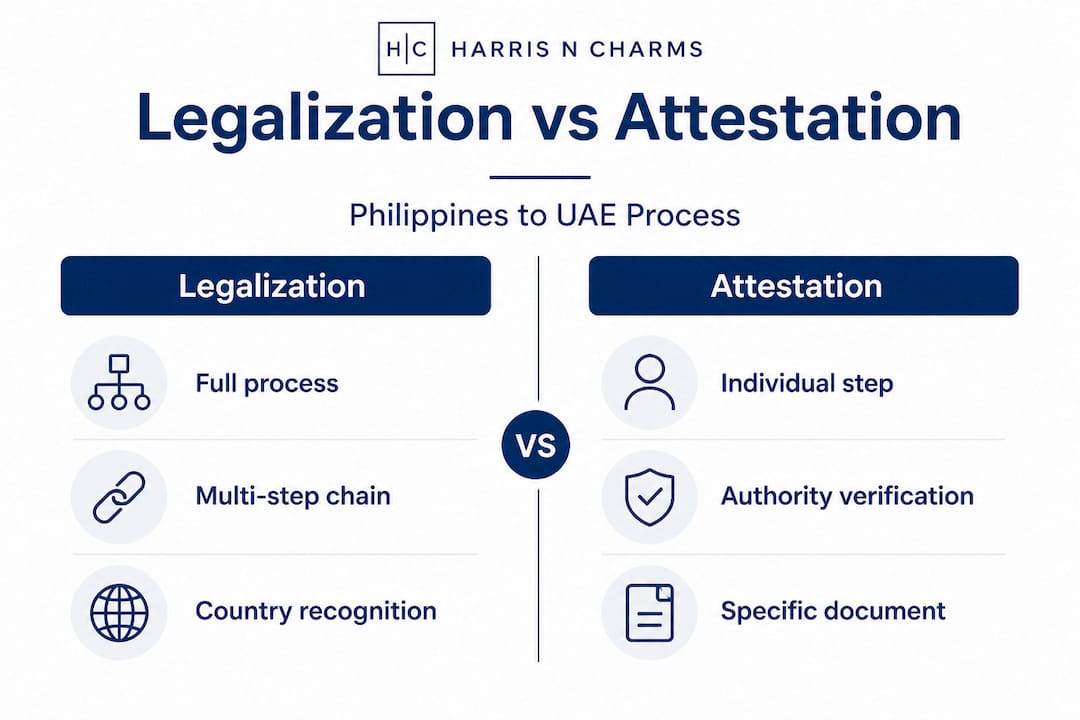
Legalization typically refers to the full multi-step chain from the originating country all the way to recognition in the receiving country. Attestation refers to the act of one specific authority verifying and stamping a document at a particular point in that chain. In other words, legalization is the overall journey, and attestation is each stop along the way.
For UAE-bound documents from the Philippines, the process as outlined for UAE compliance involves attestation by multiple bodies:
Stage | Authority | What they verify |
Step 1 | CHED or DepEd (Philippines) | Document is from a recognized institution |
Step 2 | DFA (Philippines) | Signature and seal of CHED/DepEd is authentic |
Step 3 | UAE Embassy Manila | DFA’s authentication is recognized |
Step 4 | UAE MOFA | Document is accepted for use in UAE |
The key difference in real terms: legalization is the name for the whole process, while attestation describes each individual verification step. When your employer in Dubai says “get your degree attested,” they usually mean the full legalization chain, not just one stamp.
Pro Tip: Check the PSA DFA Apostille guide to understand how birth and marriage certificates from PSA fit into the attestation chain. The process differs slightly from academic documents.
Here is a quick comparison to keep in mind:
Legalization: Used when describing the complete process for a document to be accepted abroad
Attestation: The act of verification at a single point in the chain
Apostille: A simplified, internationally recognized form of authentication used between Apostille Convention member countries
UAE MOFA attestation: The final step in the UAE that makes your document legally valid for local use
Understanding these labels helps you communicate clearly with service providers and government offices, and it prevents you from paying for the wrong service.
Which process do you need? Use cases for typical UAE requirements
Let’s get practical. Here is a breakdown of common scenarios and which process applies:
Document | Purpose | Process needed |
College diploma | Employment visa / professional license | Full legalization: CHED, DFA, UAE Embassy, UAE MOFA |
PSA birth certificate | Family/dependent visa | Full legalization: DFA apostille, UAE Embassy, UAE MOFA |
PSA marriage certificate | Spousal visa sponsorship | Full legalization: DFA apostille, UAE Embassy, UAE MOFA |
NBI clearance | Employment or residency | DFA authentication, UAE Embassy, UAE MOFA |
School transcript (child) | School enrollment in UAE | DepEd, DFA, UAE Embassy, UAE MOFA |
As documented for OFWs, the UAE MOFA digital option is now speeding up the final step significantly, cutting down what used to be a week-long process to a matter of days in many cases.
Here is a step-by-step approach to figuring out what you need:
Identify the document type (academic, civil, clearance).
Determine the intended use in the UAE (work, family, education, legal).
Check with the receiving UAE authority (employer, GDRFA, school) on their specific requirements.
Use a reputable service provider to handle Manila-side processing without traveling back.
Complete UAE MOFA attestation, using digital options where available.
The apostille service benefits are especially useful for understanding when a DFA apostille is sufficient versus when a full embassy chain is necessary. Similarly, preparing attestation papers gives you a practical checklist so you do not miss any supporting documents along the way.
A common mistake is assuming that a DFA apostille alone is enough for UAE use. It is not. The UAE requires its own MOFA step on top of whatever the Philippines has already done.
Expert tips and pitfalls: Filipino expat shortcuts for UAE documentation
Getting your documents processed without delays comes down to preparation and using the right help. Here are the most important things experienced expats have learned the hard way.
Always verify requirements directly: Rules change. What was accepted in 2023 may not be accepted today. Call the UAE authority or your employer’s HR department before starting any processing.
Use reputable service providers: As highlighted for OFWs, courier-based services handle Manila processing without requiring you to fly home, saving both time and money.
Keep digital and physical copies: Scan every document at every stage. If a document gets lost in transit or rejected, you want proof of what was previously authenticated.
Use digital MOFA attestation: The UAE’s digital MOFA option is faster and reduces the chance of documents being physically mishandled.
Do not skip the CHED or DepEd step: Many applicants try to go straight to DFA with their diploma, only to have DFA reject it because CHED verification is missing.
Track processing timelines early: DFA apostille alone can take one to two weeks, and UAE MOFA adds more time. Factor in at least four to six weeks for a complete end-to-end process if you are not using an express service.
For civil documents like marriage certificates, check the CENOMAR and DFA apostille process, which is especially relevant for Filipinos applying for family visas where marital status documentation is required.
Pro Tip: If your documents are urgently needed, ask your service provider about express lanes at DFA and whether your employer accepts digital MOFA attestation temporarily while physical copies are being processed.
Most expats confuse legalization and attestation—here’s what actually matters
Here is our honest take after working with hundreds of Filipino expats: most people spend too much time arguing about terminology and not enough time making sure they follow the correct agency sequence for their specific document and use case.
Whether you call it legalization or attestation, what the UAE actually cares about is this: did the right authorities verify your document in the right order? That is it. A document that went through CHED, DFA, the UAE Embassy, and MOFA is accepted. A document that skipped one of those steps is not, no matter how confidently you explain the difference between legalization and attestation.
The attestation overview for Filipinos lays out exactly what the UAE expects, and it is worth bookmarking. What matters far more than knowing every definition is knowing your specific document’s pathway and having someone reliable execute it correctly.
The expats who get through the process fastest are not the ones who read the most about it. They are the ones who trust a reliable process, stay on top of updates like the UAE’s digital MOFA rollout, and ask for help when requirements change. Trying to DIY the full process from Dubai while holding down a job is one of the most common reasons for delays and rejections. Know your limits, and work with people who do this every day.
Get hands-on help with your document attestation and legalization
Sorting out your Philippine documents for the UAE does not have to be a stressful solo project. Whether you need to legalize a diploma for a new job offer or get a PSA birth certificate ready for a family visa, the right support makes all the difference.
Our team at Harris N Charms specializes in document attestation services for Filipino expats across the UAE. We handle document collection, Manila-side courier processing, embassy coordination, and digital UAE MOFA submissions on your behalf. You do not need to take time off work or book a flight to Manila. Visit harrisncharms.com to get started, ask about your specific document, and get a clear, honest breakdown of what you need and how long it will take. Stress-free, compliant, and done right the first time.
Frequently asked questions
Do I need both legalization and attestation for all documents in the UAE?
Not always. Some documents only need attestation at specific points, while others require the full agency chain depending on the document type and its intended use in the UAE.
How can I speed up my document attestation for the UAE?
Use authorized couriers for Manila processing and take advantage of UAE MOFA digital options to avoid in-person trips and reduce waiting time significantly.
What happens if my document isn’t properly attested or legalized?
The UAE may reject your application for employment visas, family reunification, or other official purposes if your paperwork does not follow the correct agency sequence and authentication steps.
Do I need to travel back to Manila to process my documents?
No. Authorized service providers handle courier-based processing in Manila on your behalf, meaning you can stay in the UAE throughout the entire document preparation process.
Recommended
Comments