
Document Attestation Guide for Filipino Expats in UAE

If you’ve ever tried to use a Philippine document abroad, you know how quickly “just get it attested” turns into a multi-step process that nobody fully explained to you. This document attestation guide breaks down everything you need to know as a Filipino living in the UAE: what attestation actually means, what types exist, how to complete the DFA Apostille process step by step, and how UAE authorities handle verification on their end. Whether you’re attesting a birth certificate, a marriage contract, or a business document, this guide gives you the complete picture without the runaround.
Table of Contents
Key Takeaways
Point | Details |
Know your attestation type | Understand whether your document needs apostille, legalization, or notarization before starting. |
Prepare originals from PSA or CHED | Submitting non-certified copies is the top reason for rejections at every stage. |
Complete DFA payment within 60 minutes | Missing the Landbank Link.Biz payment window cancels your appointment automatically. |
Use personal email for DFA booking | Work or corporate emails frequently block OTP delivery and cause failed bookings. |
UAE Verify is changing the game | Over 34.5 million documents are now authenticated digitally through this platform in the UAE. |
Your document attestation guide: types, purpose, and key terms
Attestation legally validates a document’s origin and the authenticity of its signatures so foreign authorities will accept it. That’s different from notarization, which only confirms that a signer appeared before a notary and signed willingly. Attestation goes further. It tells a foreign government: this document is real, it was issued by a legitimate authority, and the signature on it is genuine.
There are three forms you’ll encounter as a Filipino expat in the UAE:
Apostille is a simplified form of authentication used between countries that belong to the Hague Convention. The Philippines is a member, so most Philippine documents get an apostille stamp from the DFA instead of going through a longer legalization process.
Legalization is the longer route. If a country is not part of the Hague Convention, multi-step legalization may involve the foreign ministry, the destination country’s embassy, and sometimes certified translations.
Notarization is a prerequisite in many cases. Before you can get apostille on a private document like an affidavit or a special power of attorney, a Philippine notary public must sign and seal it first.
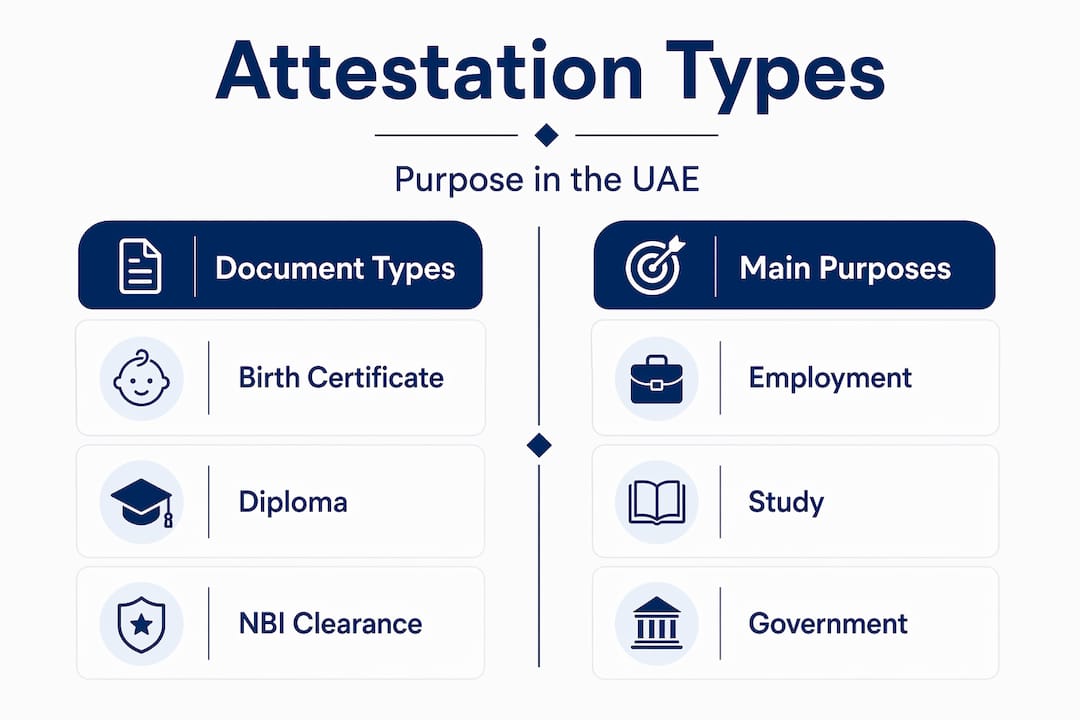
Common examples of attested documents Filipino expats need include PSA-issued birth certificates, marriage contracts, NBI clearances, school diplomas authenticated by CHED, employment contracts, and commercial documents like certificates of incorporation or business licenses.
The purpose of document attestation goes beyond formality. UAE employers, universities, and government offices will not accept unauthenticated foreign documents because there is no way to confirm they weren’t forged. Attestation creates a verifiable chain of authority from the original issuing body to the international recipient.
Pro Tip: If you’re unsure whether your document needs apostille or full legalization, check whether the receiving country is a Hague Convention member before spending time and money on the wrong process.
Prerequisites and preparation steps before you begin
Getting your paperwork ready before you touch the DFA website or walk into any UAE attestation office saves you significant time. The biggest source of delays is showing up with the wrong version of a document.
Here’s what UAE authorities and the DFA consistently require:
Document type | Required source | Notes |
Birth certificate | Philippine Statistics Authority (PSA) | Must be original PSA-issued copy, not Local Civil Registrar |
Marriage contract | PSA | Same requirement as birth certificate |
Diploma / transcript | CHED-authenticated copy | Must have CHED seal and signature |
NBI Clearance | NBI directly | Must be within validity period |
Affidavit / SPA | Notarized by a Philippine notary public | Notarization must precede apostille |
Commercial documents | DTI, SEC, or issuing agency | Certified copy with agency seal required |
For Filipinos in the UAE, the challenge is often that original Philippine documents are back home. You have two options: ask a trusted family member to secure the documents and send them through a reliable courier, or authorize a representative via a notarized Special Power of Attorney to process documents on your behalf.

The UAE’s Ministry of Foreign Affairs and International Cooperation also accepts documents processed through authorized attestation service providers. Understanding who can attest documents in the UAE before you start will prevent you from wasting time going to the wrong office.
Pro Tip: Always request at least two original copies of PSA documents at the same time. Processing a second copy later costs more time than ordering both upfront, especially when managing things remotely from the UAE.
Step-by-step DFA Apostille booking process
The DFA Apostille system has been online-only since the Philippines joined the Hague Apostille Convention. Getting it right the first time requires attention at every step. DFA Apostille appointments can take under 30 minutes to complete if your documents are ready and you follow the steps without interruption.
Here’s the full process:
Go to the official DFA Apostille online portal. Do not use third-party sites that charge extra fees for the same booking. The official system is free to navigate.
Select the correct DFA office and appointment date. Choose the location most accessible to you or your authorized representative in the Philippines.
Fill in your personal details carefully. Typos in personal data cause automatic cancellations. Double-check your full name, date of birth, and document type before proceeding.
Use a personal email address. Corporate or work email accounts frequently block OTP messages due to security firewalls. Use Gmail or Yahoo to receive your confirmation and OTP without issues.
Enter your active mobile number. The OTP for confirmation is sent to both email and SMS. Use a number you have consistent access to.
Confirm and proceed to payment. The system directs you to Landbank Link.Biz for payment. Payment must be completed within 60 minutes. If you miss this window, the appointment is cancelled automatically and you must start over.
Print your confirmation and payment receipt. Bring these along with all original documents to your appointment.
Attend the appointment. Bring valid government-issued ID. If a representative is attending on your behalf, they need a notarized authorization letter plus their own valid ID.
Collect the apostilled documents. Processing time varies by DFA office but is typically completed within the same day or within a few working days for regular processing.
For those preparing documents from the UAE side, coordinating with a family member or trusted representative back in the Philippines is the most practical approach.
UAE attestation options and the UAE Verify platform
Once your Philippine documents carry an apostille, the process does not always stop there. Some UAE employers, universities, and government bodies may require additional authentication within the UAE. This usually involves the UAE Ministry of Foreign Affairs and International Cooperation (MOFAIC), which accepts documents that have already been apostilled or legalized by their country of origin.
The bigger shift in the UAE right now is the move to digital verification. The UAE Verify platform supports instant digital verification of 78 document types from 29 federal and local entities, with over 34.5 million documents authenticated as of 2026. For documents issued by UAE entities, this removes the need to carry physical copies at all.
Here’s how traditional attestation compares to digital verification:
Factor | Traditional attestation | UAE Verify digital authentication |
Processing time | Days to weeks | Instant or near-instant |
Physical documents | Required | Not required |
Security | Seals and stamps | Blockchain-powered digital ledger |
Document types supported | Broad, including foreign docs | UAE-issued documents only (78 types) |
Cost | Varies by authority and type | Typically free to verify |
For Filipino expats, UAE Verify is most useful for verifying UAE-issued documents like employment contracts, medical reports, and educational certificates from UAE institutions. It does not replace the DFA Apostille process for Philippine-origin documents, but it does mean fewer paper copies to carry around once you’re operating within the UAE system.
For a fuller comparison of legalization versus attestation processes, the distinctions matter when deciding which path to take.
Common mistakes and how to avoid them
Most attestation problems are preventable. They almost never happen because the system is broken. They happen because of small, avoidable errors that cost weeks of processing time.
Here are the most frequent mistakes and what to do instead:
Submitting non-certified copies. Attestation rejections most often happen because documents lack original seals or authorized signatures. PSA photocopies, scanned diplomas, and non-CHED-authenticated transcripts will be rejected.
Skipping notarization on private documents. Affidavits, Special Powers of Attorney, and other private documents need a Philippine notary public’s signature and seal before they are eligible for apostille. Skipping this step means the DFA will not process the document.
Missing the DFA payment window. You have exactly 60 minutes to complete payment via Landbank Link.Biz after booking. Not having your payment details ready forces a rebooking, which means waiting for another available slot.
Using a work email for DFA booking. Corporate firewalls regularly block OTP delivery. This is one of the most common and frustrating booking failures, and it’s entirely avoidable.
Sending a representative without proper authorization. The representative must carry a notarized authorization letter and their own government-issued ID. A handwritten letter or a photocopy of an authorization is not sufficient.
Pro Tip: Before your appointment day, prepare a checklist with every required document, the correct ID, payment receipt, and authorization letter if applicable. Verify each item the night before so you are not scrambling on the day.
What to expect after attestation
An apostille does not expire on its own. Once a Philippine document receives an apostille stamp, that stamp remains valid indefinitely as a form of authentication. However, the underlying document has its own validity. An NBI clearance, for example, is typically valid for only one year from issuance. Getting it apostilled does not extend that validity.
When you present apostilled documents to UAE entities, most will accept them as complete proof of authentication for Philippine-origin records. Banks, employers, CHED-recognized institutions, and immigration authorities in the UAE are familiar with the apostille stamp and generally do not require further legalization if the Philippines is the originating country.
For countries outside the Hague Convention or for specific document types, additional embassy legalization may still be needed. In those cases, the document goes through the Philippine Department of Foreign Affairs, then to the destination country’s embassy in Manila. This process takes longer and often requires certified translations.
The UAE Verify platform is increasingly used for ongoing digital document sharing within UAE systems, helping expats avoid repeated physical submission of the same documents to different government bodies.
My honest take on navigating attestation as a Filipino in the UAE
I’ve seen how stressful this process gets when people don’t have a clear starting point. The truth is, most of the difficulty comes from not knowing which step comes before which. Filipino expats often arrive at the DFA office with documents that haven’t been notarized, or they book an apostille appointment only to realize the underlying document is a photocopy.
My strongest advice: treat preparation as the real work. The actual appointment, the physical submission, those parts are mechanical. What takes the most effort is sourcing the correct documents, confirming they meet the certification requirements, and having your payment and booking logistics sorted before you even touch the DFA portal.
I’m also genuinely impressed by what UAE Verify is doing for document authentication in this country. Digital verification platforms that replace paper are the direction everything is heading. For Filipino expats managing documents across two countries, any reduction in physical paperwork is worth paying attention to. Start learning these platforms now so you’re not behind when more processes move in that direction.
Lean on a Philippines document attestation guide written specifically for your context. Generic advice about attestation frequently misses the details that matter when you’re dealing with both Philippine and UAE requirements simultaneously.
— Harris
Let Harrisncharms handle the complexity for you
Navigating both the Philippine DFA process and UAE attestation requirements at the same time is a lot to manage from abroad. Harrisncharms specializes in document attestation services built specifically for Filipino expats in the UAE, handling the paperwork, coordination, and follow-up so you don’t have to.
Whether you need support with personal documents like birth certificates and marriage contracts, or commercial records for business purposes, Harrisncharms provides secure, reliable assistance at every stage of the attestation process. You get personalized guidance on exactly what your documents need, no guesswork and no wasted trips. Visit Harrisncharms attestation services to learn more or get in touch for help with your specific documents today.
FAQ
What is document attestation?
Document attestation is the process of verifying a document’s authenticity so it can be legally recognized in another country. It confirms the signature, seal, and origin of a document through an official authority.
What are the main types of document attestation?
The main types are apostille, legalization, and notarization. Apostille is used between Hague Convention countries; legalization is the longer route for non-member countries; notarization verifies a signer’s identity and is often a prerequisite for the other two.
What documents typically need attestation for Filipino expats in the UAE?
Common examples include PSA birth certificates, PSA marriage contracts, CHED-authenticated diplomas, NBI clearances, notarized affidavits, and commercial documents like certificates of incorporation.
How long does the DFA Apostille process take?
The online booking itself takes under 30 minutes if your documents are ready. Physical processing at the DFA office varies but is often completed within the same day or a few working days for regular service.
Does an apostille stamp expire?
The apostille stamp itself does not expire, but the underlying document may have its own validity period. An NBI clearance apostilled today, for example, still becomes invalid after the clearance’s own one-year validity period ends.
Recommended
Comments