
Diploma and TOR for Philippine School Documents: 2026 Guide
Getting your diploma and TOR for Philippine school documents processed while you are based in the UAE is one of those tasks that sounds simple until you are actually doing it. Your school is thousands of miles away, office hours do not align with your shift, and the registrar’s instructions assume you are standing at their window. Whether you need these records for a new employer in Dubai, a visa application, or enrollment in a UAE institution, understanding exactly what you need, how to get it, and how to authenticate it makes the difference between a smooth process and months of back-and-forth.
Table of Contents
Key Takeaways
Point | Details |
Know your document types | Diplomas are ceremonial; your Transcript of Records and certifications carry more legal weight abroad. |
Request everything at once | Submitting one application for multiple document types saves time and reduces follow-up trips or courier costs. |
Unpaid fees do not block you entirely | Schools must issue certified true copies for employment or study purposes even with an outstanding balance. |
Digital apostille is now available | The DFA’s 2026 eCAV platform allows electronic apostille for select CHED-issued documents, cutting processing time. |
Verify before you submit | Confirm document completeness and authenticity before sending anything to a UAE employer or embassy. |
Understanding diploma and TOR for Philippine school documents
Philippine schools issue two distinct categories of academic documents, and the difference matters enormously when you are preparing records for overseas use. The diploma is primarily a ceremonial document. It confirms your degree or completion but contains minimal academic detail. The Transcript of Records (TOR) is the official academic ledger. It lists all your subjects, grades, units, and the degree you earned. For employment, visa processing, and credential evaluation abroad, the TOR is the document that actually gets scrutinized.
Beyond these two, registrars also issue certificates of graduation, certifications of completion, and certified true copies of either document. Each serves a different purpose. A certificate of graduation may satisfy an employer asking for proof of degree without requiring the full TOR. A certified true copy of your diploma or TOR carries the registrar’s official seal and signature, making it legally usable even when the original cannot be released.
One thing many Filipinos overseas do not realize is that schools rarely reissue identical original diplomas. If your diploma is lost, your school will typically issue a duplicate or a certified graduation certificate instead. Both are accepted by most foreign institutions when properly authenticated. Knowing this upfront saves you from waiting for something that simply will not come.
Institutional policies also vary. State universities and private colleges follow different internal procedures, and some have shifted to online request systems while others still require walk-in submissions. Checking your school’s registrar website before contacting them will save you at least one round of email exchanges.
Pro Tip: When contacting your registrar, ask specifically whether they have an online request system for overseas alumni. Many Philippine universities added this option post-2020, and it may eliminate the need for a representative entirely.
How to request your documents from the registrar
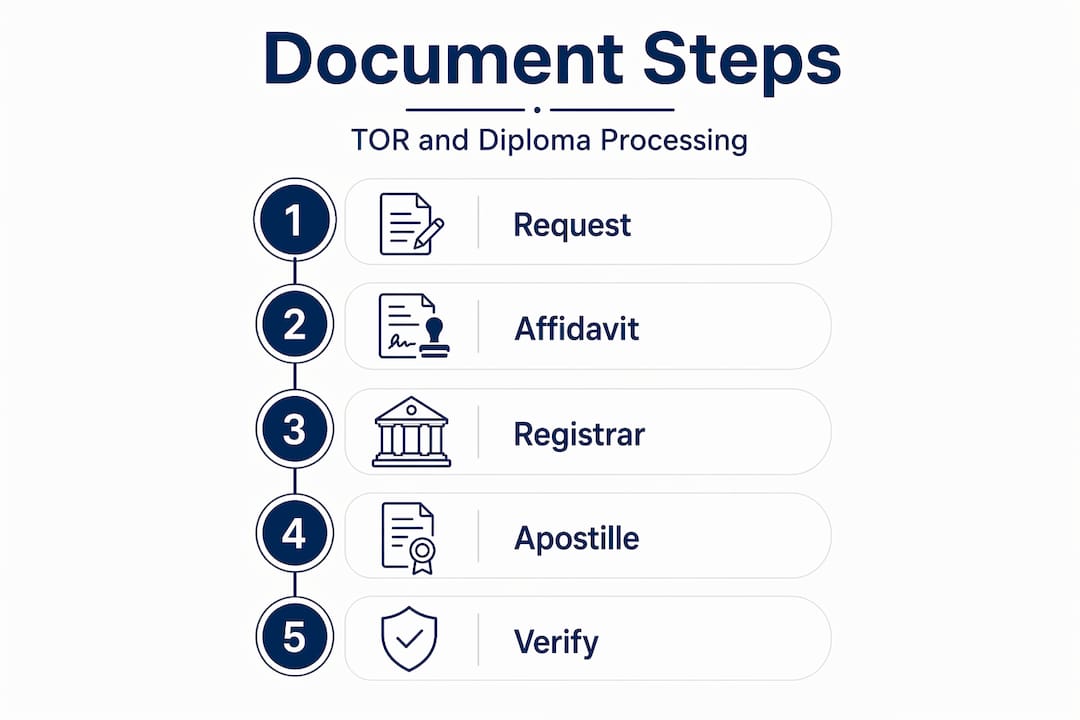
The process for requesting school documents in the Philippines follows a predictable pattern across most institutions, though the specifics differ. Here is what you generally need to prepare:
Complete your full name as it appears on your school records, including middle name and any name changes since enrollment.
Provide your student number and the academic years you attended, including the year you graduated or last enrolled.
Specify the document type you need. Options typically include TOR, diploma duplicate, certificate of graduation, and certification of units earned.
State the purpose of the request. Schools use this to determine the format and annotation required. Indicating “for employment abroad” or “for UAE visa processing” gets you the correct document type.
Submit a valid government-issued ID, usually a passport copy for overseas requests.
Fill out the registrar’s official request form, available on the school website or through email request.
Pay the required fees via the school’s accepted payment channels. Many schools now accept online bank transfers or GCash for overseas requesters.
Arrange delivery. You can authorize a representative using a notarized Special Power of Attorney, or pay for courier delivery directly to your UAE address.
For lost or damaged documents, you will need to attach an affidavit of loss or a police report, depending on the school’s requirements. Most registrars require detailed identification data to locate archived records, so providing as much information as possible shortens processing time.
Pro Tip: Request multiple document types in one application rather than submitting separate requests. One application covering your TOR, a diploma duplicate, and a graduation certificate gives you options for different purposes without doubling processing time or fees.

Dealing with withheld documents and closed schools
Two situations cause the most frustration for Filipinos trying to get school records from abroad: unpaid balances and school closures. Both have solutions, but you need to know the rules.
On unpaid balances, Philippine law and Commission on Higher Education (CHED) policy under CMO No. 40 are clear. Schools may withhold original diplomas for unpaid tuition or fees, but they are obligated to release certified true copies of your TOR or diploma for employment, continuing education, or other legitimate purposes. The certified copy will carry an annotation noting the outstanding balance, but it is still legally valid and accepted by most overseas employers and institutions.
If your school insists on full payment before releasing anything, you have several practical options:
Negotiate a payment arrangement. Many schools accept a promissory note or an installment plan that allows document release while you settle the balance.
Submit an affidavit of intent. Some schools release documents after you formally acknowledge the debt in writing.
Escalate to CHED. If the school refuses to issue even certified copies for employment purposes, the CHED regional office can intervene.
School closures are a separate challenge, and more Filipinos than expected run into this when reaching back to older institutions. When a school closes, its records do not disappear. CHED regional offices become the official custodians of those academic records. You direct your request to the CHED office covering the region where your school operated. Processing takes longer, but the documents they issue carry the same legal weight as registrar-issued copies.
Knowing the custodial chain for your academic records is critical. If your school closed, your TOR and diploma certification now live at the CHED regional office. Contact them directly with your full enrollment details and a copy of your ID.
For overseas Filipinos who cannot appear in person, a notarized Special Power of Attorney authorizing a trusted contact in the Philippines to transact on your behalf is the most practical tool for navigating these obstacles.
Apostille and authentication in 2026
Once you have your documents, you need to authenticate them for use in the UAE. The Philippines joined the Apostille Convention in 2019, and diplomas and TORs commonly require apostille for international employment, enrollment, and visa applications.
The Department of Foreign Affairs (DFA) handles apostille for Philippine school documents. In March 2026, the DFA introduced a digital apostille system through the CHED eCAV platform that changes how some of these documents get processed.
Document type | Apostille method | Submission mode | Processing time |
CHED eCAV-certified TOR | Digital apostille | Online via eCAV platform | Faster than traditional |
Original registrar-issued TOR | Traditional apostille | Physical DFA submission | Standard queue |
Diploma duplicate | Traditional apostille | Physical DFA submission | Standard queue |
Graduation certificate | Traditional or digital | Depends on issuing authority | Varies |
The digital apostille via the eCAV platform reduces the need for physical submissions and allows electronic transmission for select CHED-issued documents. This is a significant change for overseas Filipinos who previously had to rely entirely on in-person representatives in Manila. For documents not yet covered by eCAV, the traditional DFA appointment process still applies. You book an appointment through the DFA online system, submit the original authenticated school document, pay the apostille fee, and collect the document or have it couriered.
The DFA system accommodates both digital and paper apostille depending on the document type and destination country requirements. For UAE-specific purposes, check the current requirements of the UAE embassy or your employer before choosing a processing path, since some UAE institutions still request physical apostilled documents rather than electronic certificates.
Pro Tip: Use the CHED eCAV platform first to check whether your school and document type are eligible for digital apostille. If they are, you can save your representative a trip to the DFA and cut your total processing timeline considerably.
Verifying and preparing your documents for UAE use
Getting the documents is only part of the work. Before you submit anything to a UAE employer, embassy, or institution, take these steps to confirm everything is in order.
Check document completeness. Your TOR should list all your enrolled subjects, corresponding grades, total units, and your degree. A TOR missing any semester or listing an incorrect name will cause rejection.
Confirm the registrar’s seal and signature. Authenticated documents must carry the original wet seal and authorized signature. Photocopies without certification are not accepted.
Match names across all documents. Your TOR, diploma, passport, and any supporting IDs must reflect consistent name spelling. Discrepancies cause delays and sometimes require a PSA-issued certificate of live birth to explain variations.
Understand the apostille chain for UAE attestation. After DFA apostille, some UAE processes require additional MOFA (Ministry of Foreign Affairs) attestation. Knowing whether your specific use case requires this step prevents last-minute rejections.
The official registrar-issued TOR and certifications are the core legal evidence for overseas credentialing. Your original diploma supports them but cannot substitute for them. Treat your TOR as your primary document and keep multiple certified copies.
Store digital scans of all authenticated documents in a secure cloud folder alongside physical originals. Processing timelines for Philippine school documents from the UAE can stretch from four to ten weeks depending on school responsiveness, courier reliability, and DFA queue volumes. Requesting documents and apostille well ahead of your deadline is not optional. It is the only way to protect yourself from missed opportunities.
My honest take after helping hundreds of Filipinos through this
I have seen every variation of this process across the years of work at Harrisncharms. The single most common mistake I watch people make is treating the original diploma as the most important document in the pile. It is not. The diploma is largely ceremonial. UAE employers and credential evaluators want your TOR and a graduation certification from the registrar. Those carry the actual legal weight.
The second thing I have learned: do not wait for the ideal document when a certified alternative will get the job done. If your school is withholding your original diploma over an old balance, authenticated alternatives like certified true copies with annotations are genuinely useful abroad. I have seen Filipinos pass HAAD licensing requirements and UAE employment document checks with exactly these documents.
The digital apostille shift is real, but it is not complete. Understanding when paper documents are still required keeps you from betting your job offer timeline on a system that may not yet cover your specific document. Build in a parallel paper track for anything time-sensitive until you confirm digital eligibility. Stay persistent, stay organized, and remember that every obstacle in this process has a documented workaround.
— Harris
Get your school documents processed the right way
If you are ready to move forward with authenticating your Philippine school documents for UAE use, Harrisncharms is here to help you do it without the guesswork.
Harrisncharms specializes in Philippine document apostille and attestation services for Filipino expats across the UAE. Whether you need guidance on the DFA apostille process, help navigating CHED eCAV, or full support for UAE academic certificate attestation, the team handles the details so your documents meet every requirement on time. Missing a step or submitting an incomplete set can cost you weeks and sometimes an opportunity entirely. Reach out to Harrisncharms today and get your documents done right the first time.
FAQ
What is the difference between a diploma and a TOR in the Philippines?
A Philippine school diploma is a ceremonial document confirming degree completion. A Transcript of Records (TOR) is the official academic record listing all subjects, grades, and units, and carries greater legal weight for overseas employment and credential evaluation.
Can a school withhold my TOR if I have unpaid tuition fees?
Schools can withhold original documents for unpaid balances, but under CHED CMO No. 40, they must release certified true copies of your TOR or diploma for employment and study purposes. The copy will carry an annotation noting the outstanding balance.
How do I get my diploma or TOR if my school is closed?
If your school has closed, CHED regional offices serve as the custodian of those academic records. Submit your request directly to the CHED office covering your school’s former region, along with your enrollment details and a valid ID.
What is the 2026 digital apostille for Philippine school documents?
The DFA introduced a digital apostille system in March 2026 through the CHED eCAV platform, allowing electronic apostille and transmission for select CHED-certified documents. Traditional paper apostille still applies for documents not yet covered by the platform.
Do I need apostille and MOFA attestation for my TOR in the UAE?
After DFA apostille, some UAE requirements call for additional MOFA attestation depending on how you are using the document. Confirm the specific requirements with your UAE employer or the relevant embassy before submitting your documents.
Recommended
Comments