
Fast MOFA Attestation in 2 Hours for Filipino Company Documents in UAE
Updated: 2 days ago
Yes, company documents issued outside the UAE must be legally authenticated through a specific chain before UAE authorities will accept them for business use. Foreign-issued corporate papers generally need home-country notarization, then home-country foreign affairs attestation, then UAE Embassy or Consulate stamping, and finally UAE Ministry of Foreign Affairs (MOFA) attestation. If your document was already issued digitally inside the UAE and qualifies, MOFA’s digital route skips most of that and can finish in hours. If you’re unsure which path applies to your paperwork, some document attestation services review documents for Filipino expats before submission to catch problems early.
TL;DR:
Most company documents for UAE business use require a full chain of notarization, foreign affairs attestation, embassy stamping, and MOFA approval, unless issued digitally within the UAE.
Digital MOFA attestation is available only for documents issued digitally inside the UAE with verification features, while foreign-issued documents must complete the full traditional chain.
Common reasons for rejection include mismatched names, incomplete steps, lamination, or missing certifications, which can often be prevented through careful verification before submission.
Philippine company documents must complete the Philippine DFA attestation before proceeding to UAE embassy and MOFA stages; skipping this step is not possible.
Harrisncharms offers a full-service solution, handling document audit, submission, courier coordination, and translation, simplifying the process for Filipino expats and business owners in the UAE.
Table of Contents
Which Company Documents Typically Need Attestation?
Not every piece of corporate paperwork needs the full chain, but most documents tied to registering, banking, or operating a business in the UAE do. Authorities want proof that the document is genuine and that the person or company behind it actually exists and has the authority claimed.
The documents that show up most often in attestation requests include:
Memorandum and Articles of Association (MOA/AOA): required for company formation and bank account opening.
Certificate of Incorporation: confirms the company legally exists in its home jurisdiction.
Board or shareholder resolutions: needed when opening branches, appointing signatories, or approving major transactions.
Powers of Attorney (POA): used when someone acts on behalf of the company for licensing or property matters.
Trade license: sometimes attested when a foreign company needs to prove active status abroad.
Certificate of Incumbency or Good Standing: confirms current officers and that the company is compliant back home.
Commercial contracts and invoices: attested case by case, usually when a UAE court or bank specifically asks for it.
UAE authorities almost always want original documents or notarized certified copies, never laminated originals, since lamination can hide tampering or block an attestation stamp. If any document isn’t in English or Arabic, expect a request for certified translation before it moves further in the chain.
Step-by-Step Attestation Sequence for Company Documents Destined for the UAE
Skipping a step in this sequence is the single fastest way to get a document bounced back. Each stage checks the one before it, so authorities can trust the final stamp without re-verifying everything from scratch.
Notarize or certify locally. Have the document notarized, and for corporate papers, many countries require an additional “secretary of state” or equivalent certification before it goes any further.
Get home-country foreign affairs attestation. This is either an apostille (for Apostille Convention countries) or a direct Ministry/Department of Foreign Affairs attestation, depending on your document’s country of origin.
Submit to the UAE Embassy or Consulate in the issuing country. UAE Embassy guidance confirms that corporate documents must clear the origin country’s competent authority first, and some routing now runs through partner service providers rather than the embassy counter directly.
Finish with UAE MOFA attestation. This can happen digitally or through an approved courier, depending on how the document was issued and where.
Pro Tip: If your company documents originate in the Philippines, confirm your Philippine DFA attestation status before you ship anything to the UAE Embassy. A document flagged incomplete at the DFA stage will get rejected further down the chain, and by then you’ve lost days.
MOFA Digital Attestation vs Courier: What Changes and When
MOFA’s digital attestation only applies to documents that were issued digitally inside the UAE and carry a built in verification feature, usually a QR code or reference number tied to the issuing authority. A PDF scan of a UAE-issued document is not automatically eligible just because it exists in digital form.
The MOFA portal determines your route based on three inputs: issuing authority, document type, and destination country. Enter those correctly and the system tells you immediately whether digital attestation applies or whether your document needs the courier path.
Digital attestation: completed within 2 hours during working hours for eligible UAE-issued documents.
Courier attestation: takes a few business days depending on the provider handling delivery.
Foreign-issued company documents almost never qualify for digital attestation. They need embassy attestation in the country of origin first, which means MOFA is the last stop, not the only one.
Preparing Documents Before Submission
Most delays trace back to something small that could have been caught before the document ever left your desk. A rushed submission almost always costs more time than a careful one.
Cross-check every identifier. Company name, registration number, signatory names, and job titles need to match exactly across every document in the set. A dropped middle initial or an outdated title is enough to trigger a rejection.
Complete local certification first. For corporate papers, that often means a secretary of state or equivalent office before the home MFA will even accept the document.
Arrange certified Arabic translation if the receiving UAE authority specifically asks for it, and keep the original untranslated copy on hand too.
Keep documents unlaminated. Provide certified copies only when requested, never a laminated original.
Prepare courier details in advance. Have delivery addresses, contact numbers, and tracking preferences ready so nothing stalls once the document reaches the shipping stage.
Pro Tip: Photograph or scan every document before it leaves your hands. If a courier misplaces a page mid-chain, you’ll have proof of exactly what you sent and when.
Timelines, Fees, and Where Delays Usually Happen
Budget more time for the earlier steps than for MOFA itself. Home-country MFA processing and embassy attestation abroad are where things typically slow down, sometimes stretching from a few days to a few weeks depending on the country and how busy that office is.
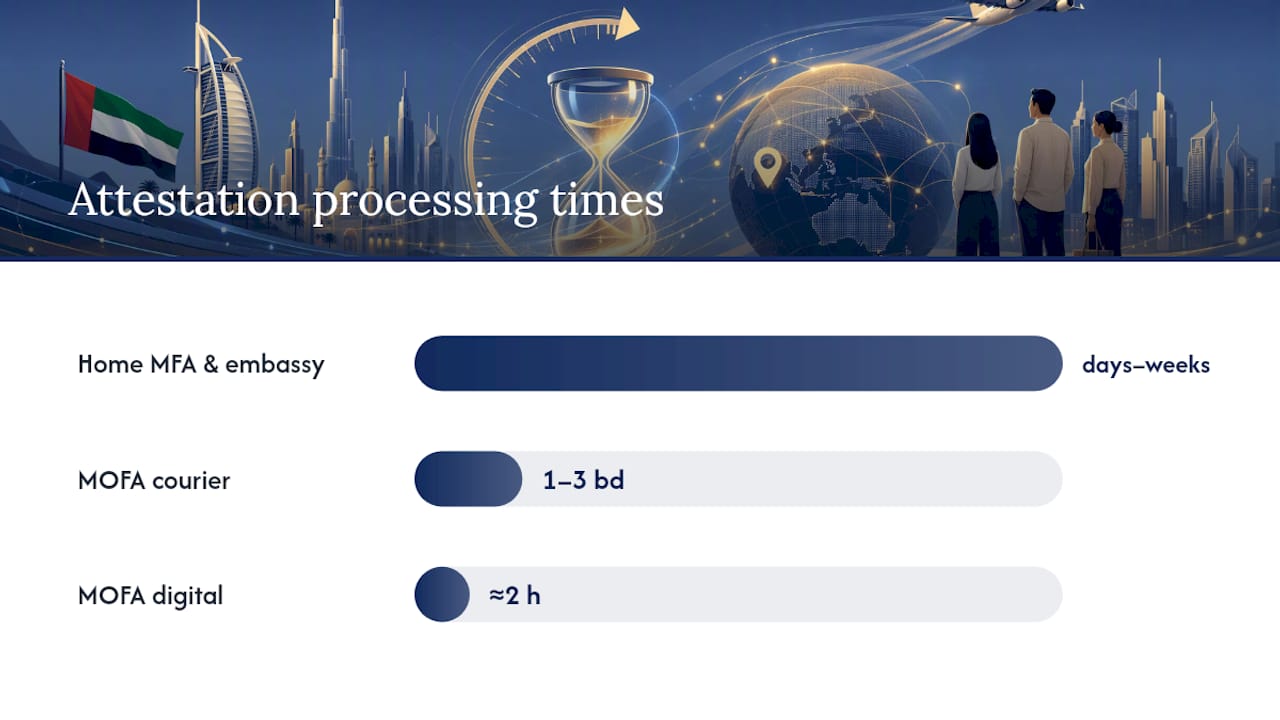
Once a document reaches the UAE, MOFA moves fast by comparison. Digital attestation clears in about 2 hours during working hours for eligible documents, while courier-based MOFA attestation runs 1 to 3 business days.
Expect fees at nearly every stage:
Notarization and local certification fees in the origin country.
Home MFA or apostille fees.
UAE Embassy or Consulate attestation fees, sometimes routed through a partner provider.
MOFA attestation fees in the UAE.
Courier charges and certified translation costs.
Ask for a full fee breakdown before choosing an express option. Express services cost more at nearly every stage, and it’s only worth paying for if a business deadline, like a bank account opening or license renewal, genuinely can’t wait.
Common Rejection Causes and Quick Fixes
Most rejected company documents fail for reasons that are entirely preventable once you know what to check. Mismatched names between the certificate and the supporting ID, missing seals or signatures, and skipped attestation steps account for the bulk of the problems attestation offices flag.
Check the order of stamps. A document attested out of sequence, say, embassy before home MFA, gets sent back regardless of how legitimate the underlying paperwork is.
Verify every name and number matches across the document, the ID of the signatory, and any supporting corporate filing.
Never submit laminated documents. Lamination usually voids the ability to add further stamps.
Confirm translations are certified, not just accurate, when the receiving authority requires Arabic.
If a document does get rejected, get the specific rejection reason in writing, fix that exact issue (re-notarize, retranslate, or resubmit through the correct authority), and resend with tracking so you know where it stands. A document attestation service for Filipinos in the UAE can often shortcut this recovery process because they already know which office to call.
What Years of Corporate Attestation Cases Have Taught Experienced Document Attestors
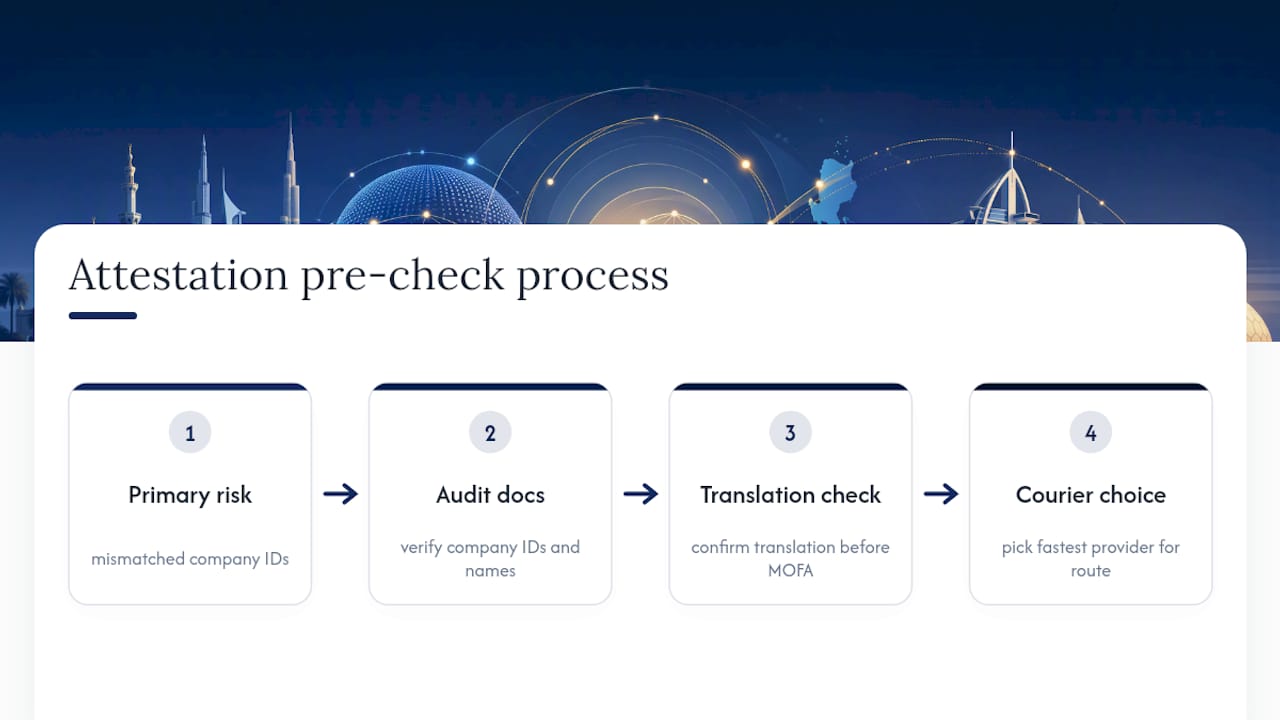
Company identifiers cause more rejections than anything else. A director’s name spelled slightly differently on a board resolution versus a trade license is enough to stall a case for weeks, so checking those details before submission saves more time than any express service ever could.
Powers of attorney and board resolutions tend to need the closest second look, since they carry signatory details that must match exactly across every linked document. A reliable process leans on a document audit before anything ships, a translation check before it reaches MOFA, and a courier choice based on which provider actually moves fastest for that specific document type and destination.
— Harris
How Harrisncharms Handles Company Document Attestation
Harrisncharms is the practical alternative to piecing this process together yourself, document by document, office by office. We run a document audit before anything gets submitted, handle the attestation filing itself, coordinate courier movement between offices, and arrange certified translation when UAE authorities require it in Arabic.

This is built for Filipino expats, overseas Filipino workers, and Filipino business owners in the UAE who need company paperwork attested for banking, licensing, visa, or registration purposes and don’t have time to chase down five different offices themselves. If you’re not sure whether your MOA, POA, or board resolution qualifies for a faster route, start with a free document check on the Harrisncharms landing page before you spend money on notarization you might not need yet.
Where to Verify Attestation Rules Yourself
Check MOFA’s official attestation service to confirm digital eligibility and current processing windows. For corporate document routing through partner providers, the UAE Embassy’s corporate document guidance explains origin-country requirements. For a plain-language walkthrough of digital verification features like QR codes, Notary Page’s verification guide covers the mechanics.
Sources
FAQ
Do UAE-Issued Company Documents Still Need MOFA Attestation?
Yes, but if the document is eligible for digital attestation, it can be completed within about 2 hours during working hours instead of going through the courier route.
How Long Does the Full Company Document Attestation Chain Take?
Home-country and embassy steps abroad usually take the longest, from several days to a few weeks depending on the country, while MOFA itself clears in 2 hours digitally or 1 to 3 business days by courier.
Can Philippine Company Documents Skip the DFA Step?
No. Philippine-issued corporate documents still need Philippine DFA attestation before they can move to the UAE Embassy and MOFA stages, regardless of how the document will eventually be used in the UAE.
Why Was My Company Document Rejected at MOFA?
The most common causes are mismatched names or titles across documents, missing seals, lamination, or submitting steps out of the required order; correcting the specific error and resubmitting with tracking usually resolves it.
Does a Power of Attorney for a Company Need the Same Attestation Process?
Yes, corporate powers of attorney follow the same notarization, home MFA, embassy, and MOFA sequence as other company documents, and signatory names must match exactly across every linked filing.
Recommended
Comments