
Certificate attestation explained: UAE guide for Filipino expats
- contact335627
- May 13
- 9 min read

Many Filipino expats in the UAE have submitted apostilled documents only to get them rejected outright. It’s one of the most common and costly mistakes in the attestation process, and it happens because the terms “apostille,” “notarization,” and “certificate attestation” are often used interchangeably in Filipino communities, online forums, and even some agencies. They are not the same thing. This guide cuts through the confusion, explains exactly what certificate attestation is, why the UAE requires a specific process, and how you can get your Philippine documents accepted without delays or rejections.
Table of Contents
Key Takeaways
Point | Details |
Attestation is essential | Certificate attestation is required for Filipino documents to be legally recognized in the UAE. |
Apostille is not accepted | The UAE requires MOFA attestation, not apostille, for document legalization. |
Step-by-step process | Follow specific procedures to ensure successful attestation and avoid document rejection. |
Avoid common mistakes | Skipping steps or misunderstanding terms can result in delays or refusals. |
Professional help available | Agencies and support resources can make attestation easier for Filipino expats. |
What is certificate attestation?
Certificate attestation is the official process of authenticating documents so that they are legally recognized in a foreign country. In the UAE, this is not a simple stamp from a notary public. Certificate attestation refers to government verification of document authenticity, typically involving the UAE Ministry of Foreign Affairs (MOFA). This means your document goes through a series of verifications by authorized government bodies before MOFA applies its final approval.
For Filipino expats, attestation matters in three main areas:
Employment: Your employer, especially in healthcare, education, or engineering, may require attested academic credentials before processing a work visa or signing a contract.
Residency: UAE immigration authorities may ask for attested civil documents such as birth certificates or marriage certificates when processing family sponsorship or residence permits.
Education: UAE universities and licensing bodies require attested school and college certificates before enrolling students or granting professional licenses.
It’s also important to understand what attestation is not. A notary public stamps a document to confirm that a signature is genuine. That is a very different process from government authentication. Attestation involves multiple layers of verification across different offices, including the originating country’s government bodies and the UAE authorities. For Filipino expats, attesting documents in the UAE follows a structured path that must not be skipped or reordered.
Common documents that Filipino expats regularly need attested include:
Academic diplomas, transcripts, and training certificates
Birth certificates and marriage certificates
Police clearance certificates
Special power of attorney and affidavits
Medical and professional license documents
Pro Tip: Before starting attestation, confirm with your UAE employer or authority exactly which documents they need attested. Requirements can differ between government entities, private companies, and educational institutions.
Certificate attestation vs apostille: Key differences for UAE expats
This is where the confusion gets expensive. Apostille and certificate attestation are two completely separate systems, and using the wrong one in the UAE will cost you time and money.
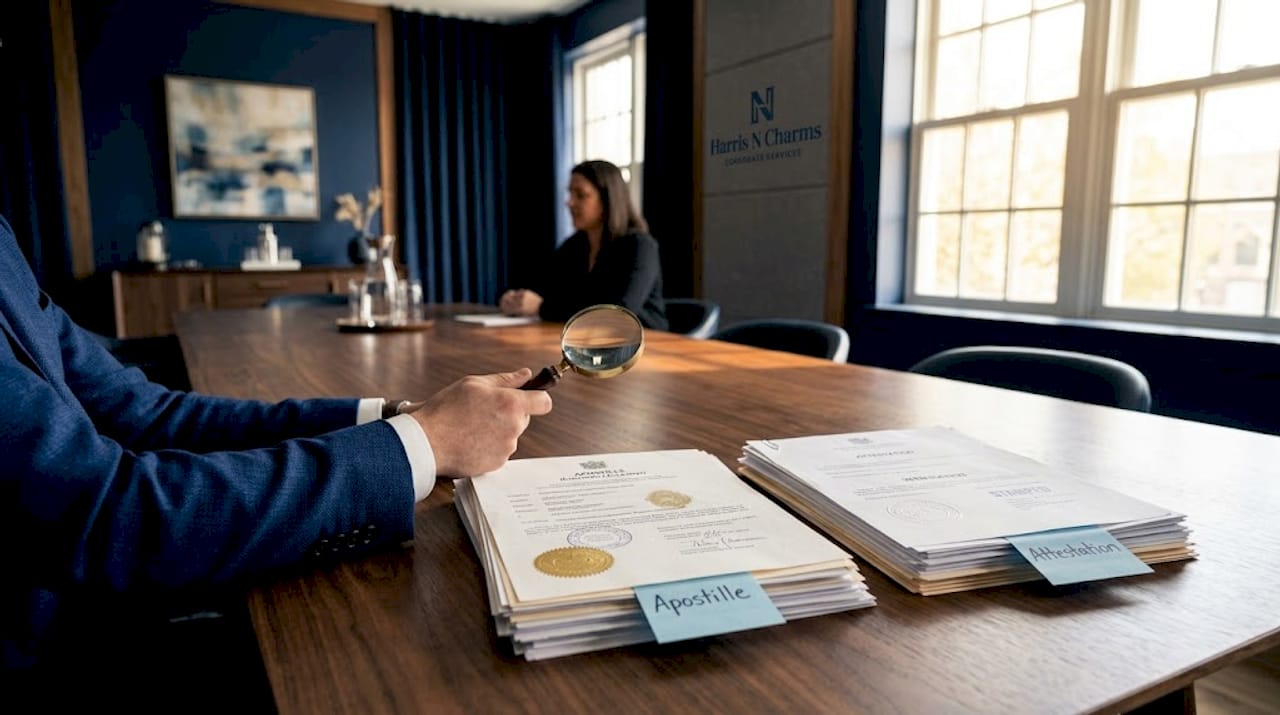
An apostille is a simplified authentication method used between countries that signed the Hague Convention of 1961. When a country issues an apostille on a document, it signals to other member countries that the document is authentic, without requiring further embassy verification. The Philippines joined the Hague Convention, which means Philippine authorities can now issue apostilles on documents.
Here is the critical point: the UAE is not a member of the Hague Convention. This means the UAE does not recognize apostilles. If you submit an apostilled Philippine document to a UAE government office, employer, or institution, it will likely be rejected. The correct process for the UAE is MOFA attestation, which is a separate, multi-step verification chain that ends with a MOFA stamp.
Understanding the difference between document legalization vs attestation can also help clarify why these systems exist and which one applies to your situation. If you are curious about what apostilles actually offer, the apostille services benefits are real, but only for countries that accept them, which excludes the UAE.
Here is a quick comparison to keep things clear:
Feature | Apostille | MOFA Attestation |
Governing body | Hague Convention (1961) | UAE Ministry of Foreign Affairs |
UAE acceptance | Not accepted | Required and accepted |
Countries covered | 120+ Hague member states | UAE and non-Hague countries |
Process complexity | Single-step apostille | Multi-step verification chain |
Philippines participation | Yes, Philippines issues apostilles | Required for UAE use |
Suitable for | Other Hague member countries | UAE employment, residency, study |
“The UAE follows its own authentication requirements outside the Hague Convention framework. Submitting an apostilled document instead of an attested one is one of the leading causes of document rejection among Filipino expats.”
Understanding this distinction before you begin the process protects you from one of the most common and avoidable errors. Once you know that MOFA attestation is the correct route, the next step is knowing exactly how to get there.
Step-by-step UAE certificate attestation process for Filipino documents
Filipino expat attestation guide for UAE expats follows a specific chain of custody. Skipping steps or using the wrong method risks rejection at the final stage, even if your document looks perfectly valid. Here is how the process works from start to finish.
Step 1: Authentication by Philippine government authorities
Your document must first be verified in the Philippines. For academic documents, this typically means getting authentication from the Department of Education (DepEd), Commission on Higher Education (CHED), or the Professional Regulation Commission (PRC), depending on the document type. Civil documents like birth and marriage certificates start with the Philippine Statistics Authority (PSA).
Step 2: Department of Foreign Affairs (DFA) authentication
After local authentication, your document goes to the Philippine DFA for authentication. The DFA confirms that the signatures and seals from the previous step are legitimate. This is where many people mistakenly stop because the Philippines now issues apostilles at this stage. For UAE use, you need this step but not as an apostille. You need standard DFA authentication.
Step 3: UAE Embassy in Manila attestation
Your authenticated document then goes to the UAE Embassy or Consulate in Manila. The UAE Embassy verifies that the DFA authentication is genuine. This step is required before any MOFA processing can begin in the UAE.
Step 4: UAE MOFA attestation
Once you are in the UAE with your embassy-verified document, the final step is MOFA attestation in the UAE. This confirms everything is in order and makes your document legally recognized in the UAE. Resources on legalizing Philippine documents provide additional details for different document types.
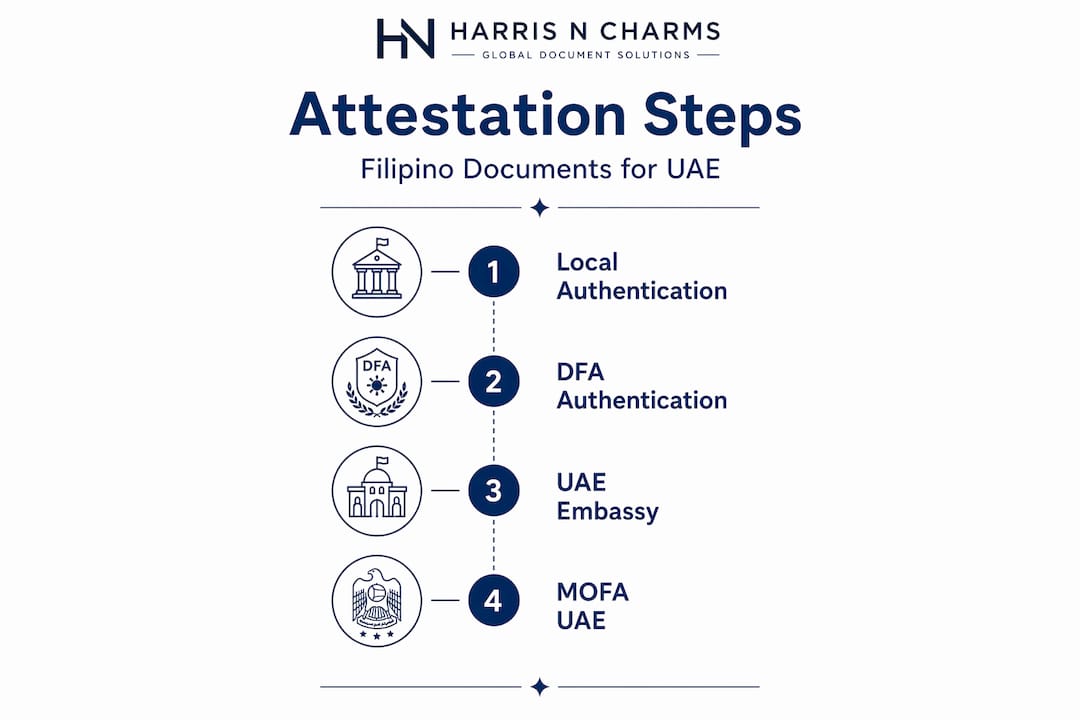
Here is a summary of typical timelines and approximate costs at each stage:
Stage | Office involved | Estimated time | Approximate cost |
Local authentication | DepEd / CHED / PSA | 3 to 7 working days | PHP 100 to 500 |
DFA authentication | Philippine DFA | 3 to 5 working days | PHP 200 to 400 |
UAE Embassy attestation | UAE Embassy Manila | 2 to 5 working days | Varies by document |
UAE MOFA attestation | UAE MOFA | 2 to 7 working days | AED 150 to 300+ |
Note that academic certificate attestation may have additional verification steps, especially for degrees from private universities, where CHED certification is mandatory before DFA can process the document.
Pro Tip: Prepare multiple certified true copies of each document before starting. You may need one set for your employer, one for MOFA, and one for your own records. Requesting additional copies early saves time and avoids repeat trips to the Philippines.
Common pitfalls and expert tips for hassle-free attestation
Having the step-by-step process is one thing. Avoiding the mistakes that derail the process is another. Careful planning and following UAE’s official MOFA guidelines are what separate successful applications from rejected ones.
Here are the top pitfalls Filipino expats encounter:
Submitting apostilled documents instead of attested ones. This is the number one mistake. Always confirm that your document has gone through UAE Embassy attestation and MOFA, not just a DFA apostille stamp.
Using expired or outdated PSA documents. PSA birth or marriage certificates that are too old may be rejected. Some UAE authorities require documents issued within the last six months.
Skipping the UAE Embassy step in Manila. Some expats try to go directly to MOFA upon arriving in the UAE without UAE Embassy verification in Manila. MOFA will not process documents that skipped this step.
Submitting photocopies instead of originals. Most authentication and attestation offices only accept original documents. Photocopies are generally only accepted for reference, not processing.
Not checking document-specific requirements. A police clearance has different requirements than a nursing diploma. Each document type has its own chain of authentication offices.
A solid starting point for preparing attestation papers correctly reduces the chance of rejection significantly. When you are short on time or unfamiliar with the process, agency attestation for Filipinos is a practical option. Agencies that specialize in Filipino document processing know the exact requirements for each document type, handle queues at government offices, and can significantly cut down processing time.
Pro Tip: If you are using an agency, verify that they are familiar with both Philippine DFA procedures and UAE MOFA requirements. Ask for client references and confirm their turnaround time in writing before handing over your original documents.
Expert shortcuts worth knowing: MOFA now offers online tracking for attested documents in the UAE. Use it. You can check whether your document is processed or if there is an issue requiring your attention before you make a trip to the office. Also, some UAE free zone employers have document coordinators who are experienced with attestation. Ask your HR department if they have an in-house process or a preferred agency.
Why certificate attestation is often misunderstood—and what Filipino expats need to know
Here is an uncomfortable truth: much of the misinformation about attestation spreads inside Filipino communities themselves. Facebook groups, Viber chats, and kababayan advice are invaluable for adjusting to life in the UAE, but they are unreliable sources for legal document processes. Someone who successfully used an apostille three years ago in a different country may confidently advise you to do the same for the UAE, completely unaware that the UAE has different requirements.
The Philippines joining the Hague Convention made this worse, not better. When the DFA started issuing apostilles in 2019, many Filipinos, and even some agencies, assumed this simplified everything globally. In reality, it simplified things for Hague member countries only. The UAE is not one of them. This creates a genuine knowledge gap that leads to real consequences: rejected documents, delayed employment, and in some cases, failed visa applications.
What we consistently see in real-world attestation cases is that the problem is not a lack of effort on the part of Filipino expats. It is incomplete or outdated information. A nurse who spent months preparing her documents in the Philippines only to find out at MOFA that the UAE Embassy stamp in Manila was missing. An OFW whose family sponsorship was delayed because his wife’s marriage certificate was apostilled but not attested. These are not edge cases. They happen regularly.
The proactive approach is simple but requires discipline. Before preparing any document, contact the specific UAE authority that will receive it and confirm their exact requirements. Not general requirements—their requirements. A government hospital in Dubai may have slightly different document standards than a private clinic in Abu Dhabi. Similarly, resources on school document attestation or affidavit attestation show that even within attestation, the document type changes the process.
Take charge of your own documents. Do not rely entirely on what your employer says, and do not rely entirely on what your agency says either. Understand the process yourself so you can catch errors before they cost you weeks of delays.
Get help with certificate attestation in the UAE
Knowing the process is the first step. Getting it done correctly and on time is another challenge entirely, especially when you are managing work, family, and the pressures of expat life in the UAE. Certificate attestation involves multiple offices across two countries, and missing any one step sends you back to the beginning.

Harrisncharms.com specializes in certificate attestation support for Filipino expats in the UAE. Whether you need help attesting academic credentials, civil documents, or legal papers, the team understands both the Philippine DFA process and UAE MOFA requirements inside and out. You get clear guidance on what to prepare, how long it will take, and what to expect at each stage. No guesswork, no costly mistakes. Reach out and let experienced professionals handle the complexity while you focus on what matters most.
Frequently asked questions
Is certificate attestation the same as apostille in the UAE?
No, the UAE requires MOFA attestation and does not accept apostille. Apostille is only recognized by countries that are members of the Hague Convention, and the UAE is not among them.
What documents usually need certificate attestation for Filipino expats in the UAE?
Educational certificates, birth and marriage certificates, affidavits, and other Philippine documents must be attested for UAE use. Attestation covers important documents including educational, civil, and legal papers across virtually all official transactions.
What happens if my documents are only apostilled and not attested?
Your documents may be rejected by UAE authorities because UAE authorities require MOFA attestation for document acceptance, not an apostille stamp issued under the Hague Convention framework.
How long does certificate attestation take for Filipino documents in the UAE?
The full process typically takes two to six weeks from start to finish, depending on document type and service speed at each office. Using a professional agency can reduce delays significantly.
Can I use an agency to handle certificate attestation?
Yes, agencies that specialize in Filipino document processing can manage the entire attestation chain from Philippine authentication to UAE MOFA, saving you time and reducing the risk of rejection.
Recommended
Comments