
Filipinos in UAE: Get Arabic Birth Certificate Translation Accepted
Updated: 2 days ago

Most UAE authorities need a Ministry of Justice (MOJ) certified translation, not just any “certified” translation, and many also require Ministry of Foreign Affairs (MOFA) attestation before they’ll accept the document. Private receivers sometimes accept a simple certified translation, but government offices rarely do. Your first move: pull out the original birth certificate, unlaminated, and contact an MOJ licensed translator or a document attestation service to start the process today.
TL;DR:
Only MOJ-certified translations with a personal license number are accepted by courts, federal agencies, and ministries, not just agency seals or generic certifications.
For government processes like visas, court filings, or passports, plan for both MOJ translation and MOFA attestation; private entities may accept simpler certifications, but confirmation is essential.
The process requires unlaminated original documents, a licensed translator, and coordination of MOJ certification plus MOFA attestation, often needing multiple steps if documents originate outside the UAE.
Attestation costs AED 150 for MOFA, while translation fees vary; expedited options are available but may increase costs, and precision in requirements can prevent delays.
Rejections commonly stem from missing license numbers, lack of attestation, laminated originals, or mismatched name spellings, which can be avoided by checking requirements beforehand.
Table of Contents
Certified vs MOJ-Certified Translation: What’s the Real Difference?
When Do You Actually Need a Translated Birth Certificate in the UAE?
How to Get an Arabic Birth Certificate Translation Accepted in the UAE
What Does Arabic Translation Cost, and How Long Does It Take?
What I’ve Learned Watching Clients Get This Wrong (And Right)
How Harris n Charms Handles Your Translation and Attestation
Certified vs MOJ-Certified Translation: What’s the Real Difference?
“Certified translation” and “MOJ-certified translation” get used interchangeably online, and that confusion causes more rejected paperwork than almost anything else in this process. A certified translation typically means a translation agency or freelance translator has signed and stamped the document, attesting to its accuracy. An MOJ-certified translation means the person who translated it holds a personal license issued by the UAE’s Ministry of Justice, and that license number appears printed on the translator’s stamp on every single page.
The difference matters because courts, ministries, and most federal bodies check for that license number specifically. A company seal alone, no matter how official it looks, is often rejected outright because it doesn’t tie the translation to an individually accountable, licensed translator.
Who typically wants which:
Courts, MOJ, GDRFA, and most federal government offices: MOJ-certified translation, full stop.
Some private schools, banks, and employers: a standard certified translation may be enough, but always confirm first.
Federal Authority for Identity and Citizenship (ICP) processes, including Emirates ID and passport-linked services, generally expect the same rigorous standard tied to identity and citizenship document requirements.
When in doubt, assume the stricter standard. It costs you a little more upfront and saves you a resubmission later.
When Do You Actually Need a Translated Birth Certificate in the UAE?
You don’t need to translate every document the moment you land in the country. But certain milestones make it unavoidable, and knowing them ahead of time saves you a scramble later.
Family or dependent visa applications, where GDRFA needs the child’s or spouse’s birth certificate translated and attested as part of the sponsorship file.
School enrollment, since most Ministry of Education-regulated schools require an Arabic version alongside the original.
Passport renewal or replacement at your embassy, particularly when the UAE authority processing the request needs local-language backup.
Court filings, including custody, inheritance, or guardianship cases, where MOJ-certified translation is close to mandatory.
Marriage registration, especially when one party’s civil status documentation originates outside the UAE.
For government submissions, plan on MOJ translation plus MOFA attestation as your default path. For anything private, like an employer’s HR file, ask the receiving office directly what they’ll accept. It’s a five-minute question that can save you a week.
How to Get an Arabic Birth Certificate Translation Accepted in the UAE
Getting a birth certificate translation Arabic service to hand you a document is the easy part. Getting UAE authorities to accept it without kicking it back is where people trip up. Here’s the order that actually works.
Gather your originals. You’ll need the birth certificate itself (never laminated), a passport copy, and, if relevant to your case, a marriage certificate. Laminate coating on an original is one of the fastest ways to get a submission flagged, since it can block the required physical stamps.
Find an MOJ-licensed translator, not just a translation company. Ask directly: “Is your translator personally MOJ-licensed, and will the license number print on the stamp on every page?” If the answer is vague, keep looking.
Confirm turnaround before you commit. A digital draft for a standard document like a birth certificate often comes back within a couple of hours, while the final MOJ-stamped version usually takes one to three business days. Rush service exists for an added fee if you’re on a deadline.
Send the translation for MOJ certification. This is the step that turns a translation into a legally recognized document for UAE government use.
Get MOFA attestation if your receiver requires it, which most government offices do. For UAE-issued documents, MOFA charges AED 150 for attestation, and the process can often be completed through MOFA’s website or Smart App rather than an in-person visit, since MOFA’s digital services cover birth and death certificates linked to MOHAP records.
If the birth certificate was issued outside the UAE, follow the full legalization chain: the issuing country’s foreign ministry, then the UAE embassy in that country, then MOFA in the UAE. Skipping a link in that chain is one of the most common reasons foreign-issued documents get bounced back.
Assemble the final package exactly the way the receiving office wants it, whether that’s GDRFA, ICP, or a school registrar, and courier it rather than mailing loose pages.
Pro Tip: Call the receiving office before you order the translation, not after. A ten-minute phone call confirming exactly which stamps and attestations they require can save you an entire resubmission cycle.
What Does Arabic Translation Cost, and How Long Does It Take?
Budgeting for this process means separating two costs: the translation itself and the attestation. They’re billed by different bodies and often by different providers entirely.
MOFA attestation runs a flat AED 150 for UAE-issued documents, which is a fixed government fee regardless of who processes your paperwork.
MOJ-certified translation pricing varies by provider and urgency, but turnaround is fairly predictable: a digital draft is typically provided within a few hours for straightforward documents, with the final stamped version usually ready in a few business days.
Same-day options exist through most licensed translators for an added rush fee, useful if you’re up against a visa or school deadline.
Extra costs to plan for include courier fees for physical document movement, notarization if your case requires it, and embassy legalization fees if the birth certificate was issued outside the UAE.
The one number worth memorizing here is the AED 150 MOFA attestation fee, since it’s fixed and government-set, unlike translation pricing, which varies by agency. Before you commit to any provider, get a written scope of work and a fixed quote. Verbal estimates for “translation plus attestation” have a way of growing once the invoice arrives.
Why Documents Get Rejected (And How to Avoid It)
Rejections almost never come down to bad luck. They follow a handful of predictable patterns, and every one of them is preventable if you check for it before submission.
The most common causes:
The translator’s stamp has no visible MOJ license number, only a company seal.
MOFA attestation is missing entirely, even though the receiving authority requires it.
The original document is laminated, which interferes with physical stamping.
Name spellings don’t match across the birth certificate, passport, and translation.
Scanned copies submitted digitally are too blurry for the reviewing officer to verify stamps or seals.
Run through this before you submit anything:
MOJ license number visible on every translated page, not just the last one.
MOFA attestation attached, if your receiver is a government body.
Passport copy and, where relevant, marriage certificate included.
Original document clean, unlaminated, and undamaged.
Clear, legible scans if you’re submitting digitally through GDRFA or ICP portals.
Pro Tip: Harris n Charms recommends confirming your receiver’s exact requirements before ordering translation. It’s the single fastest way to skip a round of rework, since MOJ-licensed translators already know which stamps each authority expects.
What I’ve Learned Watching Clients Get This Wrong (And Right)
The mistake I see most often isn’t laziness, it’s assumption. People assume “certified” and “MOJ-certified” mean the same thing, order the cheaper option, and only discover the gap when GDRFA or a court clerk hands the file back. By the time that happens, they’ve lost days they didn’t have.
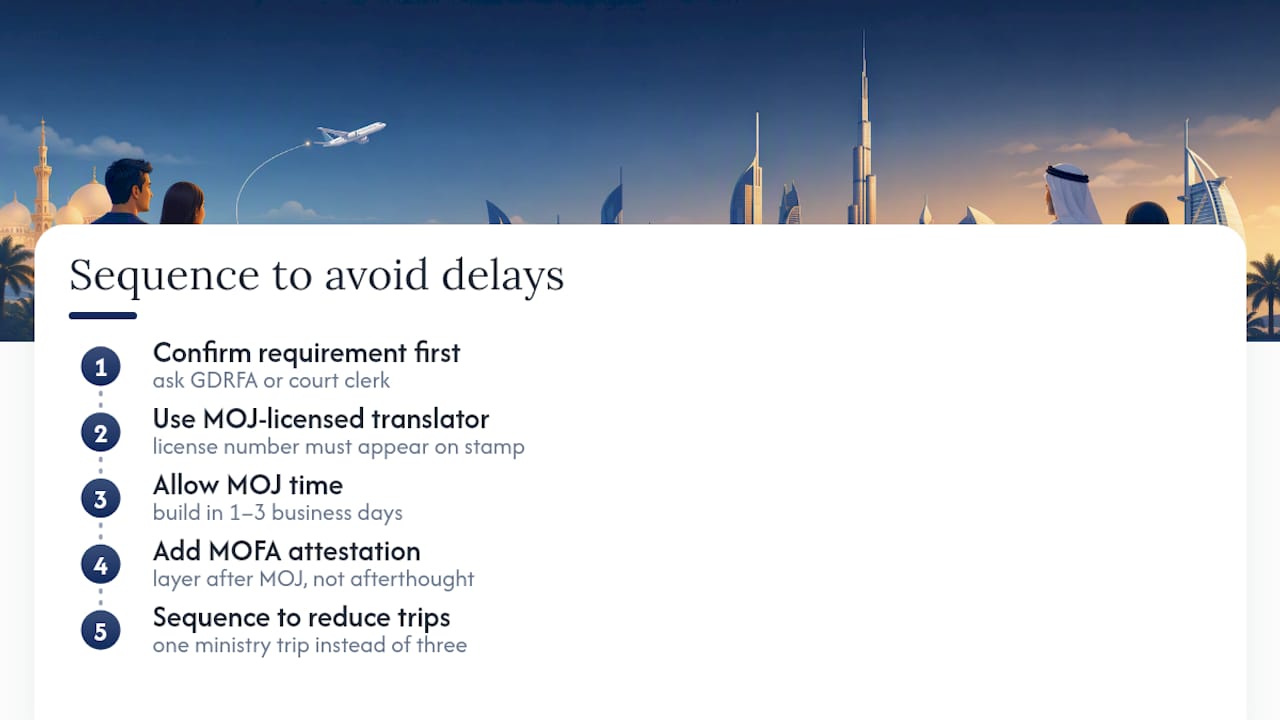
The fix is almost always procedural, not complicated. Confirm the receiver’s exact requirement first. Use a translator whose MOJ license number actually appears on the stamp. Build in the one to three business days MOJ certification realistically takes, then layer in MOFA attestation on top rather than treating it as an afterthought. Filipino expats juggling visa renewals, school deadlines, and court paperwork rarely have slack in their timeline, so sequencing this correctly the first time isn’t a nice-to-have. It’s the difference between one trip to the ministry and three.
— Harris
How Harris n Charms Handles Your Translation and Attestation
This service is an alternative to chasing down separate translators, notaries, and attestation offices on your own across Abu Dhabi and the wider UAE. It handles MOJ-certified translation and MOFA attestation coordination as one connected process, so you’re not left guessing which stamp comes before which.

If you’re staring down a family visa deadline or a school enrollment cutoff, the fastest path is to send us your original birth certificate details and let us confirm what your specific receiver needs before any money changes hands. Clients typically see MOJ-certified translation completed within one to three business days, with MOFA attestation coordinated alongside it rather than as a separate errand. For related processes, our birth certificate attestation guide for Filipinos and our Tagalog to Arabic translation guide cover adjacent scenarios worth reading. Reach out through Harris n Charms to request a quote and get your documents moving.
Where to Verify These Rules Yourself
Always confirm with your specific receiving office, since requirements can shift by case type.
This article is general information, not a substitute for advice from a qualified lawyer. Consult a qualified legal professional about your own circumstances before acting on anything here.
Sources
FAQ
Where Can I Find Arabic Translation Services in the UAE?
MOJ-licensed translators operate across the UAE, and some services coordinate MOJ-certified translation and MOFA attestation together for Filipino expats, which avoids the back-and-forth of hiring each step separately.
How Much Does Legal Translation Cost in the UAE?
Pricing varies by provider, document length, and urgency, but turnaround is more predictable than cost: expect a digital draft within a few hours and a final MOJ-stamped version in one to three business days.
How Much Does Birth Certificate Attestation Cost in the UAE?
MOFA attestation for UAE-issued documents costs AED 150, a fixed government fee separate from whatever your translator charges for the translation itself.
Should I Translate My Birth Certificate?
If you’re submitting it to any UAE government body, courts, GDRFA, ICP, or MOJ included, yes, and it needs to be MOJ-certified rather than just generically certified. Private receivers sometimes accept less, but confirm before you assume.
Recommended
Comments