
Affidavit attestation in the UAE: a complete guide for Filipinos
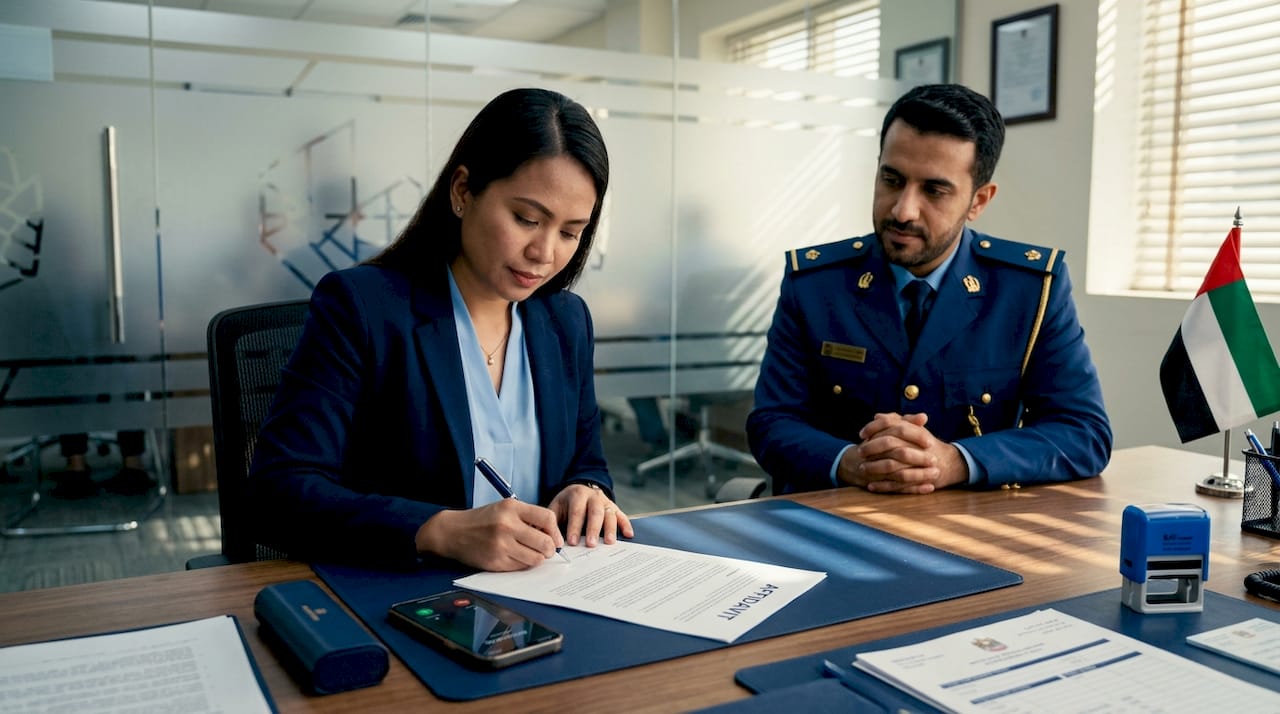
Getting your affidavit notarized feels like crossing the finish line, but for Filipino expats in the UAE, it is actually just the starting point. Affidavit attestation is the full chain of official verifications, covering the Notary Public, Ministry of Justice (MOJ), and UAE Ministry of Foreign Affairs (MOFA), that transforms your document into something courts, employers, and immigration offices will actually accept. Skipping even one link in that chain means rejection, wasted money, and delays that can affect visa applications, family visits, or employment contracts. This guide walks you through every step, every common mistake, and every scenario you are likely to face.
Table of Contents
Key Takeaways
Point | Details |
Notarization is not attestation | Legal validity in the UAE requires official authentication steps beyond notary stamping. |
Follow every step | Missing a single stage in the attestation chain can result in immediate rejection. |
Start early | Allow 5-10 days for the entire process to avoid missed deadlines and stress. |
Trust only official channels | Always use UAE government portals and the Philippine Consulate; never rely on ‘fixers’. |
Requirements vary by purpose | Affidavit type and country of origin impact fees, steps, and documentation needs. |
Understanding affidavit attestation
An affidavit is a written statement you sign under oath, declaring that what you say is true. Common examples include an Affidavit of Support and Guarantee for a family member’s visit visa, a Special Power of Attorney authorizing someone to act on your behalf back in the Philippines, or a sworn statement for an employment-related matter.
Notarization, on its own, is the first step. A UAE Notary Public witnesses your signature and verifies your identity. That is genuinely useful, but it only confirms who signed the document. It says nothing about whether the notary’s authority is recognized beyond that specific office.
Attestation goes further. It is the layered process of having each authority confirm the legitimacy of the authority below it. Think of it like a chain of guarantors: the notary vouches for you, the MOJ vouches for the notary, and MOFA vouches for the MOJ. By the time MOFA stamps your document, it carries weight with foreign governments, courts, and institutions.
Here is a quick side-by-side comparison to make this concrete:
Feature | Notarization | Full attestation |
Who performs it | UAE Notary Public | Notary + MOJ + MOFA (+ Consulate if needed) |
What it confirms | Identity and signature | Full chain of legal authenticity |
Accepted for UAE courts | Partially | Yes |
Accepted for Philippine use | No | Yes, with PCG attestation added |
Average cost | AED 50-100 | AED 150+ (MOFA alone) |
Processing time | Same day | 3-10 business days |
“Affidavit attestation is the process of verifying the authenticity of an affidavit through a chain of official authentications, primarily Notary Public, Ministry of Justice (MOJ), and UAE Ministry of Foreign Affairs (MOFA), to make it legally valid for use in UAE courts, government offices, or abroad.”
Knowing who can attest documents in the UAE is equally important, because each authority in the chain has a specific role that cannot be substituted.
Attestation is mandatory in several situations Filipino expats commonly face. Immigration offices require it for family reunification paperwork. UAE courts will not accept sworn statements without the full chain. Employment contracts, business agreements, and even school enrollment for children abroad often require attested affidavits. If you are sending any document to the Philippines for legal, property, or banking purposes, the Philippine Consulate General in Dubai or the Embassy in Abu Dhabi will require that the full UAE attestation chain is already complete before they add their own seal.
The full affidavit attestation process explained
Now that you understand what attestation is and why you need it, here is exactly how you can get your affidavit officially verified from start to finish.
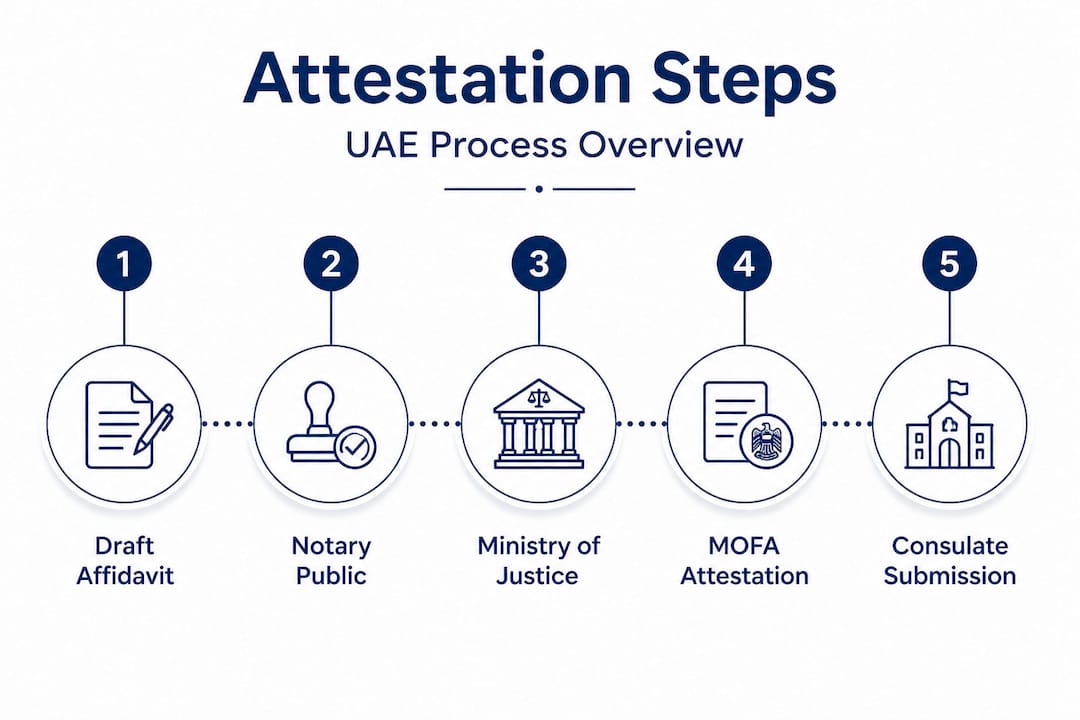
The process follows a strict sequence. You cannot skip steps or reverse the order. Here is the full chain broken down:
Draft your affidavit. Write the document in English or Arabic. If it is in Filipino or another language, have it officially translated before proceeding. Make sure names match exactly across every document and identification card you will present.
Notarization by UAE Notary Public. You must appear in person. No proxies, no exceptions. Bring your Emirates ID and passport. The notary will witness your signature and stamp the document. This typically happens the same day and costs around AED 50 to 100.
MOJ attestation. The Ministry of Justice verifies that the notary who signed your document is registered and authorized. This can be done at MOJ service centers or through approved typing centers. Processing usually takes one to two business days.
MOFA attestation. This is the final UAE-level validation. MOFA confirms the MOJ’s authority and makes your document internationally recognized. You can submit through MOFA’s online portal or use a courier service. The standard fee is AED 150, and processing takes 1-3 days.
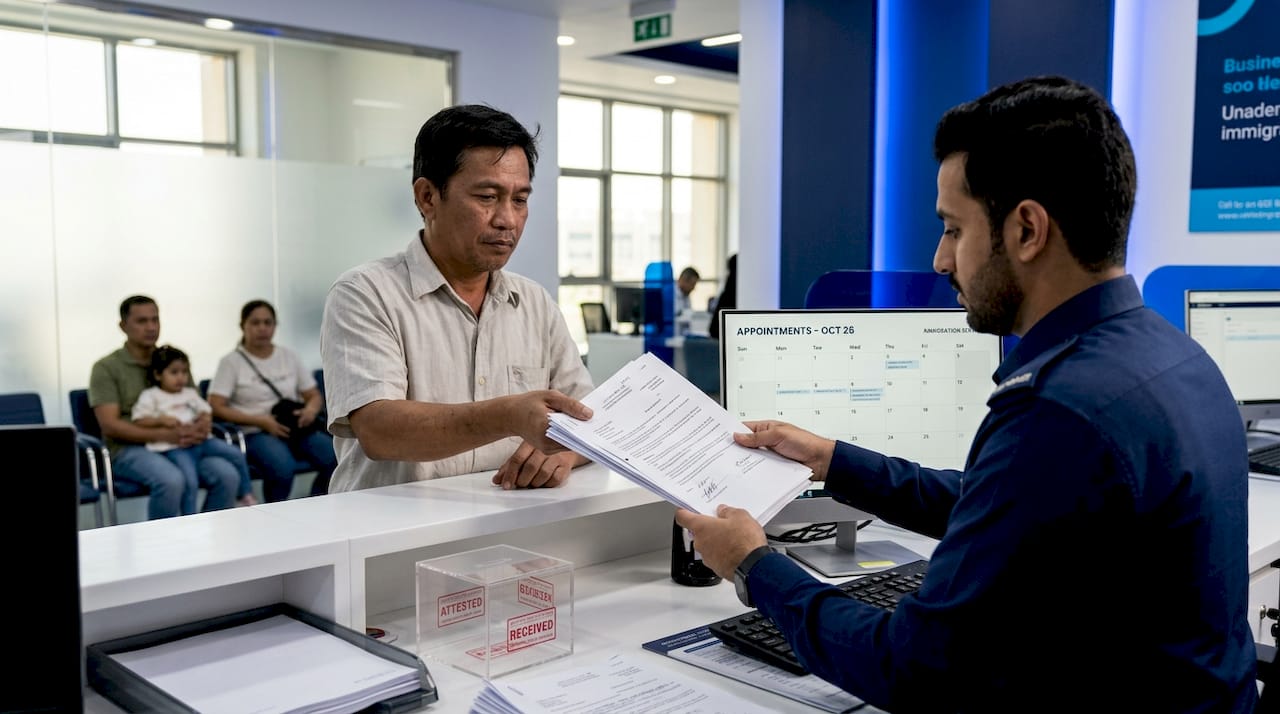
Philippine Consulate General attestation. If your affidavit will be used in the Philippines, you need one more step. The PCG in Dubai or the Philippine Embassy in Abu Dhabi will authenticate the document after all UAE attestations are complete. You must book an appointment online through the official consulate portal.
Here is a summary table to keep as a reference:
Step | Responsible office | Typical time | Approximate fee |
Draft and translate | You / translator | Varies | Varies |
Notarization | UAE Notary Public | Same day | AED 50-100 |
MOJ attestation | Ministry of Justice | 1-2 business days | AED 50-100 |
MOFA attestation | UAE Ministry of Foreign Affairs | 1-3 business days | AED 150 |
PCG or Embassy attestation | PCG Dubai / Embassy Abu Dhabi | 2-5 business days | AED 100 + AED 15 courier |
Pro Tip: Book your Philippine Consulate General appointment online immediately after submitting to MOFA, not after you receive your MOFA-stamped document. PCG slots fill up fast, and pre-booking gives you a buffer in case MOFA finishes earlier than expected. This alone can save you two to four days.
Knowing exactly how to prepare attestation papers before you walk into any government office dramatically reduces the chance of a rejection on a technicality.
Special cases and common pitfalls
Not every affidavit or scenario is straightforward. Here is what to watch out for, especially if your document started in the Philippines or you have heard mixed advice from friends.
Documents issued in the Philippines require a completely different chain. If the affidavit was drafted and notarized in the Philippines, you cannot bring it directly to MOFA UAE. The correct route is:
Notarization by a Philippine notary
Authentication by the Department of Foreign Affairs Philippines (DFA PH)
Authentication by the UAE Embassy in Manila
MOFA attestation in the UAE
Skipping any step in this chain means MOFA will reject the document. Laminated documents are another automatic disqualification. MOFA requires original, non-laminated copies. If your document has been laminated for protection, you will need a certified copy before you proceed.
Common rejection triggers include:
Name mismatches. Even a missing middle initial can cause a rejection. Your name must appear identically on the affidavit, your Emirates ID, your passport, and any supporting Philippine documents like a PSA birth certificate.
Missing prior attestation. Presenting a document to MOFA that has not yet been through the MOJ is one of the most frequent errors. Each step in the chain must be complete before moving to the next.
Unofficial translations. Translations must be certified by an approved legal translation office in the UAE. A bilingual friend’s translation will not be accepted.
Incomplete chain for Philippine-issued documents. Many expats skip the DFA Philippines step because they think the UAE Embassy in Manila is enough. It is not. Both are required.
Pro Tip: Only use official government applications and booking portals for every step of this process. The UAE Pass app handles MOFA services, and the PCG portal manages consulate appointments. Fixers and unofficial agents operating near government offices are not just unreliable; using them can result in document fraud charges, which carries serious legal consequences in the UAE. There is no shortcut that is worth that risk. For further clarity on legalizing Philippine documents for use in the UAE, always rely on official guidance.
Understanding the difference between apostille and embassy attestation is also worth your time, especially if the receiving institution abroad requests one specifically over the other.
Affidavit attestation for support, family, and work documents
Specific affidavits serve different purposes, so here is what you need to know about the most common ones for Filipino expats.
The Affidavit of Support and Guarantee (ASG) is by far the most frequently requested affidavit among Filipino expats in the UAE. You need it when sponsoring a family member’s tourist or visit visa to the UAE. The Philippine Consulate General in Dubai processes ASGs and has specific requirements:
Proof of income showing a minimum monthly salary (generally AED 5,000 or more for a single visitor, higher for multiple family members)
Proof of relationship, such as PSA-issued marriage certificates or birth certificates
Proof of accommodation, such as a tenancy contract or utility bill showing your UAE address
Valid Emirates ID and passport
The PCG Dubai processes ASGs with a fee of approximately AED 100 plus AED 15 for courier delivery. You must appear in person to sign the affidavit at the consulate. Appointments are booked through the PCG portal.
For work-related affidavits, such as those tied to employment contracts, business registration, or power of attorney for handling property transactions in the Philippines, the full UAE chain plus PCG attestation applies. The requirements vary slightly depending on the affidavit type, but the structure of the chain remains the same.
Business-related Special Powers of Attorney are particularly common among Filipino entrepreneurs in the UAE who need a trusted person in the Philippines to sign documents on their behalf. If you are running a business or planning to expand, understanding the UAE business setup process helps you anticipate which documents will require attestation along the way.
One important data point worth knowing: MOFA processed 38 million attestation requests in a single year, reflecting just how central the attestation system is to life in the UAE. With that kind of volume, even small errors in your paperwork can send you back to the end of the queue.
What most guides won’t tell you about document attestation in the UAE
Here is the part that official checklists rarely spell out clearly. Most expats who face rejections or re-attestation requests did not misunderstand the steps. They underestimated the time.
The full attestation chain, when everything goes smoothly, takes 5 to 10 business days. That is a best-case estimate. Factor in a PCG appointment that is not available for two weeks, an MOJ backlog during a public holiday, or a MOFA courier delay, and you are suddenly looking at three weeks or more. Filipino expats who start the process the week before a visa application deadline consistently find themselves in trouble.
The digital reforms currently being piloted by the UAE government will eventually change this. A QR-based digital attestation system is under development that would dramatically reduce physical handling time. But in 2026, the physical chain is still the standard for most documents, and assuming digital speed when you are dealing with physical paperwork is a risk not worth taking.
Another thing most guides skip: the psychological pull of unofficial shortcuts. When you are busy, stressed, and the consulate portal keeps showing no available slots, the offer from someone outside the building to “sort it out for you” feels tempting. But only official channels are authorized for consulate services, and any document processed through unofficial hands is legally invalid even if it looks real. Worse, it could get you flagged.
The smartest thing you can do, based on everything we see working consistently for expats, is to treat every deadline as if it is 10 days earlier than it actually is. If your visa application is due in four weeks, start the attestation chain today. The apostille service benefits are also worth exploring early, since apostille may simplify the process for certain destination countries.
Pro Tip: Start your attestation process at least 10 business days before your actual deadline. This buffer absorbs appointment delays, MOJ backlogs, and courier timing without putting your larger application at risk.
Get document support for worry-free attestation
Navigating the attestation chain on your own is absolutely possible, but a single missed step or an appointment slot you cannot get in time can push your entire timeline back by weeks.

At Harris N Charms, we work specifically with Filipino expats in the UAE who need their documents right the first time. Whether you are handling an Affidavit of Support and Guarantee, a Special Power of Attorney, or any other document that needs to move through the UAE attestation chain, our team knows the exact requirements at every stage. Explore our attestation resources or reach out directly for personalized guidance. We help you avoid the rejections, the re-submissions, and the last-minute scrambles that cost you time and money.
Frequently asked questions
Do I need to be physically present for affidavit attestation in the UAE?
Yes, personal appearance is required for notarization at the UAE Notary Public and for consulate attestation at the PCG or Embassy. No proxies are permitted at either of these steps.
Is an affidavit notarized in the UAE already valid for use in the Philippines?
No. A notarized affidavit must complete the full UAE chain (Notary, MOJ, MOFA) and then receive final attestation from the PCG in Dubai or the Philippine Embassy in Abu Dhabi before it is valid for use in the Philippines.
What documents can cause rejections during attestation?
Laminated documents, photocopies, untranslated text, name mismatches, and missing prior attestation steps are the most common causes. MOFA rejects documents that do not meet these standards without exception.
How long does the entire affidavit attestation process usually take?
Plan for 5 to 10 business days for the full chain under normal conditions. The upcoming digital MOFA pilot may reduce that window, but physical processing timelines still apply in most cases.
Can I use a fixer or agent for consulate attestation?
No. Only official government portals and the UAE Pass app are authorized for attestation services. Using unofficial intermediaries can result in invalid documents and potential legal consequences under UAE law.
Recommended
Comments