
Why attestation services matter for Filipino expats in UAE
- contact335627
- May 9
- 9 min read
Your job offer in the UAE is confirmed, the apartment is ready, and your visa application is moving forward. Then everything stalls because one document isn’t officially recognized. For thousands of Filipino expats, this scenario isn’t a rare nightmare. It’s a routine frustration that delays employment, family reunification, marriage registration, and even inheritance claims. Understanding how document attestation works, and knowing when to call in professional help, can be the difference between a smooth transition and months of costly setbacks.
Table of Contents
Key Takeaways
Point | Details |
Attestation is essential | Filipino expats in the UAE need attested documents for legal and personal transactions. |
Professional help avoids delays | Using attestation experts reduces the risk of costly mistakes and rejected paperwork. |
Choose agencies carefully | Vetting service providers thoroughly ensures your documents are safe and legally recognized. |
DIY often causes problems | Attempting attestation on your own can result in wasted time and missed opportunities. |
What is document attestation and why does it matter?
Now that we’ve set the stage, let’s clarify exactly what attestation means and why it’s so important for Filipino expats in the UAE.
Attestation is the process legalizing documents for use in a foreign country like the UAE. In simple terms, it’s an official stamp of approval that tells UAE authorities your document is genuine and was properly issued in the Philippines. Without it, your birth certificate, diploma, or marriage contract is just paper to any government office in the UAE.
There are three main types you’ll encounter. Apostille is a single-step verification accepted by countries that signed the Hague Convention. Embassy attestation involves your document being verified by the Philippine Embassy or consulate in the UAE. MOFA attestation (Ministry of Foreign Affairs) is the final step in the UAE that formally approves foreign documents for local use.
Filipino expats need the Philippine attestation process for a wide range of life events, including:
Applying for or renewing UAE work permits and residency visas
Registering a marriage in the UAE
Enrolling children in schools that require certified transcripts
Processing educational equivalency for professional licensing
Handling inheritance claims or property transfers
Opening corporate bank accounts or completing business registration
Filing court cases involving foreign parties
“Skipping attestation doesn’t just slow things down. It can invalidate entire legal transactions, force you to restart applications from scratch, and cost you job opportunities that have hard deadlines.”
The consequences of presenting un-attested documents are real. UAE government offices routinely reject applications with unverified paperwork. Employers may withdraw job offers. Courts will not accept unauthenticated evidence. For Filipino expats who traveled thousands of miles for a better life, these setbacks carry serious financial and emotional weight.
Attestation vs. legalization: What’s the difference?
With the basics covered, the next hurdle for most expats is confusion around attestation versus legalization. Legalization and attestation are often confused by expats navigating UAE requirements, and mixing them up can send you down the wrong process entirely.
Here’s the core distinction. Attestation refers to a multi-step process where different government bodies verify a document’s authenticity at each level, from the local issuing authority up to the destination country’s foreign affairs ministry. Legalization is a broader term that sometimes includes attestation but can also refer to the process of making a foreign legal document officially valid under the laws of another country. In practice, the UAE’s MOFA attestation process is often described as legalization by some agencies, which adds to the confusion.
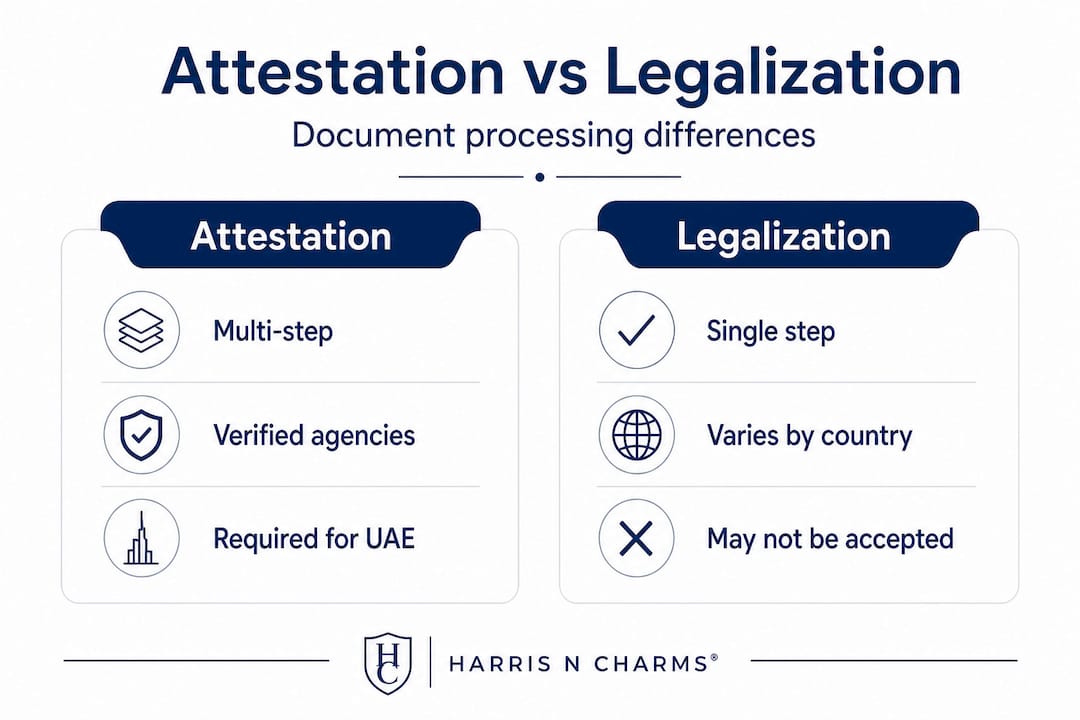
The right process depends heavily on two things: the type of document you have and the purpose it will serve. Understanding legalization vs attestation explained in detail helps you avoid wasting time and money on the wrong path.
Feature | Attestation | Legalization |
Steps involved | Multi-step (DFA, Embassy, MOFA) | Varies; often fewer steps |
Common use | Employment, visas, education | Court matters, business contracts |
Who performs it | Government agencies at each level | Notaries, consulates, ministries |
Cost range | Moderate to high | Varies widely |
Time to complete | Days to several weeks | Days to months |
Accepted by UAE | Yes, for most personal documents | Yes, for specific legal instruments |
Pro Tip: Before spending any money, check the specific requirement from the receiving authority. A UAE employer’s HR department, a court registrar, or the MOFA website will specify which process they need. Always get this in writing so you have a reference if there’s a dispute later.
It’s also worth knowing who can attest documents in the UAE context. Not every notary or agency has the authority to perform valid attestations. Knowing the authorized bodies saves you from paying for a service that won’t be accepted.
When and why you need attestation services
Once you know which process you need, the next question is: when is it wise, or necessary, to use professional attestation services?
Professional attestation is advisable when handling legal matters that require timely, officially recognized documents. But the truth is, most Filipino expats in the UAE will need attested documents at multiple points in their stay, not just once.
Here are the most common scenarios where professional attestation services become essential:
Visa processing and renewals: Your sponsor or employer needs your verified educational and professional records to process your UAE residency visa. Any error in attestation causes delays that can affect your legal status.
Marriage registration: Registering a marriage in the UAE requires both parties to submit attested civil documents, including birth certificates and certificates of no marriage (CENOMAR) from the Philippines.
Educational credential evaluation: Filipino nurses, engineers, teachers, and other licensed professionals must submit attested diplomas and transcripts to UAE licensing bodies before they can practice legally.
Business setup: Opening a business in the UAE requires attested documents proving identity, address, and sometimes financial standing.
Court and legal proceedings: Any document presented in UAE court proceedings must be properly legalized or attested. Submitting un-attested evidence can result in immediate dismissal of your case.
Inheritance and property matters: When a Filipino expat passes away in the UAE, surviving family members often need attested documents from the Philippines to claim assets or transfer property.
Many expats underestimate how much a single document error can cascade. A rejected birth certificate can delay a visa. A delayed visa can pause a job start date. A delayed job start date can affect your housing eligibility. The domino effect is real, and it’s expensive.
Checking the apostille benefits for Filipinos shows that professional services cut down on repeated trips, reduce rejection rates significantly, and often come with guarantee policies that cover reprocessing if something goes wrong.
Using an agency attestation guide to understand how agencies work also reveals that most reputable providers offer document tracking, so you always know exactly where your paperwork is in the process. That alone removes enormous stress from an already complicated situation.
How to choose a reliable attestation service provider
Having covered why professional help is beneficial, let’s walk through how to pick a provider you can genuinely trust.
Choosing an agency with experience and proper accreditation avoids legal pitfalls and wasted effort. But with so many services advertising online, separating trustworthy providers from unreliable ones requires a clear checklist.
Here’s a step-by-step approach to vetting any attestation provider:
Verify their accreditation. A legitimate agency should be registered with the UAE Ministry of Economy or a relevant authority. Ask for their trade license number and verify it independently.
Check their track record. Look for reviews on Google, Trustpilot, or Filipino expat community groups on Facebook. Pay attention to reviews specifically mentioning document types similar to yours.
Ask about turnaround times upfront. A reliable provider gives realistic timelines, not just what you want to hear. If they promise faster processing than the MOFA or DFA typically allows, that’s a warning sign.
Confirm their knowledge of Philippine-specific documents. Not all attestation agencies specialize in documents from the Philippines. Ask whether they regularly handle PSA-issued documents, DFA apostilles, and Philippine Embassy verifications.
Request a written service agreement. Before paying anything, get a clear written breakdown of services, fees, timelines, and what happens if your documents are rejected.
Red flags | Green flags |
No verifiable trade license | Registered, verifiable trade license |
Guarantees impossibly fast turnaround | Gives honest, realistic timelines |
Demands full payment upfront with no receipt | Provides official receipts and payment records |
Vague about which steps they handle | Clearly explains each attestation step |
No physical office address | Has a verified physical address in the UAE |
Poor or no reviews online | Consistent positive reviews from Filipino clients |
Reviewing attestation paper preparation tips before you hand over your documents also helps. Agencies work faster and more accurately when your paperwork is properly organized from the start. Incomplete document sets are one of the most common reasons for delays, and a good agency will walk you through preparation before accepting your files.
Pro Tip: Ask the agency directly: “Have you processed a document like mine in the last three months, and what was the outcome?” A confident, specific answer tells you more about their competence than any marketing material ever will.
The hard truth: Why trying to DIY attestation usually backfires for expats
While it may be tempting to go solo, here’s what most Filipino expats learn the hard way about doing attestation yourself.
The logic sounds reasonable. You save money, you stay in control, and you don’t have to trust a stranger with your most important documents. But the reality is that attestation involves navigating multiple government offices in two different countries, each with its own requirements, schedules, and tolerated exceptions. What looks like a simple checklist online often has unwritten rules that only experienced practitioners know.
We’ve seen composites of situations that play out repeatedly in the expat community. Someone submits their diploma for attestation through the DFA in Manila, only to find the document needs a separate notarization step they skipped. They fly back to the Philippines, redo the process, and lose three weeks of employment. Another expat brings a marriage certificate to the UAE Embassy without realizing the NSO seal (now PSA) format changed, and the document is flagged as non-standard. The time and airfare spent on these corrections often far exceed what a professional agency would have charged.
Many expats report delays and rejections when navigating attestation without expert help. These aren’t isolated stories. They represent a consistent pattern that stems from the complexity of cross-country document verification and the frequent updates to both Philippine and UAE requirements.
There’s also a subtler cost: missed opportunities. Job contracts have start dates. Visa windows have expiry periods. Court deadlines don’t wait. When your DIY attestation attempt stalls at the second or third step, those windows close. Recovering from a missed opportunity costs far more than the agency fee you were trying to avoid.
The challenges in self-attestation go beyond procedural errors. They include not knowing when a requirement has changed, not having contacts who can escalate a stuck application, and not understanding how to respond when a document is flagged for additional verification.
Professional attestation services exist because this process is genuinely complex and genuinely high stakes. Using one isn’t admitting you can’t handle it yourself. It’s recognizing that the cost of being wrong, in time, money, and life impact, is far greater than the cost of getting it right the first time.
Take the hassle out of attestation: Expert solutions for Filipino expats
If you want a stress-free path to official document recognition, here’s how you can move forward today.
Navigating attestation from the UAE is stressful enough without worrying whether each step was done correctly. Harris N Charms specializes in document attestation solutions for Filipino expats, handling everything from PSA document verification to DFA apostille coordination and MOFA attestation in the UAE.

Whether you’re processing a work permit, registering a marriage, or preparing credentials for professional licensing, the team at Harris N Charms understands the exact requirements for Philippine-issued documents and has the established relationships with both Philippine and UAE authorities to keep your process moving. You get accurate advice, transparent timelines, and a dedicated point of contact who knows your case. Reach out today to get started with a consultation and find out exactly what your documents need.
Frequently asked questions
What documents typically need attestation for use in the UAE?
Common documents include birth certificates, marriage certificates, diplomas, transcripts, and powers of attorney, among other civil and professional records.
How long does the attestation process usually take?
Processing times vary between agencies and document types, but most attestations take anywhere from several business days to a few weeks depending on complexity and urgency options.
Can I attest documents myself, or do I need an agency?
While some steps can be done independently, using an agency minimizes errors, saves significant time, and increases acceptance rates at UAE government offices and employers.
What is the difference between attestation and apostille?
An apostille is a simplified verification accepted by Hague Convention member countries, while traditional attestation follows a multi-step process involving DFA, embassy, and MOFA verification for countries that use that system.
Recommended
Comments