
UAE Document Validity Period Explained for Filipino Expats

UAE document validity period: There is no single expiry date stamped on every UAE-attested document. Whether a U.S. authority accepts your document depends on the document type, the specific receiving agency, and whether you have completed the right attestation chain. Here is what to check first:
Time-sensitive documents: Police Clearance Certificates (PCCs) and medical certificates are commonly accepted within a 3–6 month validity window only.
Effectively indefinite documents: Educational diplomas generally have no formal expiry, though some U.S. credential evaluators ask for recently issued transcripts alongside them.
Attestation requirements: Most documents destined for U.S. use need UAE MOFA attestation. Eligible digital documents may qualify for MOFA’s digital verification pathway.
Translation: Any document not in English typically requires a certified English translation before a U.S. authority will process it.
Pro Tip: Before you spend a single dirham on attestation, contact the exact U.S. office handling your case and ask for their written documentation requirements. Policies vary widely between USCIS, state agencies, universities, and banks.
Table of Contents of UAE document validity period
How do U.S. authorities decide if your UAE document is valid?
What are the attestation steps for UAE documents going to the U.S.?
Does UAE digital verification (QR codes, e-seals) work for U.S. recipients?
How do you confirm a U.S. recipient will accept your UAE document?
Harrisncharms makes UAE document attestation straightforward for Filipino expats
Which UAE documents need attestation for U.S. use?
Different document categories carry very different validity expectations. The table below captures the most common types Filipino expats deal with.
Document Type | Typical Validity Window | Common U.S. Recipient |
Police Clearance Certificate | 3–6 months | USCIS, employers, banks |
Medical certificate | 3–6 months | USCIS immigration medical, employers |
Birth / marriage certificate | No formal expiry | Vital records offices, USCIS |
Educational diploma | No formal expiry | Universities, credential evaluators |
Academic transcript | Varies; fresh copy often requested | U.S. Department of Education evaluators |
Power of attorney | Per document terms | Banks, legal offices |
Commercial / corporate documents | Per document terms | Banks, business registration |
PCCs and medical certificates are the documents most likely to cause problems. A PCC issued seven months ago may be technically attested but functionally useless to a USCIS officer who requires it to be current. Educational diplomas, on the other hand, do not expire. The attestation guide for Filipino expats from Harrisncharms walks through each category in detail.
Pro Tip: When your deadline is tight, request a freshly issued PCC or medical certificate rather than trying to reuse an older one. The cost of a new document is almost always less than a rejected application.
How do U.S. authorities decide if your UAE document is valid?
U.S. acceptance is driven entirely by the receiving authority, not by a single international rule. There is no federal standard that governs every agency.
USCIS requires certified translations of all non-English documents and properly legalized originals. For immigration medical exams, the physician’s report has its own strict freshness window.
State vital records offices typically accept attested birth and marriage certificates with no freshness requirement, but may require an apostille or consular legalization depending on the state.
U.S. credential evaluators (such as those used for university admissions or professional licensing) usually want both the original diploma and an official transcript issued directly by the institution.
Banks doing KYC often impose their own freshness windows on PCCs and utility bills, sometimes as short as 90 days.
Employers verifying credentials vary the most. Some accept MOFA-attested copies; others require third-party verification services.
Pro Tip: Find the specific department page for your U.S. recipient and screenshot or save the documentation requirements. Policies change, and having a dated record protects you if there is a dispute.
What are the attestation steps for UAE documents going to the U.S.?
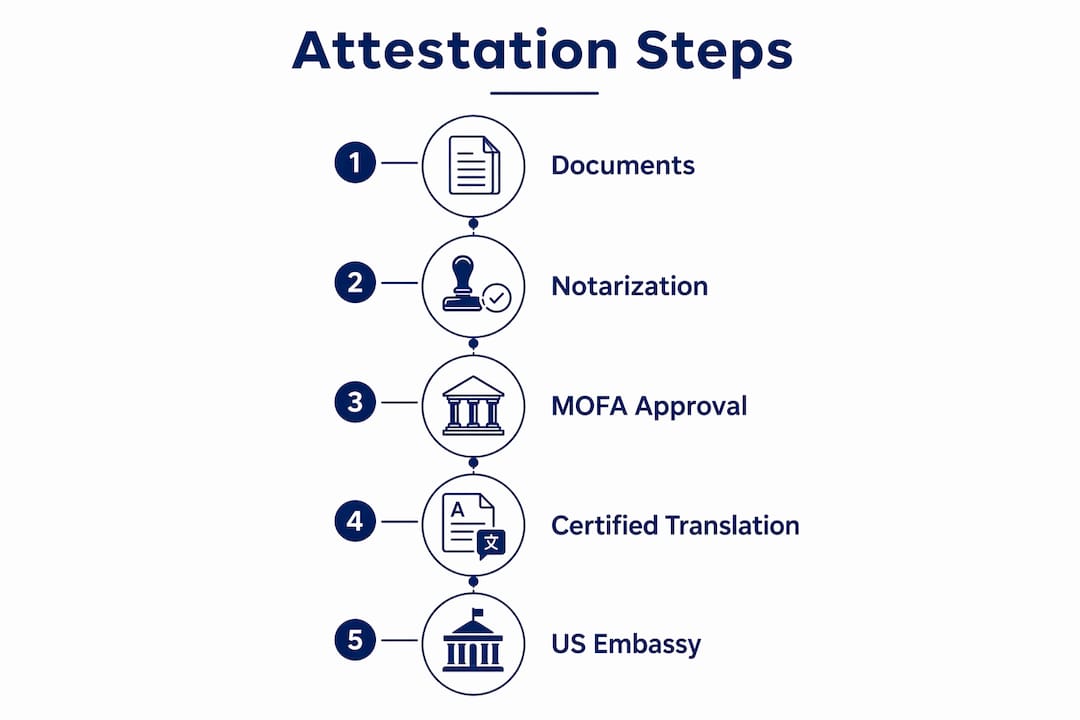
Follow the receiving authority’s required chain. For Philippine-origin documents processed through the UAE for U.S. use, the typical sequence runs:
Philippine authentication: Get the document authenticated by the relevant Philippine government authority (DFA Red Ribbon / apostille for Philippine-issued documents).
UAE notarization (if required): Some documents need notarization by a UAE-licensed notary before MOFA will process them.
UAE MOFA attestation: Submit to the UAE Ministry of Foreign Affairs for the official attestation stamp. Digital attestation is available for eligible documents and can complete in roughly 2 hours.
Certified English translation: If the document is in Arabic or Filipino, a certified translation is required before most U.S. authorities will accept it.
U.S. consular or embassy step (if required): Some U.S. recipients, particularly for immigration purposes, may require an additional step through the U.S. Embassy or a designated consular officer.
Bring originals, photocopies, a valid Emirates ID, your passport, and the certified translation to each step. The legalization vs. attestation guide from Harrisncharms clarifies which process applies to your specific document.
Pro Tip: If your UAE-issued document is digital and includes a QR code or e-seal, check MOFA’s eligibility criteria first. Digital attestation can cut processing time dramatically, but you must confirm the U.S. recipient accepts digital verification before relying on it.
Does UAE digital verification (QR codes, e-seals) work for U.S. recipients?
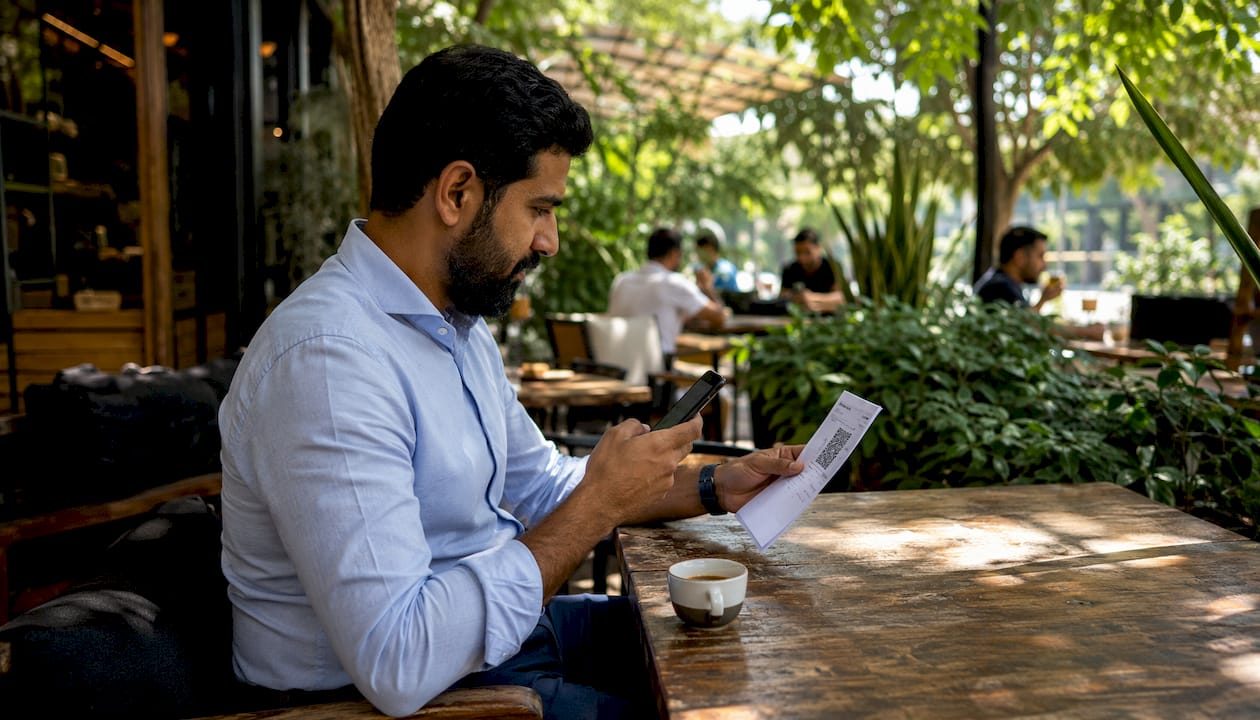
Under UAE Federal Decree-Law No. 46 of 2021, electronic documents issued by UAE public entities carry the same probative value as paper documents when they include verification features such as QR codes or electronic seals. That is the legal foundation for digital attestation.
“For MOFA’s digital attestation service, a document must be digital, UAE-issued, and include a verification mechanism — a QR code, reference number, or barcode — to qualify.” — MOFA UAE, Attestation of Official Documents
In practice, MOFA’s digital attestation can complete within approximately 2 hours for eligible documents during working hours. That is a significant advantage over courier-based chains. The catch: not every U.S. recipient has a process for verifying a QR code on a foreign document. Some USCIS offices and banks still expect a physical stamp. Always confirm with the U.S. recipient whether they accept digital verification before choosing this route. If they do, provide the verification link or reference number alongside a certified English translation. The record validation guide from Harrisncharms explains how to present QR and e-seal credentials to foreign recipients.
Pro Tip: When a U.S. agency accepts digital verification, send the verification reference number and a certified English translation in the same submission package. It removes any ambiguity about the document’s authenticity.
How do you confirm a U.S. recipient will accept your UAE document?
Always confirm directly with the specific U.S. office. Here is a repeatable process:
Identify the exact department or office handling your case (not just the agency name).
Find its official documentation requirements page and note the date you accessed it.
Call or email to ask specifically about UAE-issued documents, digital verification, and certified translation requirements.
Request written confirmation (email is fine) of what they accept.
Use this template as a starting point:
Pro Tip: Ask whether the recipient requires the translation to be done by an ATA-certified translator (American Translators Association). Some federal agencies and courts specify this standard.
What timelines and costs should you plan for?
Straightforward MOFA digital workflows can finish in hours. Traditional chains commonly take longer.
Step | Typical Duration |
Philippine DFA authentication | 3–4 weeks |
UAE notarization | 1–2 business days |
MOFA digital attestation | ~2 hours (eligible documents) |
MOFA courier-based attestation | 1–3 working days |
Embassy / consular step | 1–3 weeks (varies by mission) |
Certified English translation | 2–5 business days per document |
End-to-end (full chain) | 2–6 weeks |
For fees, MOFAIC attestation for personal and educational documents typically runs AED 150–450 per document. Translation costs vary by provider and document length. Embassy legalization fees depend on the mission. Plan a total budget that includes notarization, translation, MOFA fees, and courier or service charges.
Pro Tip: Start the process at least 3–4 weeks before your U.S. submission deadline. Embassy steps can add 2–3 weeks in difficult cases, and re-submissions for rejected documents reset the clock entirely.
Common myths about UAE document validity — debunked
Myth 1: “Once attested, a document is valid forever.” MOFA attestation has no blanket expiration, but the receiving authority sets its own freshness rules. A PCC attested 8 months ago is still technically attested. A USCIS officer may still reject it because it falls outside their 6-month window.
Myth 2: “Notarization makes a document permanently valid.” Notarization authenticates execution, not ongoing legal effectiveness. The document’s validity depends on its content, the governing legal framework, and the recipient’s policies.
Myth 3: “An apostille works for UAE-attested documents going to the U.S.” The U.S. is a party to the Hague Apostille Convention, but the UAE is not. Documents routed through the UAE follow consular legalization chains, not apostille procedures.
Myth 4: “QR codes on UAE documents are not accepted abroad.” Under Federal Decree-Law No. 46 of 2021, properly verified electronic documents carry equivalent probative value to paper. The question is whether the specific U.S. recipient has a process to verify them — which is why you confirm first.
Pro Tip: If a document was rejected once, find out exactly why in writing before resubmitting. Fixing the wrong problem wastes both time and money.
Key Takeaways
UAE document validity for U.S. use has no universal expiry — acceptance depends on document type, the receiving U.S. authority, completed attestation, and certified translation.
Point | Details |
No universal expiry | MOFA attestation has no blanket end date; the U.S. recipient sets its own freshness rules. |
Time-sensitive documents | PCCs and medical certificates are commonly accepted within a 3–6 month window only. |
Digital attestation speed | MOFA digital attestation for eligible documents can complete in approximately 2 hours. |
Plan for 2–6 weeks | Full attestation chains, including embassy steps, typically take 2–6 weeks end-to-end. |
Harrisncharms support | Harrisncharms handles MOFA attestation, certified translations, and U.S. recipient checks for Filipino expats in the UAE. |
What Filipino expats often get wrong about this process
The most common mistake is treating attestation as a one-time checkbox rather than a process that must be calibrated to a specific U.S. recipient. A document attested for one purpose, say a bank KYC check, may not satisfy a USCIS immigration officer even if the paperwork looks identical. The receiving authority’s rules are what matter, and those rules are not always published clearly.
The second mistake is underestimating translation. Many Filipino expats assume an English-language document needs no further work. But if any supporting document in the package is in Arabic or Filipino, the entire submission can stall. ATA-certified translations are worth the extra cost for federal submissions.
Start early, confirm in writing, and do not assume that what worked for a colleague’s visa application will work for your university admission or KYC submission. The details differ more than people expect.
Harrisncharms makes UAE document attestation straightforward for Filipino expats
Filipino expats in the UAE dealing with U.S. document requirements face a process that is genuinely complex: multiple authentication steps, freshness windows that vary by recipient, and translation standards that differ between a bank and a federal agency. Harrisncharms handles the full chain, from MOFA digital processing checks and certified English translations to direct liaison with U.S. recipients when written acceptance confirmation is needed.
The practical advantage is fewer rejections and less time spent chasing agencies. Harrisncharms knows which U.S. authorities require physical MOFA stamps versus digital verification, and which translation standards apply to immigration versus credential evaluation submissions. If you are preparing UAE documents for U.S. use and want the process done right the first time, get started with Harrisncharms today.
Recommended
Comments