
The Role of Online Attestation Portals in 2026

Online attestation portals are digital platforms that authenticate, verify, and attest official documents without requiring in-person visits or paper submissions. They connect issuing authorities, verification agencies, and applicants through secure digital systems, cutting turnaround times that once stretched into weeks. For individuals, businesses, and government bodies alike, these portals have become the practical backbone of cross-border document validation.
The documents they handle span a wide range: academic degrees, birth and marriage certificates, medical credentials, commercial contracts, and power of attorney forms. What makes them genuinely useful is the chain they create between the original issuing authority and the final verifying body, with every step logged and traceable. Technologies like blockchain, digital signatures, and QR code verification have made that chain harder to break or forge.
Key stakeholders served by these platforms include:
Individuals applying for jobs, visas, or university enrollment abroad
Businesses submitting commercial documents for international licensing or partnerships
Government agencies and diplomatic missions requiring authenticated seals and official records
Expatriates and diaspora communities needing cross-border document recognition, including Filipino expats navigating UAE requirements
One important caveat: a portal’s effectiveness depends heavily on whether the issuing authority has integrated its records into a digital repository. When that integration is missing, the portal functions mainly as a submission interface rather than a fully digital verification system.

What services do online attestation portals offer?
The scope of services varies by portal, but most platforms cover three broad user groups: individuals, businesses, and government or diplomatic entities.

For individuals, portals typically handle personal documents such as birth certificates, marriage certificates, educational transcripts, and medical records. Many platforms also support apostille services for countries party to the Hague Apostille Convention, allowing documents to gain international legal recognition without embassy-by-embassy endorsement. For Filipino expats in the UAE, this category covers everything from DFA-authenticated documents to TESDA certificates needed for employment verification.
For businesses, the focus shifts to commercial documents:
Certificate of incorporation and business registration records
Board resolutions and partnership agreements
Commercial contracts and trade licenses
Power of attorney documents for overseas transactions
For government and diplomatic missions, portals facilitate the verification of official seals, notarial acts, and public records. The UAE Ministry of Foreign Affairs, for example, provides digital attestation services through its official website and the UAE MOFA smartphone application, covering both documents issued inside and outside the UAE.
Portals also increasingly serve multi-jurisdictional needs. A single application can route through a national authority, a foreign ministry, and a destination country’s embassy, all within one digital workflow. India’s e-Sanad platform, operated by the Ministry of External Affairs, handles personal, educational, and commercial documents for Indian citizens and foreigners, with the explicit goal of extending the service to Indians residing abroad.
How does the digital attestation process work?
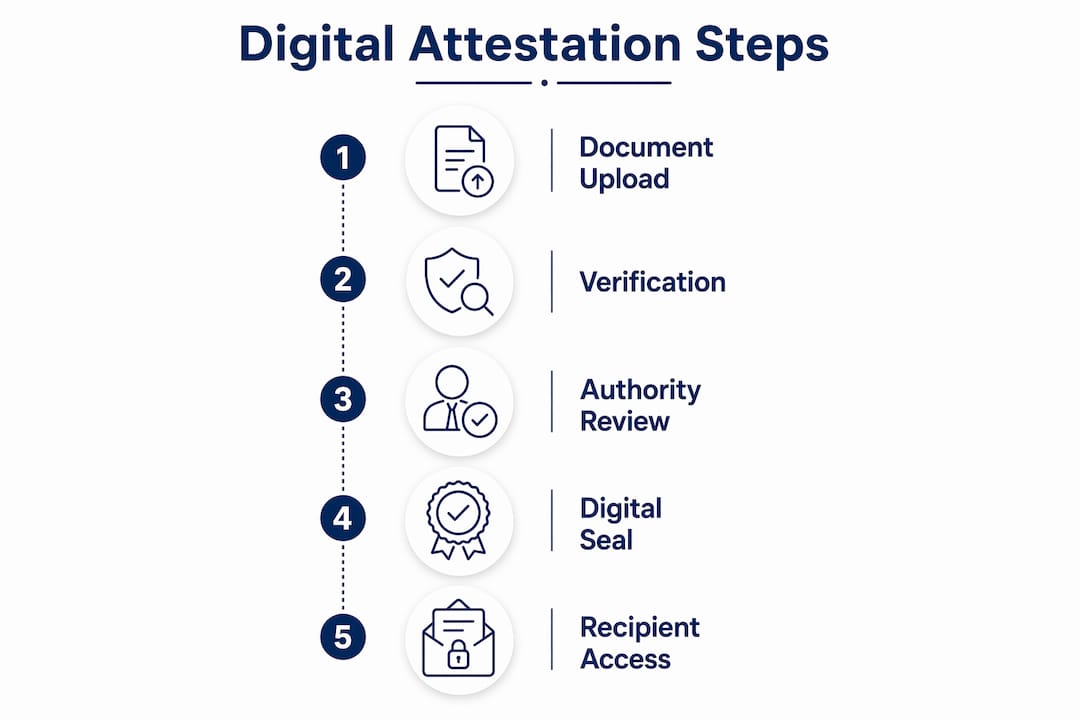
The process follows a clear sequence, though specific steps vary by platform and document type.
Create an account and register. Most portals require identity verification at registration. Systems like the research-backed Ettest platform use encrypted QR codes sent to institutional or organizational email addresses, preventing unauthorized access from the start.
Upload your document. Applicants upload high-resolution scans or digital copies of the document requiring attestation. The file must meet the platform’s format and resolution standards. Documents with erasures, overwriting, or poor scan quality are typically flagged automatically.
Verification against digital repositories. The portal cross-checks the uploaded document against the issuing authority’s digital records. India’s e-Sanad platform requires documents to be available in a recognized digital depository, such as the National Academic Depository, before online attestation can proceed.
Digital authentication. Once verified, the system applies authentication mechanisms: digital signatures, blockchain-generated certificates, or QR codes that allow any recipient to confirm authenticity independently. The Higher Education Commission’s blockchain-powered system generates a verifiable e-Attestation Certificate shareable with employers and foreign embassies.
Payment. Most portals integrate payment gateways at this stage. Fees vary by document type, destination country, and processing tier.
Status tracking. Applicants can monitor their application in real time through the portal dashboard. The UAE MOFA service provides this through both its website and mobile app.
Receipt of attested document. Fully digital documents are delivered electronically. For documents that still require a physical stamp, courier delivery is arranged through designated service providers.
Exception to note: documents issued before an authority’s digital transition date often cannot be processed online. Physical copies of those records require manual submission, regardless of what the portal otherwise supports.
What are the real benefits and limitations of these portals?
Benefits
Online attestation portals deliver measurable advantages over traditional paper-based processes:
Faster processing. Digital workflows cut turnaround times significantly. The KMPDC in Kenya reported that its manual medical certificate attestation took 7–14 business days; the shift to an online portal was intended to significantly decrease this processing time.
Reduced fraud risk. Portals that require verification through authenticated digital systems linked to authorized issuers make document forgery considerably harder. Blockchain-based certificates are particularly resistant to tampering.
Full audit trails. Every transaction is logged and traceable by both users and regulators, creating accountability that paper processes simply cannot match. The UAE MOFA service explicitly provides traceable attestation records for all transactions.
Remote access. Applicants can submit and receive documents from anywhere. The UAE MOFA portal is accessible from outside the UAE through its digital channels, a direct benefit for document verification needs of expats abroad.
Cost savings. Eliminating courier fees, travel costs, and physical document handling reduces the total cost per attestation. UK e-apostille services, for instance, remove the cost of secure postal delivery entirely.
Limitations
Integration gaps. Not all issuing authorities have digitized their records. When a portal lacks a live connection to the issuing body’s database, it acts only as a submission front end, and the actual verification still happens manually behind the scenes.
Document eligibility restrictions. Certain document types remain ineligible for digital processing. UK e-apostille services, for example, do not cover birth, marriage, or death certificates, which still require paper apostilles.
Acceptance varies by destination. E-apostille acceptance differs by country. Some foreign authorities and organizations still insist on paper apostilles, making it critical to confirm requirements before submitting digitally.
Technical barriers. System downtime, platform navigation challenges, and digital literacy gaps can delay applications. Transitioning to online attestation requires users to understand platform standards to avoid errors.
Legacy documents. Documents issued before an authority’s digital integration date cannot be attested online, even when physical copies exist.
Pro Tip: Before submitting through any portal, confirm two things: that your specific document type is eligible for digital processing, and that the destination country or organization accepts digitally attested documents. Skipping this check is the most common cause of rejected applications.
What policies and security measures govern these portals?
Regulatory oversight and security architecture are what separate a trustworthy attestation portal from a poorly built submission form.
Regulatory frameworks governing digital attestation vary by country but share common principles. The Hague Apostille Convention provides the international legal basis for apostille services, and its e-Apostille program allows member countries to issue digital apostilles and maintain electronic registers. India’s e-Sanad operates under the Ministry of External Affairs, with integration governed by agreements between the ministry and individual document issuing authorities. The UAE’s attestation services fall under the Ministry of Foreign Affairs and are governed by UAE federal legislation.
Security protocols used by credible portals include:
Encryption. Advanced Encryption Standard (AES) algorithms protect data in transit and at rest. The Ettest system, documented in peer-reviewed research at IJERT, uses symmetric key encryption tied to QR code scanning for registration verification.
Blockchain verification. Immutable ledger entries make retroactive tampering detectable. The HEC’s 2026 system uses blockchain to generate certificates that employers and embassies can verify independently.
Two-factor authentication. Most government portals require identity confirmation beyond a password, typically through a registered mobile number or institutional email.
Session management. JSON Web Tokens and similar mechanisms ensure that each request within a session is authenticated, preventing session hijacking.
Data privacy is governed by national frameworks. In the UAE, data handling on government portals falls under federal data protection regulations. Portals processing documents for EU citizens must also comply with GDPR requirements when applicable.
Audit trails and transparency are built-in features of well-designed portals. The e-Sanad portal maintains an e-Register of apostilles that any recipient can query online to verify the origin and authenticity of a specific apostille, without contacting the issuing authority directly.
Notable government initiatives demonstrating these principles in practice include the UAE MOFA’s fully digital attestation channel for QR-code-enabled documents, India’s e-Sanad with its National Academic Depository integration, and Kenya’s KMPDC transition to an online-only medical certificate attestation system from August 2026 onward.
How have US states approached digital attestation?
The United States does not operate a single federal online attestation portal. Instead, the Secretary of State in each state handles apostille and authentication services, and digital adoption has progressed unevenly across jurisdictions.
Several states have moved toward electronic apostille (e-apostille) issuance in line with the Hague Conference on Private International Law’s e-APP (Electronic Apostille Program). California, Texas, and Florida, which process among the highest volumes of international document requests nationally, have each developed online submission systems that allow applicants to request apostilles without mailing original documents to the Secretary of State’s office.
California allows online apostille requests through the Secretary of State’s website for certain document types, with status tracking and digital delivery for eligible submissions. The system integrates with notarial records maintained in the state’s database.
Texas offers an online apostille request system that accepts scanned documents and processes requests with digital tracking. Turnaround times under the online system are generally shorter than walk-in or mail-in alternatives.
Florida has expanded its digital services to include online apostille requests, with the Secretary of State’s office providing guidance on document eligibility and destination-country acceptance.
At the federal level, the US Department of State handles authentication for documents intended for countries not party to the Hague Convention. Its online portal allows applicants to submit requests and track status digitally, though physical document submission is still required for certain categories.
The broader trend across US states points toward attestation trends in 2026 that favor digital-first workflows, with the caveat that full end-to-end digital processing remains limited to document types already held in state digital repositories.
Key Takeaways
Online attestation portals work best when issuing authorities have fully digitized their records, making integration the single most important factor in portal effectiveness.
Point | Details |
Integration determines effectiveness | Portals without live issuing-authority connections act as submission interfaces, not full digital systems. |
Blockchain raises the security bar | Blockchain-generated certificates, as used by HEC’s 2026 system, make forgery and tampering detectable. |
Processing times drop significantly | KMPDC’s shift to online processing aimed to significantly reduce the 7–14 business day turnaround seen with manual attestation. |
Document eligibility varies | Certain documents, including birth and death certificates in the UK, remain ineligible for e-apostille processing. |
US adoption is state-by-state | California, Texas, and Florida lead digital apostille adoption; federal authentication still requires physical documents for some categories. |
Recommended
Comments