
The Role of Attestation in Bilateral Agreements Explained

Attestation is the formal act that makes a document legally credible across international borders. In bilateral agreements, it confirms that signatures are genuine, that signatories had the authority to bind their parties, and that the document meets the legal standards of both countries involved. Without it, a contract signed in Manila may carry no weight in Abu Dhabi, and a treaty authenticated in Washington may face rejection in a foreign court. The role of attestation in bilateral agreements is, at its core, about legal certainty: it creates a rebuttable presumption of valid execution, shifting the burden of proof to anyone who wants to challenge the document.
Common forms of attestation in bilateral contexts include:
Notarization: A notary public verifies signer identity and witnesses the signing
Consular legalization: An embassy or consulate authenticates documents for use in its home country
Apostille certification: A standardized stamp under the Hague Convention that replaces full legalization between member states
Full powers documents: Official state instruments required under the Vienna Convention on the Law of Treaties to confirm a representative’s authority to bind a state
What document attestation actually means in international law
Attestation is a formal declaration by an impartial third party confirming that a document was properly signed and that the signer’s identity was verified. It does not certify that the contents of the document are true. A notary who witnesses a contract signing confirms the signer was present and willing; they make no judgment about whether the contract’s terms are fair or accurate. That distinction matters in court, where attestation provides prima facie proof of execution, not of substance.
The legal significance of attestation shows up most clearly in high-stakes documents:
Wills and testaments: Most jurisdictions require at least two witnesses to attest the testator’s signature, creating a presumption of valid execution
Powers of attorney: Attestation confirms the grantor’s identity and voluntary consent
Commercial contracts: Especially in cross-border deals, attestation verifies both signatory authority and corporate seal authenticity
Deeds and property transfers: These require stricter attestation formalities than ordinary signed contracts
The distinction between attestation and notarization trips up many people. Notarization is one type of attestation, the most familiar one, where a licensed notary public verifies identity, witnesses the signing, and affixes an official seal. Attestation is the broader category. A witness signing a will is attesting; a notary stamping a power of attorney is also attesting, just with more formal authority behind it.
Why attestation is required in international bilateral agreements
Bilateral agreements operate across two legal systems that may have entirely different standards for what makes a document valid. Attestation is the mechanism that bridges those systems. A document executed under American law may need to satisfy Philippine or UAE legal requirements before it can be enforced there, and attestation is how that compliance gets demonstrated.
The Vienna Convention on the Law of Treaties requires that state representatives present “full powers” documents confirming their authority to negotiate and authenticate treaties. This is treaty-level attestation: formal proof that the person signing can legally bind their government. Without it, the treaty’s validity is open to challenge.
Key reasons attestation is required include:
Foreign jurisdiction compliance: Documents must meet the legal standards of the receiving country, not just the issuing one
Dispute prevention: Attestation creates a clear evidentiary record that is hard to challenge after the fact
Apostille gaps: Countries outside the Hague Apostille Convention require additional embassy legalization layers that only consular attestation can provide
Signatory authority proof: Especially in commercial agreements, attestation confirms the person signing had actual authority to do so
How the attestation process works step by step
The process varies by country and document type, but the core sequence is consistent across most bilateral agreement contexts.
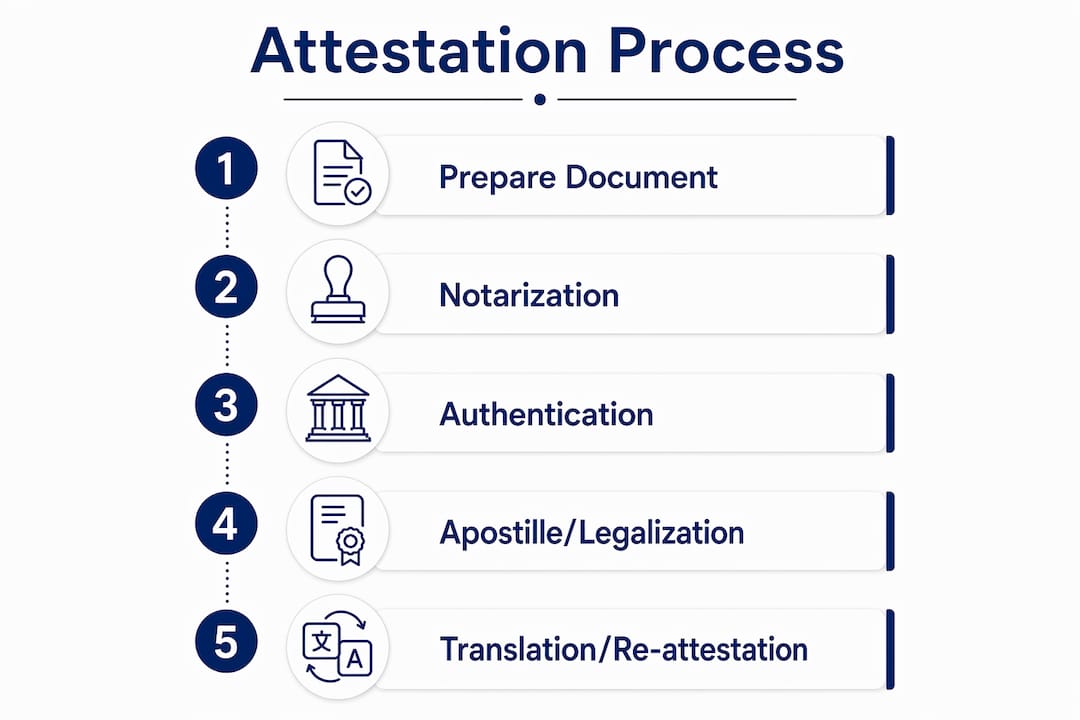
Step 1: Document preparation. The document must be complete, accurate, and free of alterations before any attestation begins. Any corrections made after signing can void the attestation.
Step 2: Notarization. For most international documents, notarization is the first layer. A notary verifies the signer’s identity, confirms they are acting voluntarily, witnesses the signing, and affixes their seal. This creates the foundational evidentiary record.

Step 3: State or national authentication. Depending on the destination country, the notarized document may need authentication by a state authority (such as a Secretary of State office) or a national authority before it can proceed to the next step.
Step 4: Apostille or consular legalization. If both countries are Hague Convention members, an apostille stamp replaces full legalization. If not, the document goes to the relevant embassy or consulate for legalization, which involves the consular officer verifying the authenticity of the prior authentication. For cross-border enforceability, this step is often the most consequential.
Step 5: Translation and re-attestation. Many countries require certified translation of attested documents into the official language of the receiving jurisdiction, sometimes with a separate attestation of the translation itself.
Timelines and preparation tips for successful attestation
Attestation timelines range from a few days for straightforward notarizations to several weeks or months for documents requiring multiple layers of consular legalization. Documents destined for countries outside the Hague Convention consistently take longer, because each government office in the chain operates on its own schedule.
Practical preparation steps:
Start early. Build in at least four to six weeks for complex international documents, more if consular offices in the destination country have known backlogs
Verify requirements upfront. Contact the destination country’s embassy or consulate before preparing documents to confirm current attestation requirements, which can change without notice
Gather supporting documents. Many attestors require supporting identification, corporate authorization letters, or certified translations before they will proceed
Check attestor qualifications. Not every notary is authorized to attest documents for international use; some jurisdictions require a notary with specific international credentials
Pro Tip: Keep a complete audit trail of every attestation step: copies of the original document, each authentication certificate, apostille or legalization stamps, and any correspondence with consular offices. If a document needs renewal or faces a legal challenge years later, that paper trail is your first line of defense.
How consular and visa services fit into the attestation process
Consular authorities sit at the center of international attestation for bilateral agreements. Their role is to verify that documents issued in a foreign country are genuine before those documents are accepted domestically. A UAE consulate reviewing a Philippine document, for example, will check that the prior notarization and authentication are legitimate before adding its own legalization stamp.

Visa services intersect with attestation more often than people expect. Employment visas, residency applications, and family reunification cases routinely require attested documents: birth certificates, marriage certificates, educational credentials, and police clearance records. For Filipino expats in the UAE, this means documents issued in the Philippines must typically pass through Philippine government authentication before UAE consular legalization.
The broader legalization framework works like this:
Consular attestation confirms the authenticity of a foreign public document
It provides internationally recognized proof that the document is genuine
It satisfies the receiving country’s legal requirements for accepting foreign documents
For bilateral agreements specifically, consular attestation often serves as the final step that makes a document enforceable in the other country’s courts
Common do’s and don’ts when obtaining document attestation
Getting attestation wrong can invalidate a document entirely. These are the rules that matter most:
Do:
Use a qualified, impartial third party with no personal or financial interest in the document’s outcome
Verify the specific attestation requirements of the destination country before starting the process
Ensure corporate documents include attestation of both the signatory’s authority and the corporate seal’s authenticity
Keep certified copies of every attested document in a secure location
Don’t:
Allow a beneficiary of a will or contract to serve as an attesting witness; this creates a conflict of interest that can void the attestation or the benefit itself
Submit documents with alterations, corrections, or missing pages; attestors will reject them
Assume a domestic notarization is sufficient for international use without checking apostille or legalization requirements
Rely on digital signatures alone for documents that require wet-ink attestation under the receiving country’s law
False attestation carries serious consequences. Knowingly verifying a false statement can trigger civil fraud claims, criminal liability under statutes like the U.S. False Claims Act, and professional license revocation for notaries and auditors.
Why attestation deserves particular attention in international agreements
Attestation in international agreements does something that a signature alone cannot: it creates a legal presumption that travels across borders. When a document carries proper attestation, the burden of proof shifts to whoever wants to challenge it. That shift is not trivial in cross-border disputes, where gathering evidence from another jurisdiction is expensive and slow.
The Vienna Convention framework aligns with this logic at the treaty level, requiring formal authentication of state authority before any treaty obligation can be recognized. The same principle applies to commercial bilateral agreements: attestation is the mechanism that makes a contract’s execution provable in a foreign court. For companies entering Sino-foreign ventures or Gulf-region commercial deals, a properly attested enforceable agreement reduces the risk of a contract being dismissed on procedural grounds before its substance is even considered.
Attestation also supports risk management in a concrete way. A deficient attestation discovered during due diligence can halt an investment, delay a merger, or expose a party to regulatory penalties. Getting it right at the outset is far cheaper than correcting it later.
Expert best practices for reliable attestation in bilateral contexts
Beyond the basics, experienced practitioners follow a set of principles that reduce rejection risk and strengthen evidentiary value.
Use uninterested third parties. An impartial attestor with no ties to either signatory preserves the attestation’s probative force if challenged in court
Verify corporate authority explicitly. For company signatories, attestation should cover both the individual’s authority (via board resolutions or power of attorney) and the authenticity of any corporate seal used
Apply stricter standards to deeds. Deeds require more rigorous attestation formalities than ordinary contracts; ignoring these formalities can invalidate the instrument even when its contents are accurate
Maintain audit trail precision. Every step in the attestation chain should be documented with dates, names, and reference numbers
Anticipate jurisdiction-specific customs. Some countries place greater legal weight on corporate seals than on signatures; others require specific witness qualifications that differ from standard notary practice
For a deeper look at how these practices are evolving, Harrisncharms covers attestation trends in 2026 and what professionals working in international document contexts need to know.
Legal implications of attestation on the enforceability of bilateral agreements
A bilateral agreement without proper attestation is not automatically void, but it is vulnerable. Courts in the receiving country may refuse to enforce it, treat it as unexecuted, or require additional proof of authenticity before proceeding. That uncertainty is the core legal risk.
Attestation creates what lawyers call prima facie evidence of valid execution. It does not prove the agreement’s terms are fair or that the parties understood them. What it does prove is that the right people signed, that they had authority to do so, and that the signing was properly witnessed. In a dispute, that proof is often the difference between a contract that gets enforced and one that gets litigated on procedural grounds for years.
For bilateral agreements specifically, the legal implications extend further. A missing or defective attestation can:
Render the agreement unenforceable in the foreign jurisdiction
Trigger regulatory penalties if the agreement was required to meet compliance standards
Expose the parties to financial losses from contracts that cannot be performed or enforced
Create reputational damage that affects future business relationships in that market
Real-world examples of attestation’s impact on bilateral agreements
The corporate seal problem in China-facing contracts. In Sino-foreign commercial agreements, the corporate seal (often called a “chop”) carries more legal weight than a signature under Chinese law. Foreign companies that attested only the signature, without explicitly verifying the seal’s authenticity and the signatory’s authority, have faced contract rejection by Chinese authorities. The fix is straightforward: attestation must explicitly cover both elements, but many standard Western attestation templates do not address seals at all.
Treaty authentication under the Vienna Convention. When states negotiate bilateral treaties, the “full powers” requirement under the Vienna Convention is a form of attestation at the highest level. A representative who signs a treaty without presenting valid full powers creates a treaty that the other state can later refuse to ratify or recognize. This has occurred in practice when diplomatic credentials were disputed, leading to delays in treaty entry into force.
Employment document attestation for Gulf-region workers. Filipino workers seeking employment in the UAE must have educational certificates, birth certificates, and other personal documents attested through a chain that runs from Philippine government authentication to UAE consular legalization. Documents that skip a step in this chain are routinely rejected by UAE immigration authorities, delaying or canceling employment. Harrisncharms provides document attestation services specifically designed to navigate this process for Filipino expats.
How attestation requirements differ between countries in bilateral agreements
No two countries handle attestation identically, and bilateral agreements often expose those differences sharply.
Hague Convention members vs. non-members. Between two Hague Convention member states, an apostille stamp is sufficient. Between a member and a non-member, full consular legalization is required. The UAE is not a Hague Convention member, which means documents from the Philippines destined for UAE use require consular legalization rather than an apostille.
Civil law vs. common law jurisdictions. Civil law countries (most of continental Europe, Latin America, and parts of Asia) often require notarial attestation with specific formalities that differ from common law notary practice. A U.S. notarization may not satisfy French or German legal requirements without additional authentication.
Corporate document requirements. Some jurisdictions require that corporate signatories present board resolutions, articles of incorporation, or certificates of good standing alongside attested contracts. Others accept a notarized signature alone. Failing to check these requirements before submitting documents is one of the most common causes of rejection.
Challenges in attestation for bilateral agreements and how to address them
Bureaucratic delays. Consular offices operate on their own timelines, and backlogs are common. The solution is early preparation and, where possible, using professional attestation services that have established relationships with consular offices and know current processing times.
Changing requirements. Attestation requirements can change with little notice, particularly when countries update their bilateral agreements or join new international conventions. Verifying requirements directly with the relevant embassy or consulate before starting the process prevents wasted effort.
Language barriers. Documents in one language often need certified translation before attestation in the receiving country. The translation itself may require separate attestation. Building translation into the timeline from the start avoids a common bottleneck.
Conflicting standards. When the two countries in a bilateral agreement have different attestation standards, the document must satisfy both. The practical approach is to meet the stricter standard first; a document that satisfies higher requirements will generally satisfy lower ones as well.
For anyone navigating these challenges, Harrisncharms offers a detailed attestation FAQ guide covering the most common procedural questions for international document use.
Key Takeaways
Attestation is the procedural foundation that makes bilateral agreements legally enforceable across borders, and skipping or shortcutting any step in the chain creates vulnerabilities that courts and foreign authorities will exploit.
Point | Details |
Attestation creates a legal presumption | It shifts the burden of proof to anyone challenging a document’s valid execution. |
Full powers are treaty-level attestation | The Vienna Convention requires formal authority documents before any state representative can bind a government. |
Apostille vs. consular legalization | Hague Convention members use apostilles; non-members like the UAE require full embassy or consular legalization. |
Corporate seals need explicit attestation | In jurisdictions like China, seal authenticity must be attested separately from the signatory’s identity. |
False attestation carries criminal risk | Knowingly verifying a false statement can trigger liability under statutes like the U.S. False Claims Act. |
Recommended
Comments