
Medical Certificate Attestation: UAE Guide for Filipinos

Medical certificate attestation is the official process of verifying a medical document’s authenticity so it is legally accepted by foreign authorities, including UAE employers, immigration offices, and government agencies. For Filipino expats and overseas workers heading to the UAE, this process is not optional. Without it, your medical records carry no legal weight abroad. Understanding what medical certificate attestation involves, and how to complete it correctly, is the difference between a smooth visa approval and a costly rejection.
What is medical certificate attestation for UAE use?
Medical certificate attestation is a multi-step document verification process that authenticates the signatures and seals on a medical document issued in the Philippines so that UAE authorities recognize it as legitimate. The process confirms that the issuing doctor, hospital, or clinic is real and authorized. It does not evaluate the medical findings themselves. It validates the chain of official signatures behind the document.
Attested medical certificates are required to obtain visa approval, work permits, and access health services legally in the UAE. That single requirement affects thousands of Filipino workers every year. Getting it wrong means starting over, often from the Philippines.
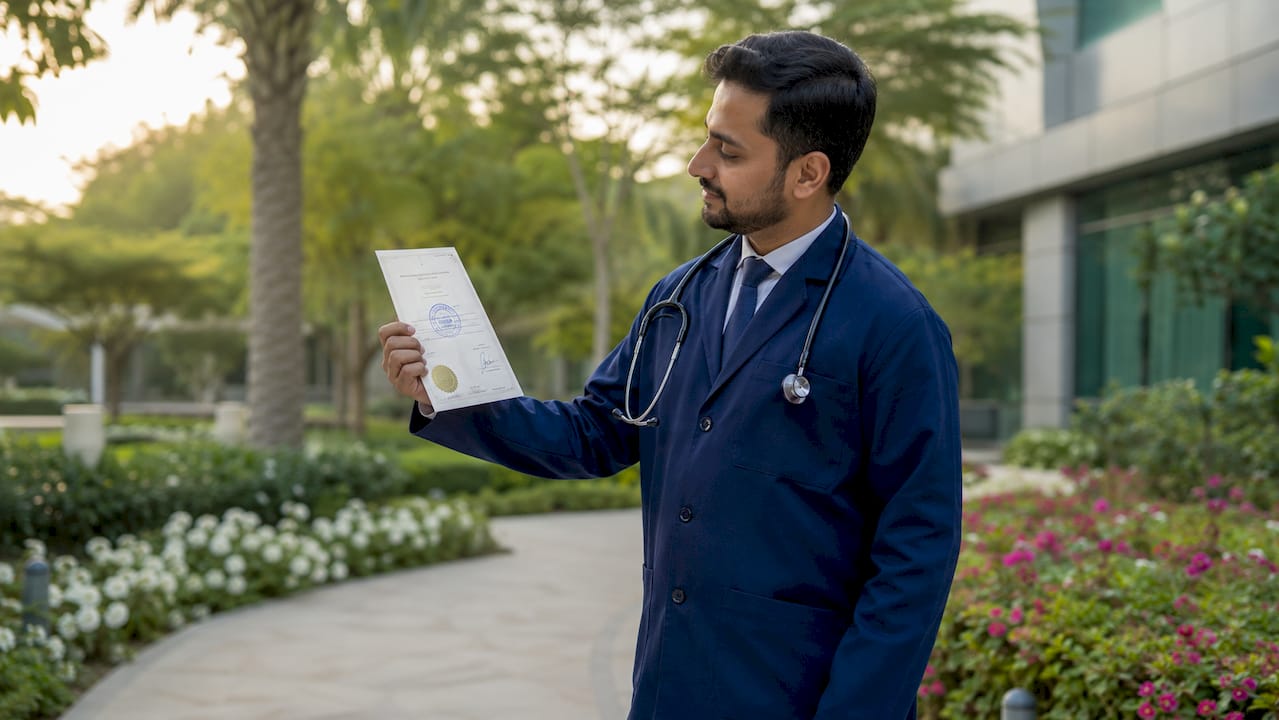
The key authorities involved in the attestation chain are a registered public notary, the Philippine Department of Foreign Affairs (DFA), the UAE Embassy or Consulate in Manila, and optionally the UAE Ministry of Foreign Affairs (MOFA) upon arrival. Each layer adds a verified stamp that the next authority recognizes.
How does the medical certificate attestation process work?
The standard attestation process for UAE use follows a clear sequence. Skipping a step or completing steps out of order causes rejection.
Notarization. A registered public notary in the Philippines certifies the doctor’s or hospital’s signature on your medical certificate. This is the foundation of the entire chain.
Authentication by the Philippine DFA. The DFA’s Office of Consular Affairs authenticates the notary’s signature. This step is the Philippine government’s formal endorsement of the document.
UAE Embassy or Consulate attestation. The UAE Embassy in Manila reviews and stamps the DFA-authenticated certificate. Embassy attestation is mandatory for medical certificates used in the UAE because the UAE is not a member of the Hague Apostille Convention.
UAE MOFA attestation (optional but recommended). After arriving in the UAE, you can submit the document to the UAE Ministry of Foreign Affairs for a final layer of authentication. MOFA attestation is recommended for residency applications and professional licensing compliance.
Digital attestation via DHA Sheryan portal. If your medical report was issued by a Dubai Health Authority (DHA) licensed facility, you may qualify for electronic attestation. The DHA Sheryan portal offers this service free of charge with a one working day turnaround.
Pro Tip: Check whether your UAE employer or the relevant government agency requires MOFA attestation before you travel. Requesting it after the fact adds time and cost to your process.
Attestation vs. apostille: what is the difference?
Filipino expats frequently confuse attestation with apostille. The two serve similar purposes but apply in different legal contexts.
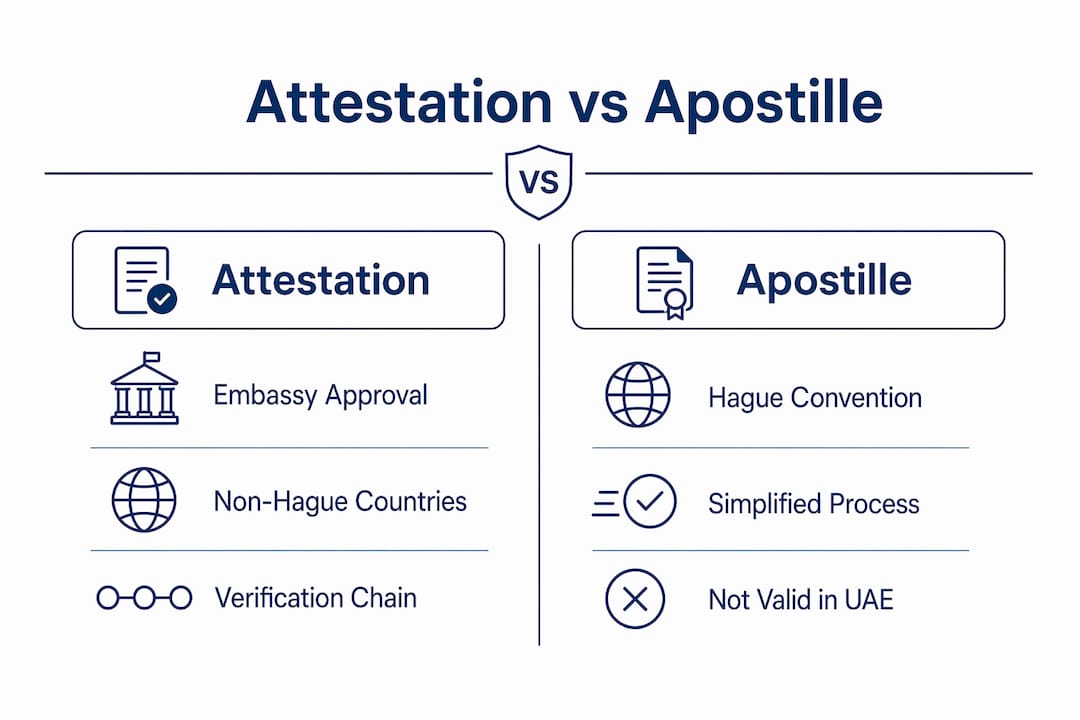
Feature | Apostille | Embassy Attestation |
Applies to | Hague Convention member countries | Non-Hague countries like the UAE |
What it certifies | Authenticity of the certifying signature | Full chain of official signatures |
Validates medical findings | No | No |
Required for UAE | No | Yes |
Issued by | Designated national authority | UAE Embassy or Consulate |
Cost and speed | Varies by country | Varies by embassy |
An apostille certifies the signature of the notary or solicitor on the document. It does not confirm the accuracy of the medical findings inside. That distinction matters because some Filipino workers assume an apostille stamp is enough for UAE submission. It is not. The UAE does not accept apostille as a substitute for embassy attestation.
The Philippines joined the Hague Apostille Convention, which means apostille is valid for documents going to other member countries such as the United States, the United Kingdom, and most of Europe. For UAE-bound documents, however, you follow the full attestation chain through the UAE Embassy in Manila.
Pro Tip: If you are applying to multiple countries at once, check each destination’s requirements separately. A document apostilled for one country still needs full embassy attestation for UAE submission.
Why is medical certificate attestation important for filipino expats?
The importance of attesting medical certificates goes beyond paperwork compliance. It protects you legally and professionally in the UAE.
Visa and work permit approval. UAE immigration authorities require attested medical documents as part of the employment visa process. Unattested certificates are rejected outright.
Employer compliance. UAE employers, particularly in healthcare, construction, and domestic work sectors, must verify that hired workers meet health standards. An attested certificate is the only form they accept.
Healthcare access. Medical certificate verification by DHA-licensed facilities is required before you can access certain health services or register with UAE health insurance programs.
Fraud prevention. Attestation protects both you and your employer from fraudulent documents. UAE authorities treat unverified medical records as potential forgeries.
Residency applications. Long-term residency and family sponsorship in the UAE require a full set of attested documents, including medical clearances.
Certificates from unrecognized providers are rejected during attestation, causing visa or employment delays that can set your plans back by weeks or months. This is why the source of your medical certificate matters as much as the attestation itself.
The DHA’s free electronic attestation service through the Sheryan portal is a significant development for Filipinos already working in Dubai. It removes the cost barrier for workers whose medical reports come from DHA-licensed facilities, and the one working day turnaround is faster than any physical submission process.
How to prepare your medical certificate for attestation
Preparation determines how smoothly your attestation goes. Most rejections come from avoidable errors made before submission.
Use a recognized medical provider. Your certificate must come from a government-approved or accredited hospital or clinic. Valid medical certificates must be issued by recognized facilities to qualify for official attestation.
Do not laminate the document. Laminated documents are rejected by attesting authorities because they cannot apply stamps or seals effectively. Keep the original flat and unaltered.
Prepare supporting documents. You will typically need a valid passport copy, a photocopy of the medical certificate, and any translation if the document is not in English or Arabic.
Request translations early. If your certificate contains Filipino language sections, have them translated by a certified translator before notarization. Submitting untranslated documents adds delays.
Scan and save digital copies. For digital attestation through the DHA Sheryan portal, you will need clear scanned copies. Keep high-resolution scans of every document at every stage.
Track embassy appointment availability. The UAE Embassy in Manila has limited appointment slots. Book your embassy attestation appointment as early as possible, especially during peak hiring seasons.
For the full picture of what UAE attestation requirements look like in 2026, review the current DFA and UAE Embassy guidelines before you begin. Requirements can shift, and submitting under outdated rules wastes time and money.
Pro Tip: Work with an authorized attestation service provider who knows the current UAE Embassy requirements in Manila. A single missed requirement can send your documents back to step one.
Key takeaways
Medical certificate attestation is the mandatory verification chain that makes your Philippine-issued medical documents legally valid in the UAE.
Point | Details |
Attestation is mandatory for UAE | Embassy attestation replaces apostille for UAE-bound medical certificates. |
Follow the correct sequence | Notarization, DFA authentication, UAE Embassy attestation, then optional MOFA. |
DHA digital option is free | DHA Sheryan portal attests eligible reports electronically in one working day at no cost. |
Document source matters | Certificates from unrecognized providers are rejected before attestation begins. |
Never laminate originals | Laminated documents cannot be stamped and will be turned away by attesting authorities. |
What i have learned working with filipino expats on attestation
The biggest mistake I see Filipino workers make is treating attestation as a last-minute task. They secure a job offer, get their medical certificate, and then discover the attestation process takes two to four weeks minimum. By then, their employer’s deadline has passed.
The second most common problem is the document source. Workers get their medical clearance from a small clinic near their home because it is convenient and cheap. That clinic is not on any recognized list. The certificate fails at the notarization stage, and the worker has to start over with a new medical exam at an accredited facility.
What I find genuinely encouraging is the DHA Sheryan portal. For Filipinos already working in Dubai, free electronic attestation in one working day is a real advantage. The challenge is that many workers do not know it exists. They pay third-party services for something they could do themselves at no cost.
My honest recommendation: treat attestation as part of your pre-departure checklist, not an afterthought. Know which authority handles each step. Confirm your medical provider is accredited before you book the appointment. And if you are unsure about who can attest documents in the UAE, get that answer before you travel, not after.
The process is straightforward once you understand it. The workers who struggle are almost always the ones who skipped the research phase.
— Harris
How Harrisncharms helps you get it right
Harrisncharms specializes in document attestation services for Filipino expats preparing to work or live in the UAE. The team handles the full attestation chain for medical certificates, from notarization coordination and DFA authentication to UAE Embassy submission and MOFA guidance upon arrival.

If you are unsure where to start or worried about missing a step, Harrisncharms provides personalized support tailored to your specific document type and UAE destination. Whether you need help with a single medical certificate or a full set of employment documents, the process is faster and less stressful with the right guidance. Reach out to Harrisncharms today to get your attestation moving without the guesswork.
FAQ
What is medical certificate attestation?
Medical certificate attestation is the official process of verifying a medical document’s authenticity through a chain of authorized signatures so it is legally accepted by UAE employers and government agencies. It involves notarization, DFA authentication, and UAE Embassy attestation.
Is medical attestation necessary for UAE employment?
Yes. UAE immigration and labor authorities require attested medical certificates for visa approval, work permits, and residency applications. Unattested documents are rejected.
How long does the attestation process take?
The full process typically takes two to four weeks, depending on embassy appointment availability and document preparation. The DHA Sheryan portal offers one working day turnaround for eligible digital attestations.
Can i use an apostille instead of embassy attestation for the UAE?
No. The UAE is not a member of the Hague Apostille Convention, so apostille is not accepted as a substitute for UAE Embassy attestation of medical certificates.
What happens if my medical certificate is from an unrecognized clinic?
Certificates from unrecognized or non-accredited providers are rejected during attestation, which delays your visa or employment process. Always obtain your medical certificate from a government-approved or accredited facility.
Recommended
Comments