
How to apostille documents: Filipino expats' guide in the UAE
If you are a Filipino expat in the UAE trying to figure out how to apostille documents from the Philippines, you have probably run into a wall of conflicting information, outdated blog posts, and bureaucratic confusion. Getting a Philippine birth certificate, marriage certificate, or any PSA-issued document accepted abroad involves a very specific process, and the wrong step early on can mean weeks of delays and unexpected expenses. This guide cuts through the noise with a clear, accurate walkthrough built specifically for you.
Table of Contents
Understanding apostille and authentication: what Filipino expats in the UAE need to know
What you need before getting your Philippine documents apostilled
Step-by-step guide to obtaining an apostille from the Philippine DFA
Common mistakes to avoid and alternatives for non-Hague destinations
After getting your documents apostilled: verification and next steps for use abroad
Why understanding apostille is crucial for Filipino expats in the UAE
How Harris N Charms can help you apostille and legalize your documents hassle-free
Key Takeaways
Point | Details |
Know the destination country | Your documents need an apostille only if the destination is a 1961 Hague Convention member country. |
Use original PSA documents | Only original PSA-issued documents printed on security paper are accepted for apostille by the DFA. |
Prepare authorization ahead | If applying through a representative, have a signed authorization letter and valid IDs ready to avoid delays. |
Avoid notarizing originals | Do not have your original public documents notarized as this invalidates them for apostille purposes. |
Non-Hague countries require legalization | For countries not in the Hague Convention, follow the authentication and legalization route, typically needed for the UAE. |
Understanding apostille and authentication: what Filipino expats in the UAE need to know
Before you do anything, you need to understand what an apostille actually is and when you need one versus something called an authentication certificate. These are not interchangeable, and confusing them is one of the most expensive mistakes Filipino expats make.
An apostille is a standardized certification that verifies the authenticity of a public document for use in another country. It was created under the 1961 Hague Convention, an international treaty that simplifies document legalization vs attestation between member countries. The core rule is straightforward: destination country membership in the Hague Convention determines whether you need an apostille or an authentication certificate. If the country is a member, you need an apostille. If it is not, you need an authentication certificate, which is a separate and more involved process.
Here is what that means for you practically:
Apostille required: The country where you will use the document is a Hague Convention member.
Authentication certificate required: The destination country is not a Hague Convention member and requires consular legalization instead.
Only the DFA issues Philippine apostilles: Philippine apostilles are issued exclusively by the Department of Foreign Affairs in the Philippines. Your nearest Philippine consulate in Dubai or Abu Dhabi cannot do this for you.
The UAE’s status matters: The UAE joined the Hague Convention, so documents used there by foreign nationals may still require proper local attestation steps on top of the apostille depending on the receiving institution.
Understanding this distinction upfront saves you from submitting the wrong process, paying the wrong fees, and waiting on a result that will ultimately be rejected.
What you need before getting your Philippine documents apostilled
Preparation is where most applications go wrong. The Philippine DFA has specific requirements, and missing even one item means your application gets rejected or significantly delayed.
Here is what you need to have ready before you even think about submitting:
Original PSA documents on security paper: These are the official copies issued by the Philippine Statistics Authority, printed on their distinctive yellow-green security paper. PSA documents for use abroad must be original PSA copies, not photocopies, not scanned prints, and not copies from your local civil registry.
Valid government-issued ID: Either the document owner or the authorized representative must present a valid, government-issued photo ID.
Authorization letter and ID copies: If someone else is filing on your behalf, authorization documents plus IDs for both you and your representative are required. A missing or unsigned authorization letter is one of the top reasons for delays.
Exact destination country: You must tell the DFA which country the document will be used in. This determines whether they issue an apostille or an authentication certificate.
Multiple originals for multiple copies: If you need three apostilled copies, you need three separate original PSA documents. One original equals one apostilled document.
Requirement | Details |
Document type | Original PSA copy on security paper |
ID requirement | Government-issued photo ID of owner or representative |
Representative filing | Signed authorization letter plus ID copies of both parties |
Destination info | Exact country name where document will be used |
Multiple copies | One original PSA document per apostilled copy needed |
Translation needs | Notarized translator’s affidavit, apostilled separately |
Pro Tip: If your document also needs translation, the translated version must be notarized by a licensed translator and then apostilled as a separate document. You cannot apostille the PSA document and expect the translation to be covered automatically.
Check out the understanding PSA DFA apostille guide for a deeper breakdown of document types that qualify, and review the apostille attestation guide for UAE-specific context before you start.
Step-by-step guide to obtaining an apostille from the Philippine DFA
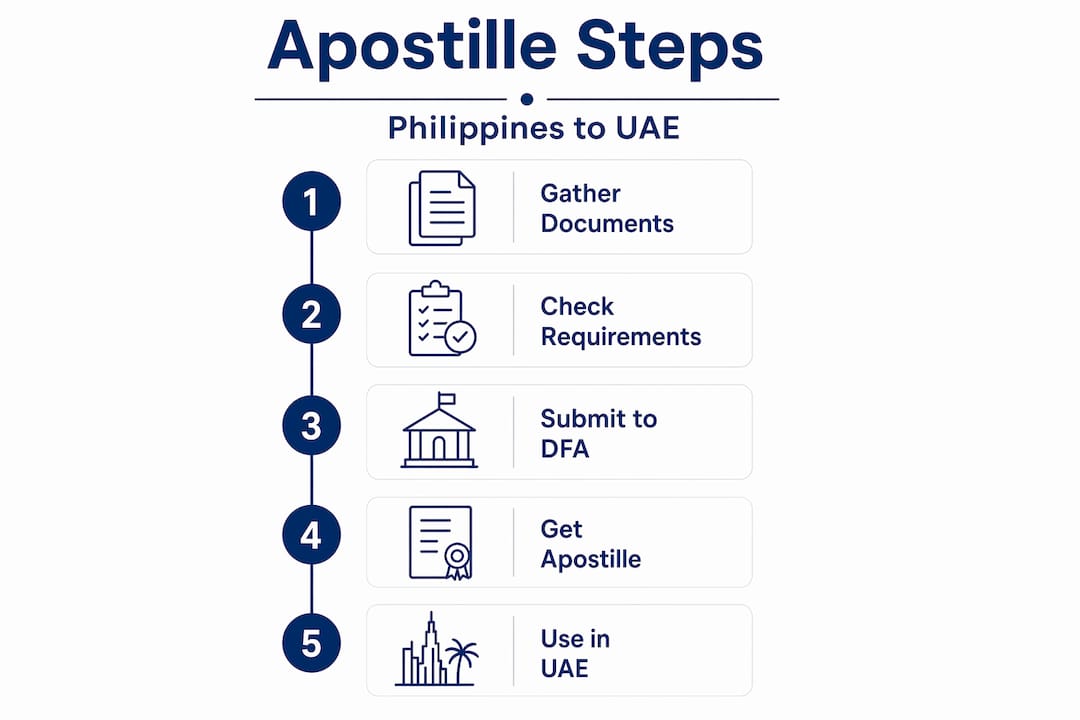
With your documents ready, here is exactly how the apostille document process works from start to finish.
Order your PSA document if you do not have one. Request it directly from the PSA through their official website or authorized outlets. Do not laminate it, do not write on it, and do not fold it excessively. Even minor physical damage can cause rejection.
Decide on your filing method. You can either book a DFA appointment at an apostille center in the Philippines or use the fully online process. PSA documents can be apostilled fully online without a physical DFA visit, with payment through LANDBANK LinkBiz and delivery via courier.
Submit your application. Whether online or in-person, submit the original PSA document, your valid ID, and any authorization paperwork. For online applications, follow the portal’s upload instructions precisely.
Pay the applicable fees. You are paying for two things: the PSA copy fee (if you ordered through PSA) and the DFA apostille fee. If you selected courier delivery, add that cost. Keep your payment receipts.
Wait for processing. Standard processing typically takes a few business days. Expedited services may be available for an additional fee. Track your application if the portal provides a tracking number.
Receive or collect your apostilled document. For online applications, documents are delivered by courier to your specified address. For in-person applications, pick up on the scheduled date.
Check the apostille certificate immediately. The apostille is a separate certificate physically attached to your PSA document, usually stapled or riveted. Do not remove those staples or rivets under any circumstances. Detaching the apostille from the document invalidates it.
Apostille translator’s affidavit separately if needed. If you have a translated document, submit the notarized affidavit for a separate apostille as a distinct document.
Pro Tip: Filipino expats in the UAE who need documents apostilled urgently should look into how to legalize Philippine documents for the UAE specifically, since some institutions here may require additional attestation steps even after the apostille is completed.

Common mistakes to avoid and alternatives for non-Hague destinations
Knowing the steps is one thing. Avoiding the mistakes that derail applications is another.
Do not notarize your original PSA document. Notarizing the original document before apostille submission is one of the most common rejection triggers. The DFA apostilles the document as-is. Adding a notarization beforehand changes its status and can render it ineligible.
Do not use civil registry copies. Local civil registry copies of birth certificates or marriage certificates are not the same as PSA-issued documents. They look similar but are not accepted for apostille.
Do not skip the authorization letter. If you are in the UAE and asking a family member or representative in the Philippines to file for you, a missing or unsigned authorization letter will hold up everything.
Confirm whether your destination needs apostille or legalization. This cannot be stressed enough.
For non-Hague countries, the legalization route is mandatory: DFA authentication in the Philippines, followed by legalization at the destination country’s embassy or consulate. This process takes longer and costs more, so confirming early prevents unnecessary rework.
For UAE-bound documents, revisit the document legalization vs attestation breakdown to confirm exactly what your receiving institution requires before you finalize your approach.
After getting your documents apostilled: verification and next steps for use abroad
Your apostilled documents arrived. Now what?
Physically check the apostille certificate. It should be clearly legible, firmly attached, and bear the official DFA seal and signature. Any damage or illegibility may cause problems at the receiving end.
Confirm the receiving authority accepts Philippine apostilles. Apostilles certify the authenticity of signatures and seals, not document content. Some institutions have their own internal acceptance protocols, so call ahead or check with your employer, school, or government agency before submitting.
Present originals, not photocopies. Unless the receiving authority explicitly allows certified copies, always present the original apostilled document.
Prepare multiple originals from the start. If you know three agencies will each need an apostilled copy, request three separate PSA documents and apostille each one. Trying to duplicate after the fact is inefficient and expensive.
Keep records of your DFA tracking numbers and receipts. If your documents are questioned or delayed, having these on hand speeds up any follow-up with DFA or courier services.
Know the real benefits of apostille services before you start. Understanding what the apostille does and does not guarantee helps you set realistic expectations with the receiving authority.
Why understanding apostille is crucial for Filipino expats in the UAE
Here is something most guides will not tell you directly: the apostille process is not just a bureaucratic hurdle. It is a decision point that has real financial consequences if you get it wrong.
Most Filipino expats who run into problems do not fail because the process is hard. They fail because they assumed the process was the same regardless of destination, document type, or filing method. That assumption costs real money in re-ordered PSA documents, re-booked DFA appointments, and in some cases, missed employment or immigration deadlines.
The international document authenticity standard established by the Hague Convention is actually one of the more logical systems governments have created. Once you understand it, the logic holds. What trips people up is not the system itself but the country-specific variations layered on top of it.
The fact that the DFA now offers a fully online apostille process is genuinely significant for expats. You no longer need to coordinate a family member’s visit to a DFA apostille center. You can initiate the entire request from Dubai, pay online, and have documents couriered directly to where they are needed. That is a real shift that most expats in the UAE have not fully taken advantage of yet.
Mastering this process also matters for the role of apostille in immigration, employment contracts, and education enrollment. Documents that are improperly legalized do not just get rejected. They can delay visa renewals, push back job start dates, or flag inconsistencies in your records with UAE authorities. Treating apostille preparation as routine admin is how those problems happen. Treating it as a critical step with specific rules is how you avoid them entirely.
How Harris N Charms can help you apostille and legalize your documents hassle-free
Handling the apostille process from the UAE while managing work, family, and the general reality of expat life is genuinely difficult. You are coordinating with family in the Philippines, tracking PSA orders, and navigating DFA portals across time zones.

Harris N Charms specializes in apostille and document legalization services for Filipino expats in the UAE. The team provides end-to-end support, from confirming which documents need apostille versus authentication, to preparing authorization paperwork, coordinating DFA filing, and managing courier delivery. Whether you need a single birth certificate apostilled or a full set of documents for a visa application or job transfer, Harris N Charms handles the details so you do not have to. Reach out and get your documents moving in the right direction.
Frequently asked questions
What is an apostille and when do I need one?
An apostille is a certificate that verifies document authenticity for use in countries that are members of the 1961 Hague Convention. You need one when the country where you will use your document is a Hague Convention member.
Can I get a Philippine apostille from the Philippine embassy in the UAE?
No. Philippine apostilles are issued exclusively by the Department of Foreign Affairs in the Philippines. Philippine embassies and consulates abroad, including those in the UAE, do not have the authority to issue apostilles.
What documents do I need to prepare before applying for an apostille?
You need an original PSA copy on security paper, a valid government-issued ID, and if someone else is filing for you, a signed authorization letter along with photocopies of both your ID and your representative’s ID.
What if my destination country is not a member of the Hague Apostille Convention?
You must follow the legalization route instead: DFA authentication plus legalization by the destination country’s embassy or consulate in the Philippines. This takes more time and involves additional fees compared to the apostille process.
Recommended
Comments