
When Digital Attestation Works for UAE Expats' Experience Certificates
Updated: 7 days ago

Yes, in most cases involving government employers, licensing bodies, or visa processing, but not always for standard private-sector hiring. Before you spend a single dirham, confirm two things with whoever is asking for the document: do they specifically require MOFA-attested experience certificate attestation UAE authorities recognize, and was your certificate issued inside the UAE or abroad? The Ministry of Foreign Affairs (MOFA) is the final word on attestation, and the route you take (foreign document versus UAE-issued document) changes everything about cost and timing.
TL;DR:
Attestation is generally required only for government, healthcare, education, and regulated licensing roles, not for most private-sector hiring.
Foreign-issued certificates must go through multiple authentication steps, including notarization, foreign ministry approval, and embassy attestation, before MOFA finalizes it.
UAE-issued documents can often be digitally attested within hours if they have verification features and are submitted via UAE PASS.
Common rejection causes include laminated originals, name mismatches, missing stamps, and unsigned documents, making careful review essential.
Using a professional attestation service can prevent costly errors, especially for foreign certificates or complex multi-country chains.
Table of Contents
Quick Checklist: Who Asks for Attested Experience Certificates?
Not every job offer or license renewal needs an attested experience certificate. Government departments, healthcare and education regulators, and certain licensing bodies almost always do. Bodies like the Dubai Health Authority, KHDA, and the Society of Engineers commonly require attested credentials as part of professional registration, and some larger private employers now ask for it too, especially for senior or regulated roles.
Before you start the attestation process for experience letter documents, run through this:
Who exactly is asking? A government authority, a licensing body, a large corporate HR department, or a visa consultant all have different tolerance levels for scanned versus original attested paper.
What document, precisely? An “experience certificate” and a “relieving letter” are not interchangeable in every employer’s eyes. Ask for the exact title they expect.
Is there an issue-date window? Some licensing authorities want experience certificates issued within the last 6 to 12 months, even though the attested document itself doesn’t expire.
Where was it issued? UAE-issued documents follow a shorter path. Documents issued in the Philippines or elsewhere abroad require a longer legalisation chain before MOFA even sees them.
Do you need a translation? If the original is in a language other than Arabic or English, you’ll likely need a certified translation before submission.
DIY or managed service? Submitting directly through MOFA works fine for straightforward UAE-issued documents. Multi-country chains and tight deadlines are where a managed service earns its fee.
Get these answers first. Skipping this step is the single biggest reason people pay for attestation twice.
How Do You Attest a Foreign-Issued Experience Certificate?
Foreign-issued documents can’t go straight to MOFA. They have to earn their way through a legalisation chain first, and skipping a link in that chain is the fastest way to get rejected at the final stage.
Here’s the sequence for UAE work experience attestation when your certificate was issued outside the UAE, for instance by a Philippine employer:
Notarize the document in the country of issue, or have the issuing company get it authenticated by a notary or the relevant chamber of commerce.
Authenticate it at the home country’s foreign affairs ministry (in the Philippines, this typically runs through the Department of Foreign Affairs before consular authentication).
Get it attested by the UAE Embassy or consulate in the issuing country. This is the step most people underestimate, since embassy appointment slots can take weeks to secure.
Submit the original to MOFA in the UAE, either in person or via an approved courier, for the final attestation stamp.
Each prior stamp validates the next. MOFA won’t accept a document missing any link in that chain, and it requires the physical original for courier-based submissions, not a photocopy or scan.
A few practical habits reduce rejection risk considerably. Ask your former employer for a signed, contactable verification, ideally an email from a company domain or a company stamp with a registration number, before you send the original overseas. MOFA does query issuing employers when authenticity looks uncertain, and having that contact ready in advance saves a round trip. If your certificate name doesn’t exactly match your passport name (a common issue with maiden names or middle names dropped on old contracts), fix that discrepancy at the notarization stage, not after MOFA flags it.
Pro Tip: Never laminate an experience certificate before attestation. Lamination is one of the most common and completely avoidable reasons documents get bounced back at the embassy or MOFA counter.
When Can You Use Digital Attestation Instead of a Courier?
UAE-issued experience certificates get a considerably faster path, and it starts with knowing whether your document qualifies for MOFA’s digital attestation route.
Check for verification features. Eligible UAE-issued digital documents need a QR code or reference number MOFA’s system can validate electronically. Without it, the document gets routed to the courier-based process by default.
Sign in with UAE PASS. MOFA’s digital attestation services require UAE PASS authentication, the UAE’s national digital identity system, to verify who’s submitting the request and match it against the document.
Let the system decide the route. If your document has the right verification element, MOFA processes it digitally, often within hours. If it doesn’t, you’ll need to submit the physical original through an approved courier.
Track your submission. Applicants who go through UAE PASS can monitor status through MOFA’s online “My Requests” feature rather than calling in blind.
For documents that require the courier path, choose an approved courier service, package the original securely, and keep your tracking number. MOFA’s courier-based attestation typically takes one to three business days once the document is physically received, compared to the same-day turnaround digital attestation offers for eligible documents.
If you’re unsure which route applies to your certificate, that uncertainty alone is a reason to ask the issuing HR department whether they can reissue it in a MOFA-compatible digital format before you commit to the courier route.
What Documents Do You Need, and What Gets Rejected?
MOFA and receiving authorities expect a specific package, and formatting mistakes cause more delays than missing paperwork does.
For most experience certificate submissions, gather:
The original experience certificate on official company letterhead, signed by an authorized signatory.
A clear photocopy of that certificate for your own records and, in some cases, for the receiving authority.
A copy of your passport, including the page with your UAE visa if applicable.
Your Emirates ID, if you already have one.
Proof of employer registration (trade license or company registration number) when the licensing authority requests it.
Translation matters more than most people expect. If your experience certificate is in Tagalog, or any language other than Arabic or English, you’ll typically need a certified translation before MOFA or the receiving authority will process it. Legal translation services in the UAE handle this routinely, and it’s worth doing before you start the legalisation chain, not after.
The most common rejection triggers, in order of frequency: laminated originals, a name on the certificate that doesn’t match the passport exactly, a missing company stamp or authorized signatory, and unsigned or photocopied “originals” submitted as if they were the real thing. If someone else is submitting on your behalf, that representative needs a signed authorization letter plus a copy of their own Emirates ID or passport.
Pro Tip: Always confirm with the receiving authority whether a scanned, attested PDF is acceptable before you pay for original courier delivery. Many private-sector recruiters accept scanned attested copies, but licensing bodies almost always want the physical original.
What Do Attestation Costs and Timelines Actually Look Like?
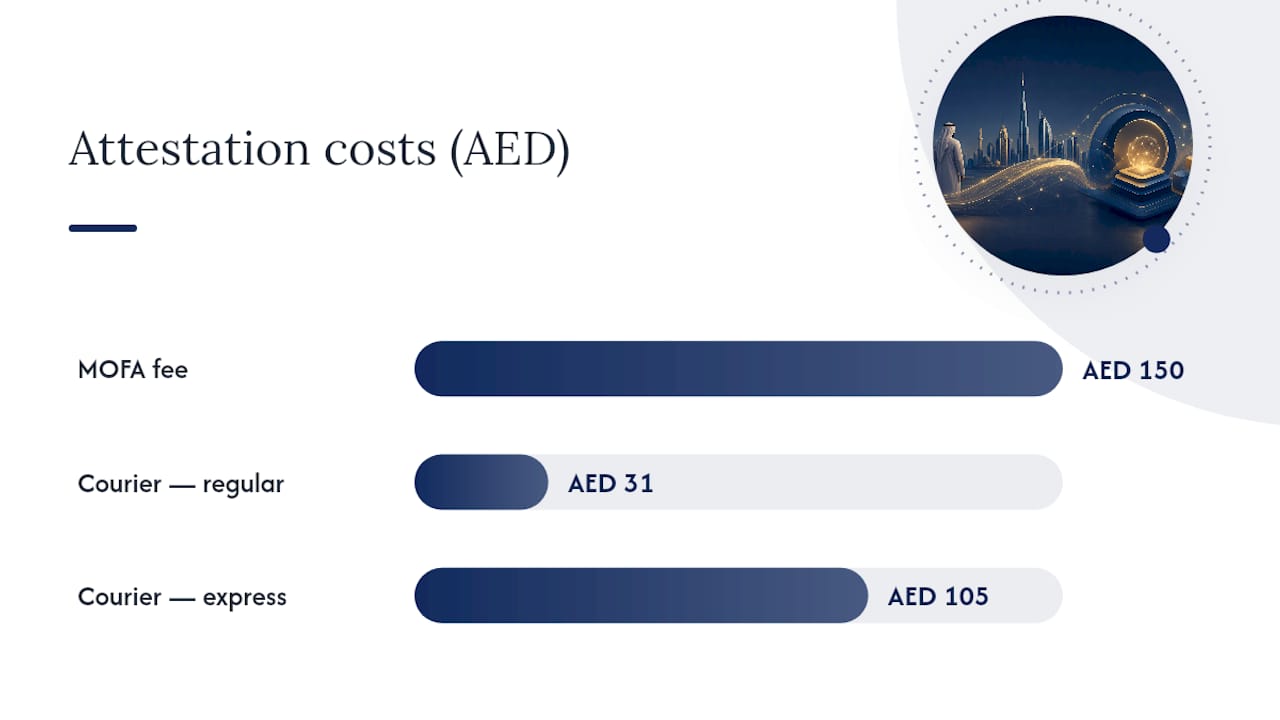
Budget for this in two parts: MOFA’s own fee, and courier costs if your document needs physical handling.
A recent UAE explainer on attestation costs lists MOFA’s individual document attestation fee at around AED 150, with courier charges running roughly AED 31 to AED 105 depending on whether you choose regular or express delivery. That courier range is the variable most people forget to budget for when they’re calculating attestation for experience letter costs.
Timeline wise:
UAE-issued digital documents, if eligible, can clear MOFA attestation within hours.
UAE-issued documents needing courier submission typically take one to three business days once MOFA receives the original.
Foreign-issued documents depend heavily on how fast your home country’s notarization and ministry authentication move, which can add anywhere from a few days to several weeks before the document even reaches MOFA.
That home-country delay is where most Filipino expats lose time they didn’t plan for. A certificate that sails through UAE embassy attestation in Manila within a week can just as easily sit for a month if the Department of Foreign Affairs authentication step gets backlogged.
To check where your application stands, MOFA offers a dedicated helpline (800 44444) and online tracking through “My Requests” for anyone who applied via UAE PASS. Keep your reference number handy. Calling without it just adds another step to a process you’re trying to speed up.
How Do You Confirm What Your Employer or Licensing Body Actually Needs?
Skip this step and you risk paying for attestation you didn’t need, or worse, discovering you attested the wrong document entirely.
Reach out directly, by email if possible, so you have a written record:
Contact HR or the licensing body’s official channel (DHA, KHDA, and the Society of Engineers all publish contact pages for exactly this kind of query).
Ask specifically: What is the exact document name they require? Is there an acceptable issue-date window? Do they need a certified translation? Will a scanned attested copy work, or do they need the original?
Get the answer in writing. A screenshot of an email or portal message is worth more than a verbal assurance when you’re three weeks into a legalisation chain and something goes sideways.
Once you have an attested experience certificate in hand, keep both a physical copy and a scanned backup. Licensing renewals and future employment applications often ask for the same document again, and re-attesting from scratch because you misplaced the original is an entirely avoidable expense.
A Practical Troubleshooting Checklist for Filipino Expats
Working through experience certificate verification UAE requirements from the Philippines adds a layer most generic guides skip entirely.
Verify with the issuing employer before you start, not after MOFA raises a flag. A quick email confirming the company still operates at the registered address saves weeks if the business has since closed or relocated.
If the employer can’t produce company registration proof quickly, request it from the Philippine Securities and Exchange Commission or the Department of Trade and Industry, depending on the business structure, rather than waiting on HR indefinitely.
If MOFA rejects a submission, ask exactly which stamp or element failed verification. Don’t guess. Go back to the issuing authority and request a corrected document rather than re-running the entire chain blind.
Prefer an authorized attestation center when you’re juggling multiple countries in the chain, tight visa deadlines, or a translation requirement on top of everything else. The coordination overhead of tracking three separate authorities’ turnaround times is exactly where things quietly slip.
Pro Tip: Keep every intermediate stamped document, not just the final attested certificate. If a licensing body later questions the chain, having the notarized and embassy-stamped copies on hand resolves it in one email instead of a week of back-and-forth.
Should You Handle Attestation Yourself or Use a Service?
Doing it yourself works fine when your document is UAE-issued, eligible for digital attestation, and you’re not racing a deadline. The MOFA process is public, the fees are published, and there’s no technical barrier to submitting it yourself.
Where a professional service earns its fee is different: foreign-issued certificates running through a multi-country chain, licensing cases where a single rejected stamp costs you another round trip through the embassy, and situations where certified translation and embassy coordination need to happen in parallel rather than one after another. The cost trade-off isn’t really about MOFA’s AED 150 fee. It’s about the weeks lost to a rejected submission you don’t discover until you’re already at the counter.
A professional service can manage the full chain from document verification through embassy coordination to final MOFA submission.
— Harris
Some services offer an alternative to piecing together a multi-country legalisation chain on your own, coordinating document verification, embassy legalisation, MOFA submission, courier handling, and certified translation where needed, so you’re not the one chasing multiple offices for status updates.

If your experience certificate was issued abroad, or you’re not sure whether your document qualifies for MOFA’s digital route, the fastest way forward is a direct conversation about your specific document and destination authority. Reach out to a document attestation service to get a clear breakdown of what your certificate needs, what it will cost, and how long the full chain will realistically take before you commit to any step yourself. You can also read the complete attestation sequence for Filipino expats for a fuller picture of what the end-to-end process involves, or check who is authorized to submit and collect documents on your behalf if someone else will be handling the paperwork for you. If you’re also preparing for interviews once your credentials clear, Muqabala’s interview practice platform is built specifically for Gulf job applications.
Sources
Requirements and fees shift periodically, so verify details directly before you submit anything.
Recommended
Comments