
Dubai E‑Trader License: 2026 Guide for UAE Residents
- contact335627
- Aug 15
- 12 min read

The Dubai E‑Trader license is a government permit issued by the Dubai Department of Economy & Tourism (DET) that lets an individual sell online from home. You apply through the Invest in Dubai portal, the total annual government cost is fixed and set by the official government fees, and approvals typically come through within 24–48 hours of payment. It’s also called the DED Trader license in some portal screens — same scheme, same rules.
This license suits solo entrepreneurs: someone running a social-media shop, a freelance design business, or a small handmade-goods store from their Dubai apartment. Two hard limits apply from day one: you cannot hire staff or sponsor employee visas, and you must hold a valid Emirates ID with Dubai residency to qualify.
Annual cost: composed of a license fee plus mandatory Dubai Chamber membership fees
Approval timeline: 24–48 hours after payment
Who qualifies: UAE residents aged 21+, individual applicants only
Key limits: No employees, no visa sponsorship, no physical shop
Ready to apply? Start at the Invest in Dubai portal.
Key Takeaways
The Dubai E‑Trader license is the lowest-cost legal route for UAE residents to sell online from home, with a fixed annual government cost set by the official fees and typical approval in 24–48 hours after payment.
Point | Details |
Annual government cost | fixed total of license fee plus Dubai Chamber membership, repeating at renewal. |
Eligibility requirements | Must be 21+, hold a valid Emirates ID, and be a Dubai resident; individual applicants only. |
Approval timeline | Typically 24–48 hours after payment via the Invest in Dubai portal. |
Key operational limits | No employees, no visa sponsorship, no physical shop; Dubai-only scope without additional licensing. |
Upgrade signals | Hire staff, import at scale, or need corporate banking — move to a mainland or free zone license. |
Harrisncharms assistance | Harrisncharms supports UAE-based Filipino expats with document attestation, filing, and DET follow-up for the E‑Trader application. |
Table of Contents
What the E‑Trader license actually covers
The E‑Trader (DED Trader) license is a personal, home-based online trading permit sitting within Dubai’s mainland licensing framework under DET. It is not a company license. There is no establishment card, no immigration file, and no commercial premises attached to it. What it gives you is a legal basis to trade online from your Dubai residence, whether through Instagram, a personal website, or a marketplace like Amazon.ae or Noon.com.
Common use cases break into two broad categories. Service-based operators — graphic designers, tutors, consultants, photographers, content creators — use it to bill clients legally without setting up a full company. Product sellers use it for handmade or curated goods sold through social media or online storefronts, though physical-goods eligibility depends on nationality and activity code (more on that in the next section).

One naming note worth flagging: “E‑Trader” and “DED Trader” refer to the same DET home-business scheme. Some portal screens show one name, some show the other. The operational limits are identical regardless of which label appears on your license PDF.
For online activities involving digital communications or broadcasting, the UAE government’s eCommerce guidance flags that a TDRA (Telecommunications and Digital Government Regulatory Authority) NOC may be required depending on the specific activity. Check the TDRA requirements for your category before you apply, not after.
Who can apply: eligibility rules and documents checklist
The Invest in Dubai portal sets three baseline eligibility conditions: you must be at least 21 years old, hold a valid Emirates ID, and be a Dubai resident. The license is individual-only — no companies, no partnerships, and no joint ownership.
Nationality differences matter
UAE and GCC nationals generally have broader activity access, including selling physical products online. Expatriate residents face more restrictions: many expat applicants are limited to service-based activities and cannot list physical goods for sale under this license type. This is one of the most commonly misunderstood points. Local advisory sources note that expats frequently assume they can sell physical products, only to discover their nationality limits which activity codes are available to them.
Documents you need before starting
Valid Emirates ID (copy)
Passport copy
Proof of Dubai residence (Makani number or tenancy contract/Ejari)
Chosen trade name (checked for availability on the portal)
Activity-specific supporting documents where required (e.g., professional certificates for regulated services)
Pro Tip: Before opening the application, look up your intended activity code on the DET or Invest in Dubai portal. Choosing the wrong code is one of the most common reasons applicants face administrative friction later — and amending a license after issuance takes time and fees.
What activities the license permits and what it does not
Permitted activities under the E‑Trader license cover a practical range of solo, home-based work. Common approved categories include graphic design, photography, social-media content creation, tutoring, personal styling, handmade fashion and accessories sold online, and general consulting. The license is built for individuals who run the entire operation themselves from a residential address.
The restrictions are equally specific. Per Invest in Dubai, the license prohibits:
Operating a physical customer-facing shop or showroom
Renting or using a warehouse for stock storage
Hiring on-site staff or sponsoring employee residence visas
Conducting business outside Dubai without separate licensing
Recent updates have tightened rules around digital marketing and influencer activities. If your business involves paid promotions, sponsored content, or digital advertising services, verify the current approved activity list on the DET portal before applying — this category has seen regulatory updates that affect which sub-activities are permitted under an individual permit.
For regulated product categories (food, health products, cosmetics), additional approvals from Dubai Municipality or the Ministry of Health apply on top of the E‑Trader license. The UAE eCommerce guidance links out to the relevant sector agencies. Selling regulated items without those clearances is a compliance risk regardless of whether your trade license is active.
Real cost breakdown: what you actually pay
The government cost is fixed and straightforward. Per Invest in Dubai:
Fee component | Amount (AED) |
License fee (incl. knowledge & innovation fees) | 1,070 |
Dubai Chamber of Commerce membership | 300 |
Total annual government cost | 1,370 |
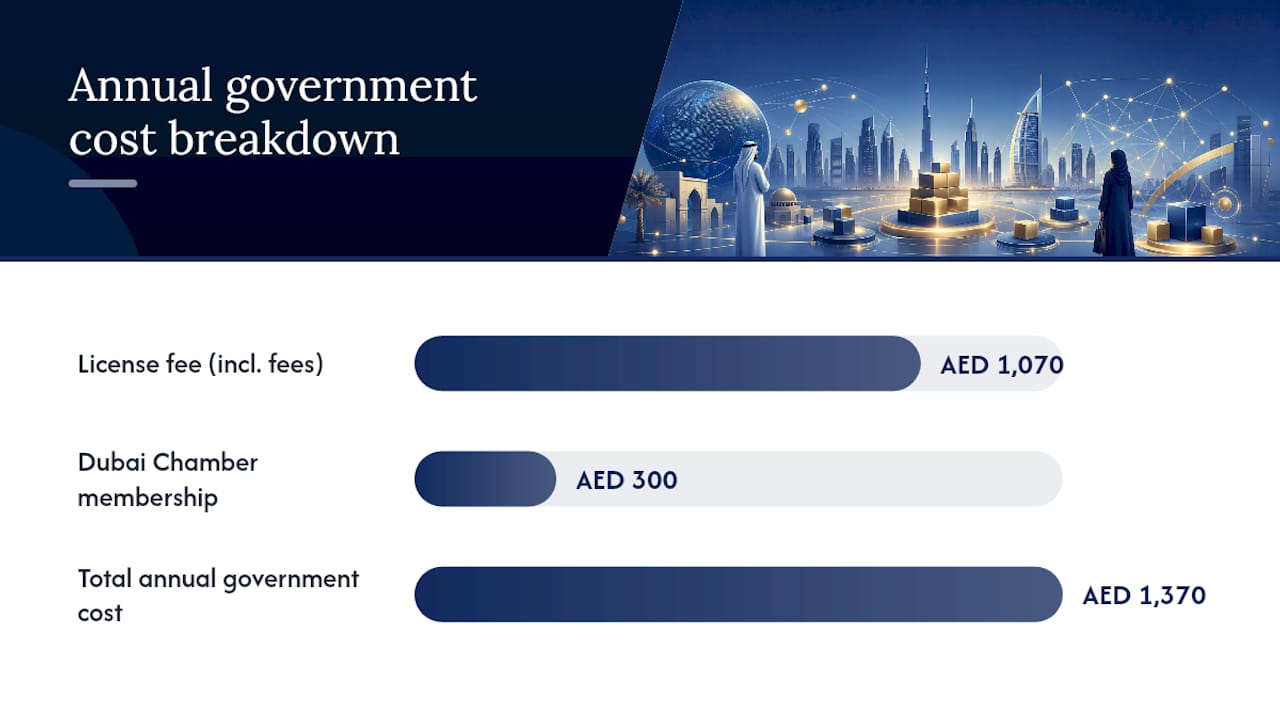
This total repeats at renewal every 12 months. There are no hidden government fees at issuance beyond these two line items.
Beyond the government cost, budget for:
Payment timing: After the portal generates a payment voucher, you have a limited window to pay. Missing that window causes the application to lapse and you restart the process.
Bank account setup: Digital business accounts (covered in Section 8) may carry their own onboarding fees or minimum balance requirements.
Payment gateway fees: Stripe UAE, PayTabs, and similar gateways charge per-transaction or monthly fees on top of your license cost.
PRO assistance: If you use a local PRO service to file on your behalf, factor in their service fee separately from the government cost.
Pro Tip: Treat the AED 300 Dubai Chamber membership as a non-optional line item — it is required at issuance and repeats at every renewal. Budget AED 1,370 per year, not AED 1,070.
How to apply: step-by-step through the Invest in Dubai portal
The entire application is digital. You do not visit a government office. The portal is the Invest in Dubai / dedtrader flow, and you authenticate with UAE Pass or a mobile OTP.
Create or log in to your Invest in Dubai account using UAE Pass or your registered mobile number.
Select your business activity from the approved DET activity list. This is the most consequential step — take your time here.
Choose a trade name and check availability on the portal in real time.
Enter your Makani number (your Dubai address’s unique geolocation code from Dubai Municipality) as proof of residence. If you do not have a Makani number, register your address at the Dubai Municipality website or app before starting the application.
Upload required documents: Emirates ID copy, passport copy, and any activity-specific supporting files.
Submit the application and wait for the portal to generate a payment voucher.
Pay the voucher within the stated window (AED 1,370 total). Payment can be made by credit/debit card through the portal.
Receive your digital license PDF by email and through your portal account.
Per BusinessDubai’s reporting, the typical issuance timeline is 24–48 hours after payment for straightforward applications. Applications with incomplete documents or flagged activity codes take longer. If an application lapses due to a missed payment window, you restart from step one — the voucher does not extend.
Documents checklist before you begin: Emirates ID, passport, Makani number, trade name ideas, and any professional certificates your chosen activity requires.
When the E‑Trader license stops being enough
The license works well until your business outgrows what an individual permit can legally support. Invest in Dubai is explicit: no staff, no visa sponsorship, no commercial premises. Those three limits are where most growing businesses hit a wall.
Operational limits to watch:
Cannot hire employees or sponsor their UAE residence visas
No establishment card, which many traditional banks require to open a corporate account
Limited import/customs options for high-volume stock
Operational scope restricted to Dubai; cross-emirate or export operations need additional licensing
Triggers that signal it’s time to upgrade:
You need to bring on even one employee
A marketplace (Amazon.ae high-volume seller categories, for example) requires a company trade license
Your bank requires an establishment card or company file for merchant services
You are importing stock regularly and need a customs client code under a company name
Monthly revenue or operational complexity makes the individual-permit structure a legal risk
When those triggers appear, the two main paths are a mainland e-commerce company license (LLC or sole establishment under DET) or a free zone e-commerce license. E-commerce licensing guides outline the key differences: free zone licenses typically cost more upfront but offer 100% foreign ownership and faster setup; mainland licenses allow you to trade directly with UAE consumers and government entities without a local agent. Both allow staff visas and corporate banking that the E‑Trader license cannot provide.
For a deeper look at the upgrade paths, the UAE business setup guide on the Harrisncharms blog covers the decision framework in detail, and the free zone document requirements guide is useful if you are leaning toward a free zone route.
Opening bank accounts and using payment gateways
Banking with an E‑Trader license is possible, but the experience varies significantly by institution. Because the license is an individual permit without an immigration file or establishment card, traditional corporate banks often require more documentation or decline individual-permit holders outright for business accounts.
Practical banking paths:
Digital and neo-banks tend to be more accessible for E‑Trader holders. Mashreq NeoBiz is frequently cited in market reporting as accepting individual trade license holders. Wio is another digital-first option worth checking.
Traditional banks often require an establishment card or company file. If your business model depends on a full corporate account from day one, this is worth investigating before you commit to the E‑Trader route.
Payment gateways like Stripe UAE and PayTabs each have their own merchant onboarding rules. Many accept individual trade licenses, but they will ask for your activity code, expected transaction volumes, and product/service descriptions. A clear, specific activity code on your license helps here.
Per Virtuzone’s advisory reporting, digital banks are frequently the practical first path for E‑Trader holders, with each bank’s internal KYC process determining the final outcome.
Before you apply for any account or gateway:
Contact the bank or gateway with your specific license activity code and expected monthly volumes
Prepare product descriptions and sample invoices
Have your TDRA NOC ready if your activity involves digital communications
Pro Tip: If merchant services or a specific payment gateway are non-negotiable for your business model, call that bank or gateway before you apply for the license. Confirm they accept E‑Trader holders for the account type you need. Discovering a mismatch after issuance costs you time and the AED 1,370 fee.
Renewals, VAT thresholds and customs notes
Renewal is straightforward: log back into the Invest in Dubai portal before your license expiry date, pay the same AED 1,370 (AED 1,070 license + AED 300 Dubai Chamber), and your license extends for another 12 months. The Dubai Chamber membership fee repeats every year without exception. Letting the license lapse means trading without a valid permit, which carries legal risk.
VAT and corporate tax:
The Federal Tax Authority (FTA) requires mandatory VAT registration once your taxable supplies reach AED 375,000 in any 12-month period. Voluntary registration is available from AED 187,500. If your E‑Trader business approaches either threshold, register proactively rather than reactively.
Corporate tax registration applies to businesses meeting the relevant thresholds. For most early-stage E‑Trader operators, this is not an immediate concern, but it is worth tracking as revenue grows.
Customs and imports:
If you are importing physical goods, even occasionally, you need a customs client code registered with Dubai Customs. Regulated product categories (electronics, food, health supplements) require additional approvals from the relevant sector authority. The UAE eCommerce guidance links to the relevant agency pages for each category.
For document renewal and expiry tracking relevant to your residency and license documents, the document renewal guide on the Harrisncharms blog covers the process for UAE-based Filipino expats.
Common application mistakes and how to avoid them
Most delays and rejections trace back to a small set of predictable errors. Knowing them in advance saves you the cost of restarting.
Mistakes applicants make most often:
Wrong activity code: Selecting a broad or incorrect activity that does not match your actual business. This either causes a rejection or forces an amendment later, which costs time and fees.
Missing or incorrect Makani number: The portal requires a valid Dubai address code. Applicants who skip this step or enter an incorrect number stall their own application.
Letting the payment voucher lapse: The portal gives you a fixed window to pay after generating the voucher. Missing it means starting over.
Assuming staff or visas are possible: Some applicants apply with the expectation of hiring help later. The license structurally cannot support this — plan accordingly or choose a different license type from the start.
Expired Emirates ID: The portal will not process an application against an expired ID. Renew it first.
Quick avoidance tips:
Cross-check your intended activity against the current DET/TDRA approved list before opening the application
Register your Makani number at Dubai Municipality before you start
Keep your Emirates ID renewal date in your calendar
Pay the voucher the same day it is generated
For regulated product categories, confirm sector approvals are in place before applying
Pro Tip: If you are unsure which activity code fits your business, contact DET directly or use a local PRO service before submitting. Amending an activity after issuance is possible but adds cost and delays. Getting it right the first time is faster and cheaper. Virtuzone’s guidance on activity code selection reinforces this point.
How Harrisncharms can help with your application and documents
Harrisncharms works with Filipino expats and UAE residents who need hands-on support navigating the documentation side of the E‑Trader application process. The practical friction points — getting Makani registered, preparing attested documents, verifying activity codes, and following up with DET and Dubai Chamber — are exactly where a local documentation specialist saves time.
Services Harrisncharms offers for E‑Trader applicants:
Document attestation and legalization for Philippine-origin documents required in UAE applications
Makani address registration assistance
Document translation (Filipino to English/Arabic where required)
Application filing support through the Invest in Dubai portal
Follow-up with DET and Dubai Chamber membership processing
Trade name reservation guidance
The typical flow: you supply document scans, Harrisncharms validates your activity and document set, assists with trade name reservation, completes the Invest in Dubai application, monitors the payment and issuance steps, and delivers your digital license copy. For readers who also need to legalize foreign documents for UAE use, the DFA authentication services guide covers that process in detail.
For a broader walkthrough of the Dubai trade license process, the obtaining a trade license in Dubai guide on the Harrisncharms blog is a practical companion to this article.
When an E‑Trader license is the smart first move
The E‑Trader license earns its place as a starting point for a specific type of entrepreneur: someone testing a business idea, running a solo service practice, or selling handmade products online without needing staff or a warehouse. At AED 1,370 per year with a 24–48 hour approval window, the cost of entry is low enough that the license pays for itself quickly if the business has any traction at all.
Where I see people go wrong is treating it as a permanent structure rather than a launchpad. The license is genuinely excellent for what it is — a legal, low-overhead way to operate online from home. But the moment you need to hire someone, import stock at volume, or open a full corporate bank account, the individual permit becomes a constraint rather than an asset.
A practical rule of thumb: if you are regularly processing more orders than you can handle alone, or if a bank or marketplace is asking for a company file, that is the signal to upgrade. Starting with E‑Trader and moving to a mainland or free zone license when the business demands it is a sensible sequence. Starting with a full company license when you are still testing an idea is an expensive way to find out the idea does not work.
Harrisncharms makes the document side straightforward
Getting an E‑Trader license in Dubai is genuinely accessible — but the document preparation step trips up more applicants than the portal itself does. Expired IDs, missing attestations, incorrect Makani entries, and activity code mismatches are the real friction points, not the government fee.
Harrisncharms handles the document and filing side for UAE-based Filipino expats and entrepreneurs: attestation, translation, Makani assistance, application filing, and follow-up with DET and Dubai Chamber. You focus on your business; Harrisncharms manages the paperwork. This is a paid service, and it is entirely optional — the portal is open to self-filers. But if you want the application done correctly the first time without spending hours on document prep, get in touch with Harrisncharms to start the process.
Sources
Before applying, confirm current activity lists, fees, and any rule updates directly on the official portals — these details can change between publication and your application date.
This article is general information, not a substitute for advice from a qualified lawyer. Consult a qualified legal professional about your own circumstances before acting on anything here.
Recommended
Comments