
3 Translation Mistakes Filipinos in UAE Make: Certified vs Notarized
Updated: Sep 25

For official filings in the UAE, you almost always need an MOJ-certified translation, not a notarized one. Certification confirms the Arabic text matches your original document; notarization only confirms the translator’s signature belongs to who signed it. If a UAE authority hasn’t explicitly asked for notarization, skip it. If they have, get the certified translation first and notarize the signature second.
TL;DR:
Most UAE authorities require a translation certified by a licensed MOJ translator, not a notarized one, to ensure acceptance of legal documents.
Notarization only verifies signer identity and does not confirm the accuracy of the translation content, often leading to rejected submissions.
Certified translations must include an MOJ stamp on every page, full translator details, and a certification statement; missing these elements causes rejection.
For official UAE filings, MOJ certification is needed for courts, ministries, immigration, and banks, while notarization is rarely required unless explicitly specified.
Proper sequence involves obtaining Philippine attestation, then translating and certifying in the UAE, avoiding unnecessary rework and double translation costs.
Table of Contents for Certified vs Notarized
What Is a Certified Translation Under the UAE Ministry of Justice?
A certified translation in the UAE is one produced by a translator or agency officially licensed by the UAE Ministry of Justice. That licensing detail matters more than people expect. MOJ-licensed translation is the only form UAE government entities accept for foreign-language documents, so a translation from an unlicensed freelancer, however fluent, gets rejected at the counter regardless of accuracy.
Every MOJ-certified translation carries a stamped certification statement declaring the Arabic text is a true and accurate rendering of the original. That statement includes the translator’s name, signature, the date, and the MOJ stamp, plus contact details for the licensed office.
Courts, ministries, immigration authorities (GDRFA), and most UAE banks expect this exact format. Before you accept a delivered translation, check for:
The MOJ stamp on every page, not just the last one
A full, legible translator name and license or office contact
A statement that reads as certification, not a generic disclaimer
Every stamp and seal on the original document translated too, including notary seals from the origin country
Skipping that last check is where a lot of Filipino expats get tripped up, because their originals often carry Philippine DFA red ribbon seals that need translating along with the main text.
What Does Notarization Actually Verify?
Notarization confirms identity, nothing else. A notary public in the UAE witnesses the translator (or the person submitting the certificate) sign the certification statement and checks their ID against that signature. The American Translators Association makes the same point about certified translations generally: the notary does not read the translation, does not compare it against the source document, and does not evaluate whether the Arabic is correct.
That distinction trips people up constantly, because a notary stamp looks official and reassuring. It just isn’t attesting to what most people assume it is.
Institutions still ask for notarization sometimes, and usually for policy reasons rather than legal ones. A bank compliance department or a foreign consulate might want an extra identity layer on file, separate from what UAE government bodies require.
A few practical rules follow from this:
Never sign the translator’s certification statement before you’re standing in front of the notary
Confirm whether the notary needs the translator present in person or accepts a pre-arranged appointment
Ask the requesting institution to specify notarization in writing so you’re not guessing
If you sign the certificate early and then show up at a notary’s office, some notaries won’t accept it, because they need to witness the actual signing.
Certified vs. Notarized: The Practical Differences
The two processes solve completely different problems, and mixing them up is the single most common reason UAE submissions bounce back. Certified translation is about the content. Notarized translation is about the signer.
Factor | Certified translation | Notarized translation |
What’s attested | Accuracy of the Arabic translation | Identity of the person who signed the certificate |
Who performs it | MOJ-licensed translator or agency | Notary public (often within the MOJ notary system) |
What the receiving authority checks | MOJ stamp, translator credentials | Notary seal, ID verification record |
Typical UAE use cases | Court filings, visa files, ministry submissions, license applications | Bank compliance files, some consular processes, university admissions |
Cost and turnaround | Typically moderate per page, with turnaround commonly ranging from same-day to a few days | An added notary fee on top of translation, usually same-day once the certificate exists |
UAE ministries, courts, and immigration departments reject non-certified translations often enough that it’s one of the most common causes of stalled visa files and delayed license applications. Notarization on its own, without MOJ certification behind it, won’t satisfy a UAE government body no matter how many notary stamps it carries.
When Do UAE Authorities Require Certified, Notarized, or Both?
Most of the time, you only need the MOJ-certified translation. The following recipients generally require MOJ certification as the baseline:
Courts for any foreign-language evidence, contracts, or judgments entered into a case file
Ministries (Justice, Interior, Human Resources and Emiratisation) handling license, labor, or civil status filings
GDRFA and immigration authorities processing visa, residency, and Golden Visa applications
Banks opening accounts or approving financing where foreign civil or corporate documents are involved
Document types that typically need MOJ certification include birth certificates, marriage certificates, educational diplomas and transcripts, powers of attorney, and court judgments. If any of those documents came from the Philippines, the translation almost always happens after your DFA and embassy attestation steps, not before.
Notarization gets added on top in narrower situations: certain consular processes back in the Philippines, or private banks running extra compliance checks on identity documents. Before you order anything, call or email the receiving authority and ask exactly what they want. Attestation chains involving multiple countries take longer than people budget for, so build in extra time rather than assuming a same-week turnaround.
How to Get an MOJ-Certified Translation in the UAE
The process is straightforward once you know the order of operations:
Gather your original documents, including any prior attestation stamps or apostilles already applied
Choose an MOJ-approved translator or agency, confirming their license before you hand over documents
Receive the certificate of accuracy with the translator’s name, signature, date, and MOJ stamp on every page
Notarize the signature only if the receiving authority explicitly requires it, and do so after certification, never before
Move on to attestation or apostille if your document needs further legalization for use outside the UAE
At pickup, check that the stamp appears on every page and that contact details for the licensed translator are legible. Bring your Emirates ID or passport and the original documents to any in-person appointment. A birth certificate translation or a diploma usually takes one to three business days once the translator has your originals, though court-bound documents sometimes move faster with expedited service.
Pro Tip: Email the receiving authority and ask them to confirm, in writing, whether they want a certified translation, a notarized signature, or both. That one email saves more rework than any checklist.
Common Mistakes That Get UAE Submissions Rejected
Three mistakes account for most rejections Harrisncharms sees among Filipino expats and other applicants:
Submitting a translation from a non-MOJ-licensed provider, even when the translation itself is accurate
Notarizing a signature before the translator has actually certified the document
Delivering a translation missing stamps, contact details, or a full rendering of seals on the original
Red flags to watch for in a provider’s work include a missing MOJ stamp, a vague certification statement that doesn’t name the translator, or no way to verify the license.
Problem | Fix |
No MOJ stamp on delivered translation | Return to provider and request a properly certified reissue |
Rejected at counter | Ask for the written rejection reason, correct the specific defect, resubmit |
Notarized before certification | Redo the certification, then notarize in the correct order |
Sequencing Attestation: A Filipino Expat’s Common Pitfall
In practice, most Filipino expats run into trouble not with the translation itself but with the order of steps before it. A document usually needs Philippine DFA authentication and UAE Embassy attestation completed first, with the MOJ-certified Arabic translation done last, once the document is already in the UAE.
Get that sequence backward, and you end up paying for a translation that has to be redone once the earlier attestation stamps land on the page and need translating too. Clients are advised on the proper order to avoid double translation costs. If you’re unsure where your document sits in that chain, our guide to legal translation in attestation breaks down the typical path.
— Harris
Get Your MOJ-Certified Translation Handled Start to Finish
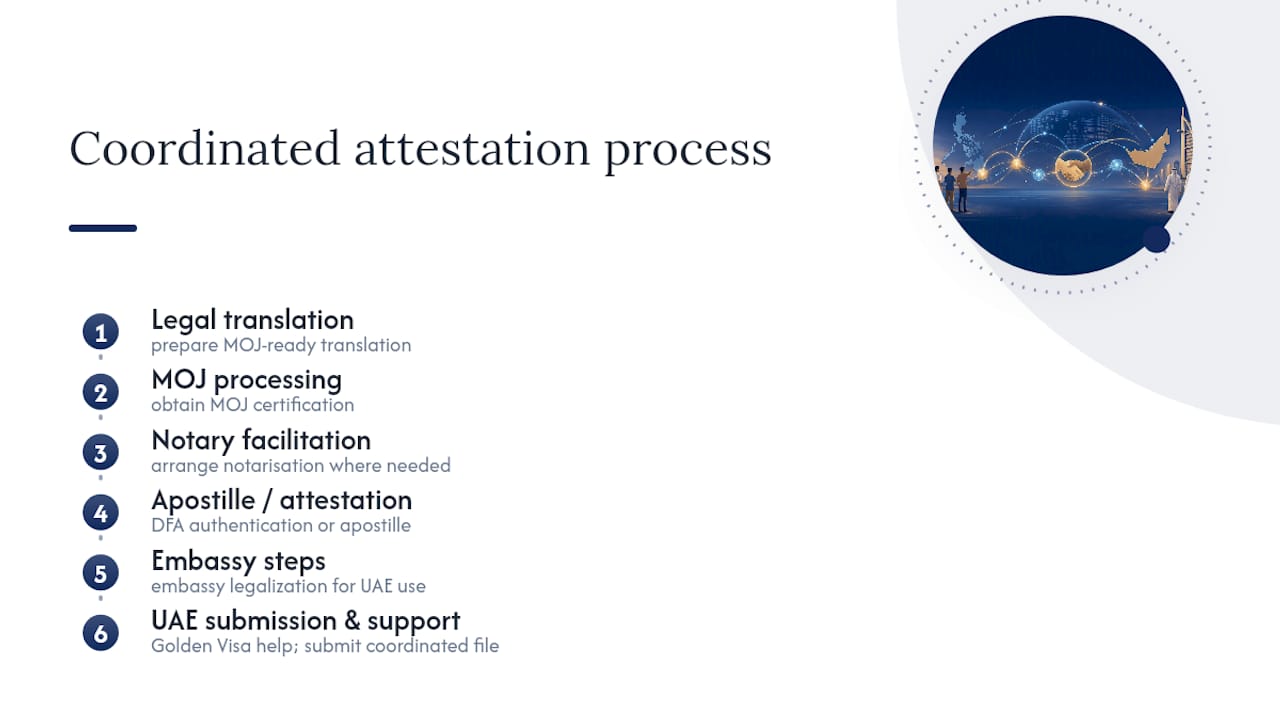
There are service providers who offer to handle legal translation, MOJ processing, notary facilitation, and apostille or attestation as one coordinated file, to simplify the process for clients.

This integrated approach can be especially useful for Filipino expats managing DFA authentication, embassy steps, and MOJ certification across two countries, where one wrong sequence may result in duplicate costs. Some providers focus on Philippine document processing for UAE use, aiming for prompt turnaround and direct communication.
If you have a document that needs translating, certifying, or attesting for a UAE submission, visit the Harrisncharms services page to see the full range of document attestation, legal translation, and Golden Visa support, and request a quote for your specific document.
Where to Verify UAE Translation Requirements
Requirements can shift by authority, so confirm directly before you submit anything.
UAE Ministry of Justice — Translators for the definitive list of licensed translators
MOHRE for labor and employment document rules
American Translators Association for general certification and notarization definitions
Sources
FAQ
Is a Certified Translation the Same as a Notarized Translation?
No. A certified translation attests to the accuracy of the translated content, while a notarized translation only confirms the identity of the person who signed the certificate. UAE authorities generally require certification; notarization gets added only when specifically requested.
What Is Legal Translation in the UAE?
Legal translation in the UAE covers official documents like contracts, court judgments, powers of attorney, and civil records that must be translated by an MOJ-licensed translator before submission to government bodies. It differs from general translation because the translator’s license and stamp are what make the document acceptable, not just linguistic accuracy.
How Do I Get a Document Notarized in the UAE?
You sign the translator’s certification statement in front of a notary public, who checks your ID and witnesses the signature. The notary does not review the translation itself, so certification should already be complete before you book the notary appointment.
How Do You Become a Certified Translator in the UAE?
Translators apply for licensing through the UAE Ministry of Justice, which sets the qualification and approval requirements for anyone producing translations accepted by UAE government entities. Only translators on that approved list can issue the stamped certification UAE authorities recognize.
Can a Translation Be Both Certified and Notarized?
Yes, and when an institution asks for both, the certified translation comes first, with notarization of the translator’s signature added afterward. Getting that order backward is one of the most common reasons documents get sent back for rework.
What Does Harrisncharms Charge for Legal Translation?
Pricing for legal translation and other document services is available directly on the Harrisncharms services page, since costs vary by document type and turnaround needed. Reach out for a quote specific to your document before booking any appointment.
Recommended
Comments